Tablet Coating Pan
ProductOverview
A tablet coating pan is a batch processing system that applies a thin liquid film to tablet surfaces. Unlike tablet presses, which operate continuously, coating pans work in discrete batches: 10–100 kg of tablets tumble inside a rotating perforated drum while spray guns apply a polymer or pigment solution. Heated inlet air evaporates the solvent; exhaust fans remove moisture and prevent agglomeration.
Coating serves multiple functions: masking bitter taste, protecting moisture-sensitive actives, sustaining drug release through enteric or controlled-release polymers, or improving tablet appearance. The coating layer is typically 2–5% of tablet weight; a 500 mg tablet receives a 10–25 mg coating.
The perforated drum geometry is fundamental. Perforation size (2–10 mm) allows air circulation while preventing tablets from falling through. Internal curved baffles lift and cascade tablets, exposing fresh surfaces to spray. As the drum rotates at 4–20 rpm, tablets tumble in a chaotic mixing pattern, achieving relatively uniform coating despite the stochastic nature of spray impact.
How it works
The coating cycle consists of five overlapping phases:
Spraying: Spray nozzles deposit liquid coating suspension at 10–50 L/hour. Two-fluid nozzles atomize the liquid into 50–200 micron droplets, which impact tablets and coalesce into a thin film. Spray timing is critical; continuous spray overwhelms the drying capacity and causes agglomeration, while intermittent spray (1 second on, 2 seconds off) allows partial drying between pulses.
Drying During Spray: Heated inlet air (40–80°C) entering the drum through the perforated wall carries away solvent vapor. The evaporative load is immense, if coating suspension is 95% solvent, then spraying 50 L/hour means 47.5 L/hour of solvent must evaporate. Inadequate air supply causes sticky, agglomerated tablets; excessive air causes uneven drying and brittle coating.
Cooling Phase: After spray ceases, inlet air continues circulating to remove residual moisture. Inlet temperature may drop to 50–60°C to allow tablets to cool below their glass-transition temperature (Tg), preventing sticking. This phase typically lasts 10–30 minutes.
Polishing Phase (optional): Some operators run the drum dry for another 5–10 minutes after spray ends, tumbling tablets against each other to buff the coating surface smooth. This step is omitted for enteric-coated tablets, which must remain undamaged.
Discharge: The drum is tilted or a hinged bottom opens, allowing tablets to fall onto a collection tray or vibrating conveyor. A small residual moisture content (2–3%) is acceptable and actually beneficial for handling; bone-dry tablets are more brittle and subject to chipping.
Key Subsystems
Spray System
The spray pump must handle aqueous polymer solutions without cavitation or shear degradation. Gear pumps work well for low-viscosity systems (1–5 cP); peristaltic pumps suit abrasive pigment suspensions. Pressure typically ranges 2–6 bar; higher pressures risk atomizer nozzle wear and uncontrolled overspray. A jacketed pump heater maintains the suspension at 40–60°C, reducing viscosity and improving atomization.
Spray nozzles are two-fluid (liquid + atomizing air) designs, common in industrial spray systems. The air cap and liquid orifice are sized to the target droplet diameter: smaller orifices produce finer mist but demand higher air pressure and are prone to blockage if suspended solids are present. Nozzle selection is critical; incompatible nozzles cause poor atomization or wasteful overspray that settles on walls rather than tablets.
Air Supply & Conditioning
The inlet blower must deliver consistent volumetric flow; undersized blowers starve the drying process, while oversized ones waste energy. Most coating pans run 500–2000 m³/h; the exact flow depends on tablet surface area, spray rate, and target drying time.
Inlet air must be heated (40–80°C) to increase evaporative capacity. The enthalpy difference between ambient (25°C, 60% RH) and heated inlet (60°C, 30% RH) is substantial, roughly 30–40 kJ/kg of dry air, sufficient to evaporate 5–10 kg of solvent per hour per kW of heater power.
Humidity control is subtle but critical. If inlet air is too dry (<20% RH), the polymer film dries too fast, creating a brittle, stress-concentrated coating prone to cracking. If too humid (>60% RH), drying slows and tablets agglomerate. The optimal range is 30–50% RH, achieved by steam injection or evaporative humidification. A hygrometer sensor in the exhaust provides feedback to the PLC, which adjusts the humidifier spray.
Exhaust & Dust Handling
The exhaust stream is warm, moisture-laden, and laden with coating dust and polymer aerosol. A cyclone separator removes coarse particles efficiently; smaller particles pass through to a bag filter (cartridge or felt-type) which captures to <1 micron. The pressure drop across the filter increases over time, requiring cartridge replacement every 100–200 operating hours.
Fire hazard is real. Organic solvent vapors (ethanol, isopropanol, acetone) and fine polymer dust can ignite if a spark or hot surface is present. Modern systems include an infrared spark detector in the exhaust duct, which triggers CO₂ or water-mist discharge if any spark is detected.
Drum Mechanics
The perforated stainless steel drum must withstand corrosive aqueous polymer solutions and mechanical wear from tumbling tablets. Stainless 316L is standard; some facilities use Hastelloy for specialized coatings (aspirin sulfate, etc.). The dynamic seal at the drum shaft is a rotating mechanical seal with an elastomer lip, typically Viton or PTFE, designed for 500–1000 operating hours between replacements.
Drum perforation size is a compromise. 2–4 mm holes maximize air penetration but risk tablet "keystoning", wedging of tablet edges into holes if rotation is uneven. 6–10 mm holes prevent keystoning but reduce air contact time. Most manufacturers standardize on 4–6 mm perforations.
Operating Considerations
Batch Preparation
Tablets must be clean (no compression dust or excess fines) and at room temperature before loading. If tablets are warm from a tablet press, they absorb coating unevenly and can reabsorb moisture if cooled afterward. Most facilities batch tablets 12–24 hours after pressing.
Recipe Management
A coating recipe specifies:
- Suspension composition (polymer, solvent, plasticizer, pigment)
- Spray rate (L/hour)
- Spray pattern (continuous, pulsed, or pulse-spray)
- Inlet air temperature and humidity targets
- Estimated batch time (30–120 minutes typical)
Modern PLC systems store recipes and display real-time trends for inlet/outlet temperature, pressure, humidity, and drum rotation. Operators log these trends to detect creep (gradual performance drift) that signals wear or humidity instability.
Troubleshooting
Agglomeration: Tablets stick together. Cause: spray rate too high, drying capacity insufficient, or humidity too high. Solution: reduce spray rate, increase inlet air temperature, or lower humidity.
Rough texture: Coating appears grainy or chunky. Cause: polymer precipitate, inadequate atomization, or dust contamination. Solution: filter suspension, check nozzle for blockage, clean intake filter.
Uneven color: Pigment settles in the spray nozzles or tubing. Cause: suspension not adequately agitated. Solution: install pump circulation or paddle agitation in supply tank.
Weight gain variance: Tablets gain different coating weights. Cause: tumbling pattern non-uniform, or spray nozzles fouled. Solution: verify drum perforation is clear, inspect nozzles, rebalance inlet air distribution.
Batch Cycle Time
A typical cycle is 60–90 minutes:
- Spray phase: 20–30 minutes (applies 5–10% w/w coating)
- Cooling and drying: 30–40 minutes
- Polishing: 5–10 minutes
- Discharge: 5 minutes
High-speed coaters can reduce this to 40–50 minutes by using higher inlet air temperature (70–80°C) and controlled humidity; however, faster cycles risk brittle coatings and require operator skill.
Maintenance & Safety
Pump wear is the most frequent maintenance item. Gear pump inner surfaces erode after 500–1000 hours; replacement cartridges extend service life. Spray nozzles should be soaked in solvent weekly to prevent polymer buildup.
The access door must have a functioning safety interlock; if the door opens during spray, the pump and inlet fan stop immediately. Interlocks prevent operator contact with hot (50–70°C) tablets and the spray stream.
Exhaust ductwork should be inspected monthly for polymer accumulation; buildup reduces air flow and increases fire risk. Duct cleanings are typically performed every 3–6 months.
See Also
- Spray System – Pump, nozzles, and circulation
- Inlet Air System – Heating, humidity, and blower control
- Exhaust & Filtration – Cyclone, bag filter, and fire suppression
- Drive & Tilt Mechanism – Rotation speed and drum tilt
Tablet Coating Pan parts and their functions
8 top-level parts · 57 parts in total · full bill of materials below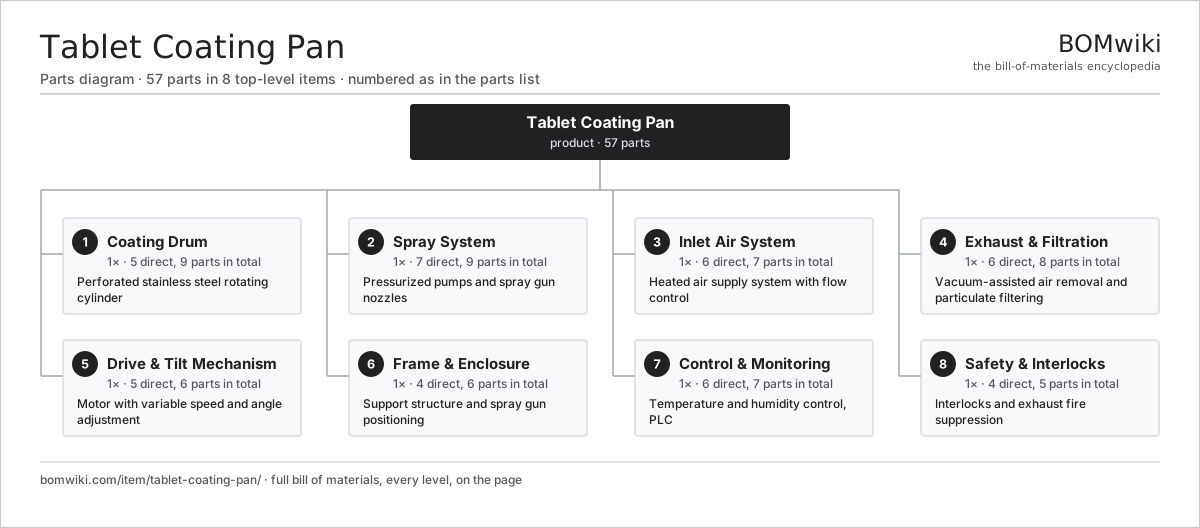
| # | Part | Qty | What it does |
|---|---|---|---|
| 1 | Coating Drum 5 parts | 1× | Perforated stainless steel rotating cylinder |
| 2 | Spray System 7 parts | 1× | Pressurized pumps and spray gun nozzles |
| 3 | Inlet Air System 6 parts | 1× | Heated air supply system with flow control |
| 4 | Exhaust & Filtration 6 parts | 1× | Vacuum-assisted air removal and particulate filtering |
| 5 | Drive & Tilt Mechanism 5 parts | 1× | Motor with variable speed and angle adjustment |
| 6 | Frame & Enclosure 4 parts | 1× | Support structure and spray gun positioning |
| 7 | Control & Monitoring 6 parts | 1× | Temperature and humidity control, PLC |
| 8 | Safety & Interlocks 4 parts | 1× | Interlocks and exhaust fire suppression |
3D model
No 3D model yet. Have a CAD file of this? Add a 3D model. STL renders right on this page; STEP, FreeCAD, and OpenSCAD sources are welcome too (openly licensed, like all 3D models on BOMwiki).
Build & assembly graph
expand / collapse · shared sub-assemblies converge · links to related products · est. labourTap an assembly to expand/collapse · tap a part to open it · use “Open page” for any node · drag to pan, scroll to zoom.
Bill of materials for Tablet Coating Pan
8 top-level lines · 51 rows shown · 57 parts total · indented to 3 levels| # | Item / sub-assembly | Part no. | Qty/assy | Ext. qty | Parts | Type |
|---|---|---|---|---|---|---|
| 1 | Coating Drum 5 parts | tablet-coating-drum | 1× | 1 | 9 | assembly |
| 1.1 | Drum Shell | tablet-coating-drum-shell | 1× | 1 | · | part |
| 1.2 | Internal Baffles | tablet-coating-drum-baffles | 1× | 1 | · | part |
| 1.3 | Shaft Seal | tablet-coating-drum-seal | 1× | 1 | · | part |
| 1.4 | Ball Bearing | ball-bearing | 4× | 4 | · | part |
| 1.5 | Drum Flange | tablet-coating-drum-flange | 2× | 2 | · | part |
| 2 | Spray System 7 parts | tablet-coating-spray-system | 1× | 1 | 9 | assembly |
| 2.1 | Coating Supply Pump | tablet-coating-supply-pump | 1× | 1 | · | part |
| 2.2 | Pump Immersion Heater | tablet-coating-pump-heater | 1× | 1 | · | part |
| 2.3 | Spray Nozzle Array | tablet-coating-nozzle-array | 1× | 1 | · | part |
| 2.4 | Atomizer Nozzles | tablet-coating-atomizer | 1× | 1 | · | part |
| 2.5 | Circulation Circuit | tablet-coating-circulation-line | 1× | 1 | · | part |
| 2.6 | Pressure Sensor | pressure-sensor | 1× | 1 | · | part |
| 2.7 | Fastener Set | fastener-set | 3× | 3 | · | part |
| 3 | Inlet Air System 6 parts | tablet-coating-air-inlet | 1× | 1 | 7 | assembly |
| 3.1 | Inlet Blower | tablet-coating-air-blower | 1× | 1 | · | part |
| 3.2 | Air Preheater | tablet-coating-preheater | 1× | 1 | · | part |
| 3.3 | Humidity Controller | tablet-coating-humidifier | 1× | 1 | · | part |
| 3.4 | Inlet Filter | tablet-coating-inlet-filter | 1× | 1 | · | part |
| 3.5 | Inlet Flow Damper | tablet-coating-flow-control | 1× | 1 | · | part |
| 3.6 | Fastener Set | fastener-set | 2× | 2 | · | part |
| 4 | Exhaust & Filtration 6 parts | tablet-coating-exhaust | 1× | 1 | 8 | assembly |
| 4.1 | Exhaust Fan | tablet-coating-exhaust-fan | 1× | 1 | · | part |
| 4.2 | Cyclone Separator | tablet-coating-cyclone | 1× | 1 | · | part |
| 4.3 | Bag Filter Unit | tablet-coating-bag-filter | 1× | 1 | · | part |
| 4.4 | Exhaust Damper | tablet-coating-exhaust-damper | 1× | 1 | · | part |
| 4.5 | Fire Suppression Module | tablet-coating-fire-suppression | 1× | 1 | · | part |
| 4.6 | Fastener Set | fastener-set | 3× | 3 | · | part |
| 5 | Drive & Tilt Mechanism 5 parts | tablet-coating-drive | 1× | 1 | 6 | assembly |
| 5.1 | Blower Motor | blower-motor | 1× | 1 | · | part |
| 5.2 | Speed Reducer Gearbox | tablet-coating-gearbox | 1× | 1 | · | part |
| 5.3 | Tilt Cylinder | tablet-coating-tilt-actuator | 1× | 1 | · | part |
| 5.4 | Speed Sensor | tablet-coating-speed-sensor | 1× | 1 | · | part |
| 5.5 | Fastener Set | fastener-set | 2× | 2 | · | part |
| 6 | Frame & Enclosure 4 parts | tablet-coating-frame | 1× | 1 | 6 | assembly |
| 6.1 | Support Frame | tablet-coating-frame-structure | 1× | 1 | · | part |
| 6.2 | Access Enclosure | tablet-coating-frame-enclosure | 1× | 1 | · | part |
| 6.3 | Overspray Shield | tablet-coating-spray-shield | 1× | 1 | · | part |
| 6.4 | Fastener Set | fastener-set | 3× | 3 | · | part |
| 7 | Control & Monitoring 6 parts | tablet-coating-electrical | 1× | 1 | 7 | assembly |
| 7.1 | Control PLC with HMI | tablet-coating-plc | 1× | 1 | · | part |
| 7.2 | Temperature Sensor | tablet-coating-temperature-probe | 1× | 1 | · | part |
| 7.3 | Humidity Sensor | tablet-coating-humidity-probe | 1× | 1 | · | part |
| 7.4 | Pressure Sensors | tablet-coating-pressure-transducers | 1× | 1 | · | part |
| 7.5 | Multi-Motor VFD | tablet-coating-vfd | 1× | 1 | · | part |
| 7.6 | Fastener Set | fastener-set | 2× | 2 | · | part |
| 8 | Safety & Interlocks 4 parts | tablet-coating-safety | 1× | 1 | 5 | assembly |
| 8.1 | Access Interlock Switch | tablet-coating-access-interlock | 1× | 1 | · | part |
| 8.2 | Pump Pressure Relief | tablet-coating-pressure-relief | 1× | 1 | · | part |
| 8.3 | Emergency Stop Button | tablet-coating-estop-button | 1× | 1 | · | part |
| 8.4 | Fastener Set | fastener-set | 2× | 2 | · | part |
Something wrong in this list? Report a problem with this BOM.
Related products
same domain, ranked by shared parts Cable Coiling Machine
36 parts · shares 3 with this page
Cable Coiling Machine
36 parts · shares 3 with this page
 Cable Extrusion Line
46 parts · shares 3 with this page
Electron Beam PBF
128 parts · shares 3 with this page
Glass Tempering Furnace
79 parts · shares 3 with this page
Cable Extrusion Line
46 parts · shares 3 with this page
Electron Beam PBF
128 parts · shares 3 with this page
Glass Tempering Furnace
79 parts · shares 3 with this page
Sourcing: possible vendors
Browse the supplier directory → Prices, MOQ, and lead times are algorithmic estimates, not quotes, and not claims about these companies. Company mappings are curated by keyword; est. price band $5k–$2M. How estimates work| Vendor | HQ | Specialty | MOQ | Lead time |
|---|---|---|---|---|
| atlascopco.com ↗ | Stockholm, SE | Compressors & industrial | 10 units | 12–20 wks |
|
🇦🇹Andritz
andritz.com ↗
|
Graz, AT | Process plants & machinery | 10 units | 12–20 wks |
| buhlergroup.com ↗ | Uzwil, CH | Food & materials processing | 10 units | 12–20 wks |
| gea.com ↗ | Düsseldorf, DE | Process technology | 10 units | 12–20 wks |
| mhi.com ↗ | Tokyo, JP | Heavy machinery | 10 units | 12–20 wks |
1,363-word article