Tablet Counting Machine
ProductOverview
A tablet counting machine is a precision device that dispenses exact quantities of tablets into bottles for patient-ready packaging. Unlike tablet presses or coating pans which produce tablets, counters are strictly a finishing operation. They bridge between bulk tablet manufacturing and final packaging, ensuring that each bottle contains the exact prescribed dosage (30, 60, 100 tablets, etc.).
The core mechanism is elegantly simple: tablets descend from a hopper in a single-file stream; optical sensors count them; a solenoid gate closes at the target count, dumping tablets into a bottle. Modern machines achieve ±1 tablet accuracy per 100 tablets (±1%) through high-speed digital counting and sub-millisecond gate response.
Throughput ranges 100–1000 tablets/minute depending on tablet size and count target. A typical operation fills 50–200 bottles per hour. The machine must handle diverse tablet shapes (round, oval, oblong) and sizes (5–20 mm diameter), requiring quick changeover of sensor calibration and gate sizing.
How it works
The counting cycle consists of four overlapping phases:
Metering: A vibratory hopper gravity-feeds tablets toward a single-file chute. Vibration frequency and amplitude are tuned so tablets descend one at a time (no stacking). A mechanical restrictor (adjustable cam or needle valve) at the hopper outlet controls feed rate, typically 100–1000 tablets/minute depending on size. Too fast and tablets jam; too slow and throughput suffers.
Counting: Tablets pass through an optical sensor array, typically a transmissive pair (light emitter and receiver across a narrow gap). As each tablet blocks the light, a pulse is generated. A high-speed digital counter accumulates pulses in real-time. A secondary capacitive sensor verifies that each pulse represents a pharmaceutical tablet (rejects dust, fragments, or foreign objects). The PLC constantly displays the running count on the touchscreen.
Gate Closing: When the count reaches the target (e.g., 100 tablets), the PLC issues a command to the solenoid gate valve. The valve energizes, pulling open a plunger that blocks the chute. Tablets in flight continue falling into the accumulation bowl; the gate closure captures the batch. Gate response time is <5 milliseconds; any slower and over-counting occurs (extra tablets pass the gate due to sensor-to-gate delay).
Bottle Positioning & Discharge: A starwheel conveyor positions an empty bottle directly under the accumulation bowl. A light vibration motor (50 Hz, low amplitude) settles tablets in the bowl, preventing compaction. The bowl, if equipped with a discharge gate, opens and tablets cascade into the bottle. The starwheel then indexes the filled bottle to a capping or sealing station (if integrated) or to an exit conveyor.
An optional reject station removes undersized, oversized, or cracked tablets before they reach the counter. A size-discrimination sensor flags anomalies; a pneumatic diverter valve ejects the defective tablet to a waste chute.
Key Subsystems
Sensor & Counting System
The optical sensor is the heart of the counter. A transmissive pair (light source + receiver) is positioned at a narrow gap in the chute. Tablets are large enough to completely block the light beam; dust particles and fragments pass through. Each complete blockage generates one pulse.
Sensor response time is typically 1 millisecond (1 kHz detection bandwidth), adequate for 1000 tablets/minute (16.7 tablets per second). At higher speeds, optical sensors may miss tablets if they descend too quickly. Some modern systems use laser triangulation or time-of-flight sensors for faster response.
A secondary capacitive or inductive sensor verifies that each counted object is indeed a pharmaceutical tablet. A ceramic tablet has high capacitance; a plastic chip or dust particle has low capacitance. Dual-sensor logic rejects false counts.
The digital counter accumulates pulses at rates up to 10 kHz, far exceeding the tablet feed rate. When the target count is reached, a signal is sent to the gate solenoid. The counter is typically implemented as a dedicated counter module (IC or FPGA) interfaced to the PLC; this ensures sub-millisecond response independent of PLC scan cycle.
Solenoid Gate & Response
The gate valve is a 2/2 solenoid-actuated butterfly or slide valve. When de-energized, gravity holds the valve open; when energized, the solenoid plunger retracts, closing the gate. The coil impedance and current ramp are tuned for <5 millisecond response.
Gate response delay is the limiting factor for counting accuracy. At 1000 tablets/minute (16.7 tablets/second), a 5 ms delay corresponds to ~0.08 tablets of over-count. In practice, sensor-to-gate electronics add 1–2 ms, and the mechanical solenoid adds another 3–4 ms. Modern fast-acting solenoids reduce total delay to <3 ms.
The gate must be sized for the tablet stream. If too small, tablets jam and backup; if too large, tablets bypass the gate uncontrolled. Changeover to different tablet sizes requires swapping or adjusting the gate opening.
Accumulation & Discharge
Tablets falling through the gate collect in a hemispherical or conical bowl. The bowl is sized to hold the maximum count per bottle (typically 1000 tablets maximum). A light vibration motor (50 Hz, amplitude 1–2 mm) at the base settles tablets without compacting them or inducing bouncing.
The bowl may have a discharge gate or simply rely on gravity when tilted. If a discharge gate is present, it opens to allow tablets to cascade into the positioned bottle. The bottle must be held securely; a pneumatic or vacuum gripper positions it directly under the bowl outlet.
Some machines employ a hinged bowl: after the bottle is positioned, the bowl pivots, emptying tablets into the bottle in one controlled cascade.
Bottle Positioning
A starwheel conveyor with spring-loaded pockets holds bottles upright. A stepper or servo motor indexes the wheel, positioning a filled bottle at the discharge station and advancing an empty bottle into position under the count bowl. Bottle sensors (proximity) detect bottle presence; if a bottle is missing, a fault alarm triggers.
The bottle must be positioned precisely, center-aligned under the bowl outlet, to prevent spillage or jamming. Changeover to different bottle sizes (50 mL, 100 mL, 500 mL) requires different starwheel pockets or pocket inserts.
Operating Considerations
Tablet Characteristics & Changeover
Tablets must be clean (no compression dust) and at room temperature. Warm tablets from a tablet press can exhibit electrostatic charge, causing them to stick together and jam the hopper. Most facilities store tablets 12–24 hours before counting.
Changeover from one tablet size to another requires:
- Emptying and cleaning the hopper
- Recalibrating sensor threshold (optical sensor sensitivity adjusted for tablet size)
- Adjusting hopper gate restriction for appropriate feed rate
- Adjusting accumulator bowl size (if multiple sizes are in use)
- Swapping starwheel pockets for the new bottle size
- Verifying gate response with a test run
Changeover time is typically 15–30 minutes.
Counting Accuracy
Counting accuracy depends on:
- Sensor cleanliness: Dust on the optical lens reduces sensitivity. Weekly cleaning with lens paper and alcohol prevents false counts.
- Tablet feed rate: If tablets descend too fast, some may not fully block the sensor, causing under-counts. Reduce vibration frequency or amplitude if this occurs.
- Gate timing: Delay between count pulse and gate closure causes over-count. Gate response time should be verified monthly with a chronometer or logic analyzer.
- Sensor alignment: Misaligned sensors miss tablets or count background reflection as tablets. Sensors should be perpendicular to tablet travel, verified with a dial indicator.
Data Integrity & Validation
Counting machines must integrate with batch tracking systems (ERP, MES). Count data is logged with timestamp, operator ID, batch number, and reject count. Signed records are maintained for FDA audits (21 CFR Part 11 if applicable).
Control limits are typically ±2 tablets per batch (if a 100-tablet batch, acceptable range is 98–102). Statistical process control plots track count variance over time; upward drift may indicate sensor contamination or gate response degradation.
Troubleshooting
Under-counting (fewer tablets than target): Cause: sensor not detecting all tablets due to dirty lens or tablet size variation. Solutions: clean optical lens, recalibrate sensor threshold.
Over-counting (more tablets than target): Cause: gate response too slow (solenoid coil weak) or sensor false-triggering. Solutions: measure gate response time (should be <5 ms), clean sensor lens, replace solenoid coil if response >8 ms.
Hopper jamming: Cause: feed rate too fast or tablets bridging. Solutions: reduce vibration frequency or amplitude, add cone-bottom insert to hopper to break bridges.
Bottle positioning errors: Cause: starwheel misalignment or spring pocket wear. Solutions: verify pocket alignment with dial indicator, replace worn pockets.
Incomplete discharge: Tablets stick in bowl. Cause: electrostatic charge or bowl angle insufficient. Solutions: ionize air above bowl (static dissipator), increase bowl tilt angle by 5–10 degrees.
Maintenance
Optical sensor lenses require weekly cleaning with lint-free lens paper and 70% isopropyl alcohol. Sensor LEDs degrade over time; replacement every 3–5 years maintains signal strength.
Solenoid gate coils should be tested annually for coil resistance and response time. If response exceeds 8 ms, the coil should be replaced.
Starwheel bearings should be greased every 500 operating hours. Spring-loaded pockets may require replacement every 2–3 years due to fatigue.
Cumulative wear in the sensor gap (tablet dust accumulation) requires periodic mechanical disassembly and cleaning; typically performed every 6–12 months.
See Also
- Detection Sensors – Optical detection and signal conditioning
- Gate Dispenser – Gate valve and response control
- Electronic Counter & Control – Digital counter and PLC logic
- Bottle Indexing System – Starwheel positioning and synchronization
Tablet Counting Machine parts and their functions
8 top-level parts · 45 parts in total · full bill of materials below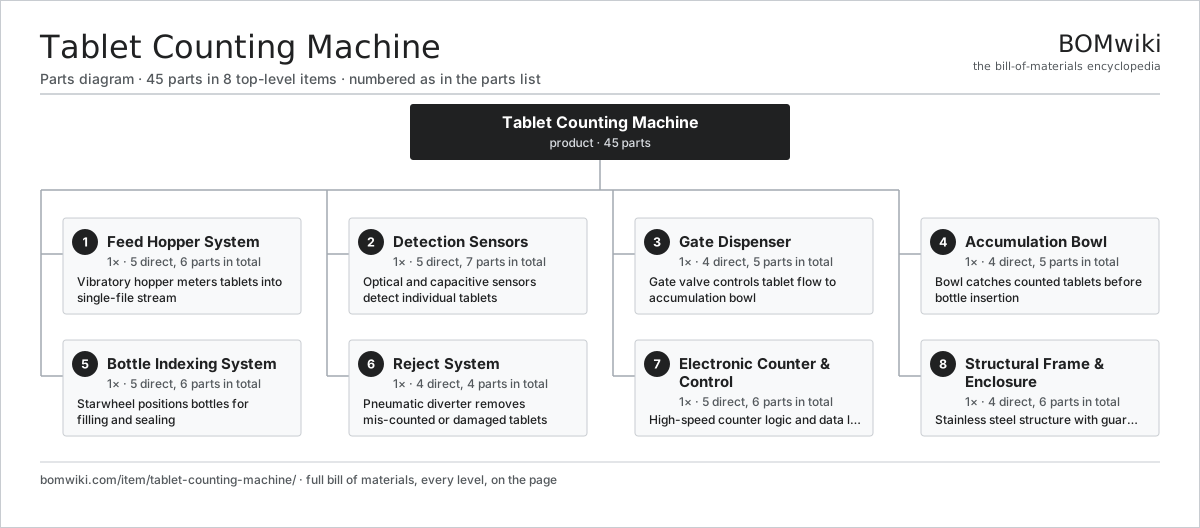
| # | Part | Qty | What it does |
|---|---|---|---|
| 1 | Feed Hopper System 5 parts | 1× | Vibratory hopper meters tablets into single-file stream |
| 2 | Detection Sensors 5 parts | 1× | Optical and capacitive sensors detect individual tablets |
| 3 | Gate Dispenser 4 parts | 1× | Gate valve controls tablet flow to accumulation bowl |
| 4 | Accumulation Bowl 4 parts | 1× | Bowl catches counted tablets before bottle insertion |
| 5 | Bottle Indexing System 5 parts | 1× | Starwheel positions bottles for filling and sealing |
| 6 | Reject System 4 parts | 1× | Pneumatic diverter removes mis-counted or damaged tablets |
| 7 | Electronic Counter & Control 5 parts | 1× | High-speed counter logic and data logging PLC |
| 8 | Structural Frame & Enclosure 4 parts | 1× | Stainless steel structure with guard enclosure |
3D model
No 3D model yet. Have a CAD file of this? Add a 3D model. STL renders right on this page; STEP, FreeCAD, and OpenSCAD sources are welcome too (openly licensed, like all 3D models on BOMwiki).
Build & assembly graph
expand / collapse · shared sub-assemblies converge · links to related products · est. labourTap an assembly to expand/collapse · tap a part to open it · use “Open page” for any node · drag to pan, scroll to zoom.
Bill of materials for Tablet Counting Machine
8 top-level lines · 44 rows shown · 45 parts total · indented to 3 levels| # | Item / sub-assembly | Part no. | Qty/assy | Ext. qty | Parts | Type |
|---|---|---|---|---|---|---|
| 1 | Feed Hopper System 5 parts | tablet-counting-feed-hopper | 1× | 1 | 6 | assembly |
| 1.1 | Hopper Bowl | tablet-counting-hopper-bowl | 1× | 1 | · | part |
| 1.2 | Feeder Vibration Motor | tablet-counting-feeder-motor | 1× | 1 | · | part |
| 1.3 | Flow Control Gate | tablet-counting-flow-gate | 1× | 1 | · | part |
| 1.4 | Feed Chute | tablet-counting-chute | 1× | 1 | · | part |
| 1.5 | Fastener Set | fastener-set | 2× | 2 | · | part |
| 2 | Detection Sensors 5 parts | tablet-counting-sensor-array | 1× | 1 | 7 | assembly |
| 2.1 | Optical Sensor | tablet-counting-optical-sensor | 2× | 2 | · | part |
| 2.2 | Capacitive Sensor | tablet-counting-capacitive-sensor | 1× | 1 | · | part |
| 2.3 | Light Emitter | tablet-counting-light-source | 1× | 1 | · | part |
| 2.4 | Signal Conditioner | tablet-counting-signal-conditioner | 1× | 1 | · | part |
| 2.5 | Fastener Set | fastener-set | 2× | 2 | · | part |
| 3 | Gate Dispenser 4 parts | tablet-counting-dispenser | 1× | 1 | 5 | assembly |
| 3.1 | Gate Valve | tablet-counting-gate-valve | 1× | 1 | · | part |
| 3.2 | Gate Actuator | tablet-counting-gate-actuator | 1× | 1 | · | part |
| 3.3 | High-Speed Solenoid | tablet-counting-response-time | 1× | 1 | · | part |
| 3.4 | Fastener Set | fastener-set | 2× | 2 | · | part |
| 4 | Accumulation Bowl 4 parts | tablet-counting-accumulator | 1× | 1 | 5 | assembly |
| 4.1 | Accumulation Bowl | tablet-counting-bowl | 1× | 1 | · | part |
| 4.2 | Bowl Vibration Motor | tablet-counting-bowl-motor | 1× | 1 | · | part |
| 4.3 | Vibration Isolator | tablet-counting-bowl-damper | 1× | 1 | · | part |
| 4.4 | Fastener Set | fastener-set | 2× | 2 | · | part |
| 5 | Bottle Indexing System 5 parts | tablet-counting-bottle-indexer | 1× | 1 | 6 | assembly |
| 5.1 | Bottle Starwheel | tablet-counting-starwheel | 1× | 1 | · | part |
| 5.2 | Bottle Indexing Motor | tablet-counting-starwheel-motor | 1× | 1 | · | part |
| 5.3 | Bottle Gripper | tablet-counting-bottle-gripper | 1× | 1 | · | part |
| 5.4 | Vacuum System | tablet-counting-vacuum-source | 1× | 1 | · | part |
| 5.5 | Fastener Set | fastener-set | 2× | 2 | · | part |
| 6 | Reject System 4 parts | tablet-counting-reject-chute | 1× | 1 | 4 | assembly |
| 6.1 | Reject Detection Sensor | tablet-counting-reject-sensor | 1× | 1 | · | part |
| 6.2 | Reject Diverter Valve | tablet-counting-reject-gate | 1× | 1 | · | part |
| 6.3 | Reject Chute | tablet-counting-reject-chute-body | 1× | 1 | · | part |
| 6.4 | Fastener Set | fastener-set | 1× | 1 | · | part |
| 7 | Electronic Counter & Control 5 parts | tablet-counting-control-system | 1× | 1 | 6 | assembly |
| 7.1 | Digital Counter Module | tablet-counting-high-speed-counter | 1× | 1 | · | part |
| 7.2 | Control PLC with HMI | tablet-counting-plc | 1× | 1 | · | part |
| 7.3 | Sensor PCB | tablet-counting-sensor-interface | 1× | 1 | · | part |
| 7.4 | Data Logging System | tablet-counting-data-logger | 1× | 1 | · | part |
| 7.5 | Fastener Set | fastener-set | 2× | 2 | · | part |
| 8 | Structural Frame & Enclosure 4 parts | tablet-counting-frame | 1× | 1 | 6 | assembly |
| 8.1 | Base Frame | tablet-counting-base-frame | 1× | 1 | · | part |
| 8.2 | Safety Guard Panels | tablet-counting-guard-panels | 1× | 1 | · | part |
| 8.3 | Electrical Enclosure | tablet-counting-electrical-enclosure | 1× | 1 | · | part |
| 8.4 | Fastener Set | fastener-set | 3× | 3 | · | part |
Something wrong in this list? Report a problem with this BOM.
Sourcing: possible vendors
Browse the supplier directory → Prices, MOQ, and lead times are algorithmic estimates, not quotes, and not claims about these companies. Company mappings are curated by keyword; est. price band $5k–$2M. How estimates work| Vendor | HQ | Specialty | MOQ | Lead time |
|---|---|---|---|---|
| atlascopco.com ↗ | Stockholm, SE | Compressors & industrial | 10 units | 12–20 wks |
|
🇦🇹Andritz
andritz.com ↗
|
Graz, AT | Process plants & machinery | 10 units | 12–20 wks |
| buhlergroup.com ↗ | Uzwil, CH | Food & materials processing | 10 units | 12–20 wks |
| gea.com ↗ | Düsseldorf, DE | Process technology | 10 units | 12–20 wks |
| mhi.com ↗ | Tokyo, JP | Heavy machinery | 10 units | 12–20 wks |
1,574-word article