Tactical Flashlight
ProductOverview
A tactical flashlight is a small handheld light engineered to the demands of police, military, and self-defense use: instant momentary activation, a beam bright enough to identify and disorient at distance, and a body that survives drops, recoil, and immersion. The format converged in the 1980s around the 25 mm aluminum tube pioneered by SureFire's weapon lights; the LED era kept the envelope and multiplied the output, a current production light delivers 1,000–3,000 lumens from a package of 130–150 mm and under 200 grams, output that required a vehicle-mounted lamp a generation ago.
The light is a stack of five subsystems threaded together: the LED Engine and Optical Head at the front, the Driver Electronics behind them, the Battery System in the Machined Body tube, and the Tailcap Switch switch closing the circuit at the rear.
Light engine and optics
A single Power LED generates the entire output, drawing 3 to 6 amps at turbo. At those currents thermal design decides everything: the die sits on a Star MCPCB with copper directly under the junction, pressed through Thermal Paste onto a machined shelf inside the Head Shell, whose external fins are the only place the 5–15 watts of heat can leave. Junction temperature must stay under roughly 125 °C; since the head's surface area cannot reject turbo-level heat indefinitely, the Microcontroller steps output down on a timer or a temperature reading. Sustained brightness, not peak lumens, is where flashlight designs genuinely differ.
The beam comes from the Parabolic Reflector, a paraboloid that collimates light the emitter throws sideways into a central hotspot while letting direct emission form a wide spill, the hotspot identifies a subject at 200+ meters, the spill keeps peripheral awareness. A Centering Gasket holds the die on the optical axis, because a fraction of a millimeter of offset visibly skews the beam. The Front Window is toughened glass with anti-reflective coating, retained by the Bezel Ring. Throw is quantified as peak beam intensity in candela; ANSI FL1 defines rated throw as the distance where the beam falls to 0.25 lux, giving the 200–450 m figures on packaging.
Regulation
Between cell and emitter sits the Driver Electronics, a switching converter that makes output independent of cell state. A lithium-ion cell falls from 4.2 V to about 3 V over discharge while the LED wants constant current at 3–6 V forward; the converter, built around the Power MOSFET, Power Inductor, and a milliohm Sense Resistor feedback shunt, holds the current loop flat at better than 90% efficiency, so the light stays at rated brightness until the cell is nearly exhausted instead of dimming continuously as direct-drive lights do. The same controller implements the mode set, typically low/medium/high/turbo plus a disorienting strobe around 10–15 Hz, and low-voltage shutdown protecting the cell.
Power and structure
Modern duty lights standardized on the Li-ion Cell, 18650 (or larger 21700) high-drain cell, 3,000–5,000 mAh with a BMS Board guarding against over-discharge and short circuit. Coil Spring contacts at both ends keep the circuit closed through recoil and drops, a rigid contact would bounce open during a pistol's slide cycle, producing flicker exactly when the light matters. Onboard charging through a sealed USB-C Charge Port under a Port Cover has displaced external chargers on most current models.
The Body Tube is CNC-turned 6061-T6 aluminum doing four jobs at once: structure, heatsink path, electrical return conductor (the tube wall carries current from the tailcap to the head), and grip, via machined knurling. The Hard-Anodized Coat is Type III hard-coat, 25–50 µm of aluminum oxide harder than tool steel, which is why duty lights show bare-metal wear only after years of holster carry. O-Ring Set seals at every thread joint achieve IPX8 submersion, and a Pocket Clip and Grip Ring cover the two standard carry styles.
The tactical interface
The defining control is the Forward-Clicky Switch in the tailcap: a forward-clicky design gives light on a half-press, momentary, extinguishing the instant the thumb lifts, and constant-on only with a full click. Momentary use is the core tactical technique: brief flashes to navigate or identify without giving away a continuous position. The Boot Cover seals the switch while transmitting the press, and the Tailcap Shell's shroud ears block accidental activation in a pocket while leaving the boot reachable with a thumb. The whole rear assembly grounds through the Switch Retainer into the tube, completing a circuit whose every joint is also a structural and waterproofing element.
Tactical Flashlight parts and their functions
6 top-level parts · 31 parts in total · full bill of materials below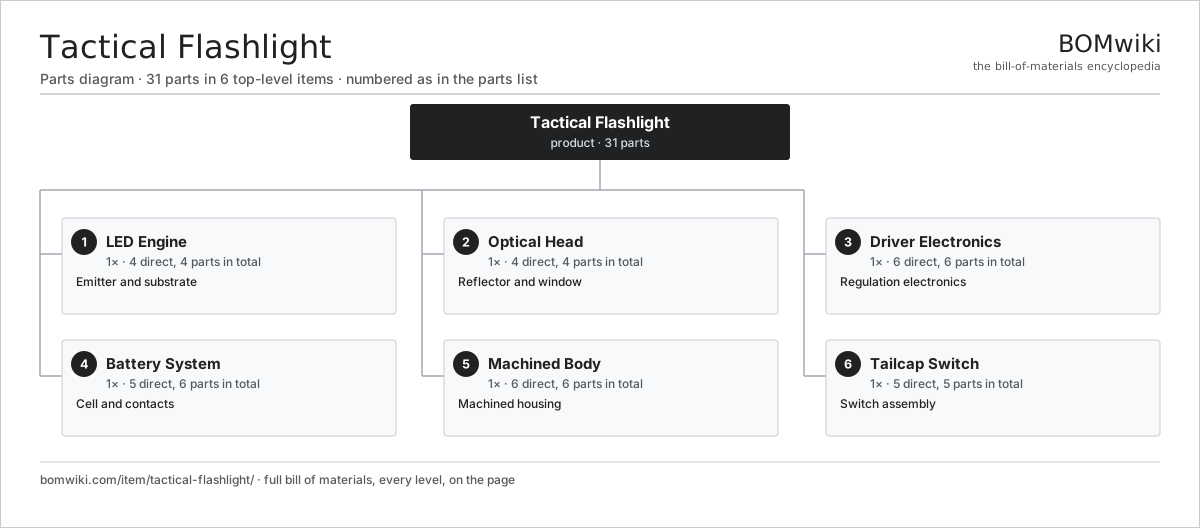
| # | Part | Qty | What it does |
|---|---|---|---|
| 1 | LED Engine 4 parts | 1× | Emitter and substrate |
| 2 | Optical Head 4 parts | 1× | Reflector and window |
| 3 | Driver Electronics 6 parts | 1× | Regulation electronics |
| 4 | Battery System 5 parts | 1× | Cell and contacts |
| 5 | Machined Body 6 parts | 1× | Machined housing |
| 6 | Tailcap Switch 5 parts | 1× | Switch assembly |
3D model
No 3D model yet. Have a CAD file of this? Add a 3D model. STL renders right on this page; STEP, FreeCAD, and OpenSCAD sources are welcome too (openly licensed, like all 3D models on BOMwiki).
Build & assembly graph
expand / collapse · shared sub-assemblies converge · links to related products · est. labourTap an assembly to expand/collapse · tap a part to open it · use “Open page” for any node · drag to pan, scroll to zoom.
Bill of materials for Tactical Flashlight
6 top-level lines · 36 rows shown · 31 parts total · indented to 3 levels| # | Item / sub-assembly | Part no. | Qty/assy | Ext. qty | Parts | Type |
|---|---|---|---|---|---|---|
| 1 | LED Engine 4 parts | tactical-flashlight-led-engine | 1× | 1 | 4 | assembly |
| 1.1 | Power LED | tactical-flashlight-power-led | 1× | 1 | · | part |
| 1.2 | Star MCPCB | tactical-flashlight-star-mcpcb | 1× | 1 | · | part |
| 1.3 | Centering Gasket | tactical-flashlight-centering-gasket | 1× | 1 | · | part |
| 1.4 | Thermal Paste | tactical-flashlight-thermal-paste | 1× | 1 | · | part |
| 2 | Optical Head 4 parts | tactical-flashlight-optical-head | 1× | 1 | 4 | assembly |
| 2.1 | Parabolic Reflector | tactical-flashlight-reflector | 1× | 1 | · | part |
| 2.2 | Front Window | tactical-flashlight-front-window | 1× | 1 | · | part |
| 2.3 | Bezel Ring | tactical-flashlight-bezel-ring | 1× | 1 | · | part |
| 2.4 | O-Ring Set | oring-set | 1× | 1 | · | part |
| 3 | Driver Electronics 6 parts | tactical-flashlight-driver | 1× | 1 | 6 | assembly |
| 3.1 | Bare PCB | pcb-bare | 1× | 1 | · | part |
| 3.2 | Microcontroller | mcu | 1× | 1 | · | part |
| 3.3 | Power MOSFET | mosfet | 1× | 1 | · | part |
| 3.4 | Power Inductor | tactical-flashlight-inductor | 1× | 1 | · | part |
| 3.5 | Sense Resistor | tactical-flashlight-sense-resistor | 1× | 1 | · | part |
| 3.6 | SMD Passive (R/C/L) | smd-passives | 1× | 1 | · | part |
| 4 | Battery System 5 parts | tactical-flashlight-battery-system | 1× | 1 | 6 | assembly |
| 4.1 | Li-ion Cell, 18650 | li-cell-18650 | 1× | 1 | · | part |
| 4.2 | BMS Board | bms-board | 1× | 1 | · | part |
| 4.3 | Coil Spring | coil-spring | 2× | 2 | · | part |
| 4.4 | USB-C Charge Port | tactical-flashlight-charge-port | 1× | 1 | · | part |
| 4.5 | Port Cover | tactical-flashlight-port-cover | 1× | 1 | · | part |
| 5 | Machined Body 6 parts | tactical-flashlight-body | 1× | 1 | 6 | assembly |
| 5.1 | Body Tube | tactical-flashlight-body-tube | 1× | 1 | · | part |
| 5.2 | Head Shell | tactical-flashlight-head-shell | 1× | 1 | · | part |
| 5.3 | Hard-Anodized Coat | tactical-flashlight-anodize-coat | 1× | 1 | · | part |
| 5.4 | Pocket Clip | tactical-flashlight-pocket-clip | 1× | 1 | · | part |
| 5.5 | Grip Ring | tactical-flashlight-grip-ring | 1× | 1 | · | part |
| 5.6 | O-Ring Set | oring-set | 1× | 1 | · | part |
| 6 | Tailcap Switch 5 parts | tactical-flashlight-tailcap | 1× | 1 | 5 | assembly |
| 6.1 | Forward-Clicky Switch | tactical-flashlight-clicky-switch | 1× | 1 | · | part |
| 6.2 | Boot Cover | tactical-flashlight-boot-cover | 1× | 1 | · | part |
| 6.3 | Tailcap Shell | tactical-flashlight-tailcap-shell | 1× | 1 | · | part |
| 6.4 | Coil Spring | coil-spring | 1× | 1 | · | part |
| 6.5 | Switch Retainer | tactical-flashlight-switch-retainer | 1× | 1 | · | part |
Something wrong in this list? Report a problem with this BOM.
Related products
same domain, ranked by shared parts Solar Street Light
68 parts · shares 4 with this page
Solar Street Light
68 parts · shares 4 with this page
 LED Work Light (Rechargeable)
88 parts · shares 3 with this page
LED Work Light (Rechargeable)
88 parts · shares 3 with this page
 Emergency Exit Light
98 parts · shares 2 with this page
Emergency Exit Light
98 parts · shares 2 with this page
 Aviation Obstruction Light
192 parts · shares 3 with this page
Aviation Obstruction Light
192 parts · shares 3 with this page
 Heliport Beacon
39 parts · shares 3 with this page
Heliport Beacon
39 parts · shares 3 with this page
Sourcing: possible vendors
Browse the supplier directory → Prices, MOQ, and lead times are algorithmic estimates, not quotes, and not claims about these companies. Company mappings are curated by keyword; est. price band $3–$2k. How estimates work| Vendor | HQ | Specialty | MOQ | Lead time |
|---|---|---|---|---|
|
🇳🇱Signify
signify.com ↗
|
Eindhoven, NL | Lighting (Philips Hue) | 2,000 units | 6–10 wks |
| acuitybrands.com ↗ | Atlanta, US | Lighting & controls | 2,000 units | 6–10 wks |
|
🇦🇹Zumtobel
zumtobelgroup.com ↗
|
Dornbirn, AT | Lighting | 2,000 units | 6–10 wks |
| creelighting.com ↗ | Racine, US | LED lighting | 2,000 units | 6–10 wks |
|
🇮🇳Havells
havells.com ↗
|
Noida, IN | Electrical & lighting | 2,000 units | 6–10 wks |
822-word article