Takoyaki Maker
ProductOverview
A takoyaki maker is a specialized electric griddle that cooks takoyaki, spherical Japanese street food balls with an octopus or shrimp center, breaded and deep-fried until crispy outside and creamy inside. The appliance features a heavy cast-iron Cast Iron Plate with 16 hemispherical dimples (cups), heated from below to 180–200 °C. The operator pours batter into each dimple, adds a filling (octopus), and uses wooden Wooden Picks to rotate each takoyaki as it cooks, coaxing it into a perfect sphere. The exterior browns and crisps in 4–6 minutes while the filling inside reaches the correct temperature. An electronic Control PCB with PID algorithm maintains consistent heat via a Heater Relay switching the Heating Element. A Ready Indicator Light glows when the plate is ready to use.
The Cast Iron Plate is the heart of the device. Its 16 dimples are each 2.5 cm in diameter and deep enough to form a complete sphere. Cast iron's high thermal mass and excellent heat distribution ensure even cooking. The Non-Stick Layer (electroless nickel or ceramic) reduces sticking and oil usage. Below the plate, a Heat Spreader Plate distributes heat from the Heating Element (1400 W) evenly across the casting. Excess oil and drippings fall into a removable Grease Drip Pan.
How it works
Setup and preheat. The operator plugs the Power Cord into a standard 230 V outlet. They flip the Power Switch to the "on" position. The Heating Element (1400 W nichrome wire) energizes, and the Heat Spreader Plate begins warming the Cast Iron Plate. The Temperature Sensor (thermocouple) continuously measures the plate surface temperature. The Control PCB MCU runs a PID loop: if temperature is below the setpoint (180 °C), the Heater Relay keeps the heater energized; if temperature climbs above setpoint, the relay cuts power to the heater. This maintains ±5 °C stability. Once the plate stabilizes at 180 °C (preheat time ≈5–8 minutes), the Ready Indicator Light (a green neon or LED bulb in the Lamp Socket Assembly) glows, signaling readiness.
Batter preparation and filling. While the plate preheats, the operator prepares takoyaki batter (a light flour/egg/dashi batter, thin like crepe batter) and cuts fresh octopus into 1 cm cubes. They place the Pick Storage Slot within reach on the Base Chassis, containing 4–6 wooden Wooden Picks.
Coating and filling. Using a large spoon or takoyaki ladle, the operator fills each Cast Iron Plate dimple about 1/3 full with batter. They quickly place a cube of octopus (or shrimp, vegetables) into the center of each dimple, then pour more batter to 2/3 full. The hot plate immediately begins setting the bottom surface of the batter into a thin crust.
First turns (90–180 seconds in). After the crust sets (~90 seconds), using the wooden Wooden Picks, the operator gently lifts the bottom edge of each takoyaki and rolls it up onto its side. The uncooked batter on the underside now contacts the hot plate and sets. They repeat this rolling motion every 60–90 seconds, gradually working the takoyaki into a sphere. Wooden picks are used to avoid piercing and leaking filling; their blunt, rounded tips roll rather than stab.
Mid-cooking (180–300 seconds). Successive turns over the next 3–4 minutes build a golden-brown crust all around the takoyaki. The exterior firms and browns to a light amber color. The internal temperature of the filling rises as heat conducts through the crust and batter toward the center.
Final turn and release (240–360 seconds). After 4–6 minutes total, the takoyaki are fully spherical and a deep golden-brown. The operator makes a final gentle roll to ensure all sides are cooked, then uses the pick to lift each takoyaki and drop it into a collection dish or tray. The Grease Drip Pan, positioned below the plate, has collected excess oil (trickling down the sides of the dimples and pooling at the base).
Plate cleaning and next batch. Between batches, the operator can wipe excess batter from the plate with a damp cloth (being careful of heat). Since the Cast Iron Plate remains at 180 °C, any residue crisps and can be scraped away. The Grease Drip Pan is removed, emptied, and re-inserted. A fresh batch of batter and filling is prepared, and the cycle repeats.
Temperature stability. Throughout cooking, the Control PCB continuously monitors the Temperature Sensor. When the plate cools due to batter being poured on (which absorbs heat), the Heater Relay energizes the Heating Element to quickly recover temperature. This responsive control ensures even cooking across all 16 dimples regardless of how quickly the operator fills them.
Safety and cleanup. The Thermal Fuse (20 A) at the element input provides secondary overtemp cutout. A Mains Plug with integral thermal breaker protects the mains wiring. After use, the operator turns off the Power Switch. The cast plate cools slowly (≈15 minutes to room temperature); during this time it remains seasoned, and no water is applied (water on hot cast iron can cause warping or rusting).
Takoyaki Maker parts and their functions
8 top-level parts · 58 parts in total · full bill of materials below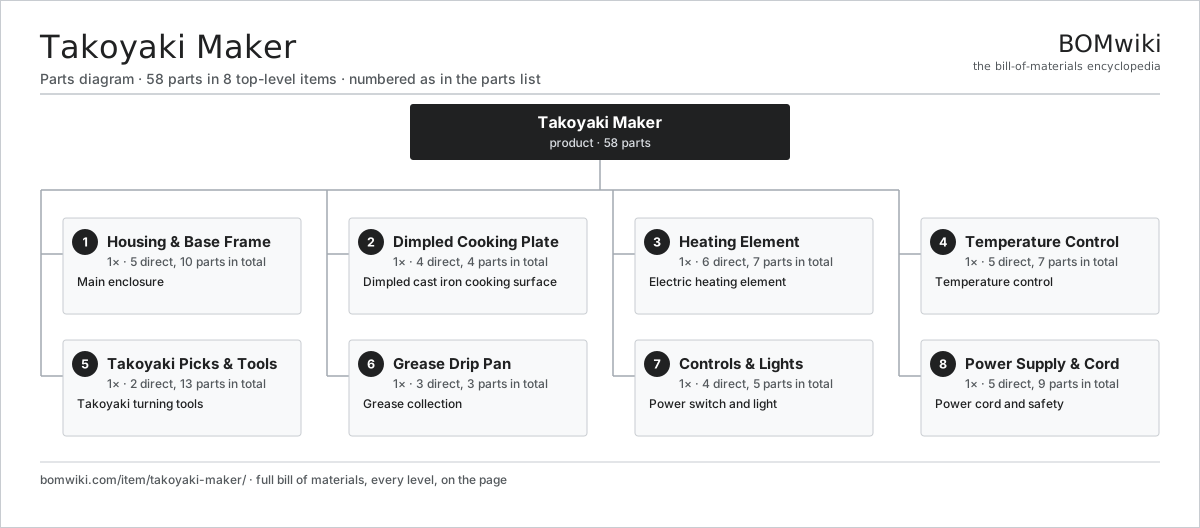
| # | Part | Qty | What it does |
|---|---|---|---|
| 1 | Housing & Base Frame 5 parts | 1× | Main enclosure |
| 2 | Dimpled Cooking Plate 4 parts | 1× | Dimpled cast iron cooking surface |
| 3 | Heating Element 6 parts | 1× | Electric heating element |
| 4 | Temperature Control 5 parts | 1× | Temperature control |
| 5 | Takoyaki Picks & Tools 2 parts | 1× | Takoyaki turning tools |
| 6 | Grease Drip Pan 3 parts | 1× | Grease collection |
| 7 | Controls & Lights 4 parts | 1× | Power switch and light |
| 8 | Power Supply & Cord 5 parts | 1× | Power cord and safety |
3D model
No 3D model yet. Have a CAD file of this? Add a 3D model. STL renders right on this page; STEP, FreeCAD, and OpenSCAD sources are welcome too (openly licensed, like all 3D models on BOMwiki).
Build & assembly graph
expand / collapse · shared sub-assemblies converge · links to related products · est. labourTap an assembly to expand/collapse · tap a part to open it · use “Open page” for any node · drag to pan, scroll to zoom.
Bill of materials for Takoyaki Maker
8 top-level lines · 42 rows shown · 58 parts total · indented to 3 levels| # | Item / sub-assembly | Part no. | Qty/assy | Ext. qty | Parts | Type |
|---|---|---|---|---|---|---|
| 1 | Housing & Base Frame 5 parts | takoyaki-maker-housing | 1× | 1 | 10 | assembly |
| 1.1 | Base Chassis | takoyaki-maker-chassis | 1× | 1 | · | part |
| 1.2 | Side Carry Handle | takoyaki-maker-handle-grip | 2× | 2 | · | part |
| 1.3 | Plate Hinge Pin | takoyaki-maker-hinge-pin | 1× | 1 | · | part |
| 1.4 | Non-Slip Foot | takoyaki-maker-feet | 4× | 4 | · | part |
| 1.5 | Fastener Set | fastener-set | 2× | 2 | · | part |
| 2 | Dimpled Cooking Plate 4 parts | takoyaki-maker-plate | 1× | 1 | 4 | assembly |
| 2.1 | Cast Iron Plate | takoyaki-maker-cast-plate | 1× | 1 | · | part |
| 2.2 | Non-Stick Layer | takoyaki-maker-non-stick-coating | 1× | 1 | · | part |
| 2.3 | Plate Support Frame | takoyaki-maker-plate-support | 1× | 1 | · | part |
| 2.4 | Fastener Set | fastener-set | 1× | 1 | · | part |
| 3 | Heating Element 6 parts | takoyaki-maker-heating | 1× | 1 | 7 | assembly |
| 3.1 | Heating Element | heating-element | 1× | 1 | · | part |
| 3.2 | Heating Chamber | takoyaki-maker-heating-chamber | 1× | 1 | · | part |
| 3.3 | Heat Spreader Plate | takoyaki-maker-heat-spreader | 1× | 1 | · | part |
| 3.4 | Thermal Fuse | thermal-fuse | 1× | 1 | · | part |
| 3.5 | Connector | connector | 2× | 2 | · | part |
| 3.6 | Wire Bundle | wire-bundle | 1× | 1 | · | part |
| 4 | Temperature Control 5 parts | takoyaki-maker-thermostat | 1× | 1 | 7 | assembly |
| 4.1 | Temperature Sensor | takoyaki-maker-temp-sensor | 1× | 1 | · | part |
| 4.2 | Control PCB | takoyaki-maker-control-board | 1× | 1 | · | part |
| 4.3 | Heater Relay | takoyaki-maker-relay | 1× | 1 | · | part |
| 4.4 | Microcontroller | mcu | 1× | 1 | · | part |
| 4.5 | Connector | connector | 3× | 3 | · | part |
| 5 | Takoyaki Picks & Tools 2 parts | takoyaki-maker-picks | 1× | 1 | 13 | assembly |
| 5.1 | Wooden Pick | takoyaki-maker-wooden-pick | 12× | 12 | · | part |
| 5.2 | Pick Storage Slot | takoyaki-maker-pick-holder | 1× | 1 | · | part |
| 6 | Grease Drip Pan 3 parts | takoyaki-maker-drip-pan | 1× | 1 | 3 | assembly |
| 6.1 | Stainless Drip Pan | takoyaki-maker-pan-tray | 1× | 1 | · | part |
| 6.2 | Disposable Liner | takoyaki-maker-pan-liner | 1× | 1 | · | part |
| 6.3 | Pan Support Rails | takoyaki-maker-pan-mount | 1× | 1 | · | part |
| 7 | Controls & Lights 4 parts | takoyaki-maker-controls | 1× | 1 | 5 | assembly |
| 7.1 | Power Switch | takoyaki-maker-power-switch | 1× | 1 | · | part |
| 7.2 | Ready Indicator Light | takoyaki-maker-ready-light | 1× | 1 | · | part |
| 7.3 | Lamp Socket Assembly | takoyaki-maker-lamp-holder | 1× | 1 | · | part |
| 7.4 | Connector | connector | 2× | 2 | · | part |
| 8 | Power Supply & Cord 5 parts | takoyaki-maker-power | 1× | 1 | 9 | assembly |
| 8.1 | Power Cord | takoyaki-maker-power-cord | 1× | 1 | · | part |
| 8.2 | Mains Plug | takoyaki-maker-plug | 1× | 1 | · | part |
| 8.3 | Thermal Fuse | thermal-fuse | 1× | 1 | · | part |
| 8.4 | Wire Bundle | wire-bundle | 2× | 2 | · | part |
| 8.5 | Connector | connector | 4× | 4 | · | part |
Something wrong in this list? Report a problem with this BOM.
Related products
same domain, ranked by shared parts Air Popcorn Popper
36 parts · shares 1 with this page
Belgian Waffle Maker
75 parts · shares 1 with this page
Air Popcorn Popper
36 parts · shares 1 with this page
Belgian Waffle Maker
75 parts · shares 1 with this page
 Bread Machine
162 parts · shares 1 with this page
Bread Machine
162 parts · shares 1 with this page
 Bread Maker
66 parts · shares 1 with this page
Bread Maker
66 parts · shares 1 with this page
 Capsule Coffee Machine
123 parts · shares 1 with this page
Capsule Coffee Machine
123 parts · shares 1 with this page
 Chocolate Fondue Fountain
110 parts · shares 1 with this page
Chocolate Fondue Fountain
110 parts · shares 1 with this page
Sourcing: possible vendors
Browse the supplier directory → Prices, MOQ, and lead times are algorithmic estimates, not quotes, and not claims about these companies. Company mappings are curated by keyword; est. price band $20–$600. How estimates work| Vendor | HQ | Specialty | MOQ | Lead time |
|---|---|---|---|---|
|
🇦🇺Breville
breville.com ↗
|
Sydney, AU | Kitchen appliances | 2,000 units | 6–10 wks |
| groupeseb.com ↗ | Écully, FR | Cookware & small appliances | 2,000 units | 6–10 wks |
| hamiltonbeach.com ↗ | Glen Allen, US | Small appliances | 2,000 units | 6–10 wks |
| panasonic.com ↗ | Osaka, JP | Electronics & appliances | 2,000 units | 6–10 wks |
|
🇨🇳Midea
midea.com ↗
|
Foshan, CN | Home appliances | 2,000 units | 6–10 wks |
892-word article