Tandem Bicycle
ProductOverview
The tandem bicycle is a bicycle designed for two riders, each with independent pedals and crankset, seated one behind the other. A timing chain (or two separate chains) connects both riders's cranksets to the rear wheel, allowing both pedal inputs to combine for greater power and speed than a single rider can achieve. Tandem bicycles range from casual recreational designs to competitive racing machines, with variations optimized for touring, mountain biking, and off-road adventures.
A typical tandem weighs 18–25 kg (heavier than a comparable single-rider bike due to reinforced frame and dual drivetrain) and requires skilled coordination between the captain (front rider, who steers) and stoker (rear rider, who provides additional power). Tandem racing has become a niche sport, with world records exceeding 100 km/h on downhill courses and marathon-distance tandems covering 200+ km in endurance events.
How it works
Dual Cranksets and Timing Chain
The captain (front rider) pedals on a standard crankset mounted at the bicycle's bottom bracket. The stoker (rear rider) sits 400–600 mm behind and pedals on a second independent crankset, typically mounted on a second bottom bracket tube. Both cranksets are front chainrings with equal tooth counts (commonly 40 teeth each, though they may differ for specific gear ratios).
A timing chain connects the front chainring (captain's chainring) to the rear chainring (stoker's chainring), forcing them to rotate in synchrony. This is critical: both riders must pedal at the same cadence (revolutions per minute). If the captain pedals at 80 rpm, the stoker must also pedal at 80 rpm. A second timing chain (or chain line) carries power from the stoker's chainring forward to the rear wheel sprocket.
The synchronized pedaling is the critical constraint of tandem operation: unlike single-rider bicycles where the rider can vary power output freely, both tandem riders must maintain consistent pedal rhythm. This requires practice and communication; novice stokers often either over-pedal (accelerating beyond the captain's input) or under-pedal (creating slack in the chain).
Power Addition
In ideal synchronous operation, the power from both riders adds. If both riders produce 100 W of pedal power at 80 rpm, the total power reaching the rear wheel is approximately 200 W (accounting for drivetrain losses of 5–10%). This doubled power input allows tandems to accelerate faster and climb steeper grades than single-rider bikes of equivalent geometry.
However, the power addition is less direct than it might appear: each rider's power is transmitted through their own bottom bracket, timing chain, and finally the rear wheel. Efficient timing chain design and synchronization are essential to minimize power loss and mechanical binding.
Steering and Geometry
Only the captain (front rider) steers the bicycle via the handlebar connected to the front fork. The stoker has limited control; they may grip a handlebar or sissy bar (a secondary support), but their primary role is pedaling. This asymmetric control can feel uncomfortable for stokers accustomed to independent bicycle operation.
The tandem's extended wheelbase (1100–1300 mm versus 1000 mm for typical single-rider bikes) creates longer straight-line stability but reduced agility. The increased mass and length mean that turning and weight shifting require more deliberate movements. Experienced captains develop a feel for the stoker's position and momentum, adjusting steering accordingly.
Brake Coordination
Tandems typically have independent front and rear brakes, each with its own control lever (captain usually operates both, or each rider operates one brake). Coordinated braking is important: if only the front brake is engaged with heavy rear-wheel power input, the rear wheel may skid; conversely, rear-only braking may feel mushy if the stoker is pedaling hard, as the pedal torque opposes the brake torque.
Modern tandem racing designs may use hydraulic disc brakes offering excellent modulation and less lever effort, critical when both riders need responsive control.
Wheel and Frame Reinforcement
Tandem frames are reinforced compared to single-rider bikes, with thicker-wall tubes, additional gussets, and often a third seat tube for the stoker's seatpost. The rear wheel experiences double the pedal power input; wheel spokes are typically heavier (2.0+ mm diameter versus 1.6–1.8 mm for single-rider bikes), and the hub is often a stronger design with more bearing preload.
The extended frame length increases bending moments, requiring stronger materials or clever geometry. Aluminum and steel tandems are common; carbon fiber and titanium tandems are available for racing enthusiasts willing to pay premium prices (3000+ USD).
Tandem Riding Technique
Synchronized Cadence
Both riders must pedal at nearly identical cadence. Small differences (1–2 rpm) are acceptable but larger deviations create slack or over-tightening in the timing chain, leading to jerking or inefficient power transmission. Experienced tandem pairs develop an almost unconscious synchronization, similar to crew in a rowing boat.
Load Sharing
The power split between captain and stoker is not necessarily 50/50. A strong captain and weaker stoker might work better with a gear ratio favoring the captain's output; conversely, a powerful stoker and lighter captain might need adjustment. Some modern tandems allow gear adjustment or use different crankset designs to balance power contributions.
Communication
Captains must communicate with stokers about planned maneuvers: "Slowing down," "Shifting gears," "Standing up to climb." Stokers need to anticipate shifts in weight distribution and be ready to provide power input when climbing steep grades.
Tandem Racing and Variants
Competitive Tandem Cycling: Racing tandems are lightweight (as low as 12–15 kg with carbon fiber construction) and feature drop bars, aerodynamic positioning, and 700c wheels. Tandem racing occurs at road races, track cycling (velodrome events), and mountain bike racing. World records for human-powered vehicles (130+ km/h) are often set by fairing-equipped tandems and other multi-rider configurations.
Tandem Touring: Long-distance tandems are designed for comfort and cargo capacity, with reinforced frames, wider tires (32–40 mm), and racks for camping gear. A well-matched tandem touring pair can sustain 100–150 km per day indefinitely, with less fatigue than single riders of equivalent ability due to shared effort.
Tandem Mountain Bikes: Dual-suspension tandems with knobby tires allow off-road riding, though the long wheelbase reduces technical handling compared to single-rider mountain bikes.
Extended Tandem and Triplet: Some enthusiasts build tandem-derived vehicles with three or more riders (triplets), requiring even more sophisticated synchronization and power management. A three-rider setup can produce 300+ W, achieving speeds exceeding 60 km/h on level ground.
Stoker Perspective and Social Aspects
The stoker role is often underappreciated: they provide substantial power input but cannot steer, see ahead easily, or control the bicycle's direction. Novice stokers report fatigue and frustration when captains ignore communication or make abrupt maneuvers. However, experienced stoker-captain pairs develop deep trust and coordination, with many reporting that tandem riding creates a stronger sense of partnership than single-rider cycling.
Tandem cycling has a small but engaged community, with clubs, events, and online forums dedicated to two-rider bicycles. Some couples use tandems for recreational touring; others are competitive athletes specializing in tandem track cycling or ultra-distance events.
Tandem Bicycle parts and their functions
7 top-level parts · 124 parts in total · full bill of materials below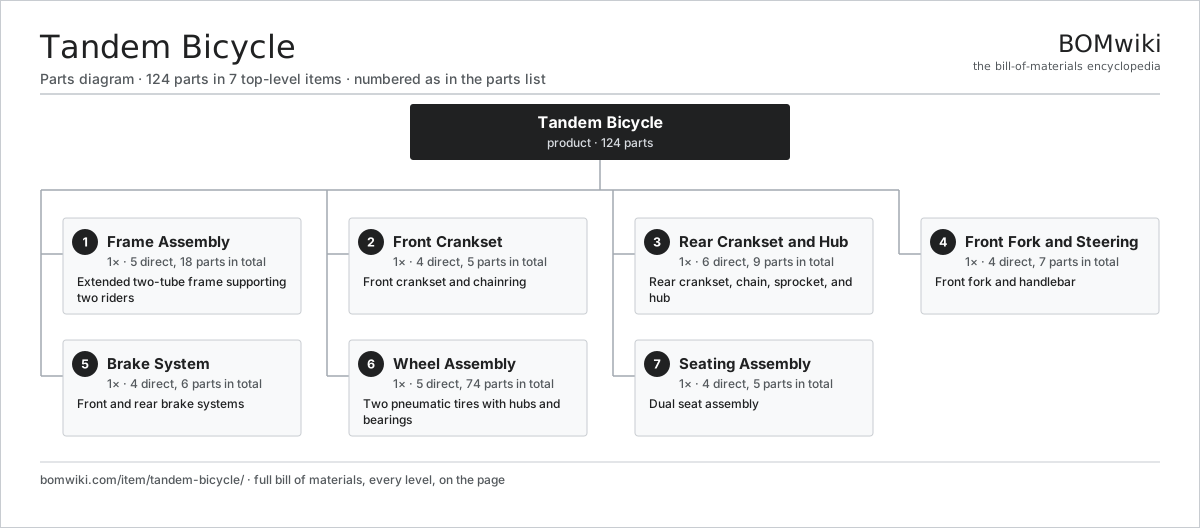
| # | Part | Qty | What it does |
|---|---|---|---|
| 1 | Frame Assembly 5 parts | 1× | Extended two-tube frame supporting two riders |
| 2 | Front Crankset 4 parts | 1× | Front crankset and chainring |
| 3 | Rear Crankset and Hub 6 parts | 1× | Rear crankset, chain, sprocket, and hub |
| 4 | Front Fork and Steering 4 parts | 1× | Front fork and handlebar |
| 5 | Brake System 4 parts | 1× | Front and rear brake systems |
| 6 | Wheel Assembly 5 parts | 1× | Two pneumatic tires with hubs and bearings |
| 7 | Seating Assembly 4 parts | 1× | Dual seat assembly |
3D model
No 3D model yet. Have a CAD file of this? Add a 3D model. STL renders right on this page; STEP, FreeCAD, and OpenSCAD sources are welcome too (openly licensed, like all 3D models on BOMwiki).
Build & assembly graph
expand / collapse · shared sub-assemblies converge · links to related products · est. labourTap an assembly to expand/collapse · tap a part to open it · use “Open page” for any node · drag to pan, scroll to zoom.
Bill of materials for Tandem Bicycle
7 top-level lines · 39 rows shown · 124 parts total · indented to 3 levels| # | Item / sub-assembly | Part no. | Qty/assy | Ext. qty | Parts | Type |
|---|---|---|---|---|---|---|
| 1 | Frame Assembly 5 parts | tandem-bicycle-frame | 1× | 1 | 18 | assembly |
| 1.1 | Top Tube | tandem-bicycle-top-tube | 1× | 1 | · | part |
| 1.2 | Seat Tube | tandem-bicycle-seat-tube | 2× | 2 | · | part |
| 1.3 | Chain Stay | tandem-bicycle-chain-stay | 2× | 2 | · | part |
| 1.4 | Front Fork | tandem-bicycle-fork | 1× | 1 | · | part |
| 1.5 | Fastener Set | fastener-set | 12× | 12 | · | part |
| 2 | Front Crankset 4 parts | tandem-bicycle-front-drivetrain | 1× | 1 | 5 | assembly |
| 2.1 | Front Crank | tandem-bicycle-front-crank | 1× | 1 | · | part |
| 2.2 | Front Chainring | tandem-bicycle-front-chainring | 1× | 1 | · | part |
| 2.3 | Timing Chain | tandem-bicycle-timing-chain | 1× | 1 | · | part |
| 2.4 | Ball Bearing | ball-bearing | 2× | 2 | · | part |
| 3 | Rear Crankset and Hub 6 parts | tandem-bicycle-rear-drivetrain | 1× | 1 | 9 | assembly |
| 3.1 | Rear Crank | tandem-bicycle-rear-crank | 1× | 1 | · | part |
| 3.2 | Rear Chainring | tandem-bicycle-rear-chainring | 1× | 1 | · | part |
| 3.3 | Rear Chain | tandem-bicycle-rear-chain | 1× | 1 | · | part |
| 3.4 | Rear Sprocket | tandem-bicycle-rear-sprocket | 1× | 1 | · | part |
| 3.5 | Freewheel | tandem-bicycle-freewheel | 1× | 1 | · | part |
| 3.6 | Ball Bearing | ball-bearing | 4× | 4 | · | part |
| 4 | Front Fork and Steering 4 parts | tandem-bicycle-steering | 1× | 1 | 7 | assembly |
| 4.1 | Fork Leg | tandem-bicycle-fork-tube | 1× | 1 | · | part |
| 4.2 | Captain's Handlebar | tandem-bicycle-handlebar | 1× | 1 | · | part |
| 4.3 | Stem | tandem-bicycle-stem | 1× | 1 | · | part |
| 4.4 | Ball Bearing | ball-bearing | 4× | 4 | · | part |
| 5 | Brake System 4 parts | tandem-bicycle-braking | 1× | 1 | 6 | assembly |
| 5.1 | Front Brake | tandem-bicycle-front-brake | 1× | 1 | · | part |
| 5.2 | Rear Brake | tandem-bicycle-rear-brake | 1× | 1 | · | part |
| 5.3 | Brake Lever | tandem-bicycle-brake-lever | 2× | 2 | · | part |
| 5.4 | Brake Cable | tandem-bicycle-brake-cable | 2× | 2 | · | part |
| 6 | Wheel Assembly 5 parts | tandem-bicycle-wheels | 1× | 1 | 74 | assembly |
| 6.1 | Wheel | tandem-bicycle-wheel | 2× | 2 | · | part |
| 6.2 | Hub | tandem-bicycle-hub | 2× | 2 | · | part |
| 6.3 | Spoke | tandem-bicycle-spoke | 64× | 64 | · | part |
| 6.4 | Tire | tandem-bicycle-tire | 2× | 2 | · | part |
| 6.5 | Ball Bearing | ball-bearing | 4× | 4 | · | part |
| 7 | Seating Assembly 4 parts | tandem-bicycle-seating | 1× | 1 | 5 | assembly |
| 7.1 | Captain Seat | tandem-bicycle-captain-seat | 1× | 1 | · | part |
| 7.2 | Stoker Seat | tandem-bicycle-stoker-seat | 1× | 1 | · | part |
| 7.3 | Seatpost | tandem-bicycle-seat-post | 2× | 2 | · | part |
| 7.4 | Rear Handlebar | tandem-bicycle-rear-handlebar | 1× | 1 | · | part |
Something wrong in this list? Report a problem with this BOM.
Sourcing: possible vendors
Browse the supplier directory → Prices, MOQ, and lead times are algorithmic estimates, not quotes, and not claims about these companies. Company mappings are curated by keyword; est. price band $200–$12k. How estimates work| Vendor | HQ | Specialty | MOQ | Lead time |
|---|---|---|---|---|
|
🇹🇼Giant
giant-bicycles.com ↗
|
Taichung, TW | Bicycles | 500 units | 6–12 wks |
|
🇺🇸Trek
trekbikes.com ↗
|
Waterloo, US | Bicycles | 500 units | 6–12 wks |
| specialized.com ↗ | Morgan Hill, US | Bicycles | 500 units | 6–12 wks |
|
🇹🇼Merida
merida-bikes.com ↗
|
Yuanlin, TW | Bicycles | 500 units | 6–12 wks |
| cannondale.com ↗ | Wilton, US | Bicycles | 500 units | 6–12 wks |
1,190-word article