Rotary Tattoo Machine
ProductOverview
A rotary tattoo machine converts DC motor rotational energy into precise linear needle reciprocation via an eccentric cam mechanism. Unlike coil machines that use magnetic pulsing, rotary machines provide smooth, adjustable stroke control and lower power consumption, making them popular for line work and color packing. The cartridge needle system enables sterile, disposable needle replacement without tool changes.
The machine consists of a brushless DC motor (typically 12 V, 18 W) driving an eccentric cam that oscillates a slider block and connected needle cartridge at adjustable frequency. The operator grips a handled housing that isolates vibration through spring and elastomer mounts, connected via shielded cable to an external Tattoo Power Supply providing regulated 12 V DC and footswitch modulation.
How it works
The Motor Assembly is a brushless three-phase motor with permanent magnet rotor and copper wound stator, commutated by Hall Sensor feedback through an embedded Microcontroller. The rotor shaft carries an Eccentric Cam disc offset 8 mm from its rotation axis. As the motor spins at constant RPM, the eccentric cam traces a circular path, driving a Slider Block up and down along a Guide Rail.
The slider block mechanically couples to the Needle Cartridge, a single-use sterile assembly containing grouped needles (1–14 configuration depending on line width or fill style) soldered to a rigid stem. The stem passes through the grip handle and emerges from a Tube Taper elastomer insert that grips the cartridge and delivers ink flow.
The Frame is a rigid aluminum skeleton mounting the motor, cam mechanism, and Guide Rail. The Grip Handle is an ergonomic cylinder with soft silicone sleeve and strain relief boot, isolating vibration through Shock Absorber mounts (springs and O-ring dampers). Power enters the grip via a magnetic locking Connector feeding the motor control module in the Frame.
The operator controls needle frequency using a footswitch wired through the Tattoo Power Supply. The switch modulates PWM duty cycle to the motor controller, varying motor speed and thus cam rotation speed and needle stroke frequency. Typical operating frequency ranges 50–150 Hz depending on desired line weight and ink saturation.
Advantages and limitations
Rotary machines excel at consistent, linear motion suitable for lining and color application. They run quieter and cooler than coil machines, with adjustable frequency enabling fine control. The cartridge system ensures needle sterility and reduces cross-contamination risk.
Limitations include fixed stroke length (typically 4–5 mm) determined by the eccentric cam offset. Unlike coil machines, stroke cannot be independently adjusted. Rotary machines also produce vibration at the motor frequency, which can accumulate hand fatigue if shock isolation is insufficient.
Standards and hygiene
Professional tattoo machines must meet regional sterilization and electrical safety standards. Needle Cartridge cartridges are single-use, pre-sterilized by ethylene oxide gas and vacuum-sealed. The grip handle and frame require surface sterilization (autoclave or surface disinfectant) between clients.
Related systems
The Rotary Tattoo Machine operates as the needle drive stage within a complete tattoo station. It connects electrically and mechanically to the Tattoo Power Supply, which regulates DC voltage, implements footswitch control logic, and provides safety interlocks. The operator also uses ink wells, applicator cups, and reference images, outside the scope of this BOM, to apply color and achieve artistic intent.
Rotary Tattoo Machine parts and their functions
7 top-level parts · 49 parts in total · full bill of materials below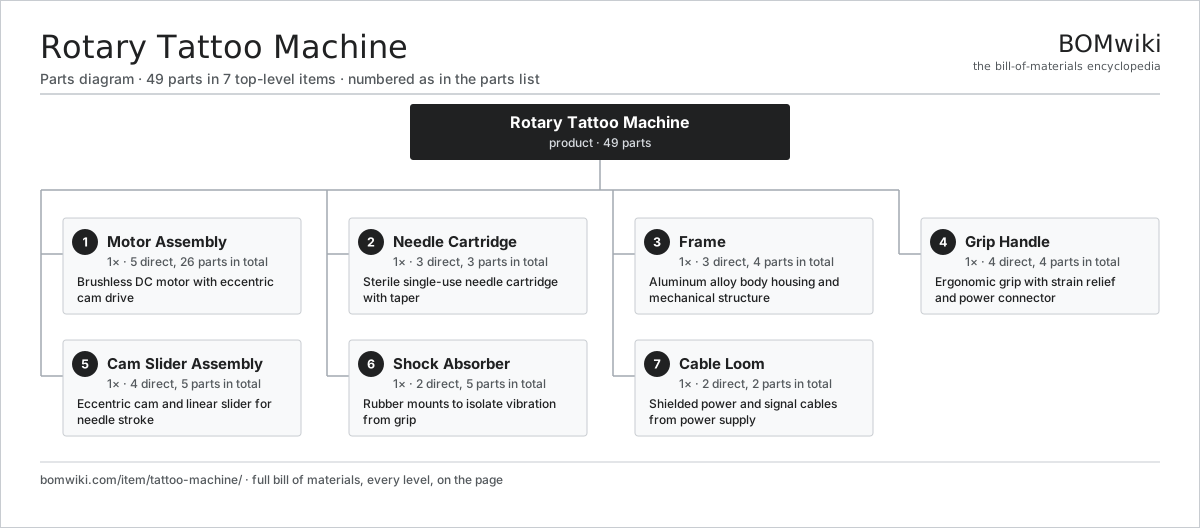
| # | Part | Qty | What it does |
|---|---|---|---|
| 1 | Motor Assembly 5 parts | 1× | Brushless DC motor with eccentric cam drive |
| 2 | Needle Cartridge 3 parts | 1× | Sterile single-use needle cartridge with taper |
| 3 | Frame 3 parts | 1× | Aluminum alloy body housing and mechanical structure |
| 4 | Grip Handle 4 parts | 1× | Ergonomic grip with strain relief and power connector |
| 5 | Cam Slider Assembly 4 parts | 1× | Eccentric cam and linear slider for needle stroke |
| 6 | Shock Absorber 2 parts | 1× | Rubber mounts to isolate vibration from grip |
| 7 | Cable Loom 2 parts | 1× | Shielded power and signal cables from power supply |
3D model
No 3D model yet. Have a CAD file of this? Add a 3D model. STL renders right on this page; STEP, FreeCAD, and OpenSCAD sources are welcome too (openly licensed, like all 3D models on BOMwiki).
Build & assembly graph
expand / collapse · shared sub-assemblies converge · links to related products · est. labourTap an assembly to expand/collapse · tap a part to open it · use “Open page” for any node · drag to pan, scroll to zoom.
Bill of materials for Rotary Tattoo Machine
7 top-level lines · 37 rows shown · 49 parts total · indented to 3 levels| # | Item / sub-assembly | Part no. | Qty/assy | Ext. qty | Parts | Type |
|---|---|---|---|---|---|---|
| 1 | Motor Assembly 5 parts | tattoo-machine-motor-assembly | 1× | 1 | 26 | assembly |
| 1.1 | Motor Housing | motor-housing | 1× | 1 | · | part |
| 1.2 | Stator Assembly 3 parts | stator-assembly | 1× | 1 | 3 | assembly |
| 1.2.1 | Stator Core (laminations) | stator-core | 1× | 1 | · | part |
| 1.2.2 | Copper Winding | copper-winding | 1× | 1 | · | part |
| 1.2.3 | Slot Insulation | stator-insulation | 1× | 1 | · | part |
| 1.3 | Rotor Assembly 4 parts | rotor-assembly | 1× | 1 | 19 | assembly |
| 1.3.1 | Rotor Shaft | rotor-shaft | 1× | 1 | · | part |
| 1.3.2 | Rotor Core | rotor-core | 1× | 1 | · | part |
| 1.3.3 | Neodymium Magnet | neodymium-magnet | 16× | 16 | · | part |
| 1.3.4 | Ball Bearing | ball-bearing | 1× | 1 | · | part |
| 1.4 | Hall Sensor | hall-sensor | 2× | 2 | · | part |
| 1.5 | Microcontroller | mcu | 1× | 1 | · | part |
| 2 | Needle Cartridge 3 parts | tattoo-machine-needle-cartridge | 1× | 1 | 3 | assembly |
| 2.1 | Needle Configuration | tattoo-machine-needle-configuration | 1× | 1 | · | part |
| 2.2 | Tube Taper | tattoo-machine-tube-taper | 1× | 1 | · | part |
| 2.3 | Safety Cap | tattoo-machine-safety-cap | 1× | 1 | · | part |
| 3 | Frame 3 parts | tattoo-machine-frame | 1× | 1 | 4 | assembly |
| 3.1 | Main Plate | tattoo-machine-main-plate | 1× | 1 | · | part |
| 3.2 | Motor Mount | tattoo-machine-motor-mount | 1× | 1 | · | part |
| 3.3 | Fastener Set | fastener-set | 2× | 2 | · | part |
| 4 | Grip Handle 4 parts | tattoo-machine-grip-handle | 1× | 1 | 4 | assembly |
| 4.1 | Handle Tube | tattoo-machine-handle-tube | 1× | 1 | · | part |
| 4.2 | Grip Sleeve | tattoo-machine-grip-sleeve | 1× | 1 | · | part |
| 4.3 | Strain Relief | tattoo-machine-strain-relief | 1× | 1 | · | part |
| 4.4 | Connector | connector | 1× | 1 | · | part |
| 5 | Cam Slider Assembly 4 parts | tattoo-machine-cam-slider-assembly | 1× | 1 | 5 | assembly |
| 5.1 | Eccentric Cam | tattoo-machine-eccentric-cam | 1× | 1 | · | part |
| 5.2 | Slider Block | tattoo-machine-slider-block | 1× | 1 | · | part |
| 5.3 | Guide Rail | tattoo-machine-guide-rail | 1× | 1 | · | part |
| 5.4 | Ball Bearing | ball-bearing | 2× | 2 | · | part |
| 6 | Shock Absorber 2 parts | tattoo-machine-shock-absorber | 1× | 1 | 5 | assembly |
| 6.1 | Coil Spring | coil-spring | 2× | 2 | · | part |
| 6.2 | O-Ring Set | oring-set | 3× | 3 | · | part |
| 7 | Cable Loom 2 parts | tattoo-machine-cable-loom | 1× | 1 | 2 | assembly |
| 7.1 | Wire Bundle | wire-bundle | 1× | 1 | · | part |
| 7.2 | Shield Braid | tattoo-machine-shield-braid | 1× | 1 | · | part |
Something wrong in this list? Report a problem with this BOM.
Related products
same domain, ranked by shared parts Electric Massage Table
180 parts · shares 11 with this page
 Water Flosser
100 parts · shares 12 with this page
 Beard Trimmer
52 parts · shares 11 with this page
Electric Nail Drill
133 parts · shares 11 with this page
 Hair Clipper
103 parts · shares 11 with this page
Sourcing: possible vendors
Browse the supplier directory → Prices, MOQ, and lead times are algorithmic estimates, not quotes, and not claims about these companies. Company mappings are curated by keyword; est. price band $15–$500. How estimates work| Vendor | HQ | Specialty | MOQ | Lead time |
|---|---|---|---|---|
| philips.com ↗ | Amsterdam, NL | Grooming & care | 2,000 units | 6–10 wks |
|
🇩🇪Braun
braun.com ↗
|
Kronberg, DE | Grooming (P&G) | 2,000 units | 6–10 wks |
|
🇺🇸Conair
conair.com ↗
|
Stamford, US | Personal care appliances | 2,000 units | 6–10 wks |
|
🇬🇧Dyson
dyson.com ↗
|
Malmesbury, GB | Vacuums & hair care | 2,000 units | 6–10 wks |
| panasonic.com ↗ | Osaka, JP | Electronics & appliances | 2,000 units | 6–10 wks |
565-word article