Tattoo Removal Laser
ProductOverview
A Q-switched Nd:YAG laser is a professional-grade medical device for selective tattoo pigment removal through photoacoustic fragmentation. The laser emits extremely short infrared pulses (6–10 nanoseconds) at 1064 nm wavelength, which is absorbed by melanin and tattoo pigments, causing them to shatter into submicron particles that are subsequently cleared by the immune system and lymphatic drainage.
Unlike older ruby or alexandrite lasers, Nd:YAG operates at a wavelength less likely to cause post-inflammatory hyperpigmentation in dark skin and can target both black and colored inks (especially when a second harmonic 532 nm frequency-doubled output is available). Multiple treatment sessions spaced 6–12 weeks apart gradually fade the tattoo until it becomes invisible.
Laser cavity and pulse generation
The Laser Cavity Head contains a Nd:YAG Rod (6 mm diameter × 80 mm length) doped with 1% neodymium ions. This crystal is optically pumped by Flash Lamp xenon tubes, which convert electrical energy into broad-spectrum UV and visible light that excites the neodymium atoms to a metastable state.
Without active modulation, excited atoms would emit random spontaneous photons. The Q-Switch acousto-optic modulator prevents laser oscillation by blocking the cavity resonator until a precise moment, allowing excited-state population to build up. When the Q-switch opens, all stored energy coherently amplifies in a narrow light burst lasting 6–10 nanoseconds.
The Output Coupler mirror transmits 30% of the 1064 nm light out of the cavity as the laser pulse, while reflecting 70% back for further amplification. Peak power during the pulse reaches 10–50 MW, despite average power being only 1–5 W (due to low repetition rate: 1–10 Hz).
Beam delivery and focusing
The laser pulse exits the cavity and reflects off a Beam Splitter Optics dichroic optics assembly, which couples the beam into the Articulated Arm. This seven-segment articulated arm contains internal Arm Mirrors at each joint, redirecting the beam while allowing full spatial positioning.
The arm terminus connects to a Handpiece and Scanning Lens containing a Focusing Lens that concentrates the 1064 nm beam to a 2–5 mm spot diameter on the skin. A Contact Window sapphire optical window provides optical transparency and serves as a contact surface, allowing the operator to position the handpiece directly on the skin. Behind this window, a Spray Cooling Nozzle atomizes cryogenic refrigerant (R134a) to precool the skin to 2–5 °C, reducing pain sensation and thermal diffusion into surrounding dermis.
Tissue interaction mechanism
When the 1064 nm infrared pulse reaches the skin, it is strongly absorbed by melanin and tattoo pigments (carbon black, iron oxide, titanium white, etc.). The absorbed photon energy heats the pigment particle rapidly to >100 °C in nanoseconds, causing instantaneous thermal expansion and acoustic shock waves that fragment the pigment into submicron particles (100–1000 nm).
These fragmented particles are small enough for white blood cells (macrophages) to engulf and transport via lymphatic drainage, gradually clearing the pigment from the dermis. Because the pulse is so short (nanoseconds), surrounding tissue experiences minimal thermal damage. The cryogenic precooling further protects the epidermis and superficial dermis from collateral heating.
Tattoo removal typically requires 6–12 sessions spaced 6–12 weeks apart. Black tattoos (carbon ink) are easiest to remove because carbon absorbs across the entire spectrum. Colored tattoos may require specialized wavelengths: 532 nm (green light) for red and purple inks, 1064 nm for blue and black. Professional removal lasers include optional frequency-doubling Harmonic Crystal (KTP) to generate 532 nm output.
Cooling system architecture
The laser cavity generates significant waste heat. A Cooling System circulates water through the Lamp Housing and Nd:YAG Rod to maintain them at 20–25 °C for optimal laser efficiency.
The Chiller Unit contains a hermetic Compressor Motor refrigeration compressor (1.5 kW capacity) that cools the circulating water. A Temperature Controller PID loop maintains setpoint at ±1 °C precision by modulating the compressor. The Condenser Fan variable-speed brushless fan rejects waste heat to the ambient environment.
System pressure is regulated by a Pressure Relief safety valve (3 bar setpoint) preventing overpressure if flow becomes restricted.
High-voltage power supply and controls
The Console and Power Supply contains a High-Voltage Supply delivering 2 kV DC at 100 mA to energize the xenon flash lamps. Triggering the flash lamps requires rapid high-frequency pulses from a Trigger Generator that modulates the Q-switch at 1 MHz.
An ARM Control MCU microcontroller sequences the timing: charge the flash lamp capacitor, fire the Q-switch to open the cavity, detect laser pulse, then reset for the next cycle. The controller also monitors water temperature, maintains safety interlocks (e.g., preventing firing if chiller is offline), and enforces maximum pulse repetition rate.
A Display Panel touchscreen shows operator-selectable parameters: pulse energy (mJ), repetition rate (Hz), total energy delivered (Joules), and real-time thermal status.
Safety and regulatory considerations
The laser emits invisible infrared light at extremely high peak power, requiring strict eye safety controls. The handpiece contact window limits exposure because the beam is internally focused. Operator protective eyewear rated for 1064 nm (typically laser-grade goggles with >99.9% optical density) is mandatory.
A Emergency Stop mushroom E-stop button on the console immediately cuts all high-voltage power. Interlocks prevent the high-voltage supply from energizing unless the chiller is running at setpoint and the cavity door is closed.
Professional use requires operator certification per ANSI Z136.1 (laser safety standard) and compliance with local medical device regulations.
Tattoo Removal Laser parts and their functions
8 top-level parts · 64 parts in total · full bill of materials below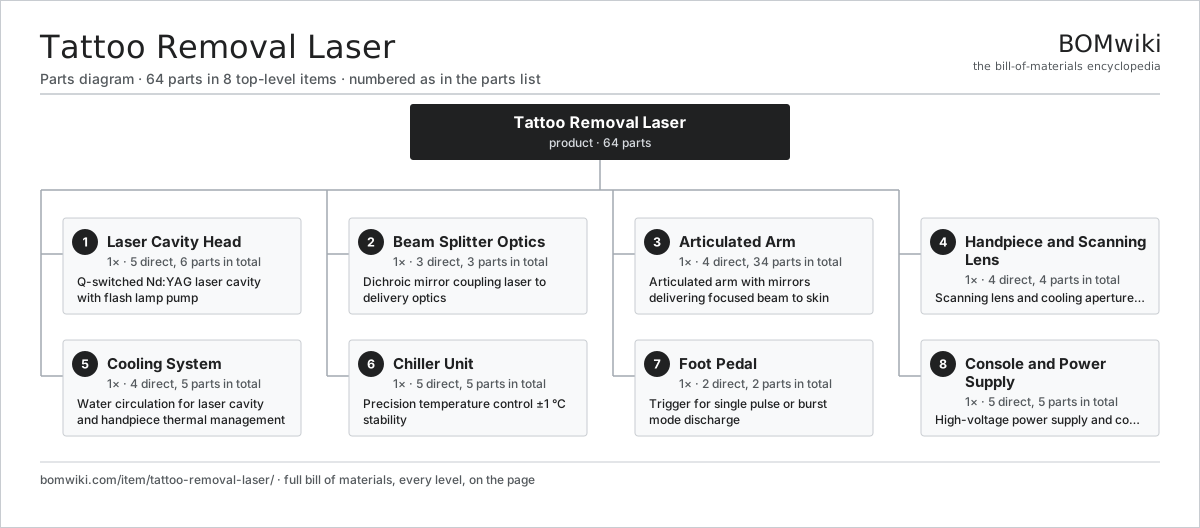
| # | Part | Qty | What it does |
|---|---|---|---|
| 1 | Laser Cavity Head 5 parts | 1× | Q-switched Nd:YAG laser cavity with flash lamp pump |
| 2 | Beam Splitter Optics 3 parts | 1× | Dichroic mirror coupling laser to delivery optics |
| 3 | Articulated Arm 4 parts | 1× | Articulated arm with mirrors delivering focused beam to skin |
| 4 | Handpiece and Scanning Lens 4 parts | 1× | Scanning lens and cooling aperture at arm terminus |
| 5 | Cooling System 4 parts | 1× | Water circulation for laser cavity and handpiece thermal management |
| 6 | Chiller Unit 5 parts | 1× | Precision temperature control ±1 °C stability |
| 7 | Foot Pedal 2 parts | 1× | Trigger for single pulse or burst mode discharge |
| 8 | Console and Power Supply 5 parts | 1× | High-voltage power supply and computer interface |
3D model
No 3D model yet. Have a CAD file of this? Add a 3D model. STL renders right on this page; STEP, FreeCAD, and OpenSCAD sources are welcome too (openly licensed, like all 3D models on BOMwiki).
Build & assembly graph
expand / collapse · shared sub-assemblies converge · links to related products · est. labourTap an assembly to expand/collapse · tap a part to open it · use “Open page” for any node · drag to pan, scroll to zoom.
Bill of materials for Tattoo Removal Laser
8 top-level lines · 40 rows shown · 64 parts total · indented to 3 levels| # | Item / sub-assembly | Part no. | Qty/assy | Ext. qty | Parts | Type |
|---|---|---|---|---|---|---|
| 1 | Laser Cavity Head 5 parts | tattoo-removal-laser-cavity-head | 1× | 1 | 6 | assembly |
| 1.1 | Nd:YAG Rod | tattoo-removal-laser-nd-yag-rod | 1× | 1 | · | part |
| 1.2 | Flash Lamp | tattoo-removal-laser-flash-lamp | 2× | 2 | · | part |
| 1.3 | Lamp Housing | tattoo-removal-laser-lamp-housing | 1× | 1 | · | part |
| 1.4 | Output Coupler | tattoo-removal-laser-output-coupler | 1× | 1 | · | part |
| 1.5 | Q-Switch | tattoo-removal-laser-q-switch | 1× | 1 | · | part |
| 2 | Beam Splitter Optics 3 parts | tattoo-removal-laser-beam-splitter | 1× | 1 | 3 | assembly |
| 2.1 | Main Mirror | tattoo-removal-laser-main-mirror | 1× | 1 | · | part |
| 2.2 | Harmonic Crystal | tattoo-removal-laser-harmonic-crystal | 1× | 1 | · | part |
| 2.3 | Filter Stack | tattoo-removal-laser-filter-stack | 1× | 1 | · | part |
| 3 | Articulated Arm 4 parts | tattoo-removal-laser-articulated-arm | 1× | 1 | 34 | assembly |
| 3.1 | Arm Segments | tattoo-removal-laser-arm-segments | 7× | 7 | · | part |
| 3.2 | Arm Mirrors | tattoo-removal-laser-arm-mirrors | 6× | 6 | · | part |
| 3.3 | Arm Bearings | tattoo-removal-laser-arm-bearings | 14× | 14 | · | part |
| 3.4 | Arm Spring Return | tattoo-removal-laser-arm-spring-return | 7× | 7 | · | part |
| 4 | Handpiece and Scanning Lens 4 parts | tattoo-removal-laser-handpiece | 1× | 1 | 4 | assembly |
| 4.1 | Focusing Lens | tattoo-removal-laser-focusing-lens | 1× | 1 | · | part |
| 4.2 | Contact Window | tattoo-removal-laser-contact-window | 1× | 1 | · | part |
| 4.3 | Spray Cooling Nozzle | tattoo-removal-laser-spray-cooling-nozzle | 1× | 1 | · | part |
| 4.4 | Handpiece Grip | tattoo-removal-laser-handpiece-grip | 1× | 1 | · | part |
| 5 | Cooling System 4 parts | tattoo-removal-laser-cooling-system | 1× | 1 | 5 | assembly |
| 5.1 | Water Pump | tattoo-removal-laser-water-pump | 1× | 1 | · | part |
| 5.2 | Heat Exchanger | tattoo-removal-laser-heat-exchanger | 1× | 1 | · | part |
| 5.3 | Thermistor Sensors | tattoo-removal-laser-thermistor-sensors | 2× | 2 | · | part |
| 5.4 | Pressure Relief | tattoo-removal-laser-pressure-relief | 1× | 1 | · | part |
| 6 | Chiller Unit 5 parts | tattoo-removal-laser-chiller-unit | 1× | 1 | 5 | assembly |
| 6.1 | Compressor Motor | tattoo-removal-laser-compressor-motor | 1× | 1 | · | part |
| 6.2 | Refrigerant Charge | tattoo-removal-laser-refrigerant-charge | 1× | 1 | · | part |
| 6.3 | Condenser Fan | tattoo-removal-laser-condenser-fan | 1× | 1 | · | part |
| 6.4 | Expansion Valve | tattoo-removal-laser-expansion-valve | 1× | 1 | · | part |
| 6.5 | Temperature Controller | tattoo-removal-laser-temperature-controller | 1× | 1 | · | part |
| 7 | Foot Pedal 2 parts | tattoo-removal-laser-foot-pedal | 1× | 1 | 2 | assembly |
| 7.1 | Pedal Switch | tattoo-removal-laser-pedal-switch | 1× | 1 | · | part |
| 7.2 | Pedal Housing | tattoo-removal-laser-pedal-housing | 1× | 1 | · | part |
| 8 | Console and Power Supply 5 parts | tattoo-removal-laser-console | 1× | 1 | 5 | assembly |
| 8.1 | High-Voltage Supply | tattoo-removal-laser-high-voltage-supply | 1× | 1 | · | part |
| 8.2 | Trigger Generator | tattoo-removal-laser-trigger-generator | 1× | 1 | · | part |
| 8.3 | Control MCU | tattoo-removal-laser-control-mcu | 1× | 1 | · | part |
| 8.4 | Display Panel | tattoo-removal-laser-display-panel | 1× | 1 | · | part |
| 8.5 | Emergency Stop | tattoo-removal-laser-emergency-stop | 1× | 1 | · | part |
Something wrong in this list? Report a problem with this BOM.
Sourcing: possible vendors
Browse the supplier directory → Prices, MOQ, and lead times are algorithmic estimates, not quotes, and not claims about these companies. Company mappings are curated by keyword; est. price band $15–$500. How estimates work| Vendor | HQ | Specialty | MOQ | Lead time |
|---|---|---|---|---|
| philips.com ↗ | Amsterdam, NL | Grooming & care | 2,000 units | 6–10 wks |
|
🇩🇪Braun
braun.com ↗
|
Kronberg, DE | Grooming (P&G) | 2,000 units | 6–10 wks |
|
🇺🇸Conair
conair.com ↗
|
Stamford, US | Personal care appliances | 2,000 units | 6–10 wks |
|
🇬🇧Dyson
dyson.com ↗
|
Malmesbury, GB | Vacuums & hair care | 2,000 units | 6–10 wks |
| panasonic.com ↗ | Osaka, JP | Electronics & appliances | 2,000 units | 6–10 wks |
991-word article