Telecom Lattice Tower
ProductOverview
A lattice tower is a freestanding or guyed steel structure composed of three or four primary legs connected by cross-bracing, forming a rigid triangular or square footprint. Lattice towers are the workhorse of the telecom industry, favored for their high load-carrying capacity, scalability to extreme heights (200+ feet), and cost efficiency compared to monopoles at large antenna loadings. The open lattice design exposes less frontal area to wind than a monopole, reducing overall moment at the base.
The three-leg variant is most common, using welded or bolted structural steel angle iron (typically 5×5×0.5 inches, Grade 50) for the vertical columns. Diagonals and horizontal chords connect the legs at 20 foot intervals, creating rigid tiers. These cross-bracing members resist torsion, lateral swaying, and member buckling. Each tier is a complete lateral-load-resisting frame.
A full-height lattice tower at 150 feet is assembled from 5–6 leg sections bolted together, with bolted or welded splice plates. Each section is approximately 25–30 feet long and weighs 1000–2000 pounds. Assembly in the field requires a mobile crane and typically takes 2–3 weeks.
The foundation is three independent concrete pads (one under each leg), typically 20×20 feet and 4–6 feet deep. Each pad has its own anchor bolt cage (4–6 bolts per leg), and the pads may be interconnected with buried copper conductors for grounding continuity. A lattice tower does not use a central monopole-style base plate; instead, each leg bolts directly to its own pad via a leveling plate.
Antenna platforms are mounted at strategic heights (40 ft, 80 ft, 120 ft, etc.), spanning from leg to leg. A platform typically supports 4–6 sector antennas, microwave dishes, or other RF equipment, with total loads of 5000+ pounds distributed across the beams.
Safety features include an exterior climbing ladder, rest platforms at 50 foot intervals, a safety lifeline cable with carabiners, and handholds welded at regular intervals. Aviation lighting is mounted on brackets at the top and midpoints, flashing red and white at FCC-specified rates.
Grounding is a critical system: copper straps bond all three legs together at intervals, and a multi-rod ground array (three to six 5/8 inch copper-clad rods, 10 feet long) is driven to <2 ohms resistance. Each antenna is bonded to the tower frame via jumper cables, and transmission lines are protected with surge arrestors rated for transient suppression.
How It Works
The three Leg Assembly columns are anchored deep in three separate Concrete Pad foundations. Each leg carries a share of the vertical antenna load, and the lateral loads (wind, seismic, ice) are distributed by the Bracing Level cross-bracing system, which transfers forces to all three legs simultaneously.
At 40 ft, 80 ft, and 120 ft, horizontal Antenna Platform frames are bolted to the bracing levels. Antennas are mounted on these platforms via Mount Clamps, and feeders are routed downward through cable management racks.
A technician ascending the tower climbs the external Climbing Ladder, resting at Rest Platforms and remaining clipped to the Safety Cable lifeline throughout. At each platform, the technician can service antennas or adjust tilts and azimuths.
Lightning currents enter the tower at the antenna mounts and are bonded by copper jumpers to the tower frame, then distributed equally among the three legs via the Leg Bonds straps. The current flows down the legs to the Anchor Bolt Cage and into the Ground Rods, which dissipate it safely into the earth. The Surge Protection devices on transmission lines clamp transients before they reach remote-radio-head or amplifier equipment.
Standards and Construction
Lattice towers are designed to EIA-222-G (ANSI/TIA) and local seismic/wind codes. A structural engineer performs calculations for wind load, ice accumulation, antenna dynamic loading, and seismic forces specific to the site. Steel is typically Grade 50 hot-rolled, with all field bolts Grade 8 (high strength).
Installation begins with site preparation: three foundation holes are dug, dewatered if necessary, and concrete is poured in lifts. Concrete cure time is 2–4 weeks. Meanwhile, leg sections and bracing are fabricated in a shop or are delivered from a precast vendor.
On-site erection uses a mobile tower crane. The first leg section is raised, aligned vertically, and bolted to the base plate. Subsequent sections are hoisted and bolted with shear-critical connections; cross-bracing is bolted in horizontal tiers. The ladder is bolted during assembly, and final alignment and bolt torque checks are performed before antenna installation.
Maintenance includes annual bolt torque inspections (especially on bolted splices), visual inspection of bolted joints and painted surfaces, grounding continuity testing, and climbing harness certification. Wind-related damage or ice load shedding may require structural engineers to re-inspect.
Telecom Lattice Tower parts and their functions
7 top-level parts · 157 parts in total · full bill of materials below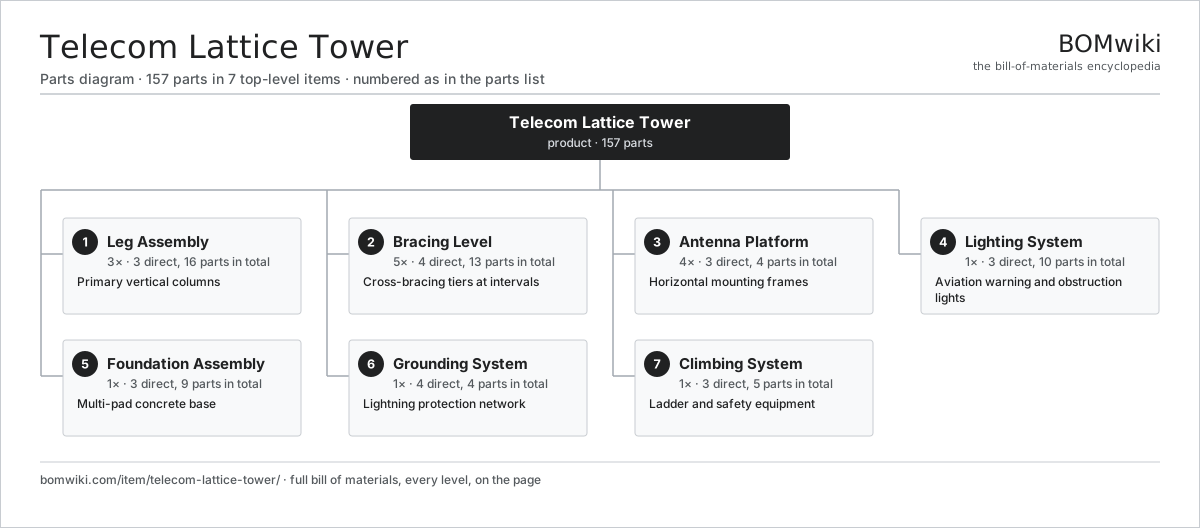
| # | Part | Qty | What it does |
|---|---|---|---|
| 1 | Leg Assembly 3 parts | 3× | Primary vertical columns |
| 2 | Bracing Level 4 parts | 5× | Cross-bracing tiers at intervals |
| 3 | Antenna Platform 3 parts | 4× | Horizontal mounting frames |
| 4 | Lighting System 3 parts | 1× | Aviation warning and obstruction lights |
| 5 | Foundation Assembly 3 parts | 1× | Multi-pad concrete base |
| 6 | Grounding System 4 parts | 1× | Lightning protection network |
| 7 | Climbing System 3 parts | 1× | Ladder and safety equipment |
3D model
No 3D model yet. Have a CAD file of this? Add a 3D model. STL renders right on this page; STEP, FreeCAD, and OpenSCAD sources are welcome too (openly licensed, like all 3D models on BOMwiki).
Build & assembly graph
expand / collapse · shared sub-assemblies converge · links to related products · est. labourTap an assembly to expand/collapse · tap a part to open it · use “Open page” for any node · drag to pan, scroll to zoom.
Bill of materials for Telecom Lattice Tower
7 top-level lines · 30 rows shown · 157 parts total · indented to 3 levels| # | Item / sub-assembly | Part no. | Qty/assy | Ext. qty | Parts | Type |
|---|---|---|---|---|---|---|
| 1 | Leg Assembly 3 parts | telecom-lattice-tower-leg-assembly | 3× | 3 | 16 | assembly |
| 1.1 | Angle Section | telecom-lattice-tower-angle-section | 8× | 24 | · | part |
| 1.2 | Fastener Set | fastener-set | 6× | 18 | · | part |
| 1.3 | Leg Weld Splice | telecom-lattice-tower-leg-weld | 2× | 6 | · | part |
| 2 | Bracing Level 4 parts | telecom-lattice-tower-bracing-levels | 5× | 5 | 13 | assembly |
| 2.1 | Main Diagonal | telecom-lattice-tower-main-diagonal | 3× | 15 | · | part |
| 2.2 | Secondary Diagonal | telecom-lattice-tower-secondary-diagonal | 3× | 15 | · | part |
| 2.3 | Horizontal Chord | telecom-lattice-tower-horizontal-chord | 3× | 15 | · | part |
| 2.4 | Fastener Set | fastener-set | 4× | 20 | · | part |
| 3 | Antenna Platform 3 parts | telecom-lattice-tower-antenna-platform | 4× | 4 | 4 | assembly |
| 3.1 | Platform Beams | telecom-lattice-tower-platform-beams | 1× | 4 | · | part |
| 3.2 | Platform Deck | telecom-lattice-tower-platform-deck | 1× | 4 | · | part |
| 3.3 | Mount Clamps | telecom-lattice-tower-mount-clamps | 2× | 8 | · | part |
| 4 | Lighting System 3 parts | telecom-lattice-tower-lighting-system | 1× | 1 | 10 | assembly |
| 4.1 | Light Fixture | telecom-lattice-tower-light-fixture | 8× | 8 | · | part |
| 4.2 | Light Controller | telecom-lattice-tower-light-controller | 1× | 1 | · | part |
| 4.3 | Light Wiring | telecom-lattice-tower-light-wiring | 1× | 1 | · | part |
| 5 | Foundation Assembly 3 parts | telecom-lattice-tower-foundation | 1× | 1 | 9 | assembly |
| 5.1 | Concrete Pad | telecom-lattice-tower-concrete-pad | 3× | 3 | · | part |
| 5.2 | Anchor Bolt Cage | telecom-lattice-tower-anchor-bolt-cage | 3× | 3 | · | part |
| 5.3 | Base Plate | telecom-lattice-tower-base-plate | 3× | 3 | · | part |
| 6 | Grounding System 4 parts | telecom-lattice-tower-grounding-system | 1× | 1 | 4 | assembly |
| 6.1 | Leg Bonds | telecom-lattice-tower-leg-bonds | 1× | 1 | · | part |
| 6.2 | Ground Rods | telecom-lattice-tower-ground-rods | 1× | 1 | · | part |
| 6.3 | Antenna Bonds | telecom-lattice-tower-antenna-bonds | 1× | 1 | · | part |
| 6.4 | Surge Protection | telecom-lattice-tower-surge-protection | 1× | 1 | · | part |
| 7 | Climbing System 3 parts | telecom-lattice-tower-climbing-system | 1× | 1 | 5 | assembly |
| 7.1 | Climbing Ladder | telecom-lattice-tower-climbing-ladder | 1× | 1 | · | part |
| 7.2 | Rest Platforms | telecom-lattice-tower-rest-platforms | 3× | 3 | · | part |
| 7.3 | Safety Cable | telecom-lattice-tower-safety-cable | 1× | 1 | · | part |
Something wrong in this list? Report a problem with this BOM.
Sourcing: possible vendors
Browse the supplier directory → Prices, MOQ, and lead times are algorithmic estimates, not quotes, and not claims about these companies. Company mappings are curated by keyword; est. price band $30–$50k. How estimates work| Vendor | HQ | Specialty | MOQ | Lead time |
|---|---|---|---|---|
|
🇺🇸Cisco
cisco.com ↗
|
San Jose, US | Networking | 500 units | 8–14 wks |
|
🇺🇸Juniper
juniper.net ↗
|
Sunnyvale, US | Networking | 500 units | 8–14 wks |
| arista.com ↗ | Santa Clara, US | Networking | 500 units | 8–14 wks |
|
🇫🇮Nokia
nokia.com ↗
|
Espoo, FI | Telecom equipment | 500 units | 8–14 wks |
|
🇨🇳Huawei
huawei.com ↗
|
Shenzhen, CN | Networking & telecom | 500 units | 8–14 wks |
833-word article