Telegraph Set
ProductOverview
The telegraph set is an electromagnetic communication device that transmits encoded messages over long distances via electrical signals. Invented by Samuel Morse and Alfred Vail in the 1830s, the telegraph was the first electronic communication technology, enabling near-instantaneous messaging across continents by the 1860s. A telegraph set consists of a transmitter (Telegraph Key) that the operator controls by hand, encoding messages in Morse code, and a receiver (Sounder) that produces audible clicks corresponding to incoming signals.
The fundamental principle is electromagnetic: a brief electrical pulse through a wire activates an electromagnet at the distant end, producing a mechanical response. The telegraph operator decodes these mechanical responses (clicks) back into intelligible text using Morse code: short clicks (dots) and long clicks (dashes) represent letters and numbers.
Telegraph Key (Transmitter)
The Telegraph Key is a spring-loaded switch operated by hand. It consists of:
Key lever: A brass or aluminum arm (typically 100 mm long) pivoting on a pivot block. The operator presses the end of the lever with a finger. The knob (grip) is shaped for ergonomic hold; early versions were simple brass balls; later designs featured shaped wooden or bakelite handles.
Contact mechanism: When the key lever is depressed, the lower contact (affixed to the lever) touches the upper contact (a fixed terminal on the pivot block), completing an electrical circuit. When the operator releases the lever, a light spring pushes the lever upward, breaking the contact.
Circuit action: The operator sends a dot by pressing the key briefly (typically 0.1–0.2 seconds), creating a short circuit closure. A dash is a longer closure (0.3–0.5 seconds). The operator''s finger control and timing encode the entire message. Experienced telegraph operators can send 20+ words per minute with practiced rhythm.
Morse Code Transmission
Morse code is a binary encoding system:
- Dot (·): Short signal, represented as "." or a 1-unit duration pulse.
- Dash (−): Long signal, represented as "−" or a 3-unit duration pulse.
- Letter/number spacing: Gaps between code units.
Example: letter "A" is · − (dot-dash); letter "B" is − · · · (dash-dot-dot-dot). Numbers 0–9 and punctuation have unique patterns. Skilled operators achieve transmission rates of 15–25 words per minute on quiet lines; speed records exceeded 45 wpm in competitive telegraphy.
Sounder (Receiver)
The Sounder is the receiving element that converts incoming electrical signals back into mechanical motion, producing audible clicks that the operator decodes.
Electromagnet: The sounder contains a coil of wire (typically 400–1000 turns) wound around an iron core. When current flows through the coil, the iron core becomes magnetized, attracting a nearby iron armature.
Armature and striker: The armature is an iron bar (20–30 mm × 10 mm) pivoted at one end. When the electromagnet activates, the magnetic field pulls the armature toward the core. The opposite end of the armature swings upward, and a hammer head on the armature strikes a metal or ceramic block, producing a sharp "click" sound.
Return spring: When the electrical signal ends, the spring pushes the armature back to its resting position, producing a second, lighter "clack" sound. Experienced operators distinguish between the up-click and down-click, using them to identify the code rhythm.
Adjustment: A tuning screw adjusts the air gap between the armature and core. This gap setting determines the sounder''s sensitivity: a smaller gap requires less current to activate the sounder, useful for weak incoming signals; a larger gap provides stability and prevents chatter (unintended oscillations).
Relay (Signal Amplifier)
Long-distance telegraph lines experience signal attenuation (weakening) due to wire resistance and capacitance. A weak signal arriving at a relay can activate the remote sounder without requiring significant current.
The relay is a sensitive electromagnet controlling a secondary circuit. It contains:
Relay coil: A high-turn electromagnet (2000–5000 turns) wound on an iron core. This high turn count makes the relay extremely sensitive to weak incoming signals. Only a few milliamps of signal current through the relay coil can activate it.
Relay armature: Similar to the sounder armature, but typically connected to switching contacts rather than a mechanical striker. When the incoming signal energizes the relay coil, the armature moves, closing a separate electrical circuit.
Secondary circuit: The relay controls a high-current circuit connected to the local sounder (or further relays). This allows weak long-line signals to activate powerful local sounders. In repeater stations on transcontinental telegraph lines, relays chain together, with each relay''s output feeding the next stage, allowing signals to traverse thousands of kilometers.
The relay is essential to telegraph infrastructure: without relays, signal attenuation would limit range to a few kilometers. With relays, a telegraph station in New York could communicate with London (transatlantic telegraph service began 1858, using relays and signal amplification).
Battery and Power
Battery terminals connect the telegraph set to a power source, typically:
- Local battery: A primary cell (Daniell cell, gravity cell) or lead-acid battery providing 6–12 V DC. Early telegraph batteries were chemical cells; later systems used rechargeable storage batteries.
- Line current: In some installations, the distant telegraph station''s battery provided signal current through the telegraph line itself. The local set simply switched the line on and off with the key.
Current flow during transmission: The operator depresses the key, closing the circuit between the positive terminal, through the sounder coil, and back to the negative (ground) terminal. Current of 100 mA–1 A flows, energizing the sounder. The distant operator, receiving this current impulse, hears their sounder produce a click.
Telegraph Line and Ground Return
Telegraph sets were typically connected in a series circuit with all other users on the same line:
Open-wire line: Copper wire strung on poles connecting telegraph offices. A single wire served as the conductor; the return path was through the earth itself (ground return). A grounding rod at each station drove current into the ground, completing the circuit.
Differential lines: For higher security and noise immunity, some systems used balanced pairs or differential signaling. But most 19th-century telegraph lines were single-wire with ground return.
Distance and impedance: Telegraph lines spanning hundreds of kilometers had significant series resistance (copper wire ~0.05 Ohm/km). A transcontinental line (3000 km) presented ~150 Ohm resistance. This resistance caused signal attenuation; relays were cascaded every 10–50 km to refresh weak signals.
Operational Use
Telegraph operators were highly trained professionals, often called "telegraphists." Key skills included:
- Morse code fluency: Sending by ear; decoding incoming clicks in real time.
- Machine operation: Adjusting relay sensitivity, troubleshooting electrical faults.
- Protocol and procedure: Message formatting, priority routing, error correction.
- Station management: Maintaining batteries, replacing worn key contacts, organizing message traffic.
A telegraph operator''s day involved sending and receiving dozens of messages, often in rapid succession. Speed and accuracy were valued; errors required resending, wasting time and money. The rhythmic sound of telegraph clicks became the signature sound of 19th-century commerce and journalism.
Limitations and Challenges
Bandwidth: Telegraph is fundamentally binary (signal present or absent). Maximum practical transmission rate is limited by operator fatigue and line noise; most telegraph lines operated at 10–20 wpm.
Noise and interference: Electrical storms, nearby machinery, and electromagnetic interference caused errors. Telegraph operators used various noise-reduction techniques (differential signaling, filters), but noise remained a limitation.
Half-duplex communication: Most telegraph lines were half-duplex (one-way at a time). Both operators could not transmit simultaneously; turn-taking was required.
Need for trained operators: Unlike telephone (invented 1876), telegraph required specialized skill. Anyone could place a telephone call, but only trained telegraphists could send and receive Morse code.
Historical Impact
The telegraph revolutionized 19th-century communication:
- News distribution: Newspapers received updated news via telegraph; national and international news reached readers the same day it occurred.
- Finance: Stock prices, commodity futures, and banking operations relied on rapid telegraph communication.
- Military: Telegraph enabled command and control of distributed armies.
- Transatlantic telegraph (1858): Connected North America and Europe; took 8 days to deliver a message via ship before telegraph; then nearly instant.
The telegraph declined in the 20th century due to telephone (superior for voice) and later radio and television (faster, richer media). However, telegraph operators remained employed into the 1970s, and some government and maritime facilities used telegraph machines as backup communication well into the computer age.
Today, telegraph sets are museum pieces and hobbyist equipment. Amateur radio enthusiasts (ham radio operators) still use Morse code as a mode, keeping the tradition alive.
Telegraph Set parts and their functions
6 top-level parts · 30 parts in total · full bill of materials below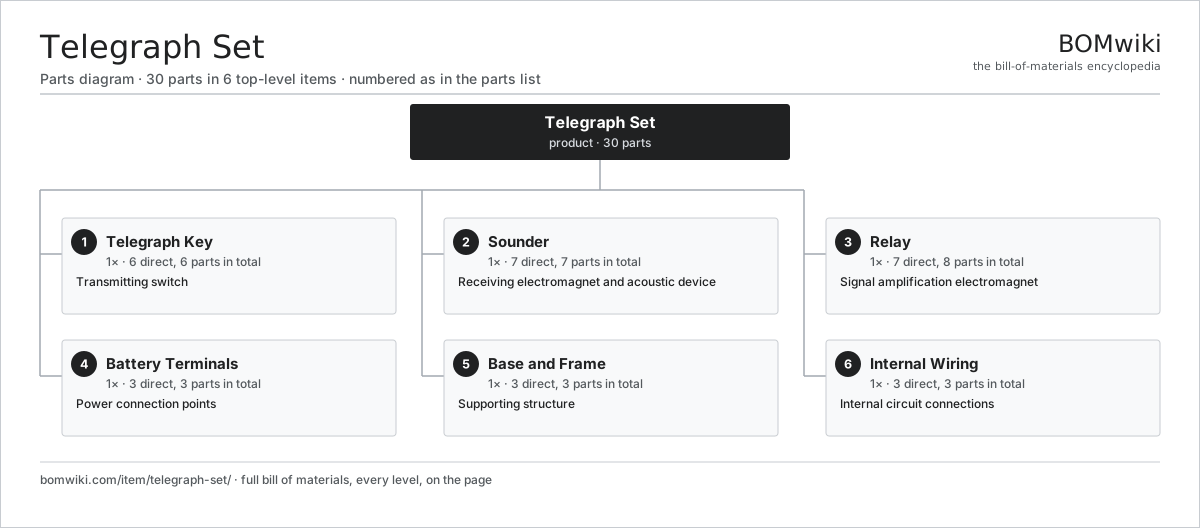
| # | Part | Qty | What it does |
|---|---|---|---|
| 1 | Telegraph Key 6 parts | 1× | Transmitting switch |
| 2 | Sounder 7 parts | 1× | Receiving electromagnet and acoustic device |
| 3 | Relay 7 parts | 1× | Signal amplification electromagnet |
| 4 | Battery Terminals 3 parts | 1× | Power connection points |
| 5 | Base and Frame 3 parts | 1× | Supporting structure |
| 6 | Internal Wiring 3 parts | 1× | Internal circuit connections |
3D model
No 3D model yet. Have a CAD file of this? Add a 3D model. STL renders right on this page; STEP, FreeCAD, and OpenSCAD sources are welcome too (openly licensed, like all 3D models on BOMwiki).
Build & assembly graph
expand / collapse · shared sub-assemblies converge · links to related products · est. labourTap an assembly to expand/collapse · tap a part to open it · use “Open page” for any node · drag to pan, scroll to zoom.
Bill of materials for Telegraph Set
6 top-level lines · 35 rows shown · 30 parts total · indented to 3 levels| # | Item / sub-assembly | Part no. | Qty/assy | Ext. qty | Parts | Type |
|---|---|---|---|---|---|---|
| 1 | Telegraph Key 6 parts | telegraph-set-key | 1× | 1 | 6 | assembly |
| 1.1 | Key Lever | telegraph-set-key-lever | 1× | 1 | · | part |
| 1.2 | Key Spring | telegraph-set-key-spring | 1× | 1 | · | part |
| 1.3 | Key Upper Contact | telegraph-set-key-contact-upper | 1× | 1 | · | part |
| 1.4 | Key Lower Contact | telegraph-set-key-contact-lower | 1× | 1 | · | part |
| 1.5 | Key Pivot Block | telegraph-set-key-pivot-block | 1× | 1 | · | part |
| 1.6 | Key Knob | telegraph-set-key-knob | 1× | 1 | · | part |
| 2 | Sounder 7 parts | telegraph-set-sounder | 1× | 1 | 7 | assembly |
| 2.1 | Sounder Coil | telegraph-set-sounder-coil | 1× | 1 | · | part |
| 2.2 | Sounder Core | telegraph-set-sounder-core | 1× | 1 | · | part |
| 2.3 | Sounder Armature | telegraph-set-sounder-armature | 1× | 1 | · | part |
| 2.4 | Sounder Striker | telegraph-set-sounder-striker | 1× | 1 | · | part |
| 2.5 | Sounder Spring | telegraph-set-sounder-spring | 1× | 1 | · | part |
| 2.6 | Sounder Adjusting Screw | telegraph-set-sounder-adjusting-screw | 1× | 1 | · | part |
| 2.7 | Sounder Base | telegraph-set-sounder-base | 1× | 1 | · | part |
| 3 | Relay 7 parts | telegraph-set-relay | 1× | 1 | 8 | assembly |
| 3.1 | Relay Coil | telegraph-set-relay-coil | 1× | 1 | · | part |
| 3.2 | Relay Core | telegraph-set-relay-core | 1× | 1 | · | part |
| 3.3 | Relay Armature | telegraph-set-relay-armature | 1× | 1 | · | part |
| 3.4 | Relay Contacts | telegraph-set-relay-contacts | 2× | 2 | · | part |
| 3.5 | Relay Spring | telegraph-set-relay-spring | 1× | 1 | · | part |
| 3.6 | Relay Adjusting Screw | telegraph-set-relay-adjusting-screw | 1× | 1 | · | part |
| 3.7 | Relay Base | telegraph-set-relay-base | 1× | 1 | · | part |
| 4 | Battery Terminals 3 parts | telegraph-set-battery-terminals | 1× | 1 | 3 | assembly |
| 4.1 | Positive Terminal | telegraph-set-battery-binding-post-positive | 1× | 1 | · | part |
| 4.2 | Negative Terminal | telegraph-set-battery-binding-post-negative | 1× | 1 | · | part |
| 4.3 | Terminal Base | telegraph-set-terminal-base | 1× | 1 | · | part |
| 5 | Base and Frame 3 parts | telegraph-set-base | 1× | 1 | 3 | assembly |
| 5.1 | Base Board | telegraph-set-base-board | 1× | 1 | · | part |
| 5.2 | Mounting Brackets | telegraph-set-mounting-brackets | 1× | 1 | · | part |
| 5.3 | Base Feet | telegraph-set-feet | 1× | 1 | · | part |
| 6 | Internal Wiring 3 parts | telegraph-set-wiring | 1× | 1 | 3 | assembly |
| 6.1 | Main Circuit Wire | telegraph-set-wire-circuit-main | 1× | 1 | · | part |
| 6.2 | Ground Wire | telegraph-set-wire-ground | 1× | 1 | · | part |
| 6.3 | Wire Insulation | telegraph-set-insulation-tube | 1× | 1 | · | part |
Something wrong in this list? Report a problem with this BOM.
Sourcing: possible vendors
Browse the supplier directory → Prices, MOQ, and lead times are algorithmic estimates, not quotes, and not claims about these companies. Company mappings are curated by keyword; est. price band $5k–$2M. How estimates work| Vendor | HQ | Specialty | MOQ | Lead time |
|---|---|---|---|---|
| atlascopco.com ↗ | Stockholm, SE | Compressors & industrial | 10 units | 12–20 wks |
|
🇦🇹Andritz
andritz.com ↗
|
Graz, AT | Process plants & machinery | 10 units | 12–20 wks |
| buhlergroup.com ↗ | Uzwil, CH | Food & materials processing | 10 units | 12–20 wks |
| gea.com ↗ | Düsseldorf, DE | Process technology | 10 units | 12–20 wks |
| mhi.com ↗ | Tokyo, JP | Heavy machinery | 10 units | 12–20 wks |
1,491-word article