Terrestrial Laser Scanner
ProductOverview
A terrestrial laser scanner (TLS), also called a terrestrial lidar, stands on the ground and shoots laser pulses in all directions, measuring the distance to every surface in view. By rotating the Scanning Head Assembly and tilting the Pan-Tilt Motor Stage, it builds a complete 3D point cloud of terrain, buildings, vegetation, or mine shafts. Survey professionals use it to measure slopes, map urban environments, document historic sites, and plan mining operations, any application where a detailed 3D model replaces traditional surveying.
The core is the Rangefinder Module, which fires nanosecond-duration laser pulses from a Laser Diode and measures the time until the light returns after bouncing off a surface. Distance equals half the round-trip time, multiplied by the speed of light. A Photodiode Array receives the faint reflected photons, and a ToF Signal Processor timestamps the arrival pulse.
The Scanning Head Assembly contains a Rotating Mirror Assembly (a high-speed galvanometer) that sweeps the laser beam side-to-side. The Pan-Tilt Motor Stage tilts the entire head up and down. Together they raster over the hemisphere and achieve a full 360° panoramic point cloud.
The GNSS/IMU Unit unit records the absolute location (via GNSS) and orientation (via gyroscopes and accelerometers) of the scanner frame, so every point cloud is geolocated in real-world coordinates. This is essential for large-scale survey: a mining operation cares not just about the shape of a slope, but its absolute coordinates relative to boundaries and previous surveys.
The Main Processor Board buffers the incoming stream of range measurements and broadcasts them over Interface Module Ethernet or Wi-Fi to a survey computer for real-time viewing and post-processing.
How it works
The Laser Diode is a pulsed infrared diode firing at 100 kHz or higher. Each pulse lasts just 3–5 nanoseconds, yielding a 1–2 meter "footprint" on a distant surface, fine enough for survey-grade accuracy. The Laser Driver conditions the pulse power; the Objective Lens collimates the beam to a narrow cone (typically 0.1–0.5 degrees wide).
The Rotating Mirror Assembly is a piezo-driven or electromagnetic galvanometer that oscillates at 10–100 Hz, sweeping the beam horizontally while it scans vertically via the Pan-Tilt Motor Stage. Modern scanners can emit and receive pulses for a single point and instantly rotate to the next target, acquiring 1 million points per second or more.
When a pulse bounces off a surface and returns, the Photodiode Array detects it as a weak photocurrent. Ambient light (sunlight) is a major noise source, so the photodiode has a narrow bandpass filter centered on the laser wavelength. The signal goes to a low-noise transimpedance amplifier and a ToF Signal Processor, which looks for the leading edge of the return pulse and timestamps it with nanosecond precision.
The GNSS/IMU Unit provides georeferencing. GNSS gives absolute position to within 0.1–1 meter depending on the receiver grade (survey-grade receivers with real-time kinematics can do 1–2 cm, but cost far more). The IMU Sensor Module measures the scanner's roll, pitch, and yaw axes, so the software can rotate every point from the scanner's local frame into Earth-fixed coordinates.
Field campaigns involve placing the scanner on a tripod at several stations around a site, acquiring a full cloud at each, then registering (aligning) the clouds using common features or control points. The Battery Pack provides 4–8 hours of operation; a survey crew typically covers a few acres in a day.
The biggest engineering constraint is the range-accuracy tradeoff. At 500 m, a point has lower precision (maybe ±50 mm) and requires good reflectivity. At 50 m, accuracy improves to ±5 mm and works on dark surfaces. The Objective Lens must be free of dust and moisture (hence the Housing Assembly weatherproofing), and the laser power is controlled both for safety and for electrical efficiency.
Terrestrial Laser Scanner parts and their functions
10 top-level parts · 570 parts in total · full bill of materials below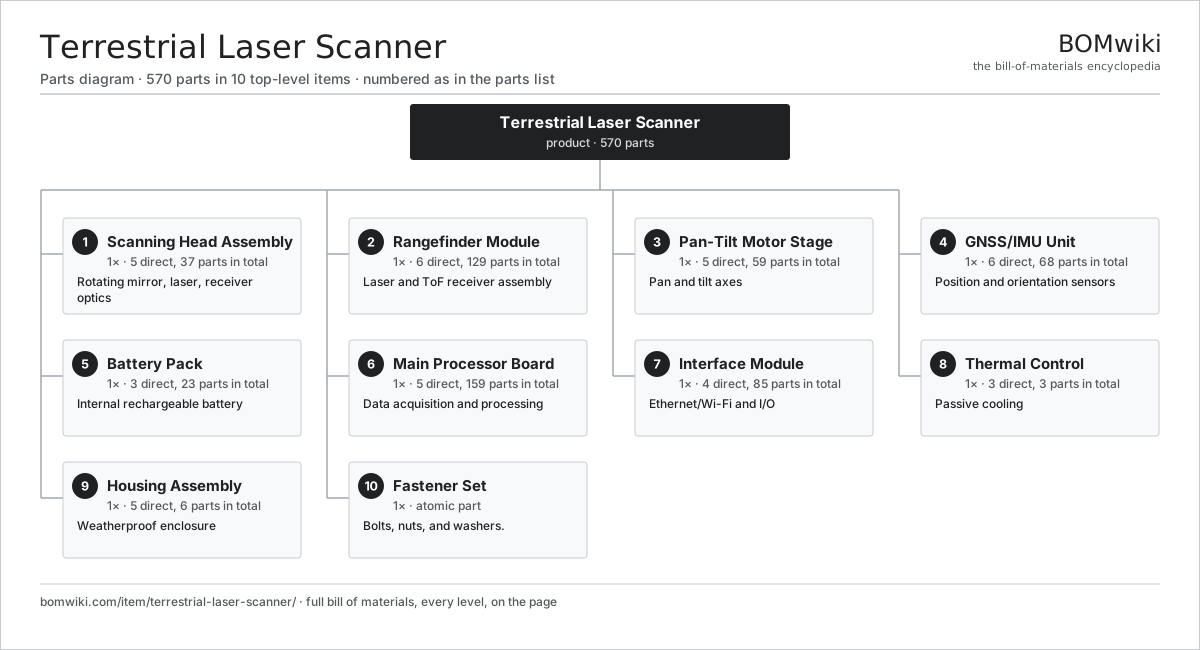
| # | Part | Qty | What it does |
|---|---|---|---|
| 1 | Scanning Head Assembly 5 parts | 1× | Rotating mirror, laser, receiver optics |
| 2 | Rangefinder Module 6 parts | 1× | Laser and ToF receiver assembly |
| 3 | Pan-Tilt Motor Stage 5 parts | 1× | Pan and tilt axes |
| 4 | GNSS/IMU Unit 6 parts | 1× | Position and orientation sensors |
| 5 | Battery Pack 3 parts | 1× | Internal rechargeable battery |
| 6 | Main Processor Board 5 parts | 1× | Data acquisition and processing |
| 7 | Interface Module 4 parts | 1× | Ethernet/Wi-Fi and I/O |
| 8 | Thermal Control 3 parts | 1× | Passive cooling |
| 9 | Housing Assembly 5 parts | 1× | Weatherproof enclosure |
| 10 | Fastener Set | 1× | Bolts, nuts, and washers. |
3D model
No 3D model yet. Have a CAD file of this? Add a 3D model. STL renders right on this page; STEP, FreeCAD, and OpenSCAD sources are welcome too (openly licensed, like all 3D models on BOMwiki).
Build & assembly graph
expand / collapse · shared sub-assemblies converge · links to related products · est. labourTap an assembly to expand/collapse · tap a part to open it · use “Open page” for any node · drag to pan, scroll to zoom.
Bill of materials for Terrestrial Laser Scanner
10 top-level lines · 69 rows shown · 570 parts total · indented to 3 levels| # | Item / sub-assembly | Part no. | Qty/assy | Ext. qty | Parts | Type |
|---|---|---|---|---|---|---|
| 1 | Scanning Head Assembly 5 parts | tls-scanning-head | 1× | 1 | 37 | assembly |
| 1.1 | Rotating Mirror Assembly 5 parts | tls-rotating-mirror | 1× | 1 | 10 | assembly |
| 1.1.1 | Galvanometer Mirror | tls-galvo-mirror | 1× | 1 | · | part |
| 1.1.2 | Scanning Coil | tls-galvo-coil | 1× | 1 | · | part |
| 1.1.3 | Neodymium Magnet | neodymium-magnet | 4× | 4 | · | part |
| 1.1.4 | Ball Bearing | ball-bearing | 2× | 2 | · | part |
| 1.1.5 | Limit Switch | limit-switch | 2× | 2 | · | part |
| 1.2 | Objective Lens | tls-objective-lens | 1× | 1 | · | part |
| 1.3 | Servo Motor 4 parts | servo-motor | 1× | 1 | 24 | assembly |
| 1.3.1 | Stator Assembly 3 parts + deeper › | stator-assembly | 1× | 1 | 3 | assembly |
| 1.3.2 | Rotor Assembly 4 parts + deeper › | rotor-assembly | 1× | 1 | 19 | assembly |
| 1.3.3 | Encoder | encoder | 1× | 1 | · | part |
| 1.3.4 | Motor Housing | motor-housing | 1× | 1 | · | part |
| 1.4 | Encoder | encoder | 1× | 1 | · | part |
| 1.5 | Motor Housing | motor-housing | 1× | 1 | · | part |
| 2 | Rangefinder Module 6 parts | tls-rangefinder-module | 1× | 1 | 129 | assembly |
| 2.1 | Laser Diode | tls-laser-source | 1× | 1 | · | part |
| 2.2 | Laser Driver 4 parts | tls-laser-driver | 1× | 1 | 5 | assembly |
| 2.2.1 | Bare PCB | pcb-bare | 1× | 1 | · | part |
| 2.2.2 | Power MOSFET | mosfet | 2× | 2 | · | part |
| 2.2.3 | Gate Driver IC | gate-driver-ic | 1× | 1 | · | part |
| 2.2.4 | Power Inductor | power-inductor | 1× | 1 | · | part |
| 2.3 | Photodiode Array | tls-photodiode-array | 1× | 1 | · | part |
| 2.4 | ToF Signal Processor | tls-tof-processor | 1× | 1 | · | part |
| 2.5 | Bare PCB | pcb-bare | 1× | 1 | · | part |
| 2.6 | SMD Passive (R/C/L) | smd-passives | 120× | 120 | · | part |
| 3 | Pan-Tilt Motor Stage 5 parts | tls-motor-stage | 1× | 1 | 59 | assembly |
| 3.1 | Servo Motor 4 parts | servo-motor | 2× | 2 | 24 | assembly |
| 3.1.1 | Stator Assembly 3 parts + deeper › | stator-assembly | 1× | 2 | 3 | assembly |
| 3.1.2 | Rotor Assembly 4 parts + deeper › | rotor-assembly | 1× | 2 | 19 | assembly |
| 3.1.3 | Encoder | encoder | 1× | 2 | · | part |
| 3.1.4 | Motor Housing | motor-housing | 1× | 2 | · | part |
| 3.2 | Encoder | encoder | 2× | 2 | · | part |
| 3.3 | Ball Bearing | ball-bearing | 4× | 4 | · | part |
| 3.4 | Limit Switch | limit-switch | 4× | 4 | · | part |
| 3.5 | Fastener Set | fastener-set | 1× | 1 | · | part |
| 4 | GNSS/IMU Unit 6 parts | tls-gnss-imu | 1× | 1 | 68 | assembly |
| 4.1 | Bare PCB | pcb-bare | 1× | 1 | · | part |
| 4.2 | GNSS Receiver Module | tls-gnss-module | 1× | 1 | · | part |
| 4.3 | IMU Sensor Module | tls-imu-sensor | 1× | 1 | · | part |
| 4.4 | Microcontroller | mcu | 1× | 1 | · | part |
| 4.5 | Connector | connector | 4× | 4 | · | part |
| 4.6 | SMD Passive (R/C/L) | smd-passives | 60× | 60 | · | part |
| 5 | Battery Pack 3 parts | tls-battery-pack | 1× | 1 | 23 | assembly |
| 5.1 | Li-ion Cell, 18650 | li-cell-18650 | 20× | 20 | · | part |
| 5.2 | BMS Board | bms-board | 1× | 1 | · | part |
| 5.3 | Connector | connector | 2× | 2 | · | part |
| 6 | Main Processor Board 5 parts | tls-main-processor | 1× | 1 | 159 | assembly |
| 6.1 | Bare PCB | pcb-bare | 1× | 1 | · | part |
| 6.2 | Compute SoC Module | soc-module | 1× | 1 | · | part |
| 6.3 | Microcontroller | mcu | 1× | 1 | · | part |
| 6.4 | SMD Passive (R/C/L) | smd-passives | 150× | 150 | · | part |
| 6.5 | Connector | connector | 6× | 6 | · | part |
| 7 | Interface Module 4 parts | tls-interface-module | 1× | 1 | 85 | assembly |
| 7.1 | Bare PCB | pcb-bare | 1× | 1 | · | part |
| 7.2 | Microcontroller | mcu | 1× | 1 | · | part |
| 7.3 | Connector | connector | 3× | 3 | · | part |
| 7.4 | SMD Passive (R/C/L) | smd-passives | 80× | 80 | · | part |
| 8 | Thermal Control 3 parts | tls-thermal-control | 1× | 1 | 3 | assembly |
| 8.1 | Radiator | radiator | 1× | 1 | · | part |
| 8.2 | O-Ring Set | oring-set | 1× | 1 | · | part |
| 8.3 | Copper Winding | copper-winding | 1× | 1 | · | part |
| 9 | Housing Assembly 5 parts | tls-housing-assembly | 1× | 1 | 6 | assembly |
| 9.1 | Main Housing Body | tls-main-housing | 1× | 1 | · | part |
| 9.2 | Protective Window | tls-protective-window | 1× | 1 | · | part |
| 9.3 | Sheet Metal Panel | sheet-panel | 2× | 2 | · | part |
| 9.4 | O-Ring Set | oring-set | 1× | 1 | · | part |
| 9.5 | Fastener Set | fastener-set | 1× | 1 | · | part |
| 10 | Fastener Set | fastener-set | 1× | 1 | · | part |
Something wrong in this list? Report a problem with this BOM.
Related products
same domain, ranked by shared parts Digital Cinema Projector
383 parts · shares 22 with this page
Digital Cinema Projector
383 parts · shares 22 with this page
 Photo Minilab
454 parts · shares 19 with this page
Thermal Rifle Scope
311 parts · shares 19 with this page
Photo Minilab
454 parts · shares 19 with this page
Thermal Rifle Scope
311 parts · shares 19 with this page
 Digital Cinema Camera
305 parts · shares 15 with this page
Thermal Binoculars
267 parts · shares 18 with this page
Digital Cinema Camera
305 parts · shares 15 with this page
Thermal Binoculars
267 parts · shares 18 with this page
 Slide Projector
182 parts · shares 16 with this page
Slide Projector
182 parts · shares 16 with this page
Sourcing: possible vendors
Browse the supplier directory → Prices, MOQ, and lead times are algorithmic estimates, not quotes, and not claims about these companies. Company mappings are curated by keyword; est. price band $100–$8k. How estimates work| Vendor | HQ | Specialty | MOQ | Lead time |
|---|---|---|---|---|
|
🇯🇵Canon
canon.com ↗
|
Tokyo, JP | Imaging & optics | 500 units | 10–16 wks |
|
🇯🇵Nikon
nikon.com ↗
|
Tokyo, JP | Imaging & optics | 500 units | 10–16 wks |
|
🇩🇪ZEISS
zeiss.com ↗
|
Oberkochen, DE | Optics & optoelectronics | 500 units | 10–16 wks |
| leica-camera.com ↗ | Wetzlar, DE | Cameras & optics | 500 units | 10–16 wks |
| flir.com ↗ | Wilsonville, US | Thermal imaging | 500 units | 10–16 wks |
664-word article