Digital Theodolite
ProductOverview
A digital theodolite is an electronic angle measurement instrument that reads horizontal (bearing) and vertical (zenith angle) directions to points of interest, transmitting the angles to an onboard LCD display and non-volatile memory. Unlike traditional manual theodolites where an operator reads a rotating scale through a magnifying lens, digital theodolites use rotary encoders and microcontroller firmware to instantly compute and display angles in degrees/minutes/seconds format. Many models include a MEMS tilt compensator that corrects for uneven tripod leveling, reducing field setup time and improving consistency. Digital theodolites bridge the gap between transit theodolites (mechanical, manual angle reading) and total stations (which also measure distance), ideal for structural deformation monitoring, building facade surveys, and angle-only networks where distance measurements are irrelevant or unavailable.
Modern digital theodolites are often integrated into surveying software ecosystems, accepting bearing setpoints, tracking angle changes, and exporting data directly to CAD or GIS platforms. They remain popular in countries where theodolite traverses (angle-only networks) are legally recognized for property boundary surveys.
How it works
The survey operator positions the instrument on a tripod over a known point (or arbitrary benchmark) and levels it using three leveling screws and a spirit bubble. The collimated telescope with illuminated crosshairs is aimed at a target (distant building, prism pole, or natural feature). The Horizontal Angle Encoder (absolute rotary encoder coupled to the telescope azimuth axis) and Vertical Angle Encoder (MEMS tilt sensor) simultaneously measure the angles and transmit them via SPI to the microcontroller. The firmware formats the angles as degrees/minutes/seconds and displays them on the LCD panel.
The dual-axis accelerometer continuously senses the instrument's tilt and automatically applies a real-time correction to the vertical (zenith) angle, this tilt compensation eliminates the need for manual leveling to high precision, a significant field advantage over mechanical theodolites.
Measurements are stored in the onboard EEPROM with timestamps. At day's end, the operator downloads the dataset to a laptop via RS-232 or USB cable (optional), then processes the angle observations to compute coordinates using inverse/forward calculations in surveying software.
Optical telescope and magnification
The telescope assembly uses a 40 mm objective lens (f/1.5) providing 25–30× magnification and a 1.5° field of view (the distance across the telescope's vision at a given range). The internal prism train creates an erect image, critical for manual aiming; the operator sees the target rightside-up, not inverted. The crosshair, etched on a glass plate at the telescope's focal plane, marks the center of the line of sight. Two fainter horizontal marks (stadia hairs) above and below the center provide a means of estimating distance: if a staff is sighted, the reading difference between upper and lower stadia marks yields distance d = 100 × (upper − lower) in meters.
The Eyepiece Lens provides −5 to +2 diopter focus to accommodate operator vision correction, and a large 40 mm exit pupil (the virtual image of the lens when viewed from infinity) that makes aiming comfortable over long sessions.
Rotary encoders and angle measurement
The Horizontal Angle Encoder is an absolute optical or magnetic rotary encoder with 16-bit resolution (0.005° per count), though the display typically rounds to 0.5° (30 arcminutes) for readability. This encoder is coupled to the main rotation axis via a flex coupling with <0.1° backlash. As the operator rotates the telescope, the encoder shaft rotates synchronously, and the firmware reads the absolute angle position without needing a zero reference or home switch.
The Vertical Angle Encoder is a MEMS dual-axis accelerometer (±2g range) that measures the instrument's tilt in the X (north-south) and Z (east-west) planes. From these accelerations, the firmware calculates tilt angle: arctan(az/ay) for north-south tilt and arctan(ax/az) for east-west. This tilt angle is subtracted from the telescope's absolute zenith reading to yield true vertical (gravity-referenced) zenith angle. The compensation works within ±2° automatically; beyond that, the operator must manually level the instrument.
Angle accuracy and thermal drift
Angle measurement accuracy is typically ±15 arcseconds (0.004°) in a benign environment, driven by encoder resolution, MEMS sensor noise, and optical collimation errors. Thermal drift in the encoder and optical system causes gradual zero-point shifts; most manufacturers recommend recalibration checks every 6–12 months in critical applications.
MEMS tilt sensors are temperature-sensitive (drift ~0.1°/°C); professional theodolites include thermistor compensation in firmware. However, transient temperature swings (e.g., moving from a warm office into cold morning air) can cause temporary ±2 arcsecond errors until thermal equilibrium is reached. Field teams typically allow 10–15 minute warmup time for long-distance precision work.
Data logging and field workflow
The EEPROM stores 500+ measurement records, each with timestamp, bearing (degrees/minutes/seconds), zenith angle, and optional memo (e.g., point name). A field data collection flow:
- Setup: Place theodolite on tripod over known point (benchmark).
- Leveling: Adjust three Leveling Screws until bubble is centered; tilt compensation handles minor residual tilt.
- Backlight: Aim telescope at a known bearing (e.g., north by compass or prior survey line) to set a reference direction. Many digital theodolites allow user-defined zero bearing, so the operator can orient angles relative to project north rather than magnetic north.
- Measurement: Aim at target point; press "Record" button on the display. Bearing and zenith are logged with timestamp.
- Traverse: Move to next station, repeat.
At the office, data is imported into surveying software (TBC, Carlson, or open-source tools) which computes coordinates using either:
- Bearing/distance traverses: If distance is manually measured (with tape or rangefinder), coordinates can be computed by forward calculations.
- Bearing-only networks: Multiple intersecting angle observations from known points are used to triangulate unknown points.
- Deformation monitoring: Series of angle observations to fixed prisms on a structure are compared over time, revealing slope or lateral movement.
Optical plummet and setup
The optical plummet is a 2.5× magnifying telescope built into the tribrach base, pointing straight down. The operator views through this plummet while adjusting the tripod legs to center the benchmark mark directly under the plummet reticle. This ensures the instrument is set precisely over the control point. An alternative is a hanging plumb bob and string, but the optical plummet is faster and immune to wind.
Practical applications and limitations
Facade surveys: Architects and engineers measure angles to building corners and parapet edges from multiple ground positions; by intersecting these angle observations, the 3D shape of the facade can be reconstructed without climbing scaffolding. This is ideal for facade surveys, window placement verification, and crack mapping.
Structural settlement monitoring: Angles to permanent prisms mounted on building columns are measured monthly or yearly. Angle changes indicate tilt or lean. Combined with distance (if a rangefinder is available), 3D coordinates are computed and compared to baseline, revealing centimeter-scale movement.
Property surveys: In jurisdictions permitting angle-only boundary surveys, multiple theodolite observations from known corners are used to infer new boundaries without legal distance measurements.
Deformation of bridges and towers: Engineers set up theodolites at multiple locations around a bridge or transmission tower, continuously track angles to prisms on the structure, and compute dynamic deformation under traffic or wind loading.
Limitations compared to total stations:
- No distance measurement: A rangefinder must be used separately, or distances must be manually taped.
- Slower data collection: Each measurement requires manual aiming and button press; total stations automate this via servo motors.
- No reflectorless distance: Cannot measure to natural surfaces (rock, concrete).
- Limited angle accuracy: ±15 arcseconds vs. ±5 arcseconds for precision transit theodolites.
Advantages:
- Simpler maintenance: No servo motors or infrared electronics to fail.
- Lower cost: 40–60% cheaper than equivalent total stations.
- Lightweight: Easier to transport to remote sites.
- Battery life: 20+ hours vs. 8 hours for total stations.
Digital Theodolite parts and their functions
7 top-level parts · 26 parts in total · full bill of materials below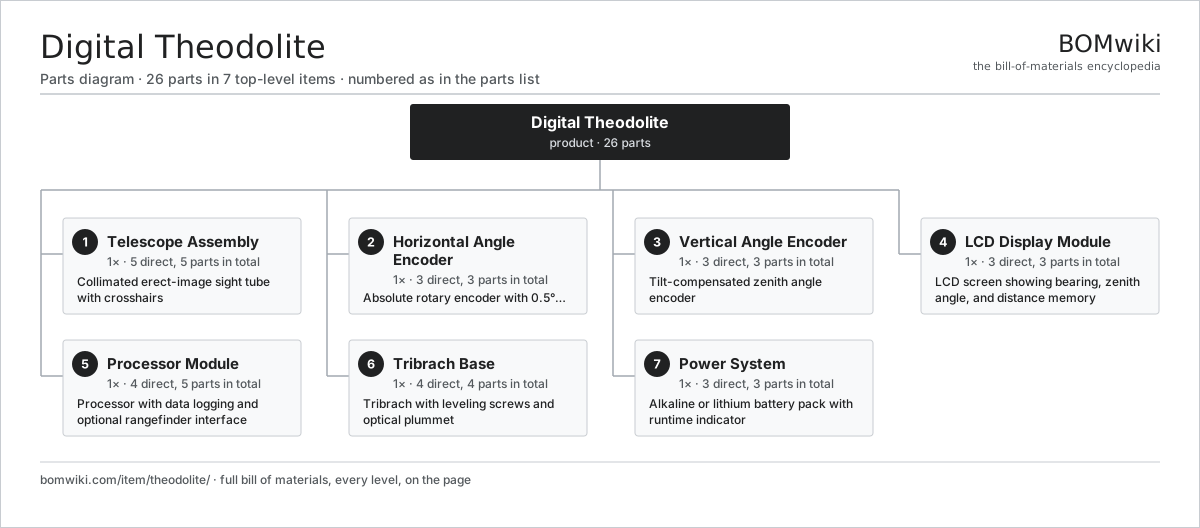
| # | Part | Qty | What it does |
|---|---|---|---|
| 1 | Telescope Assembly 5 parts | 1× | Collimated erect-image sight tube with crosshairs |
| 2 | Horizontal Angle Encoder 3 parts | 1× | Absolute rotary encoder with 0.5° resolution |
| 3 | Vertical Angle Encoder 3 parts | 1× | Tilt-compensated zenith angle encoder |
| 4 | LCD Display Module 3 parts | 1× | LCD screen showing bearing, zenith angle, and distance memory |
| 5 | Processor Module 4 parts | 1× | Processor with data logging and optional rangefinder interface |
| 6 | Tribrach Base 4 parts | 1× | Tribrach with leveling screws and optical plummet |
| 7 | Power System 3 parts | 1× | Alkaline or lithium battery pack with runtime indicator |
3D model
No 3D model yet. Have a CAD file of this? Add a 3D model. STL renders right on this page; STEP, FreeCAD, and OpenSCAD sources are welcome too (openly licensed, like all 3D models on BOMwiki).
Build & assembly graph
expand / collapse · shared sub-assemblies converge · links to related products · est. labourTap an assembly to expand/collapse · tap a part to open it · use “Open page” for any node · drag to pan, scroll to zoom.
Bill of materials for Digital Theodolite
7 top-level lines · 32 rows shown · 26 parts total · indented to 3 levels| # | Item / sub-assembly | Part no. | Qty/assy | Ext. qty | Parts | Type |
|---|---|---|---|---|---|---|
| 1 | Telescope Assembly 5 parts | theodolite-telescope | 1× | 1 | 5 | assembly |
| 1.1 | Lens Assembly | camera-lens | 1× | 1 | · | part |
| 1.2 | Illuminated Reticle | theodolite-reticle | 1× | 1 | · | part |
| 1.3 | Eyepiece Lens | theodolite-eyepiece | 1× | 1 | · | part |
| 1.4 | Coil Spring | coil-spring | 1× | 1 | · | part |
| 1.5 | Prism Erection System | theodolite-prism-train | 1× | 1 | · | part |
| 2 | Horizontal Angle Encoder 3 parts | theodolite-horizontal-encoder | 1× | 1 | 3 | assembly |
| 2.1 | Encoder | encoder | 1× | 1 | · | part |
| 2.2 | Encoder Drive Coupling | theodolite-encoder-coupling | 1× | 1 | · | part |
| 2.3 | SMD Passive (R/C/L) | smd-passives | 1× | 1 | · | part |
| 3 | Vertical Angle Encoder 3 parts | theodolite-vertical-encoder | 1× | 1 | 3 | assembly |
| 3.1 | Dual-Axis Accelerometer | theodolite-inclinometer | 1× | 1 | · | part |
| 3.2 | Microcontroller | mcu | 1× | 1 | · | part |
| 3.3 | SMD Passive (R/C/L) | smd-passives | 1× | 1 | · | part |
| 4 | LCD Display Module 3 parts | theodolite-display | 1× | 1 | 3 | assembly |
| 4.1 | LCD Panel | lcd-panel | 1× | 1 | · | part |
| 4.2 | LCD Driver IC | theodolite-display-driver | 1× | 1 | · | part |
| 4.3 | SMD Passive (R/C/L) | smd-passives | 1× | 1 | · | part |
| 5 | Processor Module 4 parts | theodolite-electronics | 1× | 1 | 5 | assembly |
| 5.1 | Microcontroller | mcu | 1× | 1 | · | part |
| 5.2 | Bare PCB | pcb-bare | 1× | 1 | · | part |
| 5.3 | SMD Passive (R/C/L) | smd-passives | 2× | 2 | · | part |
| 5.4 | Non-Volatile Memory | theodolite-flash-memory | 1× | 1 | · | part |
| 6 | Tribrach Base 4 parts | theodolite-base | 1× | 1 | 4 | assembly |
| 6.1 | Tribrach Casting | theodolite-tribrach-body | 1× | 1 | · | part |
| 6.2 | Leveling Screws | theodolite-level-screws | 1× | 1 | · | part |
| 6.3 | Plummet Optics Module | theodolite-plummet-optics | 1× | 1 | · | part |
| 6.4 | Fastener Set | fastener-set | 1× | 1 | · | part |
| 7 | Power System 3 parts | theodolite-battery | 1× | 1 | 3 | assembly |
| 7.1 | Battery Case | theodolite-battery-holder | 1× | 1 | · | part |
| 7.2 | Power Regulator | theodolite-voltage-regulator | 1× | 1 | · | part |
| 7.3 | SMD Passive (R/C/L) | smd-passives | 1× | 1 | · | part |
Something wrong in this list? Report a problem with this BOM.
Related products
same domain, ranked by shared parts Optical Level
25 parts · shares 3 with this page
Total Station
86 parts · shares 3 with this page
Digital/Bar-Code Level
28 parts · shares 3 with this page
Optical Level
25 parts · shares 3 with this page
Total Station
86 parts · shares 3 with this page
Digital/Bar-Code Level
28 parts · shares 3 with this page
 Scanning Electron Microscope
1,000 parts · shares 3 with this page
Superconductor Materials Lab
1,846 parts · shares 3 with this page
Scanning Electron Microscope
1,000 parts · shares 3 with this page
Superconductor Materials Lab
1,846 parts · shares 3 with this page
 Automated Cell Counter
54 parts · shares 2 with this page
Automated Cell Counter
54 parts · shares 2 with this page
Sourcing: possible vendors
Browse the supplier directory → Prices, MOQ, and lead times are algorithmic estimates, not quotes, and not claims about these companies. Company mappings are curated by keyword; est. price band $1k–$500k. How estimates work| Vendor | HQ | Specialty | MOQ | Lead time |
|---|---|---|---|---|
| thermofisher.com ↗ | Waltham, US | Lab instruments | 100 units | 10–18 wks |
|
🇺🇸Agilent
agilent.com ↗
|
Santa Clara, US | Analytical instruments | 100 units | 10–18 wks |
|
🇺🇸Bruker
bruker.com ↗
|
Billerica, US | Scientific instruments | 100 units | 10–18 wks |
|
🇯🇵Shimadzu
shimadzu.com ↗
|
Kyoto, JP | Analytical instruments | 100 units | 10–18 wks |
|
🇺🇸Waters
waters.com ↗
|
Milford, US | Chromatography & MS | 100 units | 10–18 wks |
1,346-word article