Therapeutic Ultrasound
ProductOverview
Therapeutic ultrasound delivers high-frequency mechanical vibrations (1–3 MHz) to deep tissues, producing thermal and non-thermal effects. The therapeutic-ultrasound-unit-piezoelectric-transducer converts radiofrequency electrical oscillation into acoustic pressure waves that propagate into muscle, tendon, and joint structures, warming tissue and promoting blood flow and collagen remodeling. Physiotherapists and sports medicine physicians use therapeutic ultrasound to manage myofascial pain, tendinopathy (rotator cuff, Achilles tendon, patellar tendon), post-operative scar tissue mobilization, and delayed-onset muscle soreness (DOMS). Unlike diagnostic ultrasound (which uses pulsed waves and displays images), therapeutic ultrasound operates in continuous or heavily pulsed mode to maximize acoustic power delivery for tissue heating.
Frequency selection and tissue penetration
The Control Console frequency selector determines penetration depth: 1 MHz penetrates 40–60 mm (reaching deep muscle and joint capsules), 1.5 MHz penetrates 25–40 mm (balanced superficial-to-deep treatment), and 3 MHz penetrates only 10–15 mm (superficial skin and fascia). Penetration depth inversely correlates with frequency due to acoustic attenuation in tissue (proportional to f²); higher-frequency ultrasound is rapidly absorbed and dissipated as heat near the surface. A clinician treating a deep shoulder rotator-cuff tendon (at ~40 mm depth) selects 1 MHz; treating superficial trigger points in the trapezius muscle selects 1.5 or 3 MHz. The RF Power Generator RF power amplifier excites the PZT Piezo Disk piezoelectric disk at the chosen resonant frequency, causing it to vibrate and radiate acoustic energy.
Thermal and non-thermal mechanisms
Acoustic energy dissipates as tissue temperature rises (thermal effect): tissues with high water content (muscle) absorb ultrasound efficiently, while collagen-rich structures (tendon, ligament, joint capsule) absorb even more. Temperatures elevated to 40–45°C increase local blood perfusion by 3–4 fold, accelerating nutrient delivery and waste removal. The Focusing Lens focusing geometry concentrates acoustic intensity at a focal depth (typically 50 mm), creating a "hot zone" of preferential heating. Non-thermal effects include acoustic streaming (microscopic fluid currents mechanically stimulating cells) and cavitation (transient bubble nucleation and collapse); these phenomena may enhance cellular signaling and collagen protein synthesis independent of temperature rise, though clinical significance remains debated.
Duty cycle and pulsed ultrasound
The Duty Cycle PWM modulator gates the RF output at adjustable duty cycles (10–100%). Continuous ultrasound (100% duty) maximizes thermal effect but risks excessive heating and patient discomfort; pulsed ultrasound (e.g., 50% duty = 50% on, 50% off) reduces average power while allowing tissue thermal relaxation. Pulsed protocols (e.g., 1.5 W/cm² at 50% duty for 5 minutes) are preferred for acute inflammation to limit temperature rise to 40–41°C, while continuous ultrasound (2 W/cm² at 100% duty) is reserved for chronic conditions requiring deeper collagen remodeling.
Acoustic coupling and safety
Ultrasound cannot propagate through air gaps; the transducer must maintain acoustic coupling via a contact medium (aqueous gel or mineral oil). The Acoustic Coupling Detector capacitive sensor detects transducer-to-skin contact; if the clinician lifts the transducer or loses contact, the Safety Cutoff Relay safety relay immediately disables RF output, preventing phantom heating. Poor coupling creates standing-wave resonances and excessive transducer heating; the Transducer Cooling System active fan and Thermal Cutoff thermal cutoff at 60°C prevent transducer damage.
Treatment protocol and patient sensation
A patient with lateral epicondylitis (tennis elbow) undergoes ultrasound therapy. The clinician applies ultrasound gel to the lateral elbow and selects 1.5 MHz frequency (balanced penetration for the extensor carpi radialis tendon at ~25–30 mm depth) and 1.5 W/cm² power at 50% duty (pulsed). The transducer head (approximately 0.5 cm² effective radiating area, yielding ~0.75 W actual power) is moved in slow circular or linear motion over the lateral elbow for 5 minutes, maintaining firm transducer-skin contact. The patient experiences mild warmth without discomfort. After treatment, pain ratings typically decrease 10–20%, with cumulative improvement over 6–8 sessions at 2–3 sessions per week.
Collagen remodeling and scar tissue mobilization
Post-operative scar tissue (following rotator cuff repair, ACL reconstruction, or tendon transfer) exhibits excessive collagen cross-linking and reduced elasticity. Therapeutic ultrasound (1 MHz, 1.0–1.5 W/cm² continuous, 5–7 minutes) applied to scar tissue once collagen maturation has begun (~3–4 weeks post-op) promotes collagen reorganization and increases tissue extensibility. Mechanistic studies suggest that acoustic streaming and cavitation-induced microtrauma stimulate fibroblast activity and matrix metalloproteinase expression, facilitating collagen remodeling toward a more organized, functional architecture. Regular ultrasound application combined with progressive range-of-motion exercises yields superior long-term outcomes vs. scar tissue immobilization.
Clinical effectiveness and evidence base
Randomized controlled trials show moderate efficacy for therapeutic ultrasound in musculoskeletal pain: meta-analyses indicate significant but small effect sizes (Cohen's d ~0.4–0.6) for tendinopathy and myofascial pain vs. sham ultrasound. Heterogeneity in published studies (varying frequency, intensity, duty cycle, treatment duration, and patient populations) makes definitive recommendations challenging. Nevertheless, therapeutic ultrasound remains widely adopted in physiotherapy and sports medicine clinics, often as an adjunct to exercise and manual therapy rather than as monotherapy. Some evidence supports ultrasound for calcific tendinopathy and post-operative swelling reduction, though application to acute inflammation is less certain.
Typical clinical session
A collegiate volleyball player presents with chronic Achilles tendinopathy (pain 5/10 at start of practice, worsens with load). The sports medicine physiatrist applies 1 MHz ultrasound at 1.25 W/cm² pulsed (50% duty) over the proximal Achilles insertion for 7 minutes, achieving tissue temperature of 41–42°C at the enthesis. The player then performs eccentric heel-drop exercises (strengthening protocol) immediately post-ultrasound, capitalizing on increased tissue extensibility. Over 4 weeks of twice-weekly ultrasound plus eccentric exercise, pain decreases to 1–2/10, and the player returns to full practice participation. The cumulative effect is attributed to both tissue heating (acute phase) and collagen reorganization (chronic adaptation).
Therapeutic Ultrasound parts and their functions
6 top-level parts · 24 parts in total · full bill of materials below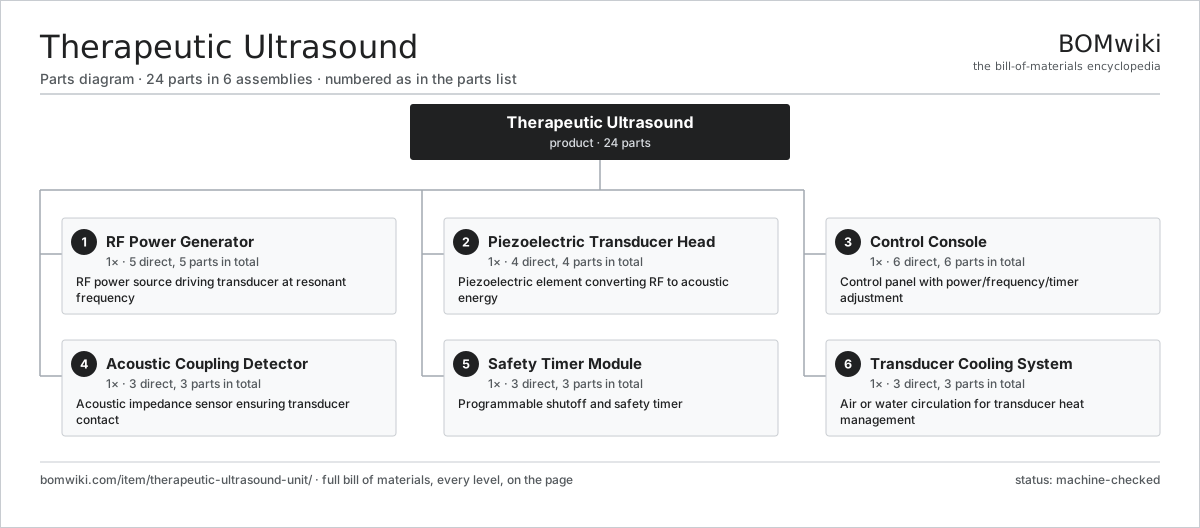
| # | Part | Qty | What it does |
|---|---|---|---|
| 1 | RF Power Generator 5 parts | 1× | RF power source driving transducer at resonant frequency |
| 2 | Piezoelectric Transducer Head 4 parts | 1× | Piezoelectric element converting RF to acoustic energy |
| 3 | Control Console 6 parts | 1× | Control panel with power/frequency/timer adjustment |
| 4 | Acoustic Coupling Detector 3 parts | 1× | Acoustic impedance sensor ensuring transducer contact |
| 5 | Safety Timer Module 3 parts | 1× | Programmable shutoff and safety timer |
| 6 | Transducer Cooling System 3 parts | 1× | Air or water circulation for transducer heat management |
3D model
No 3D model yet. Have a CAD file of this? Add a 3D model — STL renders right on this page; STEP, FreeCAD, and OpenSCAD sources are welcome too (openly licensed, like all 3D models on BOMwiki).
Build & assembly graph
expand / collapse · shared sub-assemblies converge · links to related products · est. labourTap an assembly to expand/collapse · tap a part to open it · use “Open page” for any node · drag to pan, scroll to zoom.
Bill of materials for Therapeutic Ultrasound
6 top-level lines · 30 rows shown · 24 parts total · indented to 3 levels| # | Item / sub-assembly | Part no. | Qty/assy | Ext. qty | Parts | Type |
|---|---|---|---|---|---|---|
| 1 | RF Power Generator 5 parts | therapeutic-ultrasound-unit-generator | 1× | 1 | 5 | assembly |
| 1.1 | RF Oscillator | therapeutic-ultrasound-unit-oscillator | 1× | 1 | · | part |
| 1.2 | RF Power Amplifier | therapeutic-ultrasound-unit-rf-amplifier | 1× | 1 | · | part |
| 1.3 | Impedance Matching Network | therapeutic-ultrasound-unit-impedance-match | 1× | 1 | · | part |
| 1.4 | Duty Cycle PWM | therapeutic-ultrasound-unit-duty-cycle-pwm | 1× | 1 | · | part |
| 1.5 | Power Supply | power-supply | 1× | 1 | · | part |
| 2 | Piezoelectric Transducer Head 4 parts | therapeutic-ultrasound-unit-transducer | 1× | 1 | 4 | assembly |
| 2.1 | PZT Piezo Disk | therapeutic-ultrasound-unit-pzt-element | 1× | 1 | · | part |
| 2.2 | Acoustic Backing | therapeutic-ultrasound-unit-backing-mass | 1× | 1 | · | part |
| 2.3 | Focusing Lens | therapeutic-ultrasound-unit-acoustic-lens | 1× | 1 | · | part |
| 2.4 | Acoustic Window | therapeutic-ultrasound-unit-acoustic-window | 1× | 1 | · | part |
| 3 | Control Console 6 parts | therapeutic-ultrasound-unit-console | 1× | 1 | 6 | assembly |
| 3.1 | Power Intensity Knob | therapeutic-ultrasound-unit-intensity-dial | 1× | 1 | · | part |
| 3.2 | Frequency Selector Switch | therapeutic-ultrasound-unit-freq-selector | 1× | 1 | · | part |
| 3.3 | Duty Cycle Knob | therapeutic-ultrasound-unit-duty-dial | 1× | 1 | · | part |
| 3.4 | Treatment Timer | therapeutic-ultrasound-unit-timer-knob | 1× | 1 | · | part |
| 3.5 | Mode Selector Button | therapeutic-ultrasound-unit-mode-button | 1× | 1 | · | part |
| 3.6 | LCD Display | therapeutic-ultrasound-unit-display | 1× | 1 | · | part |
| 4 | Acoustic Coupling Detector 3 parts | therapeutic-ultrasound-unit-coupling-detector | 1× | 1 | 3 | assembly |
| 4.1 | Impedance Sensor | therapeutic-ultrasound-unit-acoustic-impedance-sensor | 1× | 1 | · | part |
| 4.2 | Sensor Amplifier | therapeutic-ultrasound-unit-detector-amplifier | 1× | 1 | · | part |
| 4.3 | Safety Cutoff Relay | therapeutic-ultrasound-unit-cutoff-relay | 1× | 1 | · | part |
| 5 | Safety Timer Module 3 parts | therapeutic-ultrasound-unit-timer-circuit | 1× | 1 | 3 | assembly |
| 5.1 | Timer Microcontroller | therapeutic-ultrasound-unit-microcontroller | 1× | 1 | · | part |
| 5.2 | Timer Display | therapeutic-ultrasound-unit-timer-display | 1× | 1 | · | part |
| 5.3 | Alarm Buzzer | therapeutic-ultrasound-unit-alarm-buzzer | 1× | 1 | · | part |
| 6 | Transducer Cooling System 3 parts | therapeutic-ultrasound-unit-cooling-system | 1× | 1 | 3 | assembly |
| 6.1 | Cooling Fan | therapeutic-ultrasound-unit-cooling-fan | 1× | 1 | · | part |
| 6.2 | Aluminum Heat Sink | therapeutic-ultrasound-unit-heat-sink | 1× | 1 | · | part |
| 6.3 | Thermal Cutoff | therapeutic-ultrasound-unit-thermostat | 1× | 1 | · | part |
Related products
same domain, ranked by shared parts Anesthesia Machine
562 parts · shares 1 with this page
Anesthesia Machine
562 parts · shares 1 with this page
 Apheresis Machine
199 parts · shares 1 with this page
Apheresis Machine
199 parts · shares 1 with this page
 Autorefractor
513 parts · shares 1 with this page
Autorefractor
513 parts · shares 1 with this page
 Blood Bank Refrigerator
79 parts · shares 1 with this page
Blood Gas Analyzer
386 parts · shares 1 with this page
Blood Bank Refrigerator
79 parts · shares 1 with this page
Blood Gas Analyzer
386 parts · shares 1 with this page
 Blood/Fluid Warmer
28 parts · shares 1 with this page
Blood/Fluid Warmer
28 parts · shares 1 with this page
Sourcing: possible vendors
Prices, MOQ, and lead times are algorithmic estimates, not quotes, and not claims about these companies. Company mappings are curated by keyword; est. price band $500–$3M. How estimates work| Vendor | HQ | Specialty | MOQ | Lead time |
|---|---|---|---|---|
| gehealthcare.com ↗ | Chicago, US | Medical imaging & devices | 100 units | 12–20 wks |
| siemens-healthineers.com ↗ | Erlangen, DE | Medical systems | 100 units | 12–20 wks |
|
🇳🇱Philips
philips.com ↗
|
Amsterdam, NL | Health technology | 100 units | 12–20 wks |
| medtronic.com ↗ | Minneapolis, US | Medical devices | 100 units | 12–20 wks |
|
🇨🇳Mindray
mindray.com ↗
|
Shenzhen, CN | Medical devices | 100 units | 12–20 wks |
998-word article