Thermoelectric Generator
ProductOverview
A thermoelectric generator (TEG) converts heat directly into electricity using the Seebeck effect: when two different semiconductor materials (P-type and N-type) are joined and exposed to a temperature gradient, charge carriers drift toward the cold side, creating a voltage across the device. No moving parts, no combustion, no mechanical complexity, only solid-state physics.
A typical commercial TE module contains 8–12 pairs of bismuth telluride (Bi₂Te₃) legs, producing 5–15 V at 0.5–5 A when a 100 K temperature difference is maintained. Stacking modules in series increases voltage; parallel connection increases current. A 2 kW TEG suitable for industrial waste-heat recovery might comprise 32–64 modules arranged in a custom array.
TEGs are ideal for applications with steady heat sources and modest power requirements: remote monitoring sensors, telemetry boxes on oil/gas wells, backup power at cell towers, spacecraft propulsion assist. While electrical efficiency (3–7%) is lower than turbines or engines, the simplicity, reliability, and absence of moving parts often justify deployment where fuel cost matters less than ruggedness and maintenance-free operation.
How it Works
The Seebeck Effect
When a temperature difference ΔT is applied across a TE module, charge carriers in the semiconductor legs drift. In the P-type leg (holes), positive charges accumulate at the cold end; in the N-type leg (electrons), negative charges accumulate there. This charge separation creates an electric field and potential difference.
The Seebeck voltage is proportional to ΔT and the material's Seebeck coefficient (S), typically ~200 μV/K for bismuth telluride:
V = S × ΔT
For ΔT = 100 K: V = 200 μV/K × 100 K = 20 mV per TE pair.
A single module with 8 pairs produces 8 × 20 mV = 0.16 V, too small for practical use. Stacking 32 modules in series yields 32 × 0.16 V = 5.12 V at rated ΔT.
Module Structure and Configuration
A commercial TE module is a thin sandwich:
- Ceramic substrates (top and bottom) providing electrical insulation and thermal contact surfaces
- Bismuth telluride legs (P-type and N-type) soldered in a series-parallel electrical circuit
- Copper interconnects linking legs
One module (~56 mm square, 5 mm thick) produces 5–15 V DC at 1–5 A under a large ΔT.
Modules are arranged in series to increase voltage (V_total = V₁ + V₂ + ... + Vₙ) and in parallel to increase current (I_total = I₁ + I₂ + ... + Iₙ). A 2 kW system at 48 V output might be configured as 32 modules (4 series × 8 parallel):
- Series: 4 × 15 V = 60 V (before load)
- Parallel: 8 × 20 A = 160 A at this voltage
- Power: 60 V × 160 A = 9.6 kW (ideal, no losses)
Real power is lower due to internal resistance (~2–5 Ω per module) and non-ideal cooling.
Thermal Management and Heat Source Interface
The hot-side interface is critical. The hot plate is in contact with the heat source (exhaust pipe, furnace wall, solar receiver). Thermal paste (alumina or boron nitride, 2–5 W/mK) fills microscopic gaps, improving thermal conductance.
Temperature difference ΔT = T_hot - T_cold determines power output. For a given thermal input Q_in (watts from the heat source):
ΔT ≈ Q_in / (k × A + G_load)
where k is thermal conductance of interfaces, A is TE module area, and G_load is the thermal conductance of the cold-side heat sink.
A large, efficient cold-side heat sink with a fan maximizes ΔT by keeping T_cold low (close to ambient). Conversely, a small passive sink means T_cold rises, ΔT shrinks, and power drops.
For a 2 kW thermal input and a target ΔT = 100 K with TE array efficiency ~20%:
- Power out = 2000 W × 0.20 × (100 K efficiency factor) ≈ 50–100 W electrical.
(Note: actual efficiency is 3–7%, so output is lower; this is a simplified illustration.)
Power Output and Internal Resistance
Each TE module has an internal electrical resistance R_int (~2–5 Ω). When load resistance R_load is connected:
I = V_open / (R_int + R_load) P_out = I² × R_load
Maximum power transfer occurs when R_load = R_int (impedance matching). However, in a real system, R_load (e.g., LED string, battery charger, inverter input) is fixed, and the power conditioning electronics optimize output.
Maximum Power Point Tracking (MPPT)
The MPPT controller continuously adjusts electrical load resistance to maximize power output as temperature gradient changes. The algorithm measures voltage and current periodically, calculates power, and adjusts a DC-DC boost converter to tune load impedance.
When ΔT is high (e.g., 150 K), open-circuit voltage is high; the MPPT reduces boost converter ratio, increasing current and impedance-matching. When ΔT drops (e.g., 80 K), open-circuit voltage falls; MPPT increases boost ratio, raising voltage and impedance.
This continuous optimization increases power output by 10–20% vs. fixed-load operation.
Output Conditioning
The raw output of a TE array is low-voltage, high-current DC (e.g., 10 V, 50 A). The boost converter steps voltage up to a standard level (24 or 48 V DC) for distribution. An output filter reduces switching ripple to <2%, suitable for sensitive electronics.
For AC output, a DC-to-AC inverter (not shown in core BOM, but often added) converts to 50 or 60 Hz for grid injection or local AC loads.
Applications
Industrial Waste-Heat Recovery
A steel mill's furnace exhausts gas at 300–400 °C. By routing exhaust through a heat exchanger with TE modules on the hot side, a TEG produces 50–200 kW electrical while cooling exhaust for pollution control. Cost of TE array is high (~$100–200/W), but payback occurs in 3–7 years via recovered electricity and avoided fuel waste.
Remote Power Generation
Oil and gas wells, environmental monitoring stations, and maritime buoys in remote locations have little access to grid power. A 100–500 W TEG powered by a small furnace or solar receiver provides 24/7 power, eliminating diesel generator fuel costs and maintenance. 40-year life with zero moving parts justifies the $10,000–$50,000 capital cost.
Spacecraft and Planetary Rovers
NASA's Mars rovers (Curiosity, Perseverance) use radioisotope thermoelectric generators (RTGs): plutonium-238 decay heat drives TE modules, producing 100–300 W. Cost is enormous (~$10–20M per unit), but reliability over 10+ years with no maintenance is unmatched. Commercial TE modules follow the same principle at smaller scale.
Solar Thermal Power
Concentrated solar mirrors heat a receiver to 250–400 °C. TE modules convert the heat gradient (receiver to ambient cooler) directly to electricity. No moving parts, no startup time, power follows sun intensity within milliseconds. 5–50 kW systems are practical for remote communities with reliable solar resources.
Wearable Power
Body heat (36.5 °C skin, 20 °C ambient = 16.5 K ΔT) can power small sensors or recharge batteries. TEGs sewn into jackets or watches generate 10–100 mW, sufficient for continuous monitoring without batteries. With no moving parts, reliability and comfort exceed mechanical energy harvesters.
Performance Metrics and Efficiency
Carnot efficiency (theoretical maximum) is: η_Carnot = (T_hot - T_cold) / T_hot = ΔT / T_hot
For T_hot = 350 K, T_cold = 300 K: η_Carnot = 50 K / 350 K ≈ 14%
Actual TE efficiency is ~20–30% of Carnot efficiency (due to material losses and thermal conductance). Thus: η_actual = 0.25 × 14% ≈ 3.5%
This 3–7% electrical efficiency is low compared to turbines (30–40%) or engines (25–35%), but acceptable for:
- Heat that would otherwise be wasted (waste recovery at zero fuel cost)
- Applications where reliability and simplicity outweigh efficiency (remote power)
Thermoelectric Figure of Merit (ZT) quantifies material quality: ZT = S² × σ × T / κ
where S is Seebeck coefficient, σ is electrical conductivity, and κ is thermal conductivity. Higher ZT improves efficiency. Modern Bi₂Te₃ achieves ZT ≈ 1; advanced materials (half-Heusler alloys, skutterudites) target ZT > 1.5 for future improvement.
Limitations and Challenges
- Low efficiency: 3–7% means 93–97% of heat input is wasted. Large TE arrays are needed for significant power, raising cost.
- High material cost: Bismuth telluride and lead telluride are expensive; arrays cost $50–200/W.
- Temperature limits: Bi₂Te₃ degrades above 250 °C; higher-temp materials (lead telluride, half-Heusler) are less mature and more costly.
- Thermal interface challenges: Poor contact (air gaps, thermal paste aging) drastically reduces ΔT and power.
- Limited ΔT operation: Maximum power occurs at specific ΔT; part-load efficiency is poor if ΔT drifts far from design point.
Modern Development
Advanced materials: New TE materials with higher ZT are being developed:
- Skutterudites: ZT > 1.0 at 500–700 K
- Half-Heusler alloys: ZT ≈ 1.2, stable to 800 K
- Graphene and nanostructured materials: Promise ZT > 2–3 in laboratory, but manufacturing scalability uncertain.
Segmented TE modules: Multiple material stages optimized for different temperature ranges, stacked to cover T_hot (500 K) to T_cold (300 K), can approach 10% efficiency in cascaded configuration.
Thermoelectric cooling + heating: TEGs are reversible, apply electrical power, and they pump heat (Peltier effect). Hybrid systems combine waste-heat power generation with active cooling/heating for higher efficiency and wider temperature range coverage.
Standards and Certification
TE generators are not heavily standardized, but data sheets and reliability are validated by:
- ASTM E2086: Standard practice for measuring Seebeck coefficient.
- IEC 60904-1: Test conditions for solar cells (adapted for solar-powered TEGs).
- Manufacturer datasheets: Peak power, internal resistance, ZT over temperature range.
Long-term reliability testing (HTOL, high-temperature operating life) is manufacturer-specific. Most commercial modules are rated for 50,000–100,000 hours (20–40 years) without significant degradation if properly cooled and sealed (IP67).
Thermoelectric Generator parts and their functions
6 top-level parts · 103 parts in total · full bill of materials below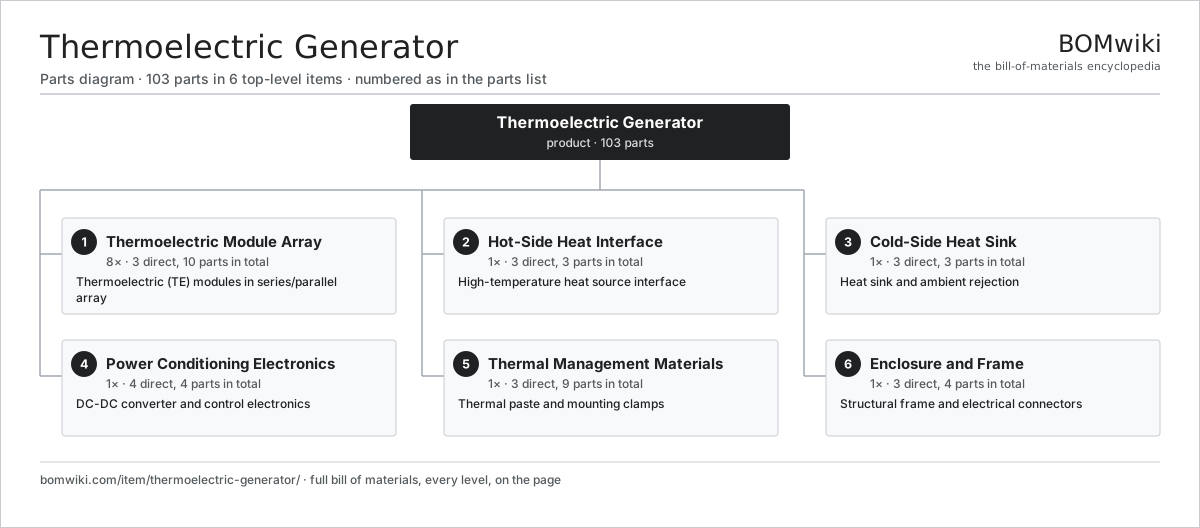
| # | Part | Qty | What it does |
|---|---|---|---|
| 1 | Thermoelectric Module Array 3 parts | 8× | Thermoelectric (TE) modules in series/parallel array |
| 2 | Hot-Side Heat Interface 3 parts | 1× | High-temperature heat source interface |
| 3 | Cold-Side Heat Sink 3 parts | 1× | Heat sink and ambient rejection |
| 4 | Power Conditioning Electronics 4 parts | 1× | DC-DC converter and control electronics |
| 5 | Thermal Management Materials 3 parts | 1× | Thermal paste and mounting clamps |
| 6 | Enclosure and Frame 3 parts | 1× | Structural frame and electrical connectors |
3D model
No 3D model yet. Have a CAD file of this? Add a 3D model. STL renders right on this page; STEP, FreeCAD, and OpenSCAD sources are welcome too (openly licensed, like all 3D models on BOMwiki).
Build & assembly graph
expand / collapse · shared sub-assemblies converge · links to related products · est. labourTap an assembly to expand/collapse · tap a part to open it · use “Open page” for any node · drag to pan, scroll to zoom.
Bill of materials for Thermoelectric Generator
6 top-level lines · 25 rows shown · 103 parts total · indented to 3 levels| # | Item / sub-assembly | Part no. | Qty/assy | Ext. qty | Parts | Type |
|---|---|---|---|---|---|---|
| 1 | Thermoelectric Module Array 3 parts | thermoelectric-generator-modules | 8× | 8 | 10 | assembly |
| 1.1 | Thermoelectric Module (P-N Pair) | thermoelectric-generator-module-pn | 8× | 64 | · | part |
| 1.2 | Electrical Bus and Interconnect | thermoelectric-generator-electrical-interconnect | 1× | 8 | · | part |
| 1.3 | Electrical Insulation Sheet | thermoelectric-generator-insulation-sheet | 1× | 8 | · | part |
| 2 | Hot-Side Heat Interface 3 parts | thermoelectric-generator-hot-side | 1× | 1 | 3 | assembly |
| 2.1 | Hot-Side Heat Absorber | thermoelectric-generator-hot-plate | 1× | 1 | · | part |
| 2.2 | Hot-Side Fin Radiator | thermoelectric-generator-hot-fin | 1× | 1 | · | part |
| 2.3 | Hot-Side Thermal Interface Material | thermoelectric-generator-hot-gasket | 1× | 1 | · | part |
| 3 | Cold-Side Heat Sink 3 parts | thermoelectric-generator-cold-side | 1× | 1 | 3 | assembly |
| 3.1 | Cold-Side Finned Heat Sink | thermoelectric-generator-heatsink-fins | 1× | 1 | · | part |
| 3.2 | Cooling Fan Motor | thermoelectric-generator-heatsink-fan | 1× | 1 | · | part |
| 3.3 | Cold-Side Thermal Interface Material | thermoelectric-generator-cold-gasket | 1× | 1 | · | part |
| 4 | Power Conditioning Electronics 4 parts | thermoelectric-generator-power-conditioning | 1× | 1 | 4 | assembly |
| 4.1 | MPPT Control Processor | thermoelectric-generator-mppt-controller | 1× | 1 | · | part |
| 4.2 | DC-DC Boost Converter | thermoelectric-generator-boost-converter | 1× | 1 | · | part |
| 4.3 | Output Filter Network | thermoelectric-generator-output-filter | 1× | 1 | · | part |
| 4.4 | Control Printed Circuit Board | thermoelectric-generator-control-pcb | 1× | 1 | · | part |
| 5 | Thermal Management Materials 3 parts | thermoelectric-generator-thermal-interface | 1× | 1 | 9 | assembly |
| 5.1 | Thermal Conduction Paste | thermoelectric-generator-thermal-paste | 1× | 1 | · | part |
| 5.2 | Spring Clamp Fixture | thermoelectric-generator-mounting-clamps | 4× | 4 | · | part |
| 5.3 | Insulated Spacer Rod | thermoelectric-generator-spacer-rods | 4× | 4 | · | part |
| 6 | Enclosure and Frame 3 parts | thermoelectric-generator-housing | 1× | 1 | 4 | assembly |
| 6.1 | Aluminum Frame Structure | thermoelectric-generator-frame | 1× | 1 | · | part |
| 6.2 | Terminal Block Connector | thermoelectric-generator-connector-block | 1× | 1 | · | part |
| 6.3 | Cable Entry Gland | thermoelectric-generator-cable-gland | 2× | 2 | · | part |
Something wrong in this list? Report a problem with this BOM.
Sourcing: possible vendors
Browse the supplier directory → Prices, MOQ, and lead times are algorithmic estimates, not quotes, and not claims about these companies. Company mappings are curated by keyword; est. price band $5k–$50M. How estimates work| Vendor | HQ | Specialty | MOQ | Lead time |
|---|---|---|---|---|
| gevernova.com ↗ | Cambridge, US | Power generation | made to order | 20–40 wks |
| siemens-energy.com ↗ | Munich, DE | Power & grid | made to order | 20–40 wks |
| hitachienergy.com ↗ | Zurich, CH | Grid & transformers | made to order | 20–40 wks |
|
🇨🇭ABB
abb.com ↗
|
Zurich, CH | Electrification & automation | made to order | 20–40 wks |
| se.com ↗ | Rueil-Malmaison, FR | Electrical & automation | made to order | 20–40 wks |
1,625-word article