Wet Tile Saw
ProductOverview
A wet tile saw cuts ceramic, porcelain and natural-stone tile with a diamond abrasive blade flooded with water. Unlike a wood saw, the Diamond Blade has no teeth: its rim is a sintered band of diamond grit in a metal bond, and it removes material by grinding a kerf. Cutting hard porcelain dry would glaze the blade and release crystalline-silica dust, so the machine recirculates water over the cut continuously, cooling the rim, flushing swarf out of the kerf, and binding the dust into slurry. The sliding-table format, where the tile rides a carriage past a fixed cutting head, is the standard for tile setters because the tile stays fully supported and the cut line stays visible.
How it works
The Motor Unit, a sealed 1.5–2.2 kW single-phase induction motor with its Motor Capacitor providing starting torque, drives the blade directly at about 3,400 rpm, roughly 44 m/s rim speed on a 250 mm blade. The blade clamps between two Blade Flanges on the Arbor Shaft; the Arbor Nut uses a left-hand thread so blade drag tightens rather than loosens it. Because the diamond rim grinds rather than slices, feed rates are slow, 300–600 mm per minute in hard porcelain, and the operator's job is to feed steadily without forcing, letting the water and the grit do the work.
The tile sits on the Sliding Table: a stainless Table Top with a Rubber Table Mat rolling on sealed Roller Cartridges along two hardened Table Rails. Rail parallelism to the blade is what determines cut straightness, and the sealed V-groove rollers exist because the running surfaces live in a constant mist of abrasive slurry, open bearings on a tile saw fail in weeks.
Water system
The Water System is a closed loop. The Submersible Pump, a magnetically coupled centrifugal unit with no shaft seal to wear, sitting submerged in the Water Tray, pushes about 500 litres per hour through the Water Hose to a pair of Spray Nozzles aimed at both flanks of the blade just above the workpiece. Water enters the kerf, absorbs the grinding heat, and returns to the tray carrying the slurry, where the solids settle. The Blade Guard hood, Splash Curtains and Rear Baffle capture the rooster-tail of water the rim throws off at 44 m/s. The tray is drained through the Drain Plug and refilled when the settled slurry layer starts being re-ingested, running the pump on dirty water sandblasts the impeller and starves the blade.
Fence, mitre and bevel
Repeatable cuts come from the Fence & Mitre System. The Rip Fence clamps across the table with Fence Clamps to set strip width against the printed scale, and the Mitre Guide registers against it for 45° diagonal cuts. For edge bevels the whole cutting head tilts on the Bevel Pivot, with detents at 22.5° and 45°, mitred external corners on wall tile are cut this way rather than with trim.
Electrical safety
A mains-powered machine that deliberately sprays water demands ground-fault protection. The GFCI Plug trips at 5–6 mA of leakage current in under 25 ms, and the Sealed Switch is membrane-sealed and switches motor and pump together so the blade can never run dry by mistake. The motor shell is gasketed, its shaft runs through Oil Seals, and a Thermal Fuse in the windings opens if cooling is lost.
Blades and maintenance
Continuous-rim blades give the cleanest edge on glazed and polished tile; segmented and turbo rims cut faster in thick stone at the cost of chipping. A blade that starts cutting slowly or drifting has usually glazed, the metal bond has polished over the diamonds, and is restored by making a few cuts into an abrasive dressing stone to re-expose grit. Routine maintenance is mostly housekeeping: flush the tray, rinse the rails and rollers, check the nozzles for slurry blockage, and verify the blade is square to the table after transport. A 250 mm continuous rim blade typically survives 80–120 linear metres of porcelain before the rim wears to the core.
Wet Tile Saw parts and their functions
8 top-level parts · 75 parts in total · full bill of materials below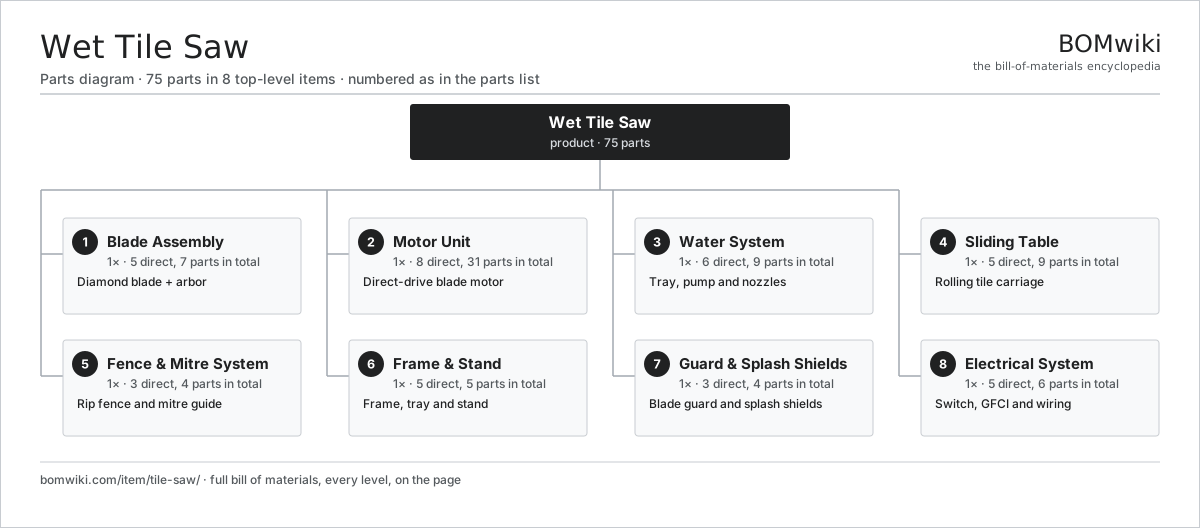
| # | Part | Qty | What it does |
|---|---|---|---|
| 1 | Blade Assembly 5 parts | 1× | Diamond blade + arbor |
| 2 | Motor Unit 8 parts | 1× | Direct-drive blade motor |
| 3 | Water System 6 parts | 1× | Tray, pump and nozzles |
| 4 | Sliding Table 5 parts | 1× | Rolling tile carriage |
| 5 | Fence & Mitre System 3 parts | 1× | Rip fence and mitre guide |
| 6 | Frame & Stand 5 parts | 1× | Frame, tray and stand |
| 7 | Guard & Splash Shields 3 parts | 1× | Blade guard and splash shields |
| 8 | Electrical System 5 parts | 1× | Switch, GFCI and wiring |
3D model
No 3D model yet. Have a CAD file of this? Add a 3D model. STL renders right on this page; STEP, FreeCAD, and OpenSCAD sources are welcome too (openly licensed, like all 3D models on BOMwiki).
Build & assembly graph
expand / collapse · shared sub-assemblies converge · links to related products · est. labourTap an assembly to expand/collapse · tap a part to open it · use “Open page” for any node · drag to pan, scroll to zoom.
Bill of materials for Wet Tile Saw
8 top-level lines · 58 rows shown · 75 parts total · indented to 3 levels| # | Item / sub-assembly | Part no. | Qty/assy | Ext. qty | Parts | Type |
|---|---|---|---|---|---|---|
| 1 | Blade Assembly 5 parts | tile-saw-blade-assembly | 1× | 1 | 7 | assembly |
| 1.1 | Diamond Blade | tile-saw-diamond-blade | 1× | 1 | · | part |
| 1.2 | Arbor Shaft | tile-saw-arbor-shaft | 1× | 1 | · | part |
| 1.3 | Blade Flange | tile-saw-blade-flange | 2× | 2 | · | part |
| 1.4 | Arbor Nut | tile-saw-arbor-nut | 1× | 1 | · | part |
| 1.5 | Ball Bearing | ball-bearing | 2× | 2 | · | part |
| 2 | Motor Unit 8 parts | tile-saw-motor-unit | 1× | 1 | 31 | assembly |
| 2.1 | Stator Assembly 3 parts | stator-assembly | 1× | 1 | 3 | assembly |
| 2.1.1 | Stator Core (laminations) | stator-core | 1× | 1 | · | part |
| 2.1.2 | Copper Winding | copper-winding | 1× | 1 | · | part |
| 2.1.3 | Slot Insulation | stator-insulation | 1× | 1 | · | part |
| 2.2 | Rotor Assembly 4 parts | rotor-assembly | 1× | 1 | 19 | assembly |
| 2.2.1 | Rotor Shaft | rotor-shaft | 1× | 1 | · | part |
| 2.2.2 | Rotor Core | rotor-core | 1× | 1 | · | part |
| 2.2.3 | Neodymium Magnet | neodymium-magnet | 16× | 16 | · | part |
| 2.2.4 | Ball Bearing | ball-bearing | 1× | 1 | · | part |
| 2.3 | Copper Winding | copper-winding | 2× | 2 | · | part |
| 2.4 | Motor Housing | motor-housing | 1× | 1 | · | part |
| 2.5 | Ball Bearing | ball-bearing | 2× | 2 | · | part |
| 2.6 | Oil Seal | oil-seal | 2× | 2 | · | part |
| 2.7 | Motor Fan | tile-saw-motor-fan | 1× | 1 | · | part |
| 2.8 | Thermal Fuse | thermal-fuse | 1× | 1 | · | part |
| 3 | Water System 6 parts | tile-saw-water-system | 1× | 1 | 9 | assembly |
| 3.1 | Water Tray | tile-saw-water-tray | 1× | 1 | · | part |
| 3.2 | Submersible Pump 3 parts | tile-saw-water-pump | 1× | 1 | 3 | assembly |
| 3.2.1 | Pump Impeller | tile-saw-pump-impeller | 1× | 1 | · | part |
| 3.2.2 | Copper Winding | copper-winding | 1× | 1 | · | part |
| 3.2.3 | Pump Body | tile-saw-pump-body | 1× | 1 | · | part |
| 3.3 | Water Hose | tile-saw-water-hose | 1× | 1 | · | part |
| 3.4 | Spray Nozzles | tile-saw-spray-nozzles | 2× | 2 | · | part |
| 3.5 | Drain Plug | tile-saw-drain-plug | 1× | 1 | · | part |
| 3.6 | O-Ring Set | oring-set | 1× | 1 | · | part |
| 4 | Sliding Table 5 parts | tile-saw-sliding-table | 1× | 1 | 9 | assembly |
| 4.1 | Table Top | tile-saw-table-top | 1× | 1 | · | part |
| 4.2 | Table Rails | tile-saw-table-rails | 2× | 2 | · | part |
| 4.3 | Roller Cartridge | tile-saw-roller-cartridge | 4× | 4 | · | part |
| 4.4 | Table Stop | tile-saw-table-stop | 1× | 1 | · | part |
| 4.5 | Rubber Table Mat | tile-saw-rubber-mat | 1× | 1 | · | part |
| 5 | Fence & Mitre System 3 parts | tile-saw-fence-system | 1× | 1 | 4 | assembly |
| 5.1 | Rip Fence | tile-saw-rip-fence | 1× | 1 | · | part |
| 5.2 | Mitre Guide | tile-saw-mitre-guide | 1× | 1 | · | part |
| 5.3 | Fence Clamps | tile-saw-fence-clamps | 2× | 2 | · | part |
| 6 | Frame & Stand 5 parts | tile-saw-frame | 1× | 1 | 5 | assembly |
| 6.1 | Chassis | tile-saw-chassis | 1× | 1 | · | part |
| 6.2 | Motor Bracket | tile-saw-motor-bracket | 1× | 1 | · | part |
| 6.3 | Bevel Pivot | tile-saw-bevel-pivot | 1× | 1 | · | part |
| 6.4 | Stand Legs | tile-saw-stand-legs | 1× | 1 | · | part |
| 6.5 | Fastener Set | fastener-set | 1× | 1 | · | part |
| 7 | Guard & Splash Shields 3 parts | tile-saw-guard | 1× | 1 | 4 | assembly |
| 7.1 | Blade Guard | tile-saw-blade-guard | 1× | 1 | · | part |
| 7.2 | Splash Curtain | tile-saw-splash-curtain | 2× | 2 | · | part |
| 7.3 | Rear Baffle | tile-saw-rear-tray-baffle | 1× | 1 | · | part |
| 8 | Electrical System 5 parts | tile-saw-electrics | 1× | 1 | 6 | assembly |
| 8.1 | GFCI Plug | tile-saw-gfci-plug | 1× | 1 | · | part |
| 8.2 | Sealed Switch | tile-saw-switch | 1× | 1 | · | part |
| 8.3 | Motor Capacitor | tile-saw-capacitor | 1× | 1 | · | part |
| 8.4 | Wire Bundle | wire-bundle | 1× | 1 | · | part |
| 8.5 | Connector | connector | 2× | 2 | · | part |
Something wrong in this list? Report a problem with this BOM.
Related products
same domain, ranked by shared parts


Sourcing: possible vendors
Browse the supplier directory → Prices, MOQ, and lead times are algorithmic estimates, not quotes, and not claims about these companies. Company mappings are curated by keyword; est. price band $30–$800. How estimates work| Vendor | HQ | Specialty | MOQ | Lead time |
|---|---|---|---|---|
| stanleyblackanddecker.com ↗ | New Britain, US | Tools (DeWalt, Craftsman) | 500 units | 6–12 wks |
| bosch-professional.com ↗ | Leinfelden, DE | Power tools | 500 units | 6–12 wks |
| ttigroup.com ↗ | Hong Kong, CN | Tools (Milwaukee, Ryobi) | 500 units | 6–12 wks |
|
🇯🇵Makita
makita.com ↗
|
Anjo, JP | Power tools | 500 units | 6–12 wks |
|
🇨🇭Hilti
hilti.com ↗
|
Schaan, CH | Construction tools | 500 units | 6–12 wks |
746-word article