Tiltrotor UAV
ProductOverview
A tiltrotor UAV combines helicopter and aeroplane in one airframe by rotating its propulsion rather than adding more of it. Two Tilting Rotor Nacelle pods at the wingtips point their rotors upward for takeoff and landing, then swing forward through about 95 degrees so the Wing carries the weight in cruise. The payoff is in the power figures: this 17 kg aircraft burns about 3.5 kW to hover but only 600 W in wing-borne cruise. A multirotor of the same weight would spend its whole flight at the hover number; the tiltrotor spends two minutes there per sortie and cruises for two and a half hours on the same Power System.
The same trade made the V-22 Osprey worth its complexity at 27 tonnes. At UAV scale the mechanism is far simpler, no cross-shafting, no blade pitch links, because an electric motor in each nacelle can be throttled in milliseconds, letting differential thrust do the work that swashplates do on a helicopter.
Nacelles and propulsion
Each nacelle packages a Proprotor, a Brushless Motor and its Electronic Speed Controller on a Tilt Spindle, a hollow titanium shaft that carries thrust and gyroscopic loads into the Wing Spar while motor power and signal wiring pass through its bore, avoiding flexing cables at the pivot. A standard Servo Motor drives the tilt through a geared linkage, with a Hall Sensor closing the angle loop; tilt rate is limited to about 15 degrees per second so the flight controller can track the shifting thrust vector.
The proprotor is the central compromise of the type. Hover wants a large disc and low disc loading; cruise wants a small, fast, coarse-pitch propeller. A fixed-pitch carbon two-blade of intermediate size gives away perhaps 15 per cent of hover efficiency and some cruise speed, which at this scale is cheaper than variable pitch. The Electronic Speed Controller runs field-oriented control through its six-Power MOSFET bridge, giving the smooth low-speed torque needed when the rotors are the only attitude control available.
Hover, transition, cruise
In hover the aircraft is a twin rotor: differential thrust rolls it, differential tilt yaws it, and synchronous tilt nudges it fore and aft. Pitch is the awkward axis, with only two rotors on the same lateral line there is no thrust couple in pitch, so the flight controller biases both nacelles slightly and uses the Ruddervator Surface ruddervators as soon as any airspeed exists.
Transition is a scheduled corridor, not a single moment. The Flight Controller tilts the nacelles forward in steps, holding altitude as lift transfers from rotors to wing across roughly 12 seconds and 0–22 m/s. Throughout, it blends two control allocations, rotor-based and surface-based, weighted by dynamic pressure from the Pressure Sensor airspeed source. The reverse transition is harder: the wing keeps lifting until deep into the deceleration, the rotors re-enter their own wake, and the controller must avoid the region of the corridor where neither rotors nor surfaces have full authority. Loss-of-control statistics for VTOL UAVs cluster in back-transition, which is why the autopilot, not the operator, always flies it.
The autopilot board carries dual Inertial Measurement Unit units sampled at 1 kHz, a GNSS Module good to about 1.5 m, and dual Microcontroller processors split between estimation/control and IO. Attitude comes from an extended Kalman filter fusing all of it.
Airframe
The Wing Spar is a full-span carbon tube, the one structural member that sees everything: lift bending, the cantilevered mass of two nacelles at its tips, and the torque pulse each time a nacelle tilts. Wingtip-mounted nacelles also place motor mass exactly where flutter analysis least wants it, so spar torsional stiffness, not strength, sizes the tube. Moulded Wing Skin sandwich shells and Aileron surfaces complete the wing. The Fuselage is a clamshell Fuselage Shell over a Bulkhead Set, with sprung Landing Skid rails, a tiltrotor lands vertically, so there is no undercarriage beyond them. The Tail Boom pushes the inverted-V tail far enough aft for cruise stability.
Power, link and payload
The Power System is a 12S string of LiPo Cell units (about 1.1 kWh) supervised by a BMS Board, feeding the ESCs through a current-sensing Power Distribution Board. Sizing is dictated by the 4 kW hover peak, not the cruise average, the pack must deliver roughly 8C briefly while spending most of the flight below 1C, an unusual duty cycle that favours high-power cells over maximum energy density.
The Datalink uses a frequency-hopping RF Transceiver at 2.4 GHz with AES-256 encryption and a diversity Antenna pair, holding telemetry and compressed video to about 40 km line of sight. The standard payload is a two-axis Payload Gimbal: an CMOS Image Sensor behind a 10x Lens Assembly, stabilised by Servo Motor axes with Encoder feedback in a Gimbal Frame hung from the vibration-isolated Payload Bay. Typical missions, pipeline patrol, maritime search, artillery spotting, exploit exactly what the configuration offers: launch from a ship deck or forest clearing, then cover 200 km of survey line without a runway at either end.
Tiltrotor UAV parts and their functions
8 top-level parts · 341 parts in total · full bill of materials below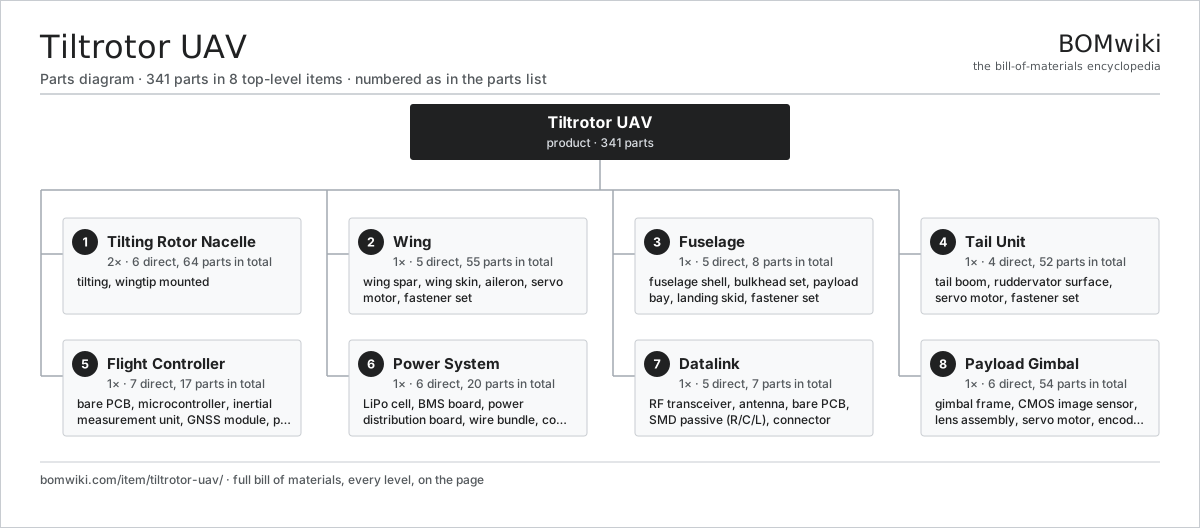
| # | Part | Qty | What it does |
|---|---|---|---|
| 1 | Tilting Rotor Nacelle 6 parts | 2× | tilting, wingtip mounted |
| 2 | Wing 5 parts | 1× | High-aspect-ratio composite wing spanning 3.2 m, carrying the nacelle tilt loads at its tips. |
| 3 | Fuselage 5 parts | 1× | Central pod housing battery, avionics and payload, with landing skids for vertical touchdown. |
| 4 | Tail Unit 4 parts | 1× | Inverted-V tail providing pitch and yaw stability in cruise, when the rotors no longer control attitude. |
| 5 | Flight Controller 7 parts | 1× | Autopilot computer blending rotor, tilt and aerodynamic control through the hover-to-cruise transition. |
| 6 | Power System 6 parts | 1× | 12S lithium battery pack of about 1.1 kWh sized for hover peaks of 4 kW and cruise draw near 600 W. |
| 7 | Datalink 5 parts | 1× | Encrypted bidirectional radio carrying telemetry, command and video to about 40 km line of sight. |
| 8 | Payload Gimbal 6 parts | 1× | Two-axis stabilised camera turret isolating the imager from airframe vibration and motion. |
3D model
No 3D model yet. Have a CAD file of this? Add a 3D model. STL renders right on this page; STEP, FreeCAD, and OpenSCAD sources are welcome too (openly licensed, like all 3D models on BOMwiki).
Build & assembly graph
expand / collapse · shared sub-assemblies converge · links to related products · est. labourTap an assembly to expand/collapse · tap a part to open it · use “Open page” for any node · drag to pan, scroll to zoom.
Bill of materials for Tiltrotor UAV
8 top-level lines · 77 rows shown · 341 parts total · indented to 3 levels| # | Item / sub-assembly | Part no. | Qty/assy | Ext. qty | Parts | Type |
|---|---|---|---|---|---|---|
| 1 | Tilting Rotor Nacelle 6 parts | tiltrotor-uav-nacelle | 2× | 2 | 64 | assembly |
| 1.1 | Proprotor | tiltrotor-uav-proprotor | 1× | 2 | · | part |
| 1.2 | Brushless Motor 4 parts | tiltrotor-uav-brushless-motor | 1× | 2 | 25 | assembly |
| 1.2.1 | Stator Assembly 3 parts + deeper › | stator-assembly | 1× | 2 | 3 | assembly |
| 1.2.2 | Rotor Assembly 4 parts + deeper › | rotor-assembly | 1× | 2 | 19 | assembly |
| 1.2.3 | Ball Bearing | ball-bearing | 2× | 4 | · | part |
| 1.2.4 | Motor Housing | motor-housing | 1× | 2 | · | part |
| 1.3 | Electronic Speed Controller 5 parts | tiltrotor-uav-esc | 1× | 2 | 12 | assembly |
| 1.3.1 | Bare PCB | pcb-bare | 1× | 2 | · | part |
| 1.3.2 | Power MOSFET | mosfet | 6× | 12 | · | part |
| 1.3.3 | Microcontroller | mcu | 1× | 2 | · | part |
| 1.3.4 | SMD Passive (R/C/L) | smd-passives | 1× | 2 | · | part |
| 1.3.5 | Connector | connector | 3× | 6 | · | part |
| 1.4 | Servo Motor 4 parts | servo-motor | 1× | 2 | 24 | assembly |
| 1.4.1 | Stator Assembly 3 parts + deeper › | stator-assembly | 1× | 2 | 3 | assembly |
| 1.4.2 | Rotor Assembly 4 parts + deeper › | rotor-assembly | 1× | 2 | 19 | assembly |
| 1.4.3 | Encoder | encoder | 1× | 2 | · | part |
| 1.4.4 | Motor Housing | motor-housing | 1× | 2 | · | part |
| 1.5 | Tilt Spindle | tiltrotor-uav-tilt-spindle | 1× | 2 | · | part |
| 1.6 | Hall Sensor | hall-sensor | 1× | 2 | · | part |
| 2 | Wing 5 parts | tiltrotor-uav-wing | 1× | 1 | 55 | assembly |
| 2.1 | Wing Spar | tiltrotor-uav-wing-spar | 1× | 1 | · | part |
| 2.2 | Wing Skin | tiltrotor-uav-wing-skin | 2× | 2 | · | part |
| 2.3 | Aileron | tiltrotor-uav-aileron | 2× | 2 | · | part |
| 2.4 | Servo Motor 4 parts | servo-motor | 2× | 2 | 24 | assembly |
| 2.4.1 | Stator Assembly 3 parts + deeper › | stator-assembly | 1× | 2 | 3 | assembly |
| 2.4.2 | Rotor Assembly 4 parts + deeper › | rotor-assembly | 1× | 2 | 19 | assembly |
| 2.4.3 | Encoder | encoder | 1× | 2 | · | part |
| 2.4.4 | Motor Housing | motor-housing | 1× | 2 | · | part |
| 2.5 | Fastener Set | fastener-set | 2× | 2 | · | part |
| 3 | Fuselage 5 parts | tiltrotor-uav-fuselage | 1× | 1 | 8 | assembly |
| 3.1 | Fuselage Shell | tiltrotor-uav-fuselage-shell | 1× | 1 | · | part |
| 3.2 | Bulkhead Set | tiltrotor-uav-bulkhead-set | 1× | 1 | · | part |
| 3.3 | Payload Bay | tiltrotor-uav-payload-bay | 1× | 1 | · | part |
| 3.4 | Landing Skid | tiltrotor-uav-landing-skid | 2× | 2 | · | part |
| 3.5 | Fastener Set | fastener-set | 3× | 3 | · | part |
| 4 | Tail Unit 4 parts | tiltrotor-uav-tail | 1× | 1 | 52 | assembly |
| 4.1 | Tail Boom | tiltrotor-uav-tail-boom | 1× | 1 | · | part |
| 4.2 | Ruddervator Surface | tiltrotor-uav-vee-surface | 2× | 2 | · | part |
| 4.3 | Servo Motor 4 parts | servo-motor | 2× | 2 | 24 | assembly |
| 4.3.1 | Stator Assembly 3 parts + deeper › | stator-assembly | 1× | 2 | 3 | assembly |
| 4.3.2 | Rotor Assembly 4 parts + deeper › | rotor-assembly | 1× | 2 | 19 | assembly |
| 4.3.3 | Encoder | encoder | 1× | 2 | · | part |
| 4.3.4 | Motor Housing | motor-housing | 1× | 2 | · | part |
| 4.4 | Fastener Set | fastener-set | 1× | 1 | · | part |
| 5 | Flight Controller 7 parts | tiltrotor-uav-flight-controller | 1× | 1 | 17 | assembly |
| 5.1 | Bare PCB | pcb-bare | 1× | 1 | · | part |
| 5.2 | Microcontroller | mcu | 2× | 2 | · | part |
| 5.3 | Inertial Measurement Unit | tiltrotor-uav-imu | 2× | 2 | · | part |
| 5.4 | GNSS Module | tiltrotor-uav-gnss-module | 1× | 1 | · | part |
| 5.5 | Pressure Sensor | pressure-sensor | 2× | 2 | · | part |
| 5.6 | SMD Passive (R/C/L) | smd-passives | 1× | 1 | · | part |
| 5.7 | Connector | connector | 8× | 8 | · | part |
| 6 | Power System 6 parts | tiltrotor-uav-power-system | 1× | 1 | 20 | assembly |
| 6.1 | LiPo Cell | lipo-cell | 12× | 12 | · | part |
| 6.2 | BMS Board | bms-board | 1× | 1 | · | part |
| 6.3 | Power Distribution Board | tiltrotor-uav-power-board | 1× | 1 | · | part |
| 6.4 | Wire Bundle | wire-bundle | 1× | 1 | · | part |
| 6.5 | Connector | connector | 4× | 4 | · | part |
| 6.6 | Thermal Fuse | thermal-fuse | 1× | 1 | · | part |
| 7 | Datalink 5 parts | tiltrotor-uav-datalink | 1× | 1 | 7 | assembly |
| 7.1 | RF Transceiver | tiltrotor-uav-rf-transceiver | 1× | 1 | · | part |
| 7.2 | Antenna | tiltrotor-uav-antenna | 2× | 2 | · | part |
| 7.3 | Bare PCB | pcb-bare | 1× | 1 | · | part |
| 7.4 | SMD Passive (R/C/L) | smd-passives | 1× | 1 | · | part |
| 7.5 | Connector | connector | 2× | 2 | · | part |
| 8 | Payload Gimbal 6 parts | tiltrotor-uav-payload-gimbal | 1× | 1 | 54 | assembly |
| 8.1 | Gimbal Frame | tiltrotor-uav-gimbal-frame | 1× | 1 | · | part |
| 8.2 | CMOS Image Sensor | image-sensor | 1× | 1 | · | part |
| 8.3 | Lens Assembly | camera-lens | 1× | 1 | · | part |
| 8.4 | Servo Motor 4 parts | servo-motor | 2× | 2 | 24 | assembly |
| 8.4.1 | Stator Assembly 3 parts + deeper › | stator-assembly | 1× | 2 | 3 | assembly |
| 8.4.2 | Rotor Assembly 4 parts + deeper › | rotor-assembly | 1× | 2 | 19 | assembly |
| 8.4.3 | Encoder | encoder | 1× | 2 | · | part |
| 8.4.4 | Motor Housing | motor-housing | 1× | 2 | · | part |
| 8.5 | Encoder | encoder | 2× | 2 | · | part |
| 8.6 | Bare PCB | pcb-bare | 1× | 1 | · | part |
Something wrong in this list? Report a problem with this BOM.
Related products
same domain, ranked by shared parts Fixed-Wing Survey Drone
382 parts · shares 16 with this page
Fixed-Wing Survey Drone
382 parts · shares 16 with this page
 Fixed-Wing UAV
308 parts · shares 16 with this page
Parcel Delivery Drone
564 parts · shares 15 with this page
Fixed-Wing UAV
308 parts · shares 16 with this page
Parcel Delivery Drone
564 parts · shares 15 with this page
 Cargo Delivery Drone
545 parts · shares 13 with this page
Cargo Delivery Drone
545 parts · shares 13 with this page
 Micro Racing Quadcopter
506 parts · shares 10 with this page
Micro Racing Quadcopter
506 parts · shares 10 with this page
 Quadcopter Drone
244 parts · shares 10 with this page
Quadcopter Drone
244 parts · shares 10 with this page
Sourcing: possible vendors
Browse the supplier directory → Prices, MOQ, and lead times are algorithmic estimates, not quotes, and not claims about these companies. Company mappings are curated by keyword; est. price band $50k–$300M. How estimates work| Vendor | HQ | Specialty | MOQ | Lead time |
|---|---|---|---|---|
|
🇺🇸Boeing
boeing.com ↗
|
Arlington, US | Aerospace OEM | made to order | 40–80 wks |
|
🇫🇷Airbus
airbus.com ↗
|
Toulouse, FR | Aerospace OEM | made to order | 40–80 wks |
| lockheedmartin.com ↗ | Bethesda, US | Aerospace & defense | made to order | 40–80 wks |
|
🇧🇷Embraer
embraer.com ↗
|
São José dos Campos, BR | Aircraft OEM | made to order | 40–80 wks |
| txtav.com ↗ | Wichita, US | Aircraft OEM | made to order | 40–80 wks |
911-word article