Time-Delay Safe
ProductOverview
A time-delay safe is the vault of choice for jewelry stores, casinos, currency exchanges, and banks that must store valuables overnight in locations where burglary risk is high. Unlike a regular safe (which can be opened any time by anyone with the correct combination or key), a time-delay safe enforces a mandatory wait period: even if a burglar obtains the combination or a manager is coerced at gunpoint, the safe's door cannot be opened until the timer counts down to the unlock time. A typical schedule is "locked 6 PM–7 AM weekdays", the safe automatically locks as the manager closes at 6 PM, and it physically cannot be opened until 7 AM the next morning. No amount of explosives, cutting torches, or threats will open it before that time. This forces a burglar to either come back the next morning (and be apprehended) or abandon the attempt.
The time-delay safe's security model rests on two independent locking systems: an electronic timer-driven solenoid lock and a mechanical combination lock. Either mechanism alone is sufficient to secure most valuables; having both provides redundancy and compliance with banking regulations (OCC and FDIC require dual-control mechanisms in high-risk environments).
Electronic Solenoid Locking
The safe's door is secured by two heavy-duty Solenoid Bolt & Firing Mechanisms, each rated 1000+ pounds of holding force. These are fail-safe solenoids: when de-energized, they physically retract and lock the door. When energized (24 VDC supplied), they allow the door to open. The Time-Delay Electronic Controller is a quartz-crystal timer (plus battery backup for power-outage resilience) that controls when the solenoids are energized. A manager or authorized user sets the unlock time via a Keypad: e.g., "Unlock 7 AM Mon–Fri, 9 AM Sat, Locked all Sunday." The timer counts down, and at 7 AM (or 9 AM Saturday), it energizes the relay that supplies 24 VDC to the solenoid coils. The solenoids retract the bolts from their pockets in the door strike. The door is now unlocked. The manager can enter the combination on the Mechanical Combination Lock, which is the second security factor (see below). Only after the combination is correct does the mechanical lock release the door latch, and the door swings open.
If a burglar forces the safe at 3 AM (before the 7 AM unlock time), the solenoid bolts remain locked no matter what. They cannot be bypassed by picking the mechanical lock because the solenoids are independently energized by the timer, not by the combination lock mechanism. If a power outage occurs at 6 PM (just as the manager locks the safe for the night), the Backup Battery (a 12V 7Ah lithium or lead-acid battery) takes over and powers the timer for 8–24 hours. The timer continues to count down. When 7 AM arrives (even if AC power is still out), the timer energizes the solenoid relay from the backup battery, and the safe unlocks normally. So no scenario, burglar attack, power failure, equipment malfunction, can cause the safe to open outside the programmed unlock window.
Mechanical Backup Lock
The Mechanical Combination Lock is a traditional 3–4 wheel dial lock, independent of any electronics. Even if the solenoid mechanism fails catastrophically (or is deliberately disabled by cutting the power lines), the mechanical lock remains engaged. A manager with the correct combination can still open the safe manually (no electronics needed). This serves two functions: it is a true backup that survives electronic failure, and it provides a second layer of security requiring different credentials (combination vs. electronic authorization). Some banks deploy the mechanical lock as a dual-control: one person knows the combination, another person has the electronic access code. Opening the safe requires both people present, enforcing segregation of duties.
The mechanical lock consists of a 3–4 wheel dial mechanism with a non-reproducible keyway (e.g., Medeco or Abloy high-security standard). The combination is difficult to guess (3 wheels × 100 possible positions = 1 million combinations if using a brute-force approach). The dial is sealed against manipulation; looking at the dial position does not reveal the wheels' internal positions. Opening requires correctly rotating each wheel in sequence. The lock is hardened against drilling: the outer dial is cemented or shrink-fitted to the inner mechanism, making a drill go astray if an attacker tries to drill through the combination lock to reach the internal gears.
Physical Burglary Resistance
The Safe Body & Frame is engineered to resist professional burglary tools for 15–30 minutes (TL-15 or TL-30 rating per UL standards). This is not "lock-picking" time; it is the time a trained burglar with specialized tools (diamond-core drill, power saw, plasma cutter, explosives) can breach the safe. A TL-15 safe typically has 1/4 inch welded steel walls, internal baffles (secondary steel plates that slow drilling), hardened components, and a recessed Door & Bolt Work design.
The door (2–3 inches solid steel) is the critical element. It cannot be pried open, the bolt pockets are recessed, preventing a pry-bar from reaching the bolts. The door cannot be drilled, attempts to drill through 3 inches of hardened steel and then through 1–2 inches of baffle plating inside requires hours and specialized diamond-core drills. The hinge pins cannot be driven out, they are 1.5 inch diameter heavy steel, and the hinge design prevents removal without disassembling the door-to-frame connection (which is welded, not bolted). The seam between the door and frame is gasketed with neoprene; attempting to pry at this joint will not work because the gasket distributes pressure across a broad area, and the frame-to-door fit is so tight that no leverage point exists.
Explosives are the last resort, and TL-15/TL-30 safes are designed to survive small charges. The welded seams are stress-relieved (annealed) to prevent cracking under shock. The corners are triangulated with gussets to distribute blast forces. A professional burglar knows that a TL-15 safe takes ~10–15 minutes of continuous high-speed drilling, sawing, or grinding, plus 5 minutes to access the locking mechanism, a total of 20+ minutes. Combined with the time-delay lock (which prevents opening even after the safe is breached), the safe becomes too time-consuming to attack in any practical scenario.
Compliance & Regulatory Context
The Federal Deposit Insurance Corporation (FDIC) and the Office of the Comptroller of the Currency (OCC) require that banks and armored car services use time-delay safes for overnight vault operations. The rule is simple: any location with >$50,000 in daily cash turnover must have a TL-15 or TL-30 safe with a time-delay lock and a backup mechanical lock. The time-delay lock must be set to a schedule that prevents opening outside the teller's working hours; supervisors cannot override it. This regulatory requirement reflects decades of banking history: in the pre-time-delay era, bank managers were sometimes forced (at gunpoint) to open the vault, and safe contents were stolen. Time-delay safes eliminate that vulnerability.
A time-delay safe is also a force multiplier for loss prevention. Insurance companies offer discounts (typically 10–15% on burglary and robbery coverage) if a bank uses a TL-15 safe with time-delay lock. The insurance company's actuaries know that such safes reduce theft risk dramatically.
Installation & Anchoring
A time-delay safe weighs 800–1500 pounds and must be permanently anchored to the floor and wall. The Mounting Lugs (four heavy steel lugs) are drilled to receive ½ inch anchor bolts. These bolts run through the floor concrete or are lag-bolted into floor joists with washers to prevent pull-through. The safe is also anchored to wall studs (typically at the corners) to prevent tilting or rocking if a burglar tries to pry it sideways. Installation requires 4–6 hours and often involves cutting concrete (if the safe is set into a vault room floor) and running electrical conduit for the 120 VAC power supply.
The power supply is critical: a dedicated 20 A circuit (no shared outlet with other equipment) is required. The Time-Delay Electronic Controller is powered by a dual 24 VDC supply: one output supplies the solenoid relay (high-current capability for the 50+ A peak inrush), the other supplies the timer logic (5 W continuous). During an AC power outage, the Backup Battery automatically takes over and powers the timer for 8–24 hours, allowing the scheduled unlock to occur even if the building loses power.
Maintenance & Testing
Monthly: The manager should visually inspect the safe body for signs of tampering (scratches around the door, dents in the metal). The Time-Delay Electronic Controller's display should show the correct current time; if the clock has drifted >2 minutes, it may need a battery replacement.
Quarterly: A test unlock should be performed during business hours. The manager sets the timer to "unlock in 5 minutes," waits, and then attempts to open the safe. The solenoid bolts should retract smoothly, the mechanical lock should operate normally, and the door should swing open. This test verifies that both security mechanisms are functional.
Annually: A full service is recommended. The locksmith inspects the Mechanical Combination Lock for wear or corrosion, lubricates the door hinges and bolt mechanisms with light machine oil, tests the Backup Battery (and replaces it if capacity is <80%), and verifies that the Solenoid Bolt & Firing Mechanisms respond smoothly to electronic commands.
Specialized Variants
Some time-delay safes include a Optional After-Hours Deposit Chute, a narrow chute that allows after-hours deposits without opening the main door. Items inserted through the chute slide into the safe interior, guarded by a Anti Fish Baffle that prevents retrieval. This is especially useful for retail stores that need to accept night-drops from armored car services or customer deposits.
High-capacity safes include Interior Organization & Shelvings, removable steel trays that compartmentalize the interior, allowing organized storage of cash (sorted by denomination), documents, jewelry, or evidence. The shelves are quick-removable (attached via thumb-turn bolts) so that they can be pulled out and restocked without reopening the safe.
History & Adoption
Time-delay safes were invented in the late 19th century as a mechanical-only device (purely mechanical timer, no electronics). The first electric time-delay safes emerged in the 1950s. Modern variants (1990s onward) added microcontroller-based timers with programmable schedules and battery backup. Today, virtually all large financial institutions, casinos, and jewelry stores use electronic time-delay safes. The cost ($5,000–$20,000 depending on size and rating) is trivial compared to the security value and insurance savings.
Time-Delay Safe parts and their functions
8 top-level parts · 135 parts in total · full bill of materials below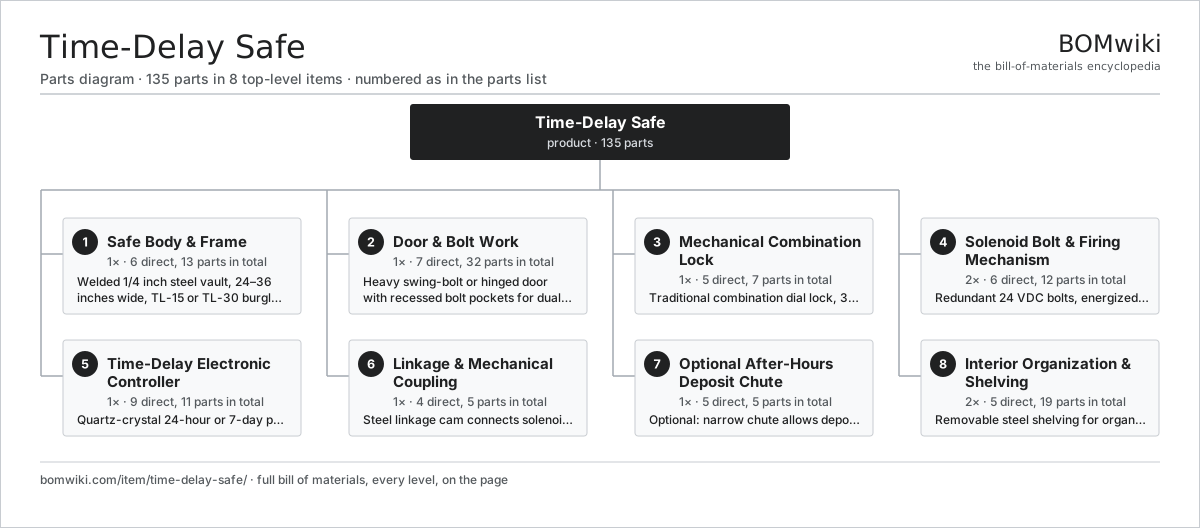
| # | Part | Qty | What it does |
|---|---|---|---|
| 1 | Safe Body & Frame 6 parts | 1× | Welded 1/4 inch steel vault, 24–36 inches wide, TL-15 or TL-30 burglary rating |
| 2 | Door & Bolt Work 7 parts | 1× | Heavy swing-bolt or hinged door with recessed bolt pockets for dual locking mechanisms |
| 3 | Mechanical Combination Lock 5 parts | 1× | Traditional combination dial lock, 3–4 wheel, non-electronic backup |
| 4 | Solenoid Bolt & Firing Mechanism 6 parts | 2× | Redundant 24 VDC bolts, energized to lock, de-energize only when timer permits |
| 5 | Time-Delay Electronic Controller 9 parts | 1× | Quartz-crystal 24-hour or 7-day programmable timer with battery backup |
| 6 | Linkage & Mechanical Coupling 4 parts | 1× | Steel linkage cam connects solenoid bolts to door latch mechanism |
| 7 | Optional After-Hours Deposit Chute 5 parts | 1× | Optional: narrow chute allows deposits after hours without full door opening |
| 8 | Interior Organization & Shelving 5 parts | 2× | Removable steel shelving for organized storage of cash, documents, or valuables |
3D model
No 3D model yet. Have a CAD file of this? Add a 3D model. STL renders right on this page; STEP, FreeCAD, and OpenSCAD sources are welcome too (openly licensed, like all 3D models on BOMwiki).
Build & assembly graph
expand / collapse · shared sub-assemblies converge · links to related products · est. labourTap an assembly to expand/collapse · tap a part to open it · use “Open page” for any node · drag to pan, scroll to zoom.
Bill of materials for Time-Delay Safe
8 top-level lines · 61 rows shown · 135 parts total · indented to 3 levels| # | Item / sub-assembly | Part no. | Qty/assy | Ext. qty | Parts | Type |
|---|---|---|---|---|---|---|
| 1 | Safe Body & Frame 6 parts | time-delay-safe-body | 1× | 1 | 13 | assembly |
| 1.1 | Steel Plate | time-delay-safe-steel-plate | 1× | 1 | · | part |
| 1.2 | Weld Seams | time-delay-safe-weld-seams | 1× | 1 | · | part |
| 1.3 | Corner Gussets | time-delay-safe-corner-gussets | 4× | 4 | · | part |
| 1.4 | Interior Baffle | time-delay-safe-interior-baffle | 2× | 2 | · | part |
| 1.5 | Mounting Lugs | time-delay-safe-mounting-lugs | 4× | 4 | · | part |
| 1.6 | Gasket Seal | time-delay-safe-gasket-seal | 1× | 1 | · | part |
| 2 | Door & Bolt Work 7 parts | time-delay-safe-door | 1× | 1 | 32 | assembly |
| 2.1 | Door Plate | time-delay-safe-door-plate | 1× | 1 | · | part |
| 2.2 | Bolt Holes | time-delay-safe-bolt-holes | 2× | 2 | · | part |
| 2.3 | Solenoid Bolt & Firing Mechanism 6 parts | time-delay-safe-solenoid-bolt | 2× | 2 | 12 | assembly |
| 2.3.1 | Solenoid Coil | time-delay-safe-solenoid-coil | 2× | 4 | · | part |
| 2.3.2 | Bolt Plunger | time-delay-safe-bolt-plunger | 2× | 4 | · | part |
| 2.3.3 | Return Spring | time-delay-safe-return-spring | 2× | 4 | · | part |
| 2.3.4 | Bolt Strike | time-delay-safe-bolt-strike | 2× | 4 | · | part |
| 2.3.5 | Relay Driver | time-delay-safe-relay-driver | 2× | 4 | · | part |
| 2.3.6 | Connector | connector | 2× | 4 | · | part |
| 2.4 | Mechanical Linkage | time-delay-safe-mechanical-linkage | 1× | 1 | · | part |
| 2.5 | Mechanical Lock Pocket | time-delay-safe-mechanical-lock-pocket | 1× | 1 | · | part |
| 2.6 | Door Hinge Pin | time-delay-safe-door-hinge-pin | 2× | 2 | · | part |
| 2.7 | Fastener Set | fastener-set | 1× | 1 | · | part |
| 3 | Mechanical Combination Lock 5 parts | time-delay-safe-mechanical-lock | 1× | 1 | 7 | assembly |
| 3.1 | Dial Wheel | time-delay-safe-dial-wheel | 3× | 3 | · | part |
| 3.2 | Gate Pin | time-delay-safe-gate-pin | 1× | 1 | · | part |
| 3.3 | Lock Housing | time-delay-safe-lock-housing | 1× | 1 | · | part |
| 3.4 | Spindle | time-delay-safe-spindle | 1× | 1 | · | part |
| 3.5 | Fastener Set | fastener-set | 1× | 1 | · | part |
| 4 | Solenoid Bolt & Firing Mechanism 6 parts | time-delay-safe-solenoid-bolt | 2× | 2 | 12 | assembly |
| 4.1 | Solenoid Coil | time-delay-safe-solenoid-coil | 2× | 4 | · | part |
| 4.2 | Bolt Plunger | time-delay-safe-bolt-plunger | 2× | 4 | · | part |
| 4.3 | Return Spring | time-delay-safe-return-spring | 2× | 4 | · | part |
| 4.4 | Bolt Strike | time-delay-safe-bolt-strike | 2× | 4 | · | part |
| 4.5 | Relay Driver | time-delay-safe-relay-driver | 2× | 4 | · | part |
| 4.6 | Connector | connector | 2× | 4 | · | part |
| 5 | Time-Delay Electronic Controller 9 parts | time-delay-safe-electronic-timer | 1× | 1 | 11 | assembly |
| 5.1 | Safe Deposit System Rtc Module | time-delay-safe-safe-deposit-system-rtc-module | 1× | 1 | · | part |
| 5.2 | Microcontroller | mcu | 1× | 1 | · | part |
| 5.3 | Bare PCB | pcb-bare | 1× | 1 | · | part |
| 5.4 | Keypad | time-delay-safe-keypad | 1× | 1 | · | part |
| 5.5 | LCD Panel | lcd-panel | 1× | 1 | · | part |
| 5.6 | Backup Battery | time-delay-safe-backup-battery | 1× | 1 | · | part |
| 5.7 | Battery Charger | time-delay-safe-battery-charger | 1× | 1 | · | part |
| 5.8 | Connector | connector | 3× | 3 | · | part |
| 5.9 | Power Supply | power-supply | 1× | 1 | · | part |
| 6 | Linkage & Mechanical Coupling 4 parts | time-delay-safe-bolt-work | 1× | 1 | 5 | assembly |
| 6.1 | Coupling Shaft | time-delay-safe-coupling-shaft | 1× | 1 | · | part |
| 6.2 | Coupling Collar | time-delay-safe-coupling-collar | 2× | 2 | · | part |
| 6.3 | Return Spring Main | time-delay-safe-return-spring-main | 1× | 1 | · | part |
| 6.4 | Fastener Set | fastener-set | 1× | 1 | · | part |
| 7 | Optional After-Hours Deposit Chute 5 parts | time-delay-safe-drop-slot | 1× | 1 | 5 | assembly |
| 7.1 | Chute Opening | time-delay-safe-chute-opening | 1× | 1 | · | part |
| 7.2 | Chute Tube | time-delay-safe-chute-tube | 1× | 1 | · | part |
| 7.3 | Anti Fish Baffle | time-delay-safe-anti-fish-baffle | 1× | 1 | · | part |
| 7.4 | Coil Spring | coil-spring | 1× | 1 | · | part |
| 7.5 | Fastener Set | fastener-set | 1× | 1 | · | part |
| 8 | Interior Organization & Shelving 5 parts | time-delay-safe-interior-shelf | 2× | 2 | 19 | assembly |
| 8.1 | Shelf Plate | time-delay-safe-shelf-plate | 2× | 4 | · | part |
| 8.2 | Shelf Support Rail | time-delay-safe-shelf-support-rail | 4× | 8 | · | part |
| 8.3 | Shelf Bracket | time-delay-safe-shelf-bracket | 8× | 16 | · | part |
| 8.4 | Divider Panel | time-delay-safe-divider-panel | 4× | 8 | · | part |
| 8.5 | Fastener Set | fastener-set | 1× | 2 | · | part |
Something wrong in this list? Report a problem with this BOM.
Related products
same domain, ranked by shared parts Handheld Label Maker
54 parts · shares 3 with this page
Paper Folding Machine
177 parts · shares 3 with this page
Handheld Label Maker
54 parts · shares 3 with this page
Paper Folding Machine
177 parts · shares 3 with this page
 Electric Stapler
45 parts · shares 3 with this page
Electric Stapler
45 parts · shares 3 with this page
 Night Depository
101 parts · shares 3 with this page
Night Depository
101 parts · shares 3 with this page
 Safe Deposit Box System
5,374 parts · shares 3 with this page
Safe Deposit Box System
5,374 parts · shares 3 with this page
Sourcing: possible vendors
Browse the supplier directory → Prices, MOQ, and lead times are algorithmic estimates, not quotes, and not claims about these companies. Company mappings are curated by keyword; est. price band $50–$15k. How estimates work| Vendor | HQ | Specialty | MOQ | Lead time |
|---|---|---|---|---|
|
🇯🇵Canon
canon.com ↗
|
Tokyo, JP | Imaging & optics | 500 units | 8–12 wks |
|
🇯🇵Ricoh
ricoh.com ↗
|
Tokyo, JP | Office imaging | 500 units | 8–12 wks |
|
🇺🇸Xerox
xerox.com ↗
|
Norwalk, US | Printers & copiers | 500 units | 8–12 wks |
|
🇯🇵Epson
epson.com ↗
|
Suwa, JP | Printers & projectors | 500 units | 8–12 wks |
|
🇯🇵Brother
brother.com ↗
|
Nagoya, JP | Printers & sewing | 500 units | 8–12 wks |
1,822-word article