Timpani
ProductOverview
Timpani (singular timpano; colloquially kettledrums) are the pitched drums of the orchestra: a membrane stretched over a copper kettle, tuned to definite notes and retuned during performance by a foot pedal. A standard orchestral set is four drums of 81, 74, 66, and 58 cm (32, 29, 26, and 23 inches), giving a combined range from about D2 to A3; each drum covers roughly a sixth via its Pedal Mechanism. Modern pedal timpani date from Dresden in the late 19th century, and the two dominant pedal designs are still called Dresden (post-and-clutch) and balanced action (the Ludwig type).
Why a drum has a pitch
An ideal stretched membrane is inharmonic; its mode frequencies do not form a musical series, which is why most drums have no clear note. Timpani get theirs by suppressing the bad modes and aligning the good ones. The player strikes about a quarter of the way in from the rim, which excites the (1,1) mode, the one heard as the principal tone, while putting the stick near a nodal circle of the symmetric (0,1) mode, whose thud decays fast anyway because it pumps air. The kettle's enclosed air mass-loads the remaining modes and shifts them: on a well-designed drum the (1,1), (2,1), and (3,1) modes fall close to the ratios 1 : 1.5 : 2, a harmonic-enough series that the ear assigns a definite pitch. The bowl is thus not a resonator in the loudspeaker sense; it is a tuning device. A Vent Hole equalizes static pressure without disturbing this.
How the tuning works
The Drum Head, a PET film about 0.19 mm thick wrapped on its Flesh Hoop, lies over the polished Bearing Edge of the Copper Bowl Shell. The Counterhoop presses down on the flesh hoop, pulled by six to eight Tension Rods passing through Rod Housing guides. Raising rod tension stretches the head; membrane frequency scales with the square root of tension, so the pedal must change rim load substantially to move the pitch a sixth.
The trick is doing that uniformly. Each rod connects below the bowl to a Spider Arm of the Spider Hub, a central hub driven vertically by the Spider Pull Rod. One pedal stroke therefore pulls every rod by the same amount, and the head stays in tune with itself across its circumference. The player balances residual unevenness rod-by-rod when fitting a head ("clearing" the head), and corrects slow drift with the Master Fine Tuner.
At the Pedal Plate, toe-down raises pitch. In a balanced-action pedal a Coil Spring opposes the head tension so the system rests wherever the foot leaves it; Dresden-style pedals instead lock through a Pedal Clutch ratchet. The Tuning Gauge gives visual reference: a Gauge Pointer driven from the pedal moves along the Gauge Scale, whose note tabs the timpanist sets by ear beforehand, since temperature and humidity shift the calibration. Gauges guide fast changes; final tuning is always by ear, often by silently flicking the head while the orchestra plays.
Construction
Bowls are copper, about 1.5 mm thick, either machine-spun or, on premium Dresden-style instruments, hand-hammered, which work-hardens the metal and slightly alters damping; fiberglass bowls serve schools and marching use. The kettle hangs from the Frame Assembly on Bowl Brackets, ideally touching it at few points so strut vibration does not color the tone. The frame's Frame Struts and Base Ring carry the several-kilonewton head load and roll on locking Wheel Assembly casters; a Height Adjuster sets playing height.
Heads were calfskin until the 1950s and some orchestras still prefer skin for its warmth, accepting its weather sensitivity; mylar holds pitch through humidity swings. Mallets are felt-wrapped with cores from hard wood to soft flannel, chosen per passage. A single 29-inch drum weighs roughly 50 kg, most of it copper and frame steel.
Usage
Timpani entered the orchestra in the 17th century paired with trumpets, tuned tonic and dominant. Beethoven freed them harmonically; Berlioz specified mallets per passage and used as many as sixteen drums. The modern timpanist plays four or five pedal drums, retuning continuously, and rolls single-stroke (alternating hands) rather than the bounce roll of the snare drum, since the resonant head sustains the sound between strokes.
Timpani parts and their functions
7 top-level parts · 83 parts in total · full bill of materials below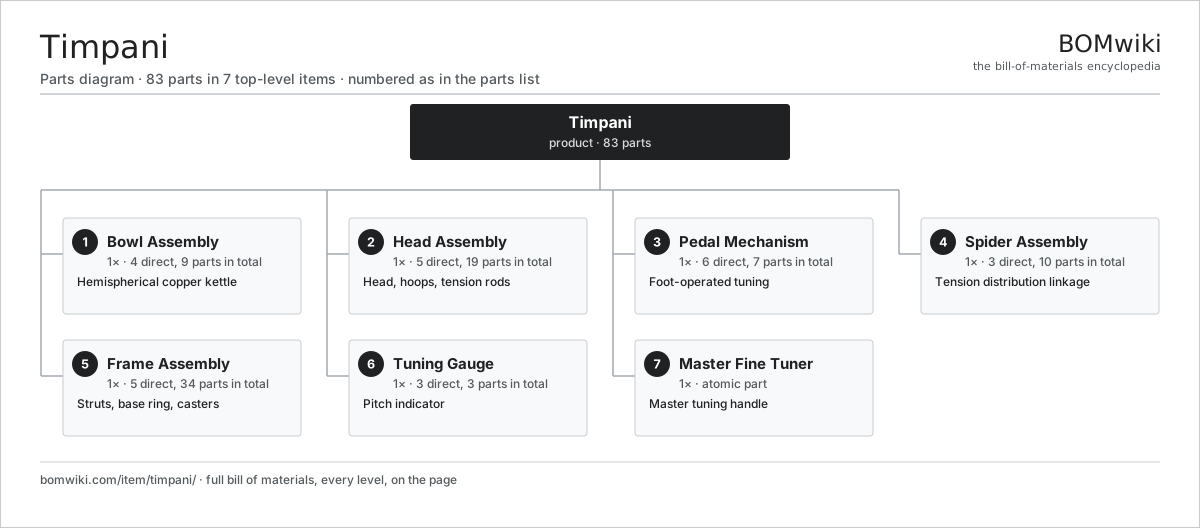
| # | Part | Qty | What it does |
|---|---|---|---|
| 1 | Bowl Assembly 4 parts | 1× | Hemispherical copper kettle |
| 2 | Head Assembly 5 parts | 1× | Head, hoops, tension rods |
| 3 | Pedal Mechanism 6 parts | 1× | Foot-operated tuning |
| 4 | Spider Assembly 3 parts | 1× | Tension distribution linkage |
| 5 | Frame Assembly 5 parts | 1× | Struts, base ring, casters |
| 6 | Tuning Gauge 3 parts | 1× | Pitch indicator |
| 7 | Master Fine Tuner | 1× | Master tuning handle |
3D model
No 3D model yet. Have a CAD file of this? Add a 3D model. STL renders right on this page; STEP, FreeCAD, and OpenSCAD sources are welcome too (openly licensed, like all 3D models on BOMwiki).
Build & assembly graph
expand / collapse · shared sub-assemblies converge · links to related products · est. labourTap an assembly to expand/collapse · tap a part to open it · use “Open page” for any node · drag to pan, scroll to zoom.
Bill of materials for Timpani
7 top-level lines · 38 rows shown · 83 parts total · indented to 3 levels| # | Item / sub-assembly | Part no. | Qty/assy | Ext. qty | Parts | Type |
|---|---|---|---|---|---|---|
| 1 | Bowl Assembly 4 parts | timpani-bowl | 1× | 1 | 9 | assembly |
| 1.1 | Copper Bowl Shell | timpani-bowl-shell | 1× | 1 | · | part |
| 1.2 | Bearing Edge | timpani-bearing-edge | 1× | 1 | · | part |
| 1.3 | Vent Hole | timpani-vent-hole | 1× | 1 | · | part |
| 1.4 | Bowl Bracket | timpani-bowl-bracket | 6× | 6 | · | part |
| 2 | Head Assembly 5 parts | timpani-head-assembly | 1× | 1 | 19 | assembly |
| 2.1 | Drum Head | timpani-head | 1× | 1 | · | part |
| 2.2 | Flesh Hoop | timpani-flesh-hoop | 1× | 1 | · | part |
| 2.3 | Counterhoop | timpani-counterhoop | 1× | 1 | · | part |
| 2.4 | Tension Rod | timpani-tension-rod | 8× | 8 | · | part |
| 2.5 | Rod Housing | timpani-rod-housing | 8× | 8 | · | part |
| 3 | Pedal Mechanism 6 parts | timpani-pedal-mechanism | 1× | 1 | 7 | assembly |
| 3.1 | Pedal Plate | timpani-pedal-plate | 1× | 1 | · | part |
| 3.2 | Pedal Linkage | timpani-pedal-linkage | 1× | 1 | · | part |
| 3.3 | Coil Spring | coil-spring | 1× | 1 | · | part |
| 3.4 | Pedal Clutch | timpani-clutch | 1× | 1 | · | part |
| 3.5 | Ball Bearing | ball-bearing | 2× | 2 | · | part |
| 3.6 | Fastener Set | fastener-set | 1× | 1 | · | part |
| 4 | Spider Assembly 3 parts | timpani-spider-assembly | 1× | 1 | 10 | assembly |
| 4.1 | Spider Hub | timpani-spider | 1× | 1 | · | part |
| 4.2 | Spider Pull Rod | timpani-spider-rod | 1× | 1 | · | part |
| 4.3 | Spider Arm | timpani-spider-arm | 8× | 8 | · | part |
| 5 | Frame Assembly 5 parts | timpani-frame | 1× | 1 | 34 | assembly |
| 5.1 | Frame Strut | timpani-strut | 4× | 4 | · | part |
| 5.2 | Base Ring | timpani-base-ring | 1× | 1 | · | part |
| 5.3 | Wheel Assembly 5 parts | wheel-assembly | 3× | 3 | 9 | assembly |
| 5.3.1 | Alloy Wheel | alloy-wheel | 1× | 3 | · | part |
| 5.3.2 | Tire | tire | 1× | 3 | · | part |
| 5.3.3 | TPMS Sensor | tpms-sensor | 1× | 3 | · | part |
| 5.3.4 | Lug Nut | lug-nut | 5× | 15 | · | part |
| 5.3.5 | Valve Stem | valve-stem | 1× | 3 | · | part |
| 5.4 | Height Adjuster | timpani-height-adjuster | 1× | 1 | · | part |
| 5.5 | Fastener Set | fastener-set | 1× | 1 | · | part |
| 6 | Tuning Gauge 3 parts | timpani-tuning-gauge | 1× | 1 | 3 | assembly |
| 6.1 | Gauge Scale | timpani-gauge-scale | 1× | 1 | · | part |
| 6.2 | Gauge Pointer | timpani-gauge-pointer | 1× | 1 | · | part |
| 6.3 | Gauge Linkage | timpani-gauge-linkage | 1× | 1 | · | part |
| 7 | Master Fine Tuner | timpani-fine-tuner | 1× | 1 | · | part |
Something wrong in this list? Report a problem with this BOM.
Related products
same domain, ranked by shared parts Drum Kit
226 parts · shares 2 with this page
Drum Kit
226 parts · shares 2 with this page
 Electronic Drum Kit
336 parts · shares 2 with this page
Electronic Drum Kit
336 parts · shares 2 with this page
 Glass Armonica
81 parts · shares 1 with this page
Glass Armonica
81 parts · shares 1 with this page
 Bb Trumpet
74 parts · shares 1 with this page
Bb Trumpet
74 parts · shares 1 with this page
 Concert Pedal Harp
554 parts · shares 1 with this page
Concert Pedal Harp
554 parts · shares 1 with this page
 Digital Piano
689 parts · shares 1 with this page
Digital Piano
689 parts · shares 1 with this page
Sourcing: possible vendors
Browse the supplier directory → Prices, MOQ, and lead times are algorithmic estimates, not quotes, and not claims about these companies. Company mappings are curated by keyword; est. price band $50–$5k. How estimates work| Vendor | HQ | Specialty | MOQ | Lead time |
|---|---|---|---|---|
| yamaha.com ↗ | Hamamatsu, JP | Audio & instruments | 200 units | 8–14 wks |
|
🇺🇸Fender
fender.com ↗
|
Los Angeles, US | Guitars & amps | 200 units | 8–14 wks |
|
🇺🇸Gibson
gibson.com ↗
|
Nashville, US | Guitars | 200 units | 8–14 wks |
|
🇯🇵Roland
roland.com ↗
|
Hamamatsu, JP | Electronic instruments | 200 units | 8–14 wks |
| steinway.com ↗ | New York, US | Pianos | 200 units | 8–14 wks |
742-word article