Tire Changer
ProductOverview
A tire changer is a hydraulic and pneumatic machine that automates the labor-intensive process of removing and installing tires on rims. The operator places the rim on the Rotating Turntable, which grips it with spring-loaded jaws. The Bead Breaker Assembly applies downward force to separate the tire sidewall (bead) from the rim edge. Once separated, the Tire Mounting Arm, a powered articulated device, clamps the tire sidewall, lifts it, and rotates around the turntable, rolling the tire bead onto the rim. When complete, the Pneumatic Inflate System inflates the tire to seal the bead.
Professional tire shops mount 50–100 tires per day on each machine. Without a tire changer, the work would be done by hand with pry bars and hammers, taking 5–10 minutes per tire and risking damage to the rim or technician injury. A machine completes the task in under a minute.
Pedestal and turntable
The Pedestal Tower Frame is a heavy steel structure supporting the rotating Rotating Turntable. The Base Frame (300–500 kg) provides a wide, stable footprint. The Vertical Post is a welded tube that rises 1.8–2.2 m and supports the arm mechanism.
The Turntable Plate is a steel or aluminum platform 300–400 mm diameter that grips the rim. The Chuck Jaws (typically three fingers) are operated by a Jaw Actuator, a pneumatic or hydraulic cylinder, to open and close. A rim is centered on the turntable by its center hole; the jaws clamp the inner rim barrel. The Drive Motor rotates the turntable at variable speed (0–50 rpm), allowing slow rotation during tire mounting for precise bead seating.
Bead breaker
Breaking the bead is the first step: the tire must be separated from the rim at the seal interface. The Bead Breaker Assembly is a hydraulic or pneumatic ram that applies 5–10 tons of downward force. A Breaker Foot, a rubber or steel shoe 50–80 mm wide, contacts the tire sidewall just above the bead. The operator positions the shoe and activates the breaker; the foot presses down and inward, rolling the tire bead away from the rim edge.
On modern tires with tight bead seals, this can require 5–10 seconds of sustained pressure. The Pressure Relief relief valve prevents over-pressurization, which could damage the rim or tire sidewall.
Articulated mounting arm
The Tire Mounting Arm is the critical powered element. It is a two-segment arm (upper and lower) joined by a hydraulic hinge, allowing complex motions. The arm starts folded against the vertical post, then extends and rises to position the tire above the rim. Once in place, the arm rotates around the turntable, rolling the tire bead onto the rim.
The Tire Clamp is a powered jaw that grips the tire sidewall (not the tread). The grip must be strong enough to support the tire (30–80 kg) yet gentle enough not to damage the sidewall or leave marks. Pneumatic clamps are faster to respond; hydraulic clamps are stronger and more reliable under heavy loads.
The Bead Roller is a rotating drum (30–50 mm diameter) on the end of the arm that guides and seats the tire bead as the arm rotates around the turntable. The roller contacts the tire at the bead and gradually forces it down and onto the rim edge. The roller surface is hardened steel or rubber; rubber is gentler but wears and requires replacement every 1–2 years.
Pneumatic inflation system
Once the tire is mounted (fully seated onto the rim), the bead must be sealed. The Pneumatic Inflate System uses shop compressed air (90 psi, 6 bar) reduced by a Air Regulator to 1.5–2.0 bar. An Air Bladder (rubber bladder chamber, 0.5–2 L) is pressurized and then bled into the tire via an Air Chuck that contacts the valve stem.
As air flows in, pressure builds inside the tire; once pressure reaches approximately 0.5 bar (5 psi), the bead seal is made and air leakage stops. At this point, a Dump Valve vents the air bladder, and the operator connects a standard tire pump (or the machine's main air supply) to finish inflating to the correct pressure.
The initial sealed inflate is critical: if the bead is not seated and sealed properly before full inflation, the tire will remain unseated and leak.
Hydraulic power system
The Hydraulic Pump Assembly is a 1–2 kW electric motor driving a gear pump that delivers 2–5 L/min. The Hydraulic Reservoir holds 10–20 L of ISO VG 46 oil. A Directional Valve solenoid spool routes oil to the turntable chuck, the bead breaker, and the arm actuators.
The Relief Valve valve is set to 2,000–3,000 psi. Most tire changers operate at the low end of this range (1,500–2,000 psi) for energy efficiency and quieter operation.
Control and operation
The Control Console has pushbuttons for:
- Turntable chuck (open/close)
- Turntable speed (slow or fast)
- Arm up/down (lift and lower)
- Arm rotation (clockwise / counterclockwise)
- Bead breaker (on/off)
- Air inflate (on/off)
A typical dismounting cycle: (1) Place rim on turntable and close chuck. (2) Activate bead breaker. (3) Once separated, move the arm down to contact tire sidewall. (4) Rotate turntable and arm together, using the roller to peel the tire bead away. (5) Once fully off, dump the tire and flip it or place the next rim on the turntable.
A typical mounting cycle: (1) Place rim on turntable and close chuck. (2) Move arm down to grasp tire sidewall with clamp. (3) Lift arm to raise tire above the rim. (4) Slowly rotate arm around turntable while the roller guides the tire bead onto the rim edge. (5) Once fully seated, move arm away and activate air inflate to seal the bead. (6) Once sealed, inflate fully with a secondary pump.
The entire dismount and mount for a tire may take 30–60 seconds on a skilled operator.
Variations and ergonomics
Some tire changers are fully automatic: the operator places the tire and rim, presses start, and the machine completes the entire cycle without intervention. These are more expensive but reduce operator fatigue on high-volume shops (100+ tires/day).
Manual machines require operator control of each step, allowing flexibility for different tire sizes, rim materials (steel vs. alloy), and tire conditions (soft vs. hard sidewalls). Most shops prefer semi-automatic machines that automate the turntable rotation but leave arm positioning and inflation to the operator.
Maintenance and wear
The Bead Roller wears with use, especially if the sidewall contact is hard (summer tires) or if oil contamination causes drag. Roller replacement is a standard maintenance item, costing 50–150 dollars and taking 30 minutes. The hydraulic pump and motor bearings last 10+ years with proper oil changes (every 500 hours or annually).
Tire Changer parts and their functions
9 top-level parts · 53 parts in total · full bill of materials below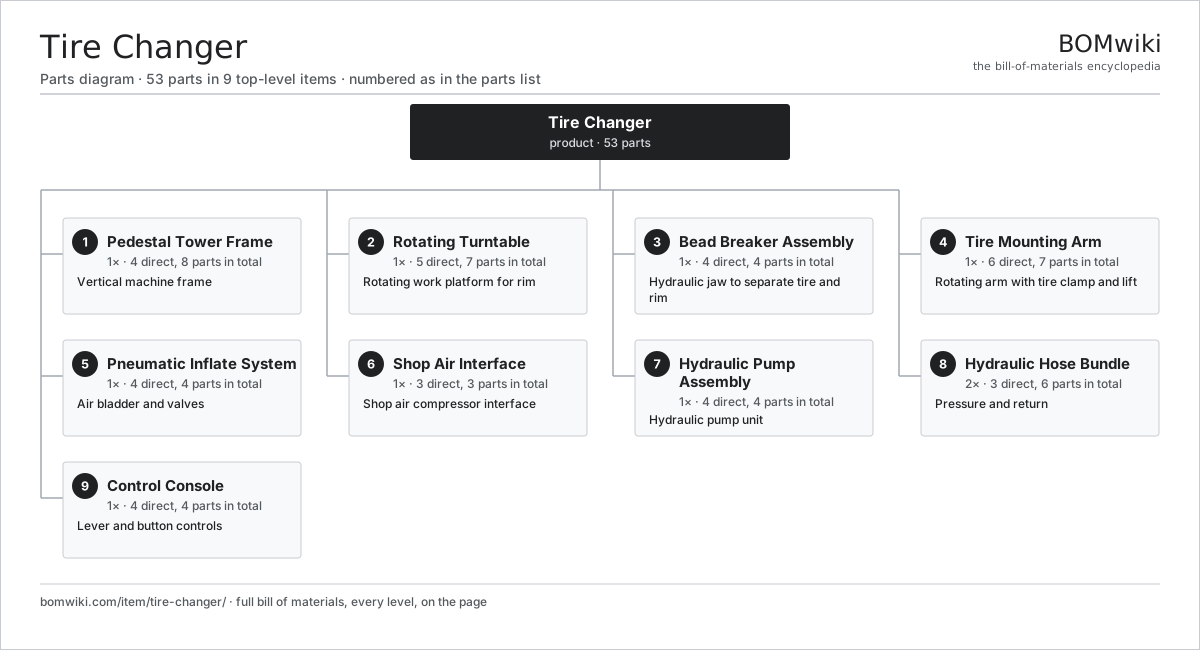
| # | Part | Qty | What it does |
|---|---|---|---|
| 1 | Pedestal Tower Frame 4 parts | 1× | Vertical machine frame |
| 2 | Rotating Turntable 5 parts | 1× | Rotating work platform for rim |
| 3 | Bead Breaker Assembly 4 parts | 1× | Hydraulic jaw to separate tire and rim |
| 4 | Tire Mounting Arm 6 parts | 1× | Rotating arm with tire clamp and lift |
| 5 | Pneumatic Inflate System 4 parts | 1× | Air bladder and valves |
| 6 | Shop Air Interface 3 parts | 1× | Shop air compressor interface |
| 7 | Hydraulic Pump Assembly 4 parts | 1× | Hydraulic pump unit |
| 8 | Hydraulic Hose Bundle 3 parts | 2× | Pressure and return |
| 9 | Control Console 4 parts | 1× | Lever and button controls |
3D model
No 3D model yet. Have a CAD file of this? Add a 3D model. STL renders right on this page; STEP, FreeCAD, and OpenSCAD sources are welcome too (openly licensed, like all 3D models on BOMwiki).
Build & assembly graph
expand / collapse · shared sub-assemblies converge · links to related products · est. labourTap an assembly to expand/collapse · tap a part to open it · use “Open page” for any node · drag to pan, scroll to zoom.
Bill of materials for Tire Changer
9 top-level lines · 46 rows shown · 53 parts total · indented to 3 levels| # | Item / sub-assembly | Part no. | Qty/assy | Ext. qty | Parts | Type |
|---|---|---|---|---|---|---|
| 1 | Pedestal Tower Frame 4 parts | tire-changer-pedestal-tower | 1× | 1 | 8 | assembly |
| 1.1 | Vertical Post | tire-changer-vertical-post | 1× | 1 | · | part |
| 1.2 | Base Frame | tire-changer-base-frame | 1× | 1 | · | part |
| 1.3 | Diagonal Brace | tire-changer-diagonal-brace | 2× | 2 | · | part |
| 1.4 | Leveling Foot | tire-changer-leveling-feet | 4× | 4 | · | part |
| 2 | Rotating Turntable 5 parts | tire-changer-turntable | 1× | 1 | 7 | assembly |
| 2.1 | Turntable Plate | tire-changer-turntable-plate | 1× | 1 | · | part |
| 2.2 | Drive Motor | tire-changer-turntable-motor | 1× | 1 | · | part |
| 2.3 | Turntable Bearing | tire-changer-turntable-bearing | 1× | 1 | · | part |
| 2.4 | Chuck Jaw | tire-changer-chuck-jaw | 3× | 3 | · | part |
| 2.5 | Jaw Actuator | tire-changer-jaw-actuator | 1× | 1 | · | part |
| 3 | Bead Breaker Assembly 4 parts | tire-changer-bead-breaker | 1× | 1 | 4 | assembly |
| 3.1 | Breaker Arm | tire-changer-breaker-arm | 1× | 1 | · | part |
| 3.2 | Breaker Foot | tire-changer-breaker-foot | 1× | 1 | · | part |
| 3.3 | Breaker Cylinder | tire-changer-breaker-cylinder | 1× | 1 | · | part |
| 3.4 | Pressure Relief | tire-changer-breaker-pressure | 1× | 1 | · | part |
| 4 | Tire Mounting Arm 6 parts | tire-changer-mounting-arm | 1× | 1 | 7 | assembly |
| 4.1 | Arm Pivot Shaft | tire-changer-arm-shaft | 1× | 1 | · | part |
| 4.2 | Upper Arm | tire-changer-arm-segment-1 | 1× | 1 | · | part |
| 4.3 | Lower Arm | tire-changer-arm-segment-2 | 1× | 1 | · | part |
| 4.4 | Arm Actuator | tire-changer-arm-actuator | 2× | 2 | · | part |
| 4.5 | Tire Clamp | tire-changer-arm-clamp | 1× | 1 | · | part |
| 4.6 | Bead Roller | tire-changer-arm-roller | 1× | 1 | · | part |
| 5 | Pneumatic Inflate System 4 parts | tire-changer-pneumatic-system | 1× | 1 | 4 | assembly |
| 5.1 | Air Bladder | tire-changer-air-bladder | 1× | 1 | · | part |
| 5.2 | Air Regulator | tire-changer-regulator | 1× | 1 | · | part |
| 5.3 | Air Chuck | tire-changer-inflation-chuck | 1× | 1 | · | part |
| 5.4 | Dump Valve | tire-changer-dump-valve | 1× | 1 | · | part |
| 6 | Shop Air Interface 3 parts | tire-changer-air-system | 1× | 1 | 3 | assembly |
| 6.1 | Air Inlet Port | tire-changer-air-inlet-port | 1× | 1 | · | part |
| 6.2 | Air Filter | tire-changer-air-filter | 1× | 1 | · | part |
| 6.3 | Air Hose | tire-changer-air-hose | 1× | 1 | · | part |
| 7 | Hydraulic Pump Assembly 4 parts | tire-changer-pump-motor | 1× | 1 | 4 | assembly |
| 7.1 | Pump Motor | tire-changer-pump-motor-unit | 1× | 1 | · | part |
| 7.2 | Hydraulic Reservoir | tire-changer-pump-reservoir | 1× | 1 | · | part |
| 7.3 | Relief Valve | tire-changer-pressure-relief | 1× | 1 | · | part |
| 7.4 | Directional Valve | tire-changer-directional-valve | 1× | 1 | · | part |
| 8 | Hydraulic Hose Bundle 3 parts | tire-changer-hose-lines | 2× | 2 | 6 | assembly |
| 8.1 | Pressure Hose | tire-changer-pressure-hose | 1× | 2 | · | part |
| 8.2 | Return Hose | tire-changer-return-hose | 1× | 2 | · | part |
| 8.3 | Quick Coupler | tire-changer-hose-coupler | 4× | 8 | · | part |
| 9 | Control Console 4 parts | tire-changer-control-console | 1× | 1 | 4 | assembly |
| 9.1 | Control Buttons | tire-changer-control-buttons | 1× | 1 | · | part |
| 9.2 | Solenoid Valve Block | tire-changer-control-solenoid-bank | 1× | 1 | · | part |
| 9.3 | Control Logic | tire-changer-control-electronics | 1× | 1 | · | part |
| 9.4 | Emergency Stop | tire-changer-emergency-stop | 1× | 1 | · | part |
Something wrong in this list? Report a problem with this BOM.
Sourcing: possible vendors
Browse the supplier directory → Prices, MOQ, and lead times are algorithmic estimates, not quotes, and not claims about these companies. Company mappings are curated by keyword; est. price band $10–$400. How estimates work| Vendor | HQ | Specialty | MOQ | Lead time |
|---|
1,195-word article