Tire Tread Scanner
ProductOverview
Tire tread depth is the single best predictor of tire safety in wet braking. As tread wears down, grooves that channel away water become shallower, and at ~2 mm (4/32 inch) the tire can no longer evacuate water fast enough, leading to hydroplaning and loss of braking. Different jurisdictions have different legal minimums (typically 2.4 mm or 2/32 inch), but professional shops and fleets often replace tires at 4 mm or even 6 mm for safety margins. Measuring tread is traditionally done with a penny or a simple depth gauge, both of which give a single point measurement. A tire, especially after collision or misalignment, can wear unevenly: the center might be at 4 mm while the shoulders are at 6 mm, or cupping (scalloped wear) might create pockets at 2 mm surrounded by deeper sections. A tire tread scanner captures the full 3D profile of the tread surface in seconds, detecting bald spots, cupping, feathering, and circumferential or lateral imbalance.
The Laser Sensor Array is a row of 5–10 laser triangulation sensors, each projecting a red laser line onto the tire and capturing the reflection. By triangulating between the laser spot position and a camera image of the line, each sensor computes depth at a point on the tire surface. As the Drive Plate and Rollers rotates the tire, the Rotational Encoder pulses, telling the Processor and DSP Unit exactly where on the circumference each laser reading is. In seconds, the processor assembles a full 3D point cloud of the tread surface, then analyzes it to compute:
- Minimum depth (worst wear point)
- Average depth
- Depth profile circumferentially (detecting flat spots or cupping)
- Depth profile laterally (detecting center vs. shoulder wear)
- Wear variance (standard deviation)
The Display and Controls shows a real-time graph of tread depth, highlighting any section below a user-set warning threshold (e.g., 2.4 mm). Results are stored in the Data Storage and Export and can be exported to fleet software or archived for compliance documentation.
Wear patterns and diagnosis
Different wear patterns reveal different problems:
- Center wear (high pressure): Inflation pressure too high. The center of the tread carries more load and wears faster. Correcting pressure extends tire life by 10–15%.
- Shoulder wear (low pressure): Inflation pressure too low. The shoulders flex excessively and wear. Also reduces fuel economy and generates heat.
- Unilateral wear (camber angle): Wheel alignment is off. If the left edge of the tire is wearing much faster than the right, the wheel is tilted inward (negative camber). Alignment corrects this.
- Feathering (sawtooth pattern): Toe-in is wrong, or the tire is scrubbing sideways. Each rib becomes sharper on one side, duller on the other. Toe alignment fixes it.
- Cupping (scalloped pockets): Suspension is worn or bouncing excessively. The tire loses and regains contact with the road rhythmically, causing shallow divots. Shocks or struts need replacement.
- Bald patches or flat-spotted sections: Wheel lockup during braking (ABS failure) or skidding. These tires are unsafe and must be replaced; the condition cannot be fixed by realignment or pressure.
The scanner detects all these patterns. Cupping, for example, shows as a periodic oscillation in the depth profile with a wavelength of 3–4 inches (the resonant bounce frequency of the suspension). Feathering shows as asymmetric rib heights circumferentially. Pressure-related wear shows as a smooth gradient (center deep, shoulders shallow) or the reverse.
Fleet management and predictive maintenance
Commercial fleets use tire scanners for predictive maintenance. By scanning every tire at each service interval (every 50,000 miles or quarterly), the fleet tracks wear rate. A linear projection of wear rate allows the fleet manager to predict when a tire will reach the replacement threshold (e.g., 2.4 mm), scheduling replacement proactively rather than reactively (and avoiding roadside failures). Data is exported to the fleet management system, which cross-correlates tire wear with mileage, fuel economy, and vehicle utilization to identify drivers with aggressive braking, misaligned vehicles, or other issues.
The Data Storage and Export supports cloud synchronization, allowing a technician to scan a tire at one location (e.g., a branch shop) and the data is visible to the fleet office or engineering team elsewhere. Historical data shows wear trends; a sudden spike in wear rate might indicate a collision or mechanical failure that needs investigation.
Safety and interpretation
Tire wear is not the only factor in safety. Tread depth below 2.4 mm (legal minimum) is unsafe in heavy rain, but even new tires (10–12 mm tread) can hydroplane if speed is high enough. Tire age matters too; even un-worn tires older than 6–10 years often have hardened rubber and reduced grip. A tire scanner does not measure age or rubber hardness, so a technician must also visually inspect for cracks, visible cord, and color degradation.
The scanner is also limited to direct contact measurement. It cannot detect internal damage (belt separation, radial cracks inside the tire) which requires X-ray or ultrasonic inspection. However, for routine wear monitoring and fleet compliance, the laser scanner is fast, accurate, and repeatable.
Tire Tread Scanner parts and their functions
7 top-level parts · 95 parts in total · full bill of materials below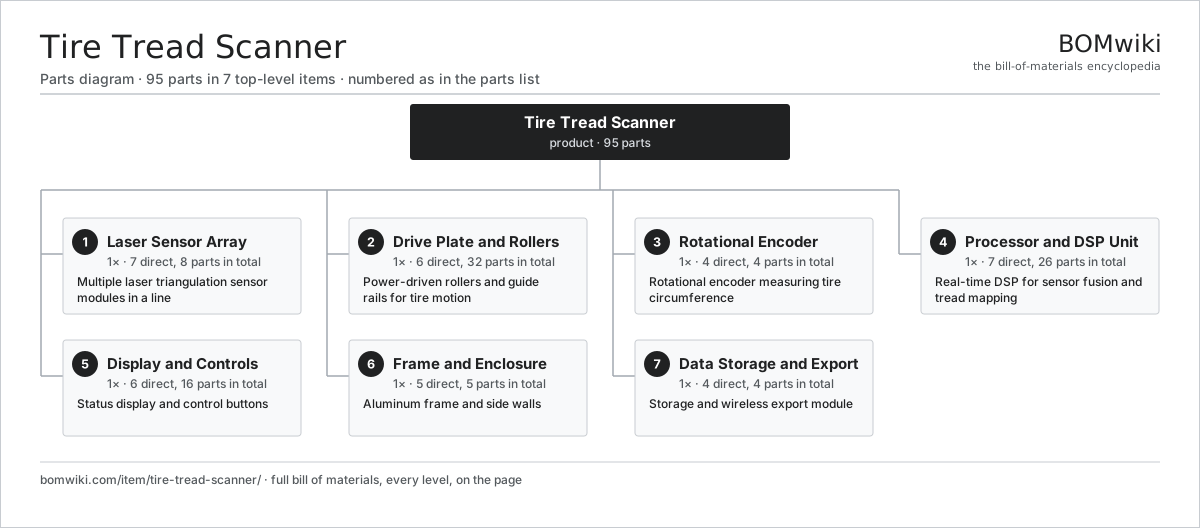
| # | Part | Qty | What it does |
|---|---|---|---|
| 1 | Laser Sensor Array 7 parts | 1× | Multiple laser triangulation sensor modules in a line |
| 2 | Drive Plate and Rollers 6 parts | 1× | Power-driven rollers and guide rails for tire motion |
| 3 | Rotational Encoder 4 parts | 1× | Rotational encoder measuring tire circumference |
| 4 | Processor and DSP Unit 7 parts | 1× | Real-time DSP for sensor fusion and tread mapping |
| 5 | Display and Controls 6 parts | 1× | Status display and control buttons |
| 6 | Frame and Enclosure 5 parts | 1× | Aluminum frame and side walls |
| 7 | Data Storage and Export 4 parts | 1× | Storage and wireless export module |
3D model
No 3D model yet. Have a CAD file of this? Add a 3D model. STL renders right on this page; STEP, FreeCAD, and OpenSCAD sources are welcome too (openly licensed, like all 3D models on BOMwiki).
Build & assembly graph
expand / collapse · shared sub-assemblies converge · links to related products · est. labourTap an assembly to expand/collapse · tap a part to open it · use “Open page” for any node · drag to pan, scroll to zoom.
Bill of materials for Tire Tread Scanner
7 top-level lines · 49 rows shown · 95 parts total · indented to 3 levels| # | Item / sub-assembly | Part no. | Qty/assy | Ext. qty | Parts | Type |
|---|---|---|---|---|---|---|
| 1 | Laser Sensor Array 7 parts | tts-sensor-array | 1× | 1 | 8 | assembly |
| 1.1 | Laser Diode | tts-laser-diode | 1× | 1 | · | part |
| 1.2 | Collimator Lens | tts-collimator-lens | 1× | 1 | · | part |
| 1.3 | Imaging Sensor | tts-imaging-sensor | 1× | 1 | · | part |
| 1.4 | Focusing Lens | tts-focusing-lens | 1× | 1 | · | part |
| 1.5 | Sensor Bracket | tts-sensor-bracket | 1× | 1 | · | part |
| 1.6 | Calibration Target | tts-distance-calibration | 1× | 1 | · | part |
| 1.7 | Ball Bearing | ball-bearing | 2× | 2 | · | part |
| 2 | Drive Plate and Rollers 6 parts | tts-drive-plate | 1× | 1 | 32 | assembly |
| 2.1 | Axis Drive Motor 3 parts | tts-drive-motor | 1× | 1 | 23 | assembly |
| 2.1.1 | Stator Assembly 3 parts + deeper › | stator-assembly | 1× | 1 | 3 | assembly |
| 2.1.2 | Rotor Assembly 4 parts + deeper › | rotor-assembly | 1× | 1 | 19 | assembly |
| 2.1.3 | Motor Housing | motor-housing | 1× | 1 | · | part |
| 2.2 | Drive Belt | tts-drive-belt | 1× | 1 | · | part |
| 2.3 | Roller | tts-drive-roller | 2× | 2 | · | part |
| 2.4 | Speed Controller | tts-speed-control | 1× | 1 | · | part |
| 2.5 | Guide Rails | tts-guide-rails | 1× | 1 | · | part |
| 2.6 | Ball Bearing | ball-bearing | 4× | 4 | · | part |
| 3 | Rotational Encoder 4 parts | tts-encoder-wheel | 1× | 1 | 4 | assembly |
| 3.1 | Encoder Disk | tts-encoder-disk | 1× | 1 | · | part |
| 3.2 | Encoder Sensor | tts-encoder-sensor | 1× | 1 | · | part |
| 3.3 | Encoder Coupling | tts-encoder-coupling | 1× | 1 | · | part |
| 3.4 | Connector | connector | 1× | 1 | · | part |
| 4 | Processor and DSP Unit 7 parts | tts-processor-unit | 1× | 1 | 26 | assembly |
| 4.1 | DSP Processor | tts-dsp-module | 1× | 1 | · | part |
| 4.2 | Camera Interface | tts-camera-interface | 1× | 1 | · | part |
| 4.3 | Encoder Input | tts-encoder-input | 1× | 1 | · | part |
| 4.4 | RAM Buffer | tts-data-buffer | 1× | 1 | · | part |
| 4.5 | SSD Storage | tts-ssd-storage | 1× | 1 | · | part |
| 4.6 | SMD Passive (R/C/L) | smd-passives | 20× | 20 | · | part |
| 4.7 | Thermal Fuse | thermal-fuse | 1× | 1 | · | part |
| 5 | Display and Controls 6 parts | tts-display-panel | 1× | 1 | 16 | assembly |
| 5.1 | Display Screen | tts-display-screen | 1× | 1 | · | part |
| 5.2 | Button Set | tts-button-set | 3× | 3 | · | part |
| 5.3 | Status LEDs | tts-status-indicator | 2× | 2 | · | part |
| 5.4 | Display Driver | tts-display-driver | 1× | 1 | · | part |
| 5.5 | SMD Passive (R/C/L) | smd-passives | 8× | 8 | · | part |
| 5.6 | Connector | connector | 1× | 1 | · | part |
| 6 | Frame and Enclosure 5 parts | tts-guide-frame | 1× | 1 | 5 | assembly |
| 6.1 | Frame Structure | tts-frame-structure | 1× | 1 | · | part |
| 6.2 | Side Panels | tts-side-panels | 1× | 1 | · | part |
| 6.3 | Light Shield | tts-light-shield | 1× | 1 | · | part |
| 6.4 | Safety Curtain | tts-safety-curtain | 1× | 1 | · | part |
| 6.5 | Fastener Set | fastener-set | 1× | 1 | · | part |
| 7 | Data Storage and Export 4 parts | tts-data-storage | 1× | 1 | 4 | assembly |
| 7.1 | Cloud Gateway | tts-cloud-gateway | 1× | 1 | · | part |
| 7.2 | USB Port | tts-usb-port | 1× | 1 | · | part |
| 7.3 | Security Chip | tts-crypto-chip | 1× | 1 | · | part |
| 7.4 | Connector | connector | 1× | 1 | · | part |
Something wrong in this list? Report a problem with this BOM.
Related products
same domain, ranked by shared parts Undercoating Sprayer
59 parts · shares 3 with this page
Undercoating Sprayer
59 parts · shares 3 with this page
 Garage Creeper
127 parts · shares 1 with this page
Garage Creeper
127 parts · shares 1 with this page
 Paint Thickness Gauge
88 parts · shares 3 with this page
Paint Thickness Gauge
88 parts · shares 3 with this page
 ADAS Calibration System
55 parts · shares 3 with this page
ADAS Calibration System
55 parts · shares 3 with this page
 Automotive Paint Booth
59 parts · shares 3 with this page
Automotive Paint Booth
59 parts · shares 3 with this page
Sourcing: possible vendors
Browse the supplier directory → Prices, MOQ, and lead times are algorithmic estimates, not quotes, and not claims about these companies. Company mappings are curated by keyword; est. price band $10–$400. How estimates work| Vendor | HQ | Specialty | MOQ | Lead time |
|---|
847-word article