Tissue Converting Line
ProductOverview
The tissue converting line transforms large parent rolls (1.5–3 m wide) of tissue from the mill into finished retail products: bath tissue, napkins, and kitchen towel rolls. The line automates embossing (for texture and bulk), lamination (bonding multiple plies), cross-cutting (sheet formation), spiral winding (onto a perforated core), folding, and packaging. A modern converting line operates at 100–300 m/min, producing 20–50 tonnes/day of finished product with minimal labor; a single operator monitors the line via HMI and performs changeovers.
The process is continuous and sequential: web travels through embosser (1–5% speed loss), laminator (5–10% loss), log saw (synchronized cuts), rewinder (spiral winding), folder, and finally to a case packer or automatic wrapper. Uptime targets are 85–95%; downtime typically results from cutter blade dulling (requiring 30–60 minute replacement), glue line plugging, or synchronization faults between web speed and cutter.
How It Works
Unwind and Web Preparation
The Unwind Stands hold one or more Spindle shafts, each accepting a 76–152 mm parent roll core. For single-ply products, one spindle feeds tissue; for multi-ply (2–4 ply), parallel spindles feed webs side-by-side. Spindle Bearing elements support the 2–5 tonne roll load; Unwind Brake applies 10–30 kN back-tension via disc friction to prevent web slippage and flutter. A Web Guide pneumatic centering device aligns the web(s) within ±2 mm of centerline before embossing.
Embossing
The Embosser Unit creates surface pattern for improved bulk, softness, and consumer appeal. A Emboss Roller (drive and support rollers, 300–500 mm diameter) carries the Emboss Pattern, custom engraved waffle (3×3 mm square cells), diamond, or leaf motif. The nip between drive and support rolls applies 50–200 kN load via a Emboss Nip pneumatic or spring system. The emboss Emboss Motor (5–15 kW VFD) drives the roller in synchronization with the main web speed; embossing reduces web speed by 1–5% due to nip friction and temporary sheet compression.
For single-ply tissue, embossing occurs immediately after unwind. For multi-ply, each ply may be embossed separately before lamination, or laminated first then embossed (depending on product design).
Lamination
The Laminator Unit bonds multiple plies together with minimal adhesive (5–20 g/m², typically starch or hot-melt synthetic). A Glue Applicator (spray, roller, or curtain coater) distributes adhesive onto one or more plies; the Adhesive System maintains heated reservoir at 60–80°C, supplies adhesive at 10–50 L/h via a metering solenoid. The web(s) then converge into a Laminate Nip Roll, where two Laminate Nip Roll rollers press plies together at 100–400 kN load. Laminate Heater heating elements (electric heaters) maintain 60–80°C at the nip to activate adhesive and improve ply bonding. By the nip exit, adhesive has set; ply separation is negligible in finished product.
For 2-ply: one parent + one ply wound together on the parent. For 3–4 ply: sequential lamination stations or carefully timed multi-ply feed lines.
Cross-Cutting and Sheet Formation
The continuous web exits the laminator and travels to the Log Saw (Cross Cutter). A Cutter Blade (rotary blade, 100–150 mm diameter, tungsten carbide edge, 500–1500 rpm) cuts the web at fixed intervals synchronized with web speed. A Length Sensor (proximity or photoelectric) detects web position and sends a trigger signal to the cutter motor; the blade aligns and cuts at the target position (typically 80–150 mm depending on product and sheet count per pack).
The Cutter Guard encloses the blade for operator safety; an interlocked access door stops rotation if opened. Blade sharpness is critical: dull blades (>100 hours of operation) compress rather than cut, causing edge fuzzing and misfeeds downstream. Blade replacement takes 30–60 minutes and is the most frequent maintenance activity.
Spiral Winding and Tensioning
Cut sheets travel to the Rewinder Unit, where they stack onto a rotating Rewind Core (38–50 mm hollow core). The Rewind Motor (3–10 kW VFD) maintains constant winding speed matched to web speed. A Rewind Tension (light air or spring tension, 1–5 kN) maintains loose stacking without over-compacting the roll. A Rewind Nip (soft elastomer roll) applies gentle pressure for consistent layering.
The sheets spiral onto the core in a single-layer fashion; as the core grows to target diameter (50–80 mm), a sensor triggers ejection. The resulting roll is compact, semi-rigid, and ready for folding or direct packaging.
Folding
The Folder Unit folds wound rolls into either C-fold (single fold) or Z-fold (double fold) configuration. A Fold Guide adjusts fold position (80/20 split for C-fold, 50/50 for Z-fold); Fold Roller (upper and lower) guide the roll into the fold without wrinkling. A Fold Motor (2–5 kW proportional valve) positions the fold mechanism. A Fold Sensor detects fold completion and position feedback for the Converting Line PLC.
Packaging Interface
Folded rolls transfer to the Packaging Interface, which feeds a robotic case packer or automatic wrapper. A Sheet Stacker accumulates rolls into fixed-count bundles (e.g., 12 rolls per pack); a Sheet Counter tracks count via 4/20 mA signal. Once the target count is reached, a Pick Arm (vacuum cups or mechanical gripper) transfers the bundle to the case packer. An Orientation Sensor (barcode or vision) confirms correct roll orientation before packing.
Operational Control
The Control System coordinates all motors and processes. A Converting Line PLC (Siemens S7-1200 or Beckhoff TwinCAT) executes stored recipes: target web speed, emboss pressure, laminate temperature, cut length, fold type, bundle count. A HMI Panel (12 inch touchscreen) displays real-time production counters, alarm status, and trend data. The operator selects a recipe (e.g., "2-Ply Bath 12-pack") and presses "Run"; the PLC ramps motors, activates heaters, and synchronizes cutter. If a fault occurs (blade dull, glue line blocked, temperature sensor drift), the HMI alerts the operator and may stop the line to prevent scrap.
Product Variants
Bath Tissue: Single or 2-ply, 4–12 rolls per pack; soft emboss pattern (waffle or diamond).
Kitchen Towel: 1-ply or 2-ply, heavily embossed for absorbency; 2–6 rolls per pack.
Napkins: Single-ply or 2-ply laminate; typically not wound (direct cut-and-fold from sheets).
Household Rolls: 2–3 ply, large diameter (100+ mm), fewer per pack.
Economics and Throughput
A modern converting line producing 40 t/day of 2-ply bath tissue (typical product) consumes 40–60 kW of electrical power (mainly emboss, laminate heating, and cutter/rewinder motors). Steam consumption is minimal (only laminate heating, 500–1000 kg/h). A single operator monitors the line; conversion labor cost is USD 2–5 per tonne. Blade replacement and adhesive are the primary consumables (USD 3–10 per tonne). Uptime of 90% translates to ~22 t/day actual output from a rated 40 t/day line.
Tissue Converting Line parts and their functions
8 top-level parts · 40 parts in total · full bill of materials below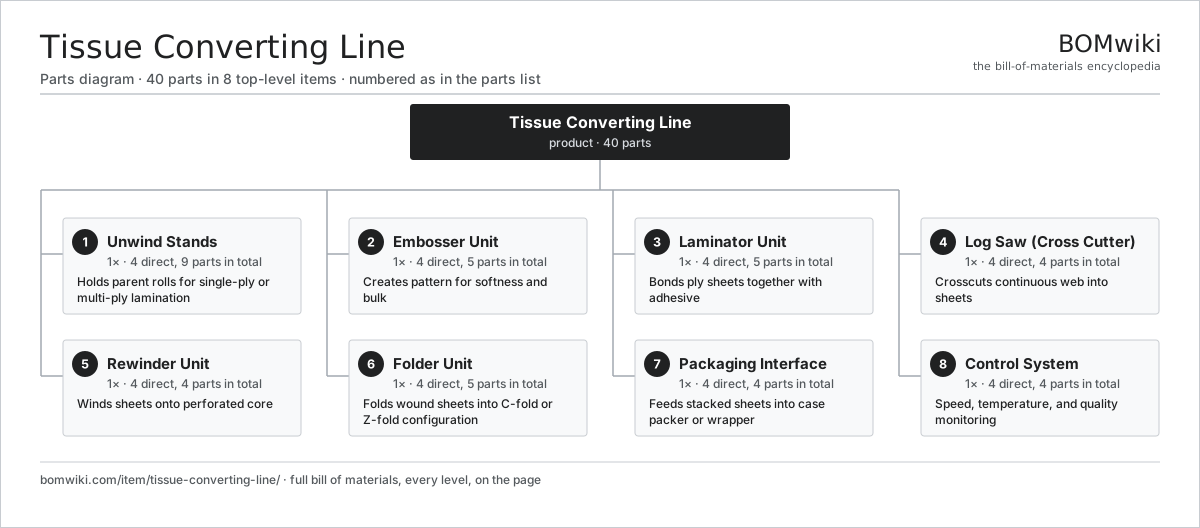
| # | Part | Qty | What it does |
|---|---|---|---|
| 1 | Unwind Stands 4 parts | 1× | Holds parent rolls for single-ply or multi-ply lamination |
| 2 | Embosser Unit 4 parts | 1× | Creates pattern for softness and bulk |
| 3 | Laminator Unit 4 parts | 1× | Bonds ply sheets together with adhesive |
| 4 | Log Saw (Cross Cutter) 4 parts | 1× | Crosscuts continuous web into sheets |
| 5 | Rewinder Unit 4 parts | 1× | Winds sheets onto perforated core |
| 6 | Folder Unit 4 parts | 1× | Folds wound sheets into C-fold or Z-fold configuration |
| 7 | Packaging Interface 4 parts | 1× | Feeds stacked sheets into case packer or wrapper |
| 8 | Control System 4 parts | 1× | Speed, temperature, and quality monitoring |
3D model
No 3D model yet. Have a CAD file of this? Add a 3D model. STL renders right on this page; STEP, FreeCAD, and OpenSCAD sources are welcome too (openly licensed, like all 3D models on BOMwiki).
Build & assembly graph
expand / collapse · shared sub-assemblies converge · links to related products · est. labourTap an assembly to expand/collapse · tap a part to open it · use “Open page” for any node · drag to pan, scroll to zoom.
Bill of materials for Tissue Converting Line
8 top-level lines · 40 rows shown · 40 parts total · indented to 3 levels| # | Item / sub-assembly | Part no. | Qty/assy | Ext. qty | Parts | Type |
|---|---|---|---|---|---|---|
| 1 | Unwind Stands 4 parts | tissue-converting-line-unwind-stands | 1× | 1 | 9 | assembly |
| 1.1 | Spindle | tissue-converting-line-spindle | 2× | 2 | · | part |
| 1.2 | Spindle Bearing | tissue-converting-line-spindle-bearing | 4× | 4 | · | part |
| 1.3 | Unwind Brake | tissue-converting-line-unwind-brake | 2× | 2 | · | part |
| 1.4 | Web Guide | tissue-converting-line-web-guide | 1× | 1 | · | part |
| 2 | Embosser Unit 4 parts | tissue-converting-line-embosser | 1× | 1 | 5 | assembly |
| 2.1 | Emboss Roller | tissue-converting-line-emboss-roller | 2× | 2 | · | part |
| 2.2 | Emboss Pattern | tissue-converting-line-emboss-pattern | 1× | 1 | · | part |
| 2.3 | Emboss Nip | tissue-converting-line-emboss-nip | 1× | 1 | · | part |
| 2.4 | Emboss Motor | tissue-converting-line-emboss-motor | 1× | 1 | · | part |
| 3 | Laminator Unit 4 parts | tissue-converting-line-laminator | 1× | 1 | 5 | assembly |
| 3.1 | Glue Applicator | tissue-converting-line-glue-applicator | 1× | 1 | · | part |
| 3.2 | Adhesive System | tissue-converting-line-glue-system | 1× | 1 | · | part |
| 3.3 | Laminate Nip Roll | tissue-converting-line-laminate-nip | 2× | 2 | · | part |
| 3.4 | Laminate Heater | tissue-converting-line-laminate-temperature | 1× | 1 | · | part |
| 4 | Log Saw (Cross Cutter) 4 parts | tissue-converting-line-log-saw | 1× | 1 | 4 | assembly |
| 4.1 | Cutter Blade | tissue-converting-line-blade-wheel | 1× | 1 | · | part |
| 4.2 | Cutter Guard | tissue-converting-line-blade-guard | 1× | 1 | · | part |
| 4.3 | Cutter Motor | tissue-converting-line-cutter-motor | 1× | 1 | · | part |
| 4.4 | Length Sensor | tissue-converting-line-cut-length-sensor | 1× | 1 | · | part |
| 5 | Rewinder Unit 4 parts | tissue-converting-line-rewinder | 1× | 1 | 4 | assembly |
| 5.1 | Rewind Core | tissue-converting-line-rewind-mandrel | 1× | 1 | · | part |
| 5.2 | Rewind Motor | tissue-converting-line-rewind-motor | 1× | 1 | · | part |
| 5.3 | Rewind Tension | tissue-converting-line-rewind-tension | 1× | 1 | · | part |
| 5.4 | Rewind Nip | tissue-converting-line-rewind-nip | 1× | 1 | · | part |
| 6 | Folder Unit 4 parts | tissue-converting-line-folder | 1× | 1 | 5 | assembly |
| 6.1 | Fold Guide | tissue-converting-line-fold-guide | 1× | 1 | · | part |
| 6.2 | Fold Roller | tissue-converting-line-fold-roller | 2× | 2 | · | part |
| 6.3 | Fold Motor | tissue-converting-line-fold-motor | 1× | 1 | · | part |
| 6.4 | Fold Sensor | tissue-converting-line-fold-sensor | 1× | 1 | · | part |
| 7 | Packaging Interface 4 parts | tissue-converting-line-packaging-interface | 1× | 1 | 4 | assembly |
| 7.1 | Sheet Stacker | tissue-converting-line-sheet-stacker | 1× | 1 | · | part |
| 7.2 | Sheet Counter | tissue-converting-line-sheet-counter | 1× | 1 | · | part |
| 7.3 | Pick Arm | tissue-converting-line-pick-arm | 1× | 1 | · | part |
| 7.4 | Orientation Sensor | tissue-converting-line-orientation-sensor | 1× | 1 | · | part |
| 8 | Control System 4 parts | tissue-converting-line-control-system | 1× | 1 | 4 | assembly |
| 8.1 | Converting Line PLC | tissue-converting-line-plc | 1× | 1 | · | part |
| 8.2 | HMI Panel | tissue-converting-line-hmi | 1× | 1 | · | part |
| 8.3 | Speed Controller | tissue-converting-line-speed-control | 1× | 1 | · | part |
| 8.4 | Sensor Suite | tissue-converting-line-sensor-array | 1× | 1 | · | part |
Something wrong in this list? Report a problem with this BOM.
Sourcing: possible vendors
Browse the supplier directory → Prices, MOQ, and lead times are algorithmic estimates, not quotes, and not claims about these companies. Company mappings are curated by keyword; est. price band $5k–$2M. How estimates work| Vendor | HQ | Specialty | MOQ | Lead time |
|---|---|---|---|---|
| atlascopco.com ↗ | Stockholm, SE | Compressors & industrial | 10 units | 12–20 wks |
|
🇦🇹Andritz
andritz.com ↗
|
Graz, AT | Process plants & machinery | 10 units | 12–20 wks |
| buhlergroup.com ↗ | Uzwil, CH | Food & materials processing | 10 units | 12–20 wks |
| gea.com ↗ | Düsseldorf, DE | Process technology | 10 units | 12–20 wks |
| mhi.com ↗ | Tokyo, JP | Heavy machinery | 10 units | 12–20 wks |
1,255-word article