Tissue Processor
ProductOverview
A tissue processor is an automated laboratory instrument that prepares tissue specimens for histological sectioning by cycling them through multiple chemical baths in a precisely programmed sequence. Tissue must transition from aqueous preservation (fixative), through dehydration (ethanol solutions), clearing (xylene), and finally infiltration with molten paraffin wax before sectioning. Manual processing, hand-transferring baskets of tissue from beaker to beaker, is labor-intensive, inconsistent, and exposes technicians to formaldehyde and xylene vapors. Automated processors eliminate this burden, improving specimen quality and operator safety.
Standard Processing Protocol
A typical overnight 12–16 hour protocol follows this sequence:
Fixation (2–4 hours, room temperature): Tissue remains in 10% buffered formalin. Fixation cross-links proteins, halting autolysis and microbial decay.
Dehydration (70%, 95%, 100% ethanol; 1–2 hours each): Ethanol gradually replaces water, preparing tissue for clearing. Multiple concentrations prevent osmotic shock.
Clearing (xylene, 2–3 hours): Xylene is miscible with both ethanol and paraffin, serving as an intermediate solvent. It also renders tissue optically clear (hence "clearing"), aiding visualization.
Paraffin Infiltration (2–3 hours at 60 °C, multiple stations): Tissue is immersed in molten paraffin wax, which fills cellular and extracellular voids. Multiple paraffin stations (typically 3) ensure complete penetration; the first removes residual xylene, the second and third provide fresh, hot paraffin.
How it works
Specimen Transport: The carousel holds 12–24 specimen baskets in indexed positions. A stepper motor advances the carousel in discrete steps, positioning each basket at a new reagent station. Dwell time at each station is programmable (typically 1–4 minutes per station depending on tissue type and thickness).
Reagent Cycling: At each station, a solenoid drain valve opens, allowing spent reagent from the previous step to drain from the basket into a waste collection line. Fresh reagent from the station's retort pot fills the basket from below (via an internal mesh support in the retort). The cycle then holds the basket at that station for the programmed dwell time.
Vacuum and Pressure: For larger or denser specimens, optional vacuum and pressure cycles enhance reagent penetration. Vacuum removes air bubbles trapped within tissue pores, and positive pressure (2–3 bar) forces reagent more deeply into dense areas. These cycles are triggered by solenoid valves controlled by the programmable timer.
Heating: Paraffin baths (stations 10–12 of a typical 12-station processor) are kept at 56–62 °C using immersion heaters controlled by thermostatic valves or electronic PID loops. Electronic control is preferred for tight ±1 °C stability. Thermometers or PT-100 RTD sensors in each paraffin retort continuously monitor temperature; if temperature drops (e.g., due to ambient cold or excessive dwell time), the heater increases power.
Timer Logic: A relay-based or microcontroller-based timer sequences solenoid valve actuation. A typical protocol specifies:
- Station 1 (formalin): 2 hours, room temperature
- Stations 2–4 (ethanol 70%, 95%, 100%): 45 min each
- Stations 5–6 (xylene): 1 hour, 30 min
- Stations 7–9 (paraffin, 60 °C): 1 hour each, with optional vacuum pulse at start of station 7 and pressure pulse at station 9
After the carousel completes all stations and returns home, specimens are ready for embedding in fresh, warm paraffin.
Specimen Handling
Before processing:
- Trim tissue to <3 × 3 × 2 mm (small, thin pieces penetrate more evenly).
- Place tissue in a specimen basket (stainless mesh or plastic).
- Basket should have ~5 mm clearance inside retort for reagent circulation.
During processing:
- Monitor temperature daily; alert if any paraffin bath drops below 56 °C (reagent crystallization risk).
- Check waste collection; some protocols drain 1–3 L total.
After processing:
- Retrieve warm baskets (paraffin is soft at 60 °C; tissue will be fully infiltrated).
- Transfer tissue immediately to a warm embedding station (heated paraffin mold) or allow to cool partially before handling.
Advantages
- Consistency: Programmable timer ensures every specimen follows identical chemical and thermal protocol.
- Safety: Eliminates hand-transferring of baskets in xylene and formaldehyde fumes.
- Labor: Overnight unattended processing; technician returns to ready-to-embed specimens.
- Throughput: 12–24 specimens per overnight run (vs. hours of manual processing).
- Quality: Uniform infiltration across specimens reduces sectioning artifacts (wrinkles, chattering).
Limitations
- Thick specimens: Processors excel with <3 mm tissue; larger samples may require extended dwell times or additional paraffin stations.
- Delicate tissue: Bone, teeth, or cartilage may require specialized protocols with extended decalcification steps pre-processing.
- Custom reagents: If non-standard solvents are required, processor stations must be drained and refilled manually (some protocols use propylene glycol or other alternatives to xylene in sensitive tissues).
Maintenance
- Daily: Check paraffin bath temperature; note ambient humidity (high humidity can cause paraffin crystallization).
- Weekly: Drain waste tank; filter paraffin baths if debris appears.
- Monthly: Clean basket mesh with brush; replace absorbent spill pads.
- Quarterly: Run processor without specimens; verify all solenoids engage and valves open/close.
- Annual service: Calibrate thermostats; replace timer batteries if relay-based; flush all tubing.
- Reagent stock: Ethanol and xylene should be purchased in concentrations matching processor stations (70%, 95%, 100% ethanol; fresh xylene monthly).
Paraffin Wax Quality
- Histological paraffin: 56–62 °C melting point, minimal water absorption, and high purity minimize bubbles and tissue drift during sectioning.
- Paraffin aging: Old paraffin (>6 months) becomes brittle and may crystallize if cooled slowly; replace at season change.
- Over-temperature: Paraffin above 65 °C induces tissue shrinkage and brittleness; processors maintain precisely <62 °C.
Safety Notes
- Xylene exposure: Known CNS depressant; prolonged skin contact or inhalation in unventilated spaces poses health risks. Automated processing dramatically reduces technician exposure.
- Formaldehyde: Carcinogenic at high concentrations; ensure adequate lab ventilation, especially around collection waste tank.
- Hot surfaces: Paraffin baths are 60 °C; covers should prevent contact burns.
Tissue Processor parts and their functions
6 top-level parts · 44 parts in total · full bill of materials below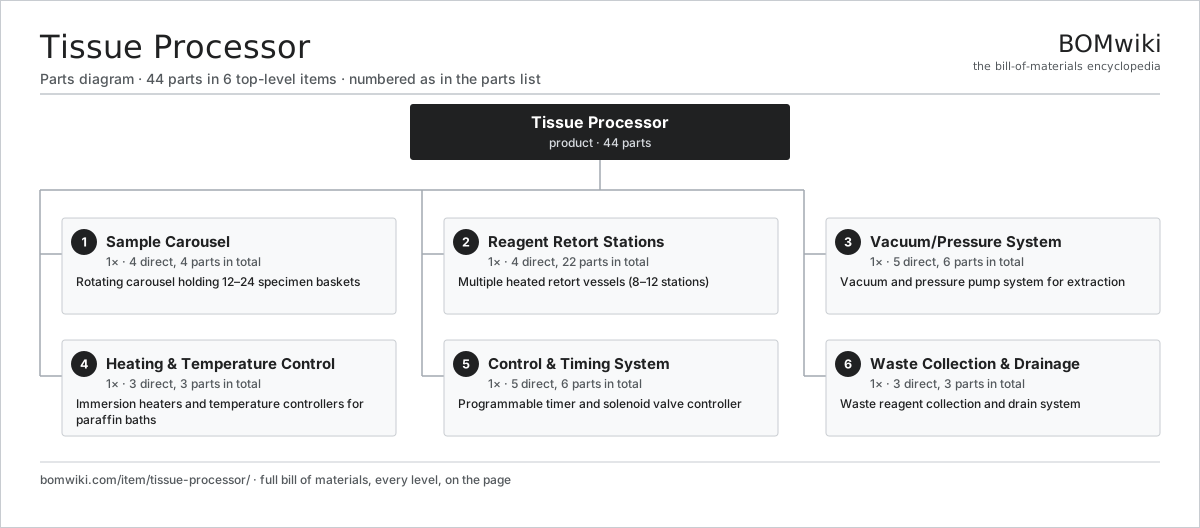
| # | Part | Qty | What it does |
|---|---|---|---|
| 1 | Sample Carousel 4 parts | 1× | Rotating carousel holding 12–24 specimen baskets |
| 2 | Reagent Retort Stations 4 parts | 1× | Multiple heated retort vessels (8–12 stations) |
| 3 | Vacuum/Pressure System 5 parts | 1× | Vacuum and pressure pump system for extraction |
| 4 | Heating & Temperature Control 3 parts | 1× | Immersion heaters and temperature controllers for paraffin baths |
| 5 | Control & Timing System 5 parts | 1× | Programmable timer and solenoid valve controller |
| 6 | Waste Collection & Drainage 3 parts | 1× | Waste reagent collection and drain system |
3D model
No 3D model yet. Have a CAD file of this? Add a 3D model. STL renders right on this page; STEP, FreeCAD, and OpenSCAD sources are welcome too (openly licensed, like all 3D models on BOMwiki).
Build & assembly graph
expand / collapse · shared sub-assemblies converge · links to related products · est. labourTap an assembly to expand/collapse · tap a part to open it · use “Open page” for any node · drag to pan, scroll to zoom.
Bill of materials for Tissue Processor
6 top-level lines · 30 rows shown · 44 parts total · indented to 3 levels| # | Item / sub-assembly | Part no. | Qty/assy | Ext. qty | Parts | Type |
|---|---|---|---|---|---|---|
| 1 | Sample Carousel 4 parts | tissue-processor-carousel | 1× | 1 | 4 | assembly |
| 1.1 | Turntable | tissue-processor-carousel-turntable | 1× | 1 | · | part |
| 1.2 | Motor Housing | motor-housing | 1× | 1 | · | part |
| 1.3 | Specimen Baskets | tissue-processor-basket-set | 1× | 1 | · | part |
| 1.4 | Carousel Bearing | tissue-processor-bearing-support | 1× | 1 | · | part |
| 2 | Reagent Retort Stations 4 parts | tissue-processor-reagent-stations | 1× | 1 | 22 | assembly |
| 2.1 | Retort Vessel | tissue-processor-retort-vessel | 8× | 8 | · | part |
| 2.2 | Immersion Heater | tissue-processor-immersion-heater | 3× | 3 | · | part |
| 2.3 | Station Thermostat | tissue-processor-thermostat | 3× | 3 | · | part |
| 2.4 | Drain Valve | tissue-processor-drain-valve | 8× | 8 | · | part |
| 3 | Vacuum/Pressure System 5 parts | tissue-processor-vacuum-pressure | 1× | 1 | 6 | assembly |
| 3.1 | Vacuum Pump | tissue-processor-vacuum-pump | 1× | 1 | · | part |
| 3.2 | Pressure Pump | tissue-processor-pressure-pump | 1× | 1 | · | part |
| 3.3 | Vacuum Solenoid | tissue-processor-solenoid-vacuum | 1× | 1 | · | part |
| 3.4 | Pressure Solenoid | tissue-processor-solenoid-pressure | 1× | 1 | · | part |
| 3.5 | Check Valve Pair | tissue-processor-check-valves | 2× | 2 | · | part |
| 4 | Heating & Temperature Control 3 parts | tissue-processor-heating-system | 1× | 1 | 3 | assembly |
| 4.1 | Heater Manifold | tissue-processor-heater-manifold | 1× | 1 | · | part |
| 4.2 | Bare PCB | pcb-bare | 1× | 1 | · | part |
| 4.3 | Temperature Sensor | temperature-sensor | 1× | 1 | · | part |
| 5 | Control & Timing System 5 parts | tissue-processor-control-panel | 1× | 1 | 6 | assembly |
| 5.1 | Bare PCB | pcb-bare | 1× | 1 | · | part |
| 5.2 | Microcontroller | mcu | 1× | 1 | · | part |
| 5.3 | Relay Module | tissue-processor-relay-module | 1× | 1 | · | part |
| 5.4 | SMD Passive (R/C/L) | smd-passives | 1× | 1 | · | part |
| 5.5 | Connector | connector | 2× | 2 | · | part |
| 6 | Waste Collection & Drainage 3 parts | tissue-processor-drainage | 1× | 1 | 3 | assembly |
| 6.1 | Waste Tank | tissue-processor-waste-reservoir | 1× | 1 | · | part |
| 6.2 | Drain Tubing | tissue-processor-drain-line | 1× | 1 | · | part |
| 6.3 | Absorbent Pads | tissue-processor-absorbent-pads | 1× | 1 | · | part |
Something wrong in this list? Report a problem with this BOM.
Related products
same domain, ranked by shared parts HPLC System
37 parts · shares 2 with this page
HPLC System
37 parts · shares 2 with this page
 Atomic Absorption Spectrometer
648 parts · shares 1 with this page
Autoclave Sterilizer
282 parts · shares 1 with this page
Dissolution Tester
370 parts · shares 1 with this page
Atomic Absorption Spectrometer
648 parts · shares 1 with this page
Autoclave Sterilizer
282 parts · shares 1 with this page
Dissolution Tester
370 parts · shares 1 with this page
 Flow Cytometer
110 parts · shares 1 with this page
Freeze Dryer
317 parts · shares 1 with this page
Flow Cytometer
110 parts · shares 1 with this page
Freeze Dryer
317 parts · shares 1 with this page
Sourcing: possible vendors
Browse the supplier directory → Prices, MOQ, and lead times are algorithmic estimates, not quotes, and not claims about these companies. Company mappings are curated by keyword; est. price band $1k–$500k. How estimates work| Vendor | HQ | Specialty | MOQ | Lead time |
|---|---|---|---|---|
| thermofisher.com ↗ | Waltham, US | Lab instruments | 100 units | 10–18 wks |
|
🇺🇸Agilent
agilent.com ↗
|
Santa Clara, US | Analytical instruments | 100 units | 10–18 wks |
|
🇺🇸Bruker
bruker.com ↗
|
Billerica, US | Scientific instruments | 100 units | 10–18 wks |
|
🇯🇵Shimadzu
shimadzu.com ↗
|
Kyoto, JP | Analytical instruments | 100 units | 10–18 wks |
|
🇺🇸Waters
waters.com ↗
|
Milford, US | Chromatography & MS | 100 units | 10–18 wks |
939-word article