Torque Limiter
ProductOverview
Torque limiters are mechanical clutches that slip at a preset torque threshold, protecting machinery from shock loads, jamming, and operator error. Unlike rigid couplings, they decouple motor from load when resistance exceeds design limits, allowing the motor to overrun safely while the driven equipment remains stationary or moving at reduced speed.
Industrial torque limiters employ a stack of alternating friction discs clamped by precision springs. As input torque increases, spring compression increases proportionally until it matches friction capacity. Beyond this point, the input hub spins relative to the output hub, dissipating energy through sliding friction. The slip is progressive and smooth, preventing the mechanical shock that would occur with instantaneous jamming.
Applications include conveyor belt drives (jam detection), hopper hoppers (bridging protection), punch press clutches (clutch/brake integration), and submersible pump couplings (sand ingestion protection). Textile machinery and paper mills rely on torque limiters for continuous operation without operator supervision.
Operating principle
The friction disc stack consists of alternating metal backing plates with sintered friction faces (μ = 0.3–0.5). Spring pressure, controlled by mechanical adjustment, pre-compresses the stack to a nominal load. Below this load, friction is sufficient and the input and output hubs rotate together at identical speed (no slip).
When overload torque arrives, a conveyor belt suddenly jams, or a hopper bridge forms, the friction torque capacity is exceeded. Input hub begins sliding relative to output hub, with velocity difference proportional to torque overload. This slip generates heat through friction: continuous overload at 1.5× rated torque raises coupling temperature ~30 °C above ambient.
The bearings support radial and low axial loads; they do not see the slip torque directly. Angular-contact pairs are typical; typical bearing life is >5 years in standard duty.
Adjustment and calibration
Torque setting is achieved by turning an external adjustment nut, compressing the spring stack. Turn-down typically ranges 20–100% of nameplate torque, with 5% repeatability over the range. A calibrated scale on the housing indicates torque setting directly (in N·m or % of rated). A locking pin prevents accidental loosening during operation.
Calibration is validated in the factory: the coupling is rotated under increasing load torque, and slip begins at ±5% of setpoint. Field verification is simple: apply load, measure input and output speed, and confirm slip appears at expected torque.
Friction disc materials and life
Standard friction facing is sintered bronze or resin-bonded material (μ = 0.3–0.5), bonded to steel backing plates. Repeated slip cycles cause gradual facing wear; typical life is 5,000–10,000 slip cycles before friction coefficient drops 10–15% and retorquing is required. In heavy duty (continuous slip), friction discs require replacement every 1–2 years.
Facing material selection depends on duty:
- Sintered bronze: Low wear rate, high cost, suitable for frequent-slip applications (conveyor jams).
- Resin-bonded phenolic: Moderate cost, 2–3× faster wear, typical in punch press and hoist drives.
- Organic composite: Lowest cost, fastest wear, used where duty cycle is light.
Changing discs requires disassembly but no special tools; typically 1–2 hours field labor.
Thermal management
Continuous slip at rated torque generates ~5–10 kW heat per 100 N·m (proportional to slip speed and torque). Small limiters (<10 N·m) dissipate heat through the steel housing, raising local temperature moderately. Large units (>50 N·m) in continuous-slip duty require attention: ambient temperature rise of 20–40 °C is normal, but sustained operation above 80 °C oil temperature (if present in adjacent machinery) may indicate undersizing or excessive slip duty.
In high-speed applications (>3000 RPM), slip losses increase nonlinearly. A 3000 RPM, 50 N·m limiter slipping 200 RPM (6.7% slip) dissipates ~5 kW; sustained operation requires a well-ventilated enclosure or auxiliary cooling.
Load protection and shock mitigation
The key advantage is gradual slip versus instantaneous mechanical failure. A conveyor belt coupling limiter slips for <1 second when a jam is detected, protecting the motor, gearbox, and frame from mechanical shock that would otherwise crack teeth or shatter shafts. Electrical interlocks can detect slip (speed mismatch sensor) and alarm the operator.
Punch press and brake-clutch applications exploit this: the limiter allows smooth engagement (motor ramps to speed while load accelerates), then holds lock (no slip) during stamping, then slips if the punch jams on material. Adjustment is set to 1.1× normal stamping torque, allowing operator intervention before damage.
Noise and vibration
Slipping torque limiters generate noise from friction transients and bearing preload vibration. Typical noise level is 70–80 dB(A) at 1 m under slip conditions. Progressive slip (smooth friction curves) generates less noise than stick-slip; premium designs use multi-groove friction surfaces to dampen vibration.
Maintenance and diagnostics
Sealed bearing compartments with grease packing require minimal maintenance. Annual visual inspection for grease weeping or dust ingress is standard. Friction disc wear is detected by reduced slip torque; if a limiter begins slipping below setpoint, friction discs are suspect.
Fail-safe design: if friction discs wear completely, the limiter over-slips (high slip ratio) and overheats, signaling imminent failure before catastrophic breakdown. In critical applications (mine hoists, offshore cranes), a second independent torque limiter or mechanical brake is specified as backup.
Torque Limiter parts and their functions
7 top-level parts · 32 parts in total · full bill of materials below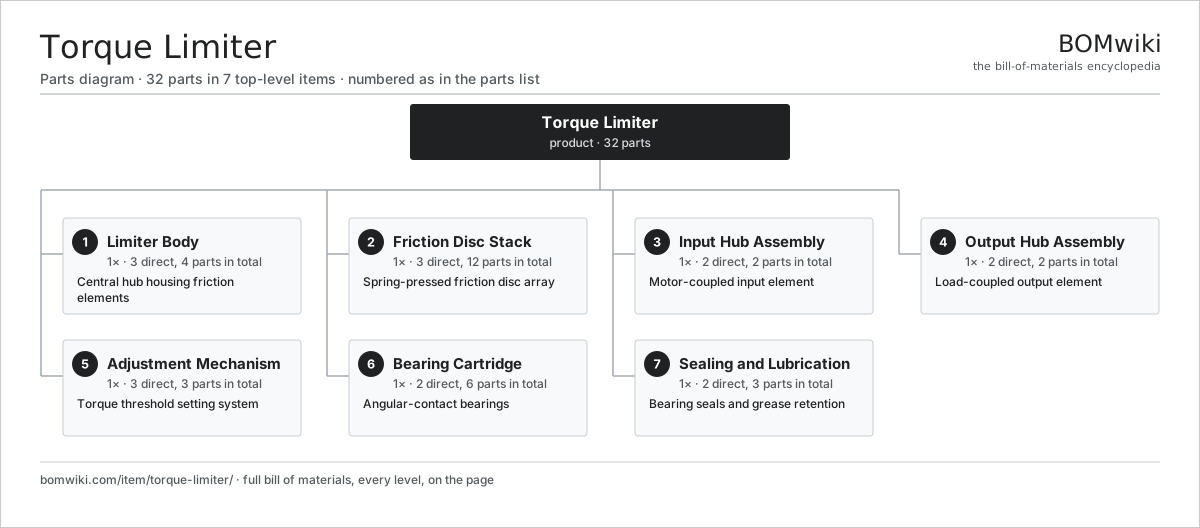
| # | Part | Qty | What it does |
|---|---|---|---|
| 1 | Limiter Body 3 parts | 1× | Central hub housing friction elements |
| 2 | Friction Disc Stack 3 parts | 1× | Spring-pressed friction disc array |
| 3 | Input Hub Assembly 2 parts | 1× | Motor-coupled input element |
| 4 | Output Hub Assembly 2 parts | 1× | Load-coupled output element |
| 5 | Adjustment Mechanism 3 parts | 1× | Torque threshold setting system |
| 6 | Bearing Cartridge 2 parts | 1× | Angular-contact bearings |
| 7 | Sealing and Lubrication 2 parts | 1× | Bearing seals and grease retention |
3D model
No 3D model yet. Have a CAD file of this? Add a 3D model. STL renders right on this page; STEP, FreeCAD, and OpenSCAD sources are welcome too (openly licensed, like all 3D models on BOMwiki).
Build & assembly graph
expand / collapse · shared sub-assemblies converge · links to related products · est. labourTap an assembly to expand/collapse · tap a part to open it · use “Open page” for any node · drag to pan, scroll to zoom.
Bill of materials for Torque Limiter
7 top-level lines · 24 rows shown · 32 parts total · indented to 3 levels| # | Item / sub-assembly | Part no. | Qty/assy | Ext. qty | Parts | Type |
|---|---|---|---|---|---|---|
| 1 | Limiter Body 3 parts | torque-limiter-body | 1× | 1 | 4 | assembly |
| 1.1 | Body Core | torque-limiter-body-core | 1× | 1 | · | part |
| 1.2 | End Cap | torque-limiter-end-caps | 2× | 2 | · | part |
| 1.3 | Fastener Set | fastener-set | 1× | 1 | · | part |
| 2 | Friction Disc Stack 3 parts | torque-limiter-friction-stack | 1× | 1 | 12 | assembly |
| 2.1 | Friction Disc | torque-limiter-friction-disc | 8× | 8 | · | part |
| 2.2 | Compression Spring | torque-limiter-spring-element | 2× | 2 | · | part |
| 2.3 | Wave Washer | torque-limiter-wave-washer | 2× | 2 | · | part |
| 3 | Input Hub Assembly 2 parts | torque-limiter-input-hub | 1× | 1 | 2 | assembly |
| 3.1 | Input Shaft | torque-limiter-input-shaft | 1× | 1 | · | part |
| 3.2 | Hub Key | torque-limiter-hub-key | 1× | 1 | · | part |
| 4 | Output Hub Assembly 2 parts | torque-limiter-output-hub | 1× | 1 | 2 | assembly |
| 4.1 | Output Shaft | torque-limiter-output-shaft | 1× | 1 | · | part |
| 4.2 | Output Coupling | torque-limiter-output-coupling | 1× | 1 | · | part |
| 5 | Adjustment Mechanism 3 parts | torque-limiter-adjustment-mechanism | 1× | 1 | 3 | assembly |
| 5.1 | Adjustment Nut | torque-limiter-adjustment-nut | 1× | 1 | · | part |
| 5.2 | Torque Scale Plate | torque-limiter-adjustment-scale | 1× | 1 | · | part |
| 5.3 | Anti-Rotation Pin | torque-limiter-locking-pin | 1× | 1 | · | part |
| 6 | Bearing Cartridge 2 parts | torque-limiter-bearing-support | 1× | 1 | 6 | assembly |
| 6.1 | Ball Bearing | ball-bearing | 4× | 4 | · | part |
| 6.2 | Bearing Spacer | torque-limiter-bearing-spacer | 2× | 2 | · | part |
| 7 | Sealing and Lubrication 2 parts | torque-limiter-lubrication-seals | 1× | 1 | 3 | assembly |
| 7.1 | Labyrinth Seal | torque-limiter-labyrinth-seal | 2× | 2 | · | part |
| 7.2 | Bearing Grease Cartridge | torque-limiter-bearing-grease | 1× | 1 | · | part |
Something wrong in this list? Report a problem with this BOM.
Related products
same domain, ranked by shared parts All-Electric Injection Molding Machine
851 parts · shares 1 with this page
All-Electric Injection Molding Machine
851 parts · shares 1 with this page
 Ampoule Filling-Sealing Machine
53 parts · shares 1 with this page
AOI Machine
38 parts · shares 1 with this page
Automated Paint Spray Line
2,003 parts · shares 1 with this page
Ampoule Filling-Sealing Machine
53 parts · shares 1 with this page
AOI Machine
38 parts · shares 1 with this page
Automated Paint Spray Line
2,003 parts · shares 1 with this page
Sourcing: possible vendors
Browse the supplier directory → Prices, MOQ, and lead times are algorithmic estimates, not quotes, and not claims about these companies. Company mappings are curated by keyword; est. price band $5k–$2M. How estimates work| Vendor | HQ | Specialty | MOQ | Lead time |
|---|---|---|---|---|
| atlascopco.com ↗ | Stockholm, SE | Compressors & industrial | 10 units | 12–20 wks |
|
🇦🇹Andritz
andritz.com ↗
|
Graz, AT | Process plants & machinery | 10 units | 12–20 wks |
| buhlergroup.com ↗ | Uzwil, CH | Food & materials processing | 10 units | 12–20 wks |
| gea.com ↗ | Düsseldorf, DE | Process technology | 10 units | 12–20 wks |
| mhi.com ↗ | Tokyo, JP | Heavy machinery | 10 units | 12–20 wks |
903-word article