Total Station
ProductOverview
A total station integrates electronic distance measurement (EDM), dual-axis angle encoders, servo-driven rotation axes, and onboard processing into a single surveying instrument. The device combines a 30× telescope with infrared phase-shift rangefinding, allowing surveyors to measure both direction and distance to prism targets or natural features, then compute real-time 3D coordinates without manual calculation. The onboard computer logs data, can drive servo motors to follow targets, and transmits measurements via Bluetooth to a field controller or CAD application.
Total stations are the standard for land survey, construction stakeout, and precision structural monitoring. The evolution from transit theodolites reflects decades of optical and electronic refinement: modern instruments achieve 5-meter range measurement with 3 mm accuracy, automatic-level compensators, and sub-second measurement cycles that allow rapid site documentation and design verification.
How it works
The Optical Train provides the collimated sighting path and encoder feedback. The surveyor or motorized servo aligns the crosshairs on a target Prism Pole with Prism or reflective surface. When the measurement trigger fires, the EDM Rangefinder emits a modulated infrared beam that reflects off the prism; the phase delay between transmitted and received signals is converted to distance by the Range Processor IC. Simultaneously, the Encoder readings capture the telescope's horizontal and vertical angles. The processor receives both measurements, applies calibration offsets (tribrach offset, instrument height), and reports the target's 3D position in the survey coordinate system.
The tribrach base is leveled using three mechanical leveling screws checked against a bubble level. The optical plummet ensures the instrument is positioned directly above the survey point. Once set, the Servo Drive Assembly allow motor-driven horizontal and vertical rotation for continuous target tracking; encoder feedback closes the loop for repeatability.
Power comes from a rechargeable lithium battery pack managed by a BMS Board that monitors cell voltage and temperature. The Multi-Output Regulator supplies regulated 5V, 12V, and 3.3V rails to the telescope illumination, encoders, servos, and processor. Data transfers occur via USB for local downloading or Bluetooth for real-time field control.
Optical path and distance measurement
The objective lens captures light from the target. For distance, the Infrared Emitter transmits a frequency-modulated infrared pulse coaxially with the visible sightline. A retro-reflector prism (three Corner-Cube Prisms) bounces the light directly back. The receiver detects the return signal; the phase difference between modulation sent and received determines round-trip distance using standard electromagnetic propagation equations. Reflectorless (natural-surface) modes use weaker backscatter from distant objects, limiting range to 500 m but enabling measurement on rock, concrete, or utility lines without a prism pole.
The illuminated reticle consists of LED-lit etched marks that the observer aligns with the target. Precise collimation is achieved through mechanical and optical design of the telescope barrel, objective, and focal plane.
Servo automation and positioning
The horizontal and vertical Servo Drive Assembly consist of NEMA 23 stepping motors coupled through harmonic drives that provide 100:1 reduction, minimizing backlash and runout. Servo firmware in the processor accepts angle setpoints (e.g., "rotate to bearing 045° 30′ 15″, zenith 85°") and drives the motors to null the encoder feedback. This closed-loop servo capability is essential for automated aiming in high-precision applications like structure deformation monitoring or power-line clearance surveys.
Data logging and field workflow
Survey measurements are stored to a microSD card via the card slot, recording timestamp, distance, horizontal angle, vertical angle, and prism height. Simultaneously, the Bluetooth radio streams real-time data to a field tablet running survey software (e.g., Leica Captivate, Trimble Access, or open-source Rtklib clients). Field software computes and displays 3D coordinates relative to a project coordinate system, allows definition of calibration points, and can stakeout (guide the surveyor to) design points by showing distance and angle to target.
Practical considerations
Measurement accuracy degrades with distance, atmospheric turbidity, and prism alignment. Reflectorless modes are inherently noisier than prism-based measurements. The servo drives are slow (0.7 s per measurement) compared to manual theodolites, but enable unattended data collection and allow integration with construction equipment (GPS-free machine guidance). Battery life is typically 6–8 hours of continuous use; field teams carry spare packs and charging stations at base camp. Instrument setup (leveling, compass calibration if magnetic bearing is needed) takes 5–10 minutes per setup point.
Total Station parts and their functions
8 top-level parts · 86 parts in total · full bill of materials below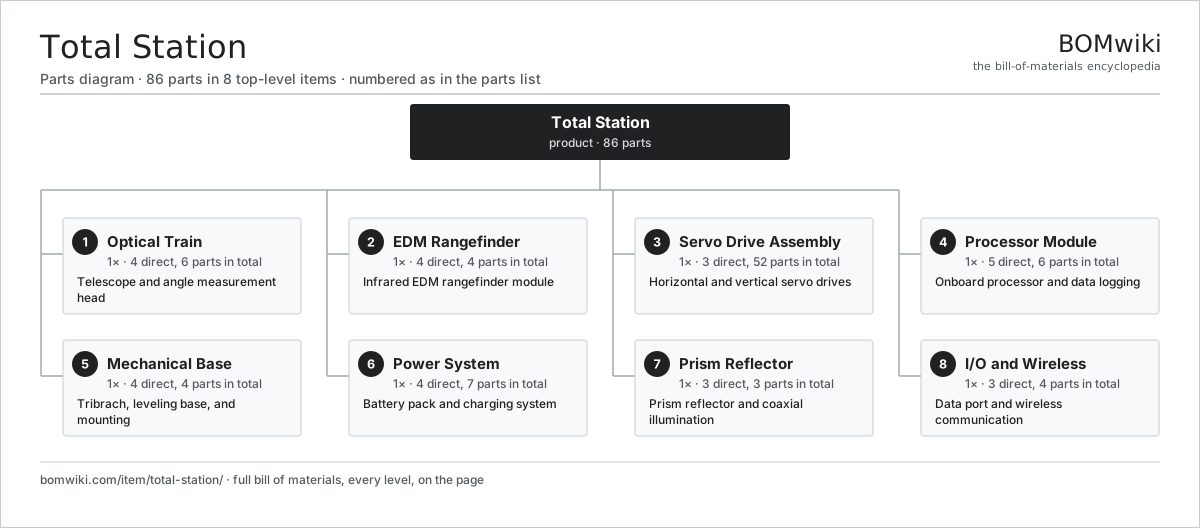
| # | Part | Qty | What it does |
|---|---|---|---|
| 1 | Optical Train 4 parts | 1× | Telescope and angle measurement head |
| 2 | EDM Rangefinder 4 parts | 1× | Infrared EDM rangefinder module |
| 3 | Servo Drive Assembly 3 parts | 1× | Horizontal and vertical servo drives |
| 4 | Processor Module 5 parts | 1× | Onboard processor and data logging |
| 5 | Mechanical Base 4 parts | 1× | Tribrach, leveling base, and mounting |
| 6 | Power System 4 parts | 1× | Battery pack and charging system |
| 7 | Prism Reflector 3 parts | 1× | Prism reflector and coaxial illumination |
| 8 | I/O and Wireless 3 parts | 1× | Data port and wireless communication |
3D model
No 3D model yet. Have a CAD file of this? Add a 3D model. STL renders right on this page; STEP, FreeCAD, and OpenSCAD sources are welcome too (openly licensed, like all 3D models on BOMwiki).
Build & assembly graph
expand / collapse · shared sub-assemblies converge · links to related products · est. labourTap an assembly to expand/collapse · tap a part to open it · use “Open page” for any node · drag to pan, scroll to zoom.
Bill of materials for Total Station
8 top-level lines · 42 rows shown · 86 parts total · indented to 3 levels| # | Item / sub-assembly | Part no. | Qty/assy | Ext. qty | Parts | Type |
|---|---|---|---|---|---|---|
| 1 | Optical Train 4 parts | total-station-optical-train | 1× | 1 | 6 | assembly |
| 1.1 | Lens Assembly | camera-lens | 1× | 1 | · | part |
| 1.2 | Reticle Illuminator | total-station-reticle | 1× | 1 | · | part |
| 1.3 | Encoder | encoder | 2× | 2 | · | part |
| 1.4 | Coil Spring | coil-spring | 2× | 2 | · | part |
| 2 | EDM Rangefinder 4 parts | total-station-distance-meter | 1× | 1 | 4 | assembly |
| 2.1 | Infrared Emitter | total-station-ir-led | 1× | 1 | · | part |
| 2.2 | Photodiode Receiver | total-station-photodiode | 1× | 1 | · | part |
| 2.3 | Range Processor IC | total-station-range-processor | 1× | 1 | · | part |
| 2.4 | SMD Passive (R/C/L) | smd-passives | 1× | 1 | · | part |
| 3 | Servo Drive Assembly 3 parts | total-station-servos | 1× | 1 | 52 | assembly |
| 3.1 | Servo Motor 4 parts | servo-motor | 2× | 2 | 24 | assembly |
| 3.1.1 | Stator Assembly 3 parts + deeper › | stator-assembly | 1× | 2 | 3 | assembly |
| 3.1.2 | Rotor Assembly 4 parts + deeper › | rotor-assembly | 1× | 2 | 19 | assembly |
| 3.1.3 | Encoder | encoder | 1× | 2 | · | part |
| 3.1.4 | Motor Housing | motor-housing | 1× | 2 | · | part |
| 3.2 | Harmonic Drive Gearbox | total-station-harmonic-drive | 2× | 2 | · | part |
| 3.3 | Hall Sensor | hall-sensor | 2× | 2 | · | part |
| 4 | Processor Module 5 parts | total-station-electronics | 1× | 1 | 6 | assembly |
| 4.1 | Microcontroller | mcu | 1× | 1 | · | part |
| 4.2 | Bare PCB | pcb-bare | 1× | 1 | · | part |
| 4.3 | SMD Passive (R/C/L) | smd-passives | 2× | 2 | · | part |
| 4.4 | MicroSD Slot | total-station-sd-socket | 1× | 1 | · | part |
| 4.5 | Relay | relay | 1× | 1 | · | part |
| 5 | Mechanical Base 4 parts | total-station-mechanical | 1× | 1 | 4 | assembly |
| 5.1 | Tribrach Casting | total-station-tribrach | 1× | 1 | · | part |
| 5.2 | Leveling Adjusters | total-station-level-screws | 1× | 1 | · | part |
| 5.3 | Instrument Plates | total-station-baseplates | 1× | 1 | · | part |
| 5.4 | Fastener Set | fastener-set | 1× | 1 | · | part |
| 6 | Power System 4 parts | total-station-power | 1× | 1 | 7 | assembly |
| 6.1 | Li-ion Cell, 18650 | li-cell-18650 | 4× | 4 | · | part |
| 6.2 | BMS Board | bms-board | 1× | 1 | · | part |
| 6.3 | Multi-Output Regulator | total-station-buck-converter | 1× | 1 | · | part |
| 6.4 | Thermal Fuse | thermal-fuse | 1× | 1 | · | part |
| 7 | Prism Reflector 3 parts | total-station-optics | 1× | 1 | 3 | assembly |
| 7.1 | Corner-Cube Prisms | total-station-corner-cubes | 1× | 1 | · | part |
| 7.2 | Prism Mount | total-station-prism-holder | 1× | 1 | · | part |
| 7.3 | Fastener Set | fastener-set | 1× | 1 | · | part |
| 8 | I/O and Wireless 3 parts | total-station-interface | 1× | 1 | 4 | assembly |
| 8.1 | Connector | connector | 2× | 2 | · | part |
| 8.2 | Bluetooth Module | total-station-ble-module | 1× | 1 | · | part |
| 8.3 | SMD Passive (R/C/L) | smd-passives | 1× | 1 | · | part |
Something wrong in this list? Report a problem with this BOM.
Used in 1 assembly
Related products
same domain, ranked by shared parts Laboratory Centrifuge
278 parts · shares 11 with this page
Superconductor Materials Lab
1,846 parts · shares 15 with this page
Laboratory Centrifuge
278 parts · shares 11 with this page
Superconductor Materials Lab
1,846 parts · shares 15 with this page
 Flow Cytometer
110 parts · shares 12 with this page
Flow Cytometer
110 parts · shares 12 with this page
 Rockwell Hardness Tester
97 parts · shares 12 with this page
Pipe Laser
23 parts · shares 3 with this page
Rockwell Hardness Tester
97 parts · shares 12 with this page
Pipe Laser
23 parts · shares 3 with this page
 GNSS RTK Rover
35 parts · shares 3 with this page
GNSS RTK Rover
35 parts · shares 3 with this page
Sourcing: possible vendors
Browse the supplier directory → Prices, MOQ, and lead times are algorithmic estimates, not quotes, and not claims about these companies. Company mappings are curated by keyword; est. price band $1k–$500k. How estimates work| Vendor | HQ | Specialty | MOQ | Lead time |
|---|---|---|---|---|
| thermofisher.com ↗ | Waltham, US | Lab instruments | 100 units | 10–18 wks |
|
🇺🇸Agilent
agilent.com ↗
|
Santa Clara, US | Analytical instruments | 100 units | 10–18 wks |
|
🇺🇸Bruker
bruker.com ↗
|
Billerica, US | Scientific instruments | 100 units | 10–18 wks |
|
🇯🇵Shimadzu
shimadzu.com ↗
|
Kyoto, JP | Analytical instruments | 100 units | 10–18 wks |
|
🇺🇸Waters
waters.com ↗
|
Milford, US | Chromatography & MS | 100 units | 10–18 wks |
773-word article