Dynamic Track Stabilizer
ProductOverview
Track stabilizers (or track stiffness improvement machines) are vibratory compactors that apply progressive dynamic force to ballast and subgrade, significantly increasing soil stiffness compared to static rolling or tamping alone. Unlike ballast tamping machines (which impact locally under sleepers), stabilizers use whole-body roller vibration across the full track width, achieving deeper and more uniform compaction (up to 1 m depth in subgrade).
Stabilization is critical for:
- Newly laid or renewed track: Ballast and subgrade settle significantly in first 6–12 months; stabilization accelerates this process, reducing in-service geometry degradation.
- High-speed lines: Modern HSR (>250 km/h) requires track stiffness modulus >60 MN/m²; stabilization achieves this specification, preventing speed-related geometry drift.
- Heavy-haul freight lines: Dynamic loading from 30-ton+ axles compacts subgrade progressively; stabilization pre-compacts to reduce ongoing settlement.
Modern stabilizers employ variable-frequency vibration (10–40 Hz), allowing frequency sweep optimization: starting at low frequency (10 Hz) for coarse ballast mobilization, transitioning to high frequency (30–40 Hz) for fine-particle settling and density maximization.
Track Geometry Instability & Stabilization Need
Geometry Degradation Mechanisms
New track (post-tamping, pre-stabilization) exhibits:
- Ballast void ratio: 0.70–0.75 (typical post-tamping).
- Subgrade stiffness: 20–30 MN/m² (uncompacted fill or weathered soil).
- Track geometry tolerance: ±20 mm vertical (acceptable for <120 km/h operation).
After 6 months of service (10M–20M train passages):
- Ballast settlement: 20–50 mm (sleepers sink into slightly-yielding ballast bed).
- Subgrade settlement: 30–80 mm (soft fill compacts under repeated wheel load).
- Total subsidence: 50–130 mm, exceeding geometry tolerance (±10 mm for >200 km/h).
- Curvature drift: Differential settlement across track width (one rail subsidizes more than other) creates super-elevation (banking) errors.
This geometry drift requires repeated geometry correction (speed restrictions, frequent tamping), increasing maintenance cost and reducing revenue service.
Preventive Stabilization
Pre-service stabilization (before opening track to revenue traffic):
- Accelerates settlement: Progressive vibratory compaction induces 50–100 mm settlement over 2–4 hours (consolidating voids that would otherwise settle slowly over 6 months).
- Increases stiffness: Stiffness modulus improves from ~25 MN/m² (post-tamping) to 50–70 MN/m² (stabilized), matching design specifications.
- Locks geometry: Once stabilized, track remains stable in-service, requiring less frequent geometry correction (every 5–10 years instead of annually).
Result: New track opening with high initial geometry quality, reduced early-life geometry maintenance, and extended intervals between major tamping work.
Vibratory Compaction Theory
Resonance & Material Response
Soil and ballast have a natural resonant frequency (typically 10–15 Hz for ballast over subgrade). When vibration frequency matches resonance:
- Amplitude amplification: Dynamic displacement of soil surface is 2–5× larger than exciter (roller) vibration amplitude.
- Shear strain development: Large relative soil particle movement mobilizes friction and interlocking.
- Void rearrangement: Particles settle into lower-energy (denser) packing.
The eccentric drive mechanism rotates counter-rotating masses, creating a resultant vertical force that oscillates at tunable frequency (10–40 Hz).
Peak force equation:
$$F_{ ext{peak}} = M_e imes omega^2 imes e + W_{ ext{static}}$$
Where:
- $M_e$ = equivalent eccentric mass.
- $omega$ = angular frequency (rad/sec).
- $e$ = eccentricity (distance from rotation axis to mass center).
- $W_{ ext{static}}$ = static roller weight.
At 20 Hz, 2 kg eccentric mass, 0.05 m eccentricity:
$$F_{ ext{peak}} = 2 imes (2pi imes 20)^2 imes 0.05 + 150,000 = 158,000 + 150,000 = 308 ext{ kN}$$
This peak force drives soil particles into dense packing far more effectively than static 150 kN load alone.
Multi-Pass Frequency Sweep Strategy
Optimal compaction uses frequency sweep:
- Pass 1 (low frequency, 10–12 Hz): Coarse ballast and subgrade surface particles move appreciably; densification begins. Settlement: 20–40 mm.
- Pass 2 (intermediate, 15–20 Hz): Finer particles mobilized; intermediate voids collapse. Settlement: 15–25 mm.
- Pass 3 (high frequency, 30–35 Hz): Fine particles and fines settle into remaining voids; diminishing returns. Settlement: 5–15 mm.
- Pass 4 (optional, variable frequency, 10–40 Hz sweep): If stiffness is still <55 MN/m², final pass using continuous frequency sweep from 10 to 40 Hz and back.
Total settlement over 4 passes: 50–120 mm. Final stiffness modulus: 60–80 MN/m².
Machine Subsystems & Control
Vibrating Roller Unit
The compaction roller (800 mm diameter steel drum) has:
- Roller surface: Hardened steel, typically polished or lightly crowned (slight barrel shape) to prevent lateral edge digging.
- Eccentric drive system: Internal counter-rotating weights driven by AC or hydraulic motor at variable speed (1000–3000 rpm = 17–50 Hz eccentric frequency).
- Amplitude modulation: Hydraulic proportional valve shifts eccentric mass position, changing vibration amplitude from 1 mm (low) to 3 mm (high).
Frequency control methods:
- Fixed-speed motor + gearbox: Engine speed is constant; gearbox locks frequency. Lower flexibility but proven durability.
- Variable-frequency AC motor (VFD-driven): Motor speed adjusts 0–3000 rpm, enabling smooth frequency sweep. Modern approach, more control.
- Hydraulic motor + proportional pump: Pump displacement modulation controls motor speed; combines hydraulic power sharing with frequency adjustment.
Load Cylinder System
The load cylinders press roller downward with proportional force:
- Static weight: ~150 kN from roller & frame gravity.
- Additional hydraulic load: 50–300 kN proportional pressure, controlled via proportional valve.
- Total downward force: 200–450 kN peak (static + dynamic oscillation).
Dual cylinders (one per roller) are synchronized via load equalization valve; pressure feedback ensures symmetric load distribution (±10% tolerance), preventing one roller from sinking deeper than the other.
Stiffness Measurement & Feedback
The measuring system continuously assesses compaction quality:
Accelerometer array (triaxial IMU): Mounted on roller frame, captures vertical and lateral acceleration (0–50 Hz bandwidth). Frequency spectrum analysis detects resonance peak shift:
- Loose ballast: Resonance ~10 Hz.
- Compacted ballast: Resonance ~18–22 Hz.
- Frequency shift signals increased stiffness.
Displacement sensor (LVDT): Measures roller vertical position relative to ground. Settlement per pass is logged:
- Pass 1: 30 mm settlement → stiffness ~30 MN/m².
- Pass 2: 20 mm settlement → stiffness ~45 MN/m².
- Pass 3: 10 mm settlement → stiffness ~65 MN/m².
- When settlement drops below 5 mm/pass, operator infers stiffness >60 MN/m²; typically stops compaction.
GPS position tracking (RTK-GPS): Logs machine location at ±10 cm accuracy. Combined with stiffness feedback, creates a spatial map of track stiffness variation (e.g., "Section 2.5–3.0 km is stiff, 3.0–3.2 km is soft and needs extra pass").
Hydraulic Power Management
The main pump (150 kW engine, 65 cc/rev) distributes:
- Load circuit: 30–50 cc/sec @ 280 bar to load cylinders.
- Vibration motor: 20–40 cc/sec to eccentric motor, proportional valve regulates speed (thus frequency).
- Traction: Variable flow to traction motor.
Proportional manifold allows independent speed control of load and vibration circuits, enabling independent optimization:
- High load (280 kN) + low frequency (10 Hz): Aggressive coarse-grain compaction, slow advance.
- Medium load (200 kN) + high frequency (35 Hz): Fine-grain settling, faster advance.
Operational Workflow
Pre-Stabilization Assessment
- Track inspection: Verify track geometry is close to spec (within ±50 mm); severely out-of-spec sections require prior geometry correction (tamping/undercutting).
- Soil investigation: Identify problem zones (soft subgrade, high water table) requiring extra passes.
- Schedule coordination: Stabilization is time-consuming (2–4 hours per km); schedule during non-revenue windows (nights, weekend closures).
Stabilization Sequence (Per Section)
Pass 1: Low-Frequency Mobilization (Speed: 10 m/min)
- Machine enters section at 10 m/min.
- Frequency set to 12 Hz; amplitude 2 mm; load 200 kN.
- Operator monitors accelerometer output; if frequency spectrum shows weak response (low vibration amplitude), load is increased to 250 kN.
- Settlement depth logged via LVDT: typically 30–40 mm over the pass.
Pass 2: Intermediate-Frequency Compaction (Speed: 8 m/min, after 2-hour rest)
- Allow 1–2 hours between passes (consolidation time; soil internal friction momentarily increases after vibration stops).
- Re-enter section at 8 m/min, frequency 18 Hz, amplitude 2.5 mm, load 220 kN.
- Settlement: 15–25 mm (lower than Pass 1 because coarser voids are already collapsed).
Pass 3: High-Frequency Densification (Speed: 6 m/min, after 2-hour rest)
- Machine returns at 6 m/min, frequency 32 Hz, amplitude 3 mm, load 230 kN.
- Settlement: 8–15 mm (fine particles settling).
- Accelerometer peak frequency has shifted from 10 Hz to 18–22 Hz, confirming stiffness increase.
Pass 4: Optional Verification (Variable frequency sweep, 5 m/min)
- If stiffness is still <55 MN/m² (settlement >5 mm/pass), a 4th pass is applied using continuous frequency sweep (10–40 Hz over 10 minutes).
- Settlement <5 mm → stiffness achievement confirmed (~60+ MN/m²).
Total time per km:
- 4 passes × 6 minutes per pass (including setup, overlap) = 24 minutes active rolling time.
- Dwell time between passes: 6 hours (1.5 hours × 4).
- Total: ~7 hours elapsed time per km (continuous overnight operation possible: 21:00–04:00).
Production rate: ~3–4 km per 12-hour overnight shift (accounting for pass gaps and crew breaks).
Quality Control & Acceptance
Stiffness Verification Testing
Post-stabilization, quality is verified via:
- Falling Weight Deflectometer (FWD): A 7.15 ton mass is dropped from 1.5 m height. Vertical deflection is measured at the impact point and 2 m away. Stiffness modulus is back-calculated:
$$E = rac{q imes d}{w}$$
Where $q$ is applied pressure, $d$ is deflection, $w$ is influence coefficient. Target: E > 60 MN/m².
Plate load test: A 300 mm diameter rigid plate is loaded incrementally (10 kN steps) to 100 kN. Deflection per load increment is measured; stiffness = load/deflection. Target: <10 mm deflection at 100 kN load.
Visual settlement monitoring: After stabilization, track is monitored for settlement over 1 week. If settlement >5 mm (residual consolidation), additional stabilization may be required.
Geometry Verification
Post-stabilization, standard tamping machines conduct a final geometry pass:
- Measure and correct any lingering elevation deviations.
- Verify gauge and alignment are within spec.
- Lock in final geometry before revenue service opening.
Practical Challenges & Operator Skill
Moisture Sensitivity
Optimum compaction occurs at intermediate moisture content (~12–15% for typical ballast-over-clay subgrade). Conditions outside this range cause:
- Waterlogged ballast (>18% moisture): High pore pressure reduces effective stress; vibration cannot compact efficiently. Stabilization is deferred until drainage improves (vacuum extraction or drying period).
- Very dry ballast (<8% moisture): Low internal friction; particles slide rather than rearrange. Light water sprinkling (not saturation) is sometimes applied before stabilization.
Experienced operators sense optimal moisture by visual inspection (material color, surface glistening) and schedule stabilization accordingly.
Subgrade Variation
Subgrade stiffness varies spatially:
- Stiff clay: Can achieve 80+ MN/m² (minimal settlement, fewer passes needed).
- Soft fill or silt: May plateau at 40–50 MN/m² despite additional passes (reaches frictional limit; further densification is unproductive).
Machine operators review soil boring logs before work and adjust pass count and frequency strategy per zone. Some sections may require 5+ passes; others stabilize in 2.
Settlement Asymmetry
Occasionally, one rail subsidizes more than the other (differential settlement). Causes:
- Subgrade stiffness variation: One side is clay, the other is sand → different compaction behavior.
- Asymmetric initial elevation: One side is 50 mm higher initially; it settles more to reach equilibrium.
Correction: Operator uses traction control to deliberately bias the machine toward the softer side, overlapping the roller more heavily in that zone during one of the passes.
Maintenance & Durability
Roller Surface Wear
Roller drums experience wear from repeated ballast contact:
- Wear rate: ~0.1–0.3 mm per km (dependent on ballast angularity and moisture).
- Typical life: 2,000–5,000 km before diameter reduces sufficiently to cause imbalance.
Preventive maintenance:
- Ultrasonic thickness measurement: Every 500 km, measure drum thickness at multiple points.
- Replacement threshold: When average thickness is 5 mm below nominal, rollers are sent for trueing (grinding) or replaced.
Bearing & Eccentric Mechanism Wear
Eccentric bearings carry high dynamic loads (impulse forces). Seal degradation and bearing clearance increase over time:
- Seal inspection: Every 200 operating hours; replace if cracked or leaking.
- Bearing play check: Manually rotate roller; if excessive wobble (>0.5 mm TIR) is detected, bearings are replaced.
Hydraulic Hose Integrity
Vibration environment accelerates hose degradation:
- High-pressure hoses: Inspect every 100 hours for cracks, bulges, or seepage.
- Accumulator bladder: Pre-charge pressure (100 bar nitrogen) degrades ~5% annually; re-pressurize annually.
Economics & Deployment
Cost Structure
- Equipment amortization (8-year life, €400k machine): €50k/year.
- Operator: €80–€100/hour (skilled equipment operator).
- Fuel & hydraulics: €200–€300/km.
- Maintenance & wear parts: €100–€200/km.
- Total cost: €600–€1,000 per km stabilized.
Comparison to Static Tamping Alone
Static tamping (no vibration):
- Achieves 35–45 MN/m² stiffness (tamping compacts ballast but subgrade is less affected).
- Requires repeated tamping every 3–5 years (ongoing settlement).
Stabilization + light tamping:
- Achieves 60–75 MN/m² stiffness (initial investment).
- Extends interval to 7–10 years before geometry intervention needed.
Lifecycle cost for 20-year track life:
- Static tamping only: 4 major tamping cycles × €2,000/km = €8,000/km.
- Stabilization + maintenance: 1 stabilization €800/km + 2–3 light tamping €500/km = €1,300–€1,800/km.
- Savings: €6,000–€7,000 per km over track life.
Standards & Specifications
Stabilized track must meet:
- EN 13848-1: Railway applications – Track geometry quality – Part 1: Characterization of track geometry.
- Stiffness modulus: 60–80 MN/m² (required for >200 km/h operation).
- Geometry tolerance: ±10 mm vertical, ±15 mm horizontal (post-stabilization acceptance).
- Settlement control: <5 mm residual settlement 1 week post-opening.
National administrations (e.g., Deutsche Bahn, SNCF) specify stabilization as mandatory for all new track construction and major renewal projects.
Dynamic Track Stabilizer parts and their functions
6 top-level parts · 52 parts in total · full bill of materials below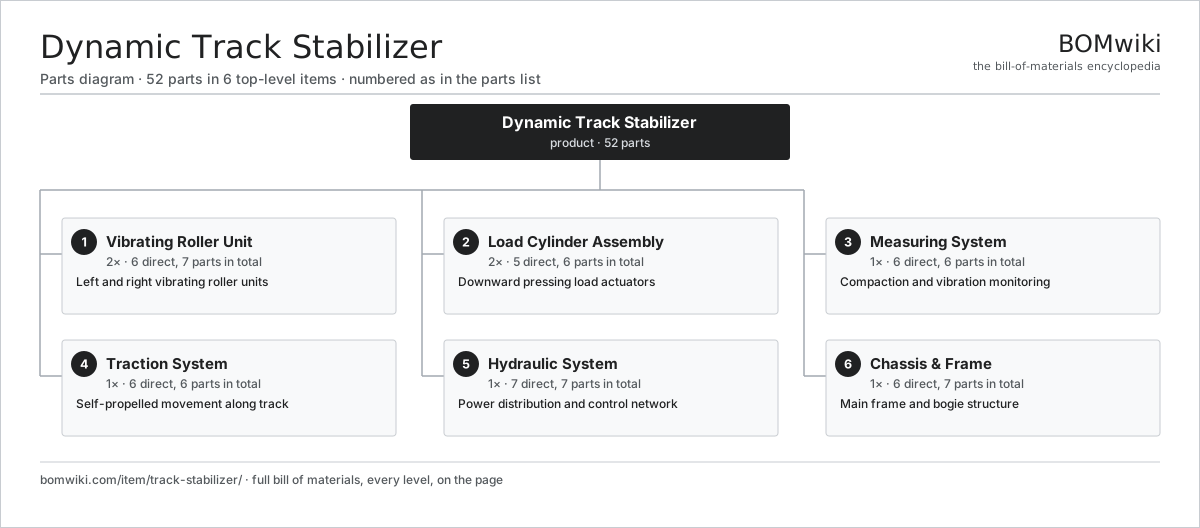
| # | Part | Qty | What it does |
|---|---|---|---|
| 1 | Vibrating Roller Unit 6 parts | 2× | Left and right vibrating roller units |
| 2 | Load Cylinder Assembly 5 parts | 2× | Downward pressing load actuators |
| 3 | Measuring System 6 parts | 1× | Compaction and vibration monitoring |
| 4 | Traction System 6 parts | 1× | Self-propelled movement along track |
| 5 | Hydraulic System 7 parts | 1× | Power distribution and control network |
| 6 | Chassis & Frame 6 parts | 1× | Main frame and bogie structure |
3D model
No 3D model yet. Have a CAD file of this? Add a 3D model. STL renders right on this page; STEP, FreeCAD, and OpenSCAD sources are welcome too (openly licensed, like all 3D models on BOMwiki).
Build & assembly graph
expand / collapse · shared sub-assemblies converge · links to related products · est. labourTap an assembly to expand/collapse · tap a part to open it · use “Open page” for any node · drag to pan, scroll to zoom.
Bill of materials for Dynamic Track Stabilizer
6 top-level lines · 42 rows shown · 52 parts total · indented to 3 levels| # | Item / sub-assembly | Part no. | Qty/assy | Ext. qty | Parts | Type |
|---|---|---|---|---|---|---|
| 1 | Vibrating Roller Unit 6 parts | track-stabilizer-vibration-unit | 2× | 2 | 7 | assembly |
| 1.1 | Compaction Roller | track-stabilizer-roller | 1× | 2 | · | part |
| 1.2 | Eccentric Drive | track-stabilizer-eccentric-drive | 1× | 2 | · | part |
| 1.3 | Roller Bearing | track-stabilizer-roller-bearing | 2× | 4 | · | part |
| 1.4 | Frequency Motor | track-stabilizer-frequency-motor | 1× | 2 | · | part |
| 1.5 | Amplitude Control | track-stabilizer-amplitude-control | 1× | 2 | · | part |
| 1.6 | Roller Axle | track-stabilizer-roller-axle | 1× | 2 | · | part |
| 2 | Load Cylinder Assembly 5 parts | track-stabilizer-load-cylinder | 2× | 2 | 6 | assembly |
| 2.1 | Pressure Cylinder | track-stabilizer-pressure-cylinder | 1× | 2 | · | part |
| 2.2 | Load Equalization Valve | track-stabilizer-load-equalization-valve | 1× | 2 | · | part |
| 2.3 | Cylinder Attachment | track-stabilizer-cylinder-attachment | 1× | 2 | · | part |
| 2.4 | Load Feedback | track-stabilizer-load-feedback | 2× | 4 | · | part |
| 2.5 | Pressure Sensor | pressure-sensor | 1× | 2 | · | part |
| 3 | Measuring System 6 parts | track-stabilizer-measuring-system | 1× | 1 | 6 | assembly |
| 3.1 | Accelerometer Array | track-stabilizer-accelerometer-array | 1× | 1 | · | part |
| 3.2 | Force Sensor | track-stabilizer-force-sensor | 1× | 1 | · | part |
| 3.3 | Displacement Sensor | track-stabilizer-displacement-sensor | 1× | 1 | · | part |
| 3.4 | Data Logger PC | track-stabilizer-data-logger | 1× | 1 | · | part |
| 3.5 | GPS Module | track-stabilizer-gps-module | 1× | 1 | · | part |
| 3.6 | Bare PCB | pcb-bare | 1× | 1 | · | part |
| 4 | Traction System 6 parts | track-stabilizer-traction-system | 1× | 1 | 6 | assembly |
| 4.1 | Traction Motor | track-stabilizer-traction-motor | 1× | 1 | · | part |
| 4.2 | Traction Gearbox | track-stabilizer-traction-gearbox | 1× | 1 | · | part |
| 4.3 | Traction Wheel | track-stabilizer-traction-wheel | 1× | 1 | · | part |
| 4.4 | Speed Control | track-stabilizer-speed-control | 1× | 1 | · | part |
| 4.5 | Brake Unit | track-stabilizer-brake | 1× | 1 | · | part |
| 4.6 | Encoder | encoder | 1× | 1 | · | part |
| 5 | Hydraulic System 7 parts | track-stabilizer-hydraulic-system | 1× | 1 | 7 | assembly |
| 5.1 | Main Pump | track-stabilizer-main-pump | 1× | 1 | · | part |
| 5.2 | Proportional Manifold | track-stabilizer-proportional-manifold | 1× | 1 | · | part |
| 5.3 | Accumulator | track-stabilizer-accumulator | 1× | 1 | · | part |
| 5.4 | Filter Unit | track-stabilizer-filter | 1× | 1 | · | part |
| 5.5 | Cooler | track-stabilizer-cooler | 1× | 1 | · | part |
| 5.6 | Reservoir | track-stabilizer-reservoir | 1× | 1 | · | part |
| 5.7 | Pressure Sensor | pressure-sensor | 1× | 1 | · | part |
| 6 | Chassis & Frame 6 parts | track-stabilizer-chassis | 1× | 1 | 7 | assembly |
| 6.1 | Main Frame | track-stabilizer-main-frame | 1× | 1 | · | part |
| 6.2 | Front Bogie | track-stabilizer-front-bogie | 1× | 1 | · | part |
| 6.3 | Rear Bogie | track-stabilizer-rear-bogie | 1× | 1 | · | part |
| 6.4 | Roller Support Frame | track-stabilizer-roller-support | 2× | 2 | · | part |
| 6.5 | Operator Cab | track-stabilizer-operator-cab | 1× | 1 | · | part |
| 6.6 | Diesel Engine | track-stabilizer-diesel-engine | 1× | 1 | · | part |
Something wrong in this list? Report a problem with this BOM.
Related products
same domain, ranked by shared parts Automated People Mover
450 parts · shares 1 with this page
Automated People Mover
450 parts · shares 1 with this page
 Ballast Cleaning Machine
54 parts · shares 1 with this page
Ballast Cleaning Machine
54 parts · shares 1 with this page
 Ballast Tamping Machine
51 parts · shares 1 with this page
Ballast Tamping Machine
51 parts · shares 1 with this page
 Ballast Undercutter
38 parts · shares 1 with this page
Ballast Undercutter
38 parts · shares 1 with this page
 Bus Rapid Transit Vehicle
4,251 parts · shares 1 with this page
Bus Rapid Transit Vehicle
4,251 parts · shares 1 with this page
 Coach Bus
999 parts · shares 1 with this page
Coach Bus
999 parts · shares 1 with this page
Sourcing: possible vendors
Browse the supplier directory → Prices, MOQ, and lead times are algorithmic estimates, not quotes, and not claims about these companies. Company mappings are curated by keyword; est. price band $500k–$60M. How estimates work| Vendor | HQ | Specialty | MOQ | Lead time |
|---|---|---|---|---|
|
🇨🇳CRRC
crrcgc.cc ↗
|
Beijing, CN | Rolling stock & rail systems | made to order | 40–72 wks |
|
🇫🇷Alstom
alstom.com ↗
|
Saint-Ouen, FR | Rail rolling stock | made to order | 40–72 wks |
| mobility.siemens.com ↗ | Munich, DE | Rail systems | made to order | 40–72 wks |
| stadlerrail.com ↗ | Bussnang, CH | Rail rolling stock | made to order | 40–72 wks |
|
🇺🇸Wabtec
wabteccorp.com ↗
|
Pittsburgh, US | Rail equipment | made to order | 40–72 wks |
2,326-word article