Trail Camera
ProductOverview
A trail camera (camera trap) is an unattended camera left outdoors for weeks or months that photographs whatever walks past it. Hunters use them to pattern game, biologists use them for population surveys, and property owners use them as off-grid security cameras. The entire design problem is energy: the camera must respond to an animal within a few hundred milliseconds while drawing almost nothing the rest of the time, because its only power source is the Battery Tray of eight AA cells.
The device spends nearly all of its life asleep. Only the PIR Trigger Module and a supervisor Microcontroller stay powered, drawing on the order of 100–200 µA. When the PIR detects a warm moving body, the supervisor wakes the imaging SoC on the Main Board, the Camera Module captures a still or starts video, the file is written to the SD Card Slot, and the system drops back to sleep. A good design completes the wake-to-capture sequence in 0.2–0.3 s, slow cameras photograph empty trail where the animal used to be.
Everything lives inside the Weatherproof Housing, an IP66 clamshell with a perimeter gasket from the O-Ring Set, compressed by two Cam Latch units. The Lens Window and the dark IR / PIR Window are the only optical openings; the IR window doubles as a visual disguise, hiding the LED array behind material that is opaque to the eye but transparent at 850 nm.
Triggering
The Pyroelectric IR Sensor is a dual-element pyroelectric detector. It does not image anything; it measures changes in incoming long-wave infrared (8–14 µm), the band radiated by warm bodies. The PIR Fresnel Lens in front of it is moulded into many small segments, each focusing a different slice of the scene onto the sensor elements. A warm body crossing the field moves from one zone to the next, producing an alternating signal on the two elements. The amplifier on the PIR daughterboard compares this differential signal against a threshold; common-mode changes such as the whole scene warming in the sun cancel out, which is what gives PIR its false-trigger immunity.
Sensitivity is a configurable trade-off. High sensitivity catches small or distant animals but also triggers on sun-heated vegetation moving in wind; users typically aim the camera north and clear branches from the detection cone. Detection range depends on the target's temperature contrast, a deer at 25 m in winter is an easier target than the same deer in 30 °C summer air.
Imaging day and night
The Camera Module uses a small CMOS CMOS Image Sensor behind a fixed-focus Lens Assembly set around f/2.0 with hyperfocal focus from roughly 1 m to infinity. By day, the IR-Cut Filter sits in the optical path so that infrared light does not contaminate colour rendering. At night the Ambient Light Sensor reports darkness, the Filter Solenoid flips the filter out of the path, and the sensor uses its full silicon sensitivity, which extends well past 850 nm.
Night exposures are lit by the IR LED Array: typically 36 Infrared LED emitters pulsed by the LED Driver IC in sync with the exposure, rather than run continuously, which both extends battery life and allows higher peak current. 850 nm LEDs emit a faint red glow visible as dots to humans and some game; 940 nm "no-glow" variants are invisible but the sensor is roughly half as sensitive there, costing flash range. Night images are monochrome because the scene is lit by a single wavelength.
Marketing megapixel figures (often "48 MP") are interpolated; the native sensor is usually 4–8 MP, which is honest resolution for a lens of this size and entirely adequate for species identification.
Power and endurance
The supervisor MCU manages a strict power budget. Standby draw of 150 µA gives over a year of shelf life on the AA stack; the real consumption is captures, since each IR-lit photo costs an LED pulse of several amps for tens of milliseconds and each minute of night video runs the array continuously. A camera on a busy feeder site can flatten alkalines in weeks. Lithium iron-disulfide AA cells are preferred in cold climates because they hold voltage at −20 °C where alkalines collapse. The External DC Jack accepts a 12 V solar panel with internal battery, which makes deployments effectively indefinite.
Deployment
The camera straps to a tree with the Mounting Strap and Strap Buckle through moulded channels in the Rear Shell, typically 1–1.5 m above ground, angled slightly down a trail rather than across it so the subject stays in the detection cone longer. The Tripod Insert takes standard 1/4-20 mounts, and the Security Lock Loop accepts a cable lock. Configuration, trigger interval, burst count, photo/video mode, happens on the internal LCD Panel and Navigation Keypad before the Power/Mode Switch is set to armed and the door latched. Cellular variants add an LTE modem and transmit thumbnails on each trigger, trading battery life for remote monitoring.
Trail Camera parts and their functions
10 top-level parts · 266 parts in total · full bill of materials below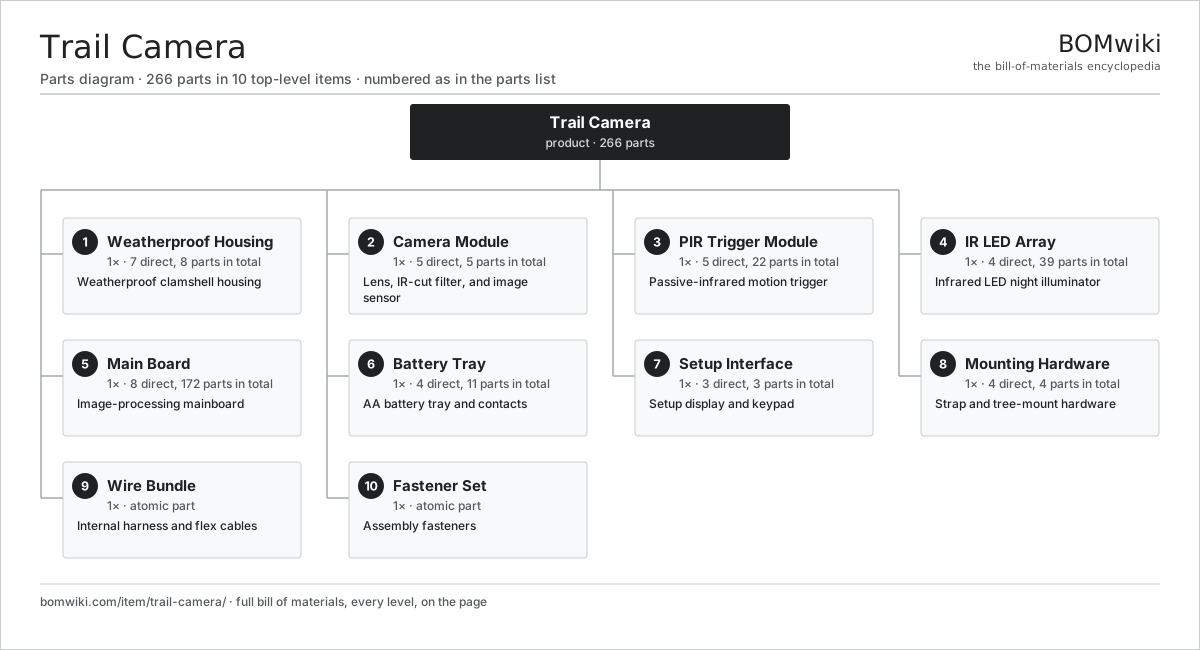
| # | Part | Qty | What it does |
|---|---|---|---|
| 1 | Weatherproof Housing 7 parts | 1× | Weatherproof clamshell housing |
| 2 | Camera Module 5 parts | 1× | Lens, IR-cut filter, and image sensor |
| 3 | PIR Trigger Module 5 parts | 1× | Passive-infrared motion trigger |
| 4 | IR LED Array 4 parts | 1× | Infrared LED night illuminator |
| 5 | Main Board 8 parts | 1× | Image-processing mainboard |
| 6 | Battery Tray 4 parts | 1× | AA battery tray and contacts |
| 7 | Setup Interface 3 parts | 1× | Setup display and keypad |
| 8 | Mounting Hardware 4 parts | 1× | Strap and tree-mount hardware |
| 9 | Wire Bundle | 1× | Internal harness and flex cables |
| 10 | Fastener Set | 1× | Assembly fasteners |
3D model
No 3D model yet. Have a CAD file of this? Add a 3D model. STL renders right on this page; STEP, FreeCAD, and OpenSCAD sources are welcome too (openly licensed, like all 3D models on BOMwiki).
Build & assembly graph
expand / collapse · shared sub-assemblies converge · links to related products · est. labourTap an assembly to expand/collapse · tap a part to open it · use “Open page” for any node · drag to pan, scroll to zoom.
Bill of materials for Trail Camera
10 top-level lines · 50 rows shown · 266 parts total · indented to 3 levels| # | Item / sub-assembly | Part no. | Qty/assy | Ext. qty | Parts | Type |
|---|---|---|---|---|---|---|
| 1 | Weatherproof Housing 7 parts | trail-camera-housing | 1× | 1 | 8 | assembly |
| 1.1 | Front Shell | trail-camera-front-shell | 1× | 1 | · | part |
| 1.2 | Rear Shell | trail-camera-rear-shell | 1× | 1 | · | part |
| 1.3 | Lens Window | trail-camera-lens-window | 1× | 1 | · | part |
| 1.4 | IR / PIR Window | trail-camera-ir-window | 1× | 1 | · | part |
| 1.5 | Cam Latch | trail-camera-latch | 2× | 2 | · | part |
| 1.6 | Hinge Pin | trail-camera-hinge-pin | 1× | 1 | · | part |
| 1.7 | O-Ring Set | oring-set | 1× | 1 | · | part |
| 2 | Camera Module 5 parts | trail-camera-camera-module | 1× | 1 | 5 | assembly |
| 2.1 | Lens Assembly | camera-lens | 1× | 1 | · | part |
| 2.2 | CMOS Image Sensor | image-sensor | 1× | 1 | · | part |
| 2.3 | IR-Cut Filter | trail-camera-ircut-filter | 1× | 1 | · | part |
| 2.4 | Filter Solenoid | trail-camera-filter-solenoid | 1× | 1 | · | part |
| 2.5 | Lens Holder | trail-camera-lens-holder | 1× | 1 | · | part |
| 3 | PIR Trigger Module 5 parts | trail-camera-pir-module | 1× | 1 | 22 | assembly |
| 3.1 | Pyroelectric IR Sensor | trail-camera-pir-sensor | 1× | 1 | · | part |
| 3.2 | PIR Fresnel Lens | trail-camera-fresnel-lens | 1× | 1 | · | part |
| 3.3 | Bare PCB | pcb-bare | 1× | 1 | · | part |
| 3.4 | SMD Passive (R/C/L) | smd-passives | 18× | 18 | · | part |
| 3.5 | Connector | connector | 1× | 1 | · | part |
| 4 | IR LED Array 4 parts | trail-camera-ir-array | 1× | 1 | 39 | assembly |
| 4.1 | Infrared LED | trail-camera-ir-led | 36× | 36 | · | part |
| 4.2 | LED Driver IC | trail-camera-led-driver | 1× | 1 | · | part |
| 4.3 | Bare PCB | pcb-bare | 1× | 1 | · | part |
| 4.4 | Connector | connector | 1× | 1 | · | part |
| 5 | Main Board 8 parts | trail-camera-main-board | 1× | 1 | 172 | assembly |
| 5.1 | Bare PCB | pcb-bare | 1× | 1 | · | part |
| 5.2 | Compute SoC Module | soc-module | 1× | 1 | · | part |
| 5.3 | Microcontroller | mcu | 1× | 1 | · | part |
| 5.4 | Firmware Flash IC | trail-camera-flash-ic | 1× | 1 | · | part |
| 5.5 | SD Card Slot | trail-camera-sd-slot | 1× | 1 | · | part |
| 5.6 | Ambient Light Sensor | trail-camera-light-sensor | 1× | 1 | · | part |
| 5.7 | SMD Passive (R/C/L) | smd-passives | 160× | 160 | · | part |
| 5.8 | Connector | connector | 6× | 6 | · | part |
| 6 | Battery Tray 4 parts | trail-camera-battery-tray | 1× | 1 | 11 | assembly |
| 6.1 | AA Cell | trail-camera-aa-cell | 8× | 8 | · | part |
| 6.2 | Tray Frame | trail-camera-tray-frame | 1× | 1 | · | part |
| 6.3 | Battery Contact Set | trail-camera-battery-contacts | 1× | 1 | · | part |
| 6.4 | External DC Jack | trail-camera-dc-jack | 1× | 1 | · | part |
| 7 | Setup Interface 3 parts | trail-camera-ui | 1× | 1 | 3 | assembly |
| 7.1 | LCD Panel | lcd-panel | 1× | 1 | · | part |
| 7.2 | Navigation Keypad | trail-camera-keypad | 1× | 1 | · | part |
| 7.3 | Power/Mode Switch | trail-camera-mode-switch | 1× | 1 | · | part |
| 8 | Mounting Hardware 4 parts | trail-camera-mounting | 1× | 1 | 4 | assembly |
| 8.1 | Mounting Strap | trail-camera-strap | 1× | 1 | · | part |
| 8.2 | Strap Buckle | trail-camera-buckle | 1× | 1 | · | part |
| 8.3 | Tripod Insert | trail-camera-tripod-insert | 1× | 1 | · | part |
| 8.4 | Security Lock Loop | trail-camera-lock-loop | 1× | 1 | · | part |
| 9 | Wire Bundle | wire-bundle | 1× | 1 | · | part |
| 10 | Fastener Set | fastener-set | 1× | 1 | · | part |
Something wrong in this list? Report a problem with this BOM.
Related products
same domain, ranked by shared parts Action Camera
271 parts · shares 8 with this page
Action Camera
271 parts · shares 8 with this page
 Electronic Autocollimator
34 parts · shares 8 with this page
Electronic Autocollimator
34 parts · shares 8 with this page
 Dashcam
221 parts · shares 7 with this page
Dashcam
221 parts · shares 7 with this page
 Digital Microscope
88 parts · shares 7 with this page
Digital Microscope
88 parts · shares 7 with this page
 DSLR Camera
553 parts · shares 7 with this page
Profile Projector
94 parts · shares 7 with this page
DSLR Camera
553 parts · shares 7 with this page
Profile Projector
94 parts · shares 7 with this page
Sourcing: possible vendors
Browse the supplier directory → Prices, MOQ, and lead times are algorithmic estimates, not quotes, and not claims about these companies. Company mappings are curated by keyword; est. price band $100–$8k. How estimates work| Vendor | HQ | Specialty | MOQ | Lead time |
|---|---|---|---|---|
|
🇯🇵Canon
canon.com ↗
|
Tokyo, JP | Imaging & optics | 500 units | 10–16 wks |
|
🇯🇵Nikon
nikon.com ↗
|
Tokyo, JP | Imaging & optics | 500 units | 10–16 wks |
|
🇩🇪ZEISS
zeiss.com ↗
|
Oberkochen, DE | Optics & optoelectronics | 500 units | 10–16 wks |
| leica-camera.com ↗ | Wetzlar, DE | Cameras & optics | 500 units | 10–16 wks |
| flir.com ↗ | Wilsonville, US | Thermal imaging | 500 units | 10–16 wks |
883-word article