Transfer Press
ProductOverview
A transfer press is a large-capacity stamping machine mounting four to eight separate die sets on a common frame, with a synchronized mechanical transfer system moving workpieces from station to station. Unlike a Progressive Die, where all operations occur in one compact die with the workpiece advancing vertically within the die set, a transfer press keeps the workpiece at a fixed vertical elevation while the press slide moves up and down over each station in sequence. The Transfer Fingers or conveyor mechanism grasps the part after each stroke and advances it horizontally to the next die. Transfer presses are economical for large forgings, complex stampings requiring deep draws, or when individual die stations must be accessible for manual adjustment or inspection. A typical transfer press line in an automotive plant might blanking, piercing, drawing, redraw, trim, and flanging, six operations on a single machine, handling a 50 kg hood panel from blank to finished assembly-ready part.
Station geometry and mechanical flow
The Die Stations are arranged linearly, each with a bolster plate beneath and an upper die mounting position on the slide. The workpiece path is horizontal: the part enters station 1 (loading), moves to station 2 (first draw), station 3 (redraw), and so on. The Slide Assembly descends vertically over station 1, performs the operation, and retracts. While the slide is retracting, the transfer system (typically Transfer Fingers or a chain conveyor) moves the part 200–500 mm horizontally to station 2. By the time station 1 is clear and the operator loads the next blank, the slide is already descending over station 2 to perform the next operation.
This parallel workflow is the key advantage: the machine can accept new blanks at the input station while the die stations are processing earlier parts at different stages. Cycle time is typically the longest individual operation (e.g., a deep draw taking 3 seconds) plus the mechanical transfer time (1–2 seconds), so a six-station press might achieve one complete part every 4–5 seconds.
Mechanical transfer systems
Three primary transfer mechanisms are common:
Cam-Driven Fingers: The Crankshaft drives not only the slide upward and downward but also a second set of connecting rods synchronized to a Transfer Cam. The cam lobe dwell is timed to allow the slide to clear the part before transfer begins. As the crankshaft rotates, the cam pushes Transfer Fingers forward on a Transfer Guide Rail rail, propelling the part to the next station. A return spring retracts the fingers for the next cycle. The advantage is simplicity: the motor runs one crankshaft and one pump. The disadvantage is inflexible timing, if a single station takes longer than the crankshaft allows, the system jams.
Hydraulic Transfer: A secondary Hydraulic Press cylinder is added, independently controlled via solenoid valves. This allows variable-speed advance and dwell. If station 3 is slow (redraw is deep), a pressure transducer can trigger the main slide to hold at bottom longer before the hydraulic transfer fingers push the part forward. Flexibility at the cost of additional complexity and maintenance.
Belt-and-Roller Conveyor: For smaller parts or continuous-feed applications, a motorized conveyor underneath or alongside the press moves parts through the station array. Less common for high-impact stamping but used for forming and trimming operations where shock loads are moderate.
Slide and guide system
The Slide Assembly is a massive steel beam with Guide Posts and Guide Bushings similar to a mechanical stamping press, but wider and stiffer. The slide must be absolutely rigid to prevent tilting as it moves from one station to the next, a tilted slide will miss alignment with the lower die or jam. Precision guide-post reaming to 0.002 inch tolerance is mandatory. The Upper Die Mounting Plate is hardened and ground flat. A single fastener-set bolts the upper die block to this plate at each station, and the block swaps quickly for part changeover.
Die station complexity
Lower dies are bolted to the Bolster Plate Station 1, Bolster Plate Station 2, and subsequent bolster plates, which are welded or bolted to the Bolster Support Block. Dies at early stations (blanking, piercing) are relatively simple flat cavities. Later stations (deep drawing, redrawing) require stripper plates, pressure pads, and graduated punch sizes to avoid tearing or wrinkling. The transfer system must ensure precise part position at each station, often using pilot pins or nesting features in the die that engage the part geometry.
Synchronization and timing
The heart of transfer-press reliability is timing. The crankshaft and transfer cam are keyed to rotate together, so every operation is locked to the mechanical cycle. If the crankshaft makes 20 revolutions per minute (20 rpm = 300 strokes/min), then every station performs its operation exactly every 3 seconds. Synchronization is inherent, not software-controlled, an advantage for robustness and an advantage for long part-run stability. However, if one die fails mid-run, the entire machine jams; the operator must e-stop, replace the broken die, and reset the system. This differs from a progressive die, where jams often cause only that coil strip to waste.
Lubrication and drive
The Drive System includes the motor, Crankshaft, Flywheel, and Clutch-Brake Unit, mirroring a mechanical stamping press. The flywheel smooths speed variation as each station exerts load. The Lubrication System is centralized: the pump draws from a reservoir and distributes oil to crankshaft journals, link pins, guide bushings, and transfer mechanism bearings. Inadequate lubrication on transfer cam followers or guide posts causes wear and misalignment, leading to scrap parts. A belt-driven or crankshaft-driven pump ensures lube pressure whenever the motor runs, even during slow manual advance (jog mode) for die setup.
Die changeover
Changing from one part design to another requires swapping all die sets, guides, and transfer fingers. A two-operator team working methodically can achieve die changeover in 2–4 hours. Quick-die-change tooling (standardized clamps, bolt patterns) reduce this. Some shops pre-stage the next die set while the current run finishes, allowing swap in under 1 hour.
Cooling and thermal management
Unlike a progressive coil-fed die, transfer presses generate scrap that must be removed. A scrap conveyor or chute beneath the frame carries trimmed edges and punched slugs away. High-speed transfer presses (250+ strokes/min) heat the die surfaces significantly. Cooling channels drilled into upper and lower die blocks, fed by circulating coolant (mineral oil or semi-synthetic), prevent die softening and part geometry drift. Without cooling, a deep-draw die might grow 0.2 mm over 8 hours of continuous operation, ruining part dimensions.
Safety and automation
Transfer presses require two-handed control systems or light-curtain guards to prevent operator injury during transfer and descent. Emergency stop buttons must instantaneously cut clutch power and apply the brake. Guarding around the transfer mechanism prevents hands from being drawn into the finger zones. Modern installations integrate with PLC-controlled counting systems that stop the machine after a pre-set number of parts, eliminating manual counting errors.
Comparison to progressive dies
A transfer press is slower per station (20–50 strokes/min) than a progressive die (100–300 strokes/min) but handles larger, heavier, or geometrically complex parts. Progressive dies excel for small stampings (fasteners, brackets under 10 kg). Transfer presses dominate mid-to-large automotive body stampings (fenders, door panels, hoods, 5–100 kg). Cost is higher for transfer presses (£200k–£500k) but justified by long production runs and flexibility to adjust operation parameters without rebuilding the die set.
Transfer Press parts and their functions
7 top-level parts · 133 parts in total · full bill of materials below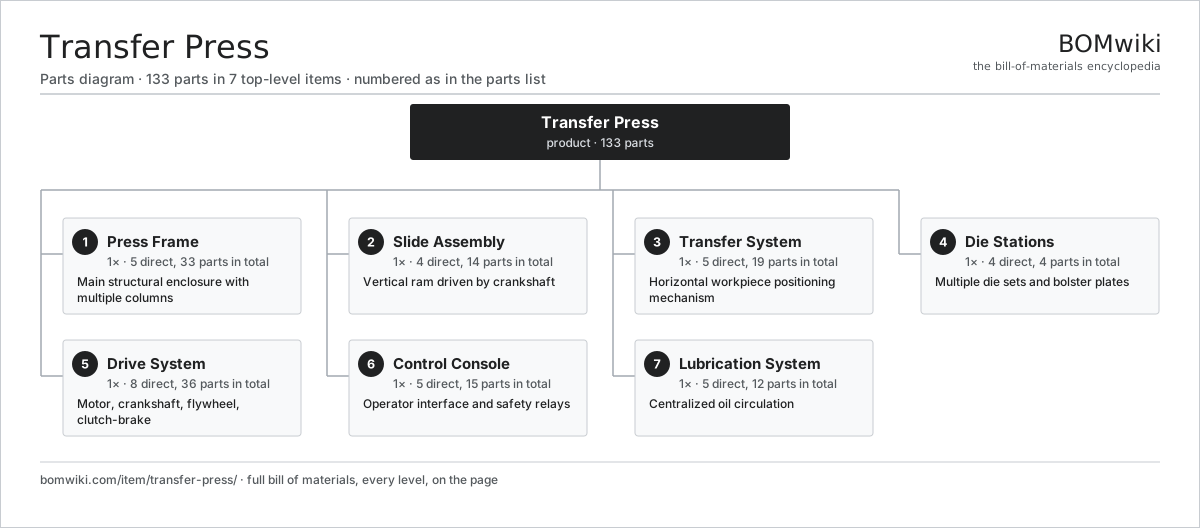
| # | Part | Qty | What it does |
|---|---|---|---|
| 1 | Press Frame 5 parts | 1× | Main structural enclosure with multiple columns |
| 2 | Slide Assembly 4 parts | 1× | Vertical ram driven by crankshaft |
| 3 | Transfer System 5 parts | 1× | Horizontal workpiece positioning mechanism |
| 4 | Die Stations 4 parts | 1× | Multiple die sets and bolster plates |
| 5 | Drive System 8 parts | 1× | Motor, crankshaft, flywheel, clutch-brake |
| 6 | Control Console 5 parts | 1× | Operator interface and safety relays |
| 7 | Lubrication System 5 parts | 1× | Centralized oil circulation |
3D model
No 3D model yet. Have a CAD file of this? Add a 3D model. STL renders right on this page; STEP, FreeCAD, and OpenSCAD sources are welcome too (openly licensed, like all 3D models on BOMwiki).
Build & assembly graph
expand / collapse · shared sub-assemblies converge · links to related products · est. labourTap an assembly to expand/collapse · tap a part to open it · use “Open page” for any node · drag to pan, scroll to zoom.
Bill of materials for Transfer Press
7 top-level lines · 50 rows shown · 133 parts total · indented to 3 levels| # | Item / sub-assembly | Part no. | Qty/assy | Ext. qty | Parts | Type |
|---|---|---|---|---|---|---|
| 1 | Press Frame 5 parts | transfer-press-frame | 1× | 1 | 33 | assembly |
| 1.1 | Side Columns | transfer-press-frame-side-columns | 4× | 4 | · | part |
| 1.2 | Crossbeam | transfer-press-frame-crossbeams | 6× | 6 | · | part |
| 1.3 | Base Plate | transfer-press-frame-base-plate | 1× | 1 | · | part |
| 1.4 | Rail Mount Bracket | transfer-press-transfer-rail-mounts | 2× | 2 | · | part |
| 1.5 | Fastener Set | fastener-set | 20× | 20 | · | part |
| 2 | Slide Assembly 4 parts | transfer-press-slide-assembly | 1× | 1 | 14 | assembly |
| 2.1 | Slide Block | transfer-press-slide-block | 1× | 1 | · | part |
| 2.2 | Guide Posts | transfer-press-slide-guide-posts | 4× | 4 | · | part |
| 2.3 | Guide Bushings | transfer-press-slide-guide-bushings | 8× | 8 | · | part |
| 2.4 | Upper Die Mounting Plate | transfer-press-upper-die-mounting-plate | 1× | 1 | · | part |
| 3 | Transfer System 5 parts | transfer-press-transfer-rails | 1× | 1 | 19 | assembly |
| 3.1 | Transfer Fingers | transfer-press-transfer-fingers | 4× | 4 | · | part |
| 3.2 | Finger Arm | transfer-press-finger-arms | 4× | 4 | · | part |
| 3.3 | Transfer Cam | transfer-press-transfer-cam | 1× | 1 | · | part |
| 3.4 | Transfer Guide Rail | transfer-press-transfer-guides | 2× | 2 | · | part |
| 3.5 | Fastener Set | fastener-set | 8× | 8 | · | part |
| 4 | Die Stations 4 parts | transfer-press-die-stations | 1× | 1 | 4 | assembly |
| 4.1 | Bolster Plate Station 1 | transfer-press-bolster-plate-1 | 1× | 1 | · | part |
| 4.2 | Bolster Plate Station 2 | transfer-press-bolster-plate-2 | 1× | 1 | · | part |
| 4.3 | Bolster Plate Station 3 | transfer-press-bolster-plate-3 | 1× | 1 | · | part |
| 4.4 | Bolster Support Block | transfer-press-bolster-mounting-block | 1× | 1 | · | part |
| 5 | Drive System 8 parts | transfer-press-drive-system | 1× | 1 | 36 | assembly |
| 5.1 | Motor Housing | motor-housing | 1× | 1 | · | part |
| 5.2 | Stator Assembly 3 parts | stator-assembly | 1× | 1 | 3 | assembly |
| 5.2.1 | Stator Core (laminations) | stator-core | 1× | 1 | · | part |
| 5.2.2 | Copper Winding | copper-winding | 1× | 1 | · | part |
| 5.2.3 | Slot Insulation | stator-insulation | 1× | 1 | · | part |
| 5.3 | Rotor Assembly 4 parts | rotor-assembly | 1× | 1 | 19 | assembly |
| 5.3.1 | Rotor Shaft | rotor-shaft | 1× | 1 | · | part |
| 5.3.2 | Rotor Core | rotor-core | 1× | 1 | · | part |
| 5.3.3 | Neodymium Magnet | neodymium-magnet | 16× | 16 | · | part |
| 5.3.4 | Ball Bearing | ball-bearing | 1× | 1 | · | part |
| 5.4 | Crankshaft | transfer-press-crankshaft | 1× | 1 | · | part |
| 5.5 | Flywheel | transfer-press-flywheel | 1× | 1 | · | part |
| 5.6 | Connecting Rod | transfer-press-connecting-rods | 2× | 2 | · | part |
| 5.7 | Clutch-Brake Unit | transfer-press-clutch-brake | 1× | 1 | · | part |
| 5.8 | Ball Bearing | ball-bearing | 8× | 8 | · | part |
| 6 | Control Console 5 parts | transfer-press-control-console | 1× | 1 | 15 | assembly |
| 6.1 | Control Cabinet | transfer-press-console-enclosure | 1× | 1 | · | part |
| 6.2 | Relay | relay | 6× | 6 | · | part |
| 6.3 | E-Stop Button | transfer-press-emergency-stop-button | 1× | 1 | · | part |
| 6.4 | Pressure Sensor | pressure-sensor | 1× | 1 | · | part |
| 6.5 | Connector | connector | 6× | 6 | · | part |
| 7 | Lubrication System 5 parts | transfer-press-lubrication-system | 1× | 1 | 12 | assembly |
| 7.1 | Lube Pump | transfer-press-lube-pump | 1× | 1 | · | part |
| 7.2 | Lube Filter | transfer-press-lube-filter | 1× | 1 | · | part |
| 7.3 | Lube Cooler | transfer-press-lube-cooler | 1× | 1 | · | part |
| 7.4 | Lube Distribution Block | transfer-press-lube-manifold | 1× | 1 | · | part |
| 7.5 | Connector | connector | 8× | 8 | · | part |
Something wrong in this list? Report a problem with this BOM.
Sourcing: possible vendors
Browse the supplier directory → Prices, MOQ, and lead times are algorithmic estimates, not quotes, and not claims about these companies. Company mappings are curated by keyword; est. price band $10k–$1M. How estimates work| Vendor | HQ | Specialty | MOQ | Lead time |
|---|---|---|---|---|
|
🇩🇪DMG MORI
dmgmori.com ↗
|
Bielefeld, DE | Machine tools | 5 units | 12–20 wks |
|
🇯🇵Mazak
mazak.com ↗
|
Oguchi, JP | Machine tools | 5 units | 12–20 wks |
| haascnc.com ↗ | Oxnard, US | CNC machine tools | 5 units | 12–20 wks |
|
🇯🇵Okuma
okuma.com ↗
|
Niwa, JP | Machine tools | 5 units | 12–20 wks |
|
🇩🇪Trumpf
trumpf.com ↗
|
Ditzingen, DE | Laser & sheet-metal machines | 5 units | 12–20 wks |
1,298-word article