Transmission Jack
ProductOverview
A transmission jack is a specialized hydraulic lift designed specifically for removing and supporting manual or automatic transmissions. Unlike a general-purpose engine hoist, the transmission jack has a very low profile to fit beneath vehicles with minimal ground clearance, and a narrow base to maneuver in tight quarters. The Transmission Saddle Head cradles the transmission housing with a Saddle Plate and optional transmission-jack-adjustable-clamp to distribute the load evenly. A secondary Hydraulic Tilt Control hydraulic function allows the head to tilt slightly, easing extraction as the transmission is pulled away from the bell housing.
Transmission jacks are essential in shops performing major repairs or rebuilds; they eliminate the risk of dropping a heavy transmission on the technician and prevent damage to the internal components from uneven support.
Compact base and low profile
The Compact Base Frame is intentionally narrow (500–700 mm) to fit under modern vehicle chassis. Unlike engine hoists, which have a wide triangular footprint for stability under extended loads, the transmission jack prioritizes ground clearance and maneuverability. The base still provides adequate stability for a 2–3 ton load because the transmission is lifted close to the vehicle frame, minimizing cantilever moment.
The Base Plate and Vertical Supports are welded from steel; the entire structure is designed to collapse to a height of 150–200 mm when fully lowered, allowing it to roll under a vehicle chassis that may sit only 200–250 mm from the ground.
Hydraulic lift and cylinder
The Lift Cylinder is a compact double-acting unit, typically 16–20 mm bore and 150–250 mm stroke, rated 2–3 tons. It lifts the Transmission Saddle Head directly or through a lever mechanism. The Piston Rod is hardened and chrome-plated to withstand corrosion and wear from the clutch fluid or transmission oil that drips onto it during extraction.
The small bore means the Hand Pump Unit must be stroked many times to reach full height (50–100 strokes typical), but each stroke requires less effort because the pressure is lower. A one-speed pump is standard; the low-pressure requirement (1,500–2,500 psi) means the hand pump handle can be relatively short, fitting comfortably in the confined space under a vehicle.
Transmission saddle and mounting
The Transmission Saddle Head is the critical interface between the jack and the transmission. A Saddle Plate, 200–300 mm wide, supports the transmission bell housing. Modern transmissions are wide and square; the saddle must distribute pressure over a large area to avoid crushing the aluminum casting. Some jacks use a fixed plate; others offer an Adjustable Clamp that can slide along the cylinder rod to center the load under the vehicle's transmission geometry.
A Head Swivel Joint (ball joint or trunnion bearing) allows the head to self-level if the transmission is tilted during extraction, preventing edge loading that could crack the casting.
Tilt function
The Hydraulic Tilt Control is a secondary hydraulic feature unique to transmission jacks. A small Tilt Cylinder powered by a separate valve function allows the head to tilt 15–20 degrees. When extracting a transmission, the technician lifts it away from the bell housing, then engages the tilt function to rotate the head, disengaging the transmission input shaft from the bellhousing pilot bearing. Without the tilt function, the transmission would hang straight down and require significant pull to separate.
The tilt cylinder is small (500–800 N force) because it only needs to overcome friction and bearing preload, not the weight of the transmission. A Function Selector or button on the pump allows the operator to choose between lift and tilt function; pressurizing only one circuit at a time.
Pump and manual control
The Hand Pump Unit is compact and lightweight, typically 3–5 L reservoir integral to the pump body. The Pump Handle is short to allow operation in the confined space under a vehicle. A Relief Valve protects against overpressure, set to 2,000–2,500 psi. If a fully loaded transmission jams during extraction, continued pumping increases pressure until the relief cracks; the operator hears or feels pressure release and knows the limit is reached.
The pump is typically two-speed: long strokes for fast low-pressure motion, short strokes for sustained pressure. A Function Selector routes pump output to either the lift cylinder or the tilt circuit. Some jacks simplify this to a single pump valve with a lever that selects lift or tilt; the pump always pressurizes but only one circuit is active.
Hose routing and quick-disconnect
The High-Pressure Hose Assembly are compact and lightweight. A Lift Pressure Hose (3/8 inch) carries pressure from pump to cylinder; a Return Hose (1/2 inch) allows quick backflow as the transmission is lowered by gravity. Quick-disconnect Hose Coupler allow the hose assembly to be disconnected and replaced without spilling fluid.
All hoses are routed along the jack frame and secured with clips to prevent interference with casters or contact with heat sources.
Safety and mechanical lock
The Safety Hold Mechanism is a mechanical failsafe unique to transmission jacks. A Lock Pin, spring-loaded and engaged by default, engages a notch or slot on the Lift Cylinder rod. If the hose ruptures and the pump loses pressure, the lock pin holds the cylinder in place, preventing uncontrolled descent onto the technician or the engine bay. The pin can only be retracted by pushing or pulling the Release Lever, a deliberate action required to lower the transmission.
This design prevents injury from a hydraulic system failure; the lock engages automatically when pressure is lost and requires manual release to lower the load, giving the operator time to diagnose the problem (often a loose hose coupling) before continuing.
Operational workflow
A transmission removal typically proceeds as follows: (1) The fully lowered jack is rolled under the vehicle and positioned under the transmission bell housing. (2) The technician operates the pump handle to raise the Transmission Saddle Head, taking up the weight and supporting the transmission. (3) Once the transmission is fully supported, the vehicle's transmission mount bolts are removed. (4) The technician pumps the handle to raise the transmission slightly away from the engine block, disengaging any dowel pins. (5) The tilt function is engaged, tilting the head to separate the transmission input shaft from the bellhousing pilot bearing. (6) The transmission is pulled away from the engine by hand or with a small pull-hoist. (7) Once clear, the Release Lever is pulled to retract the lock pin, and the Pump Handle is used to lower the transmission into a parts cart or workbench.
The entire operation rarely exceeds 15–20 minutes and requires no overhead infrastructure.
Transmission Jack parts and their functions
8 top-level parts · 75 parts in total · full bill of materials below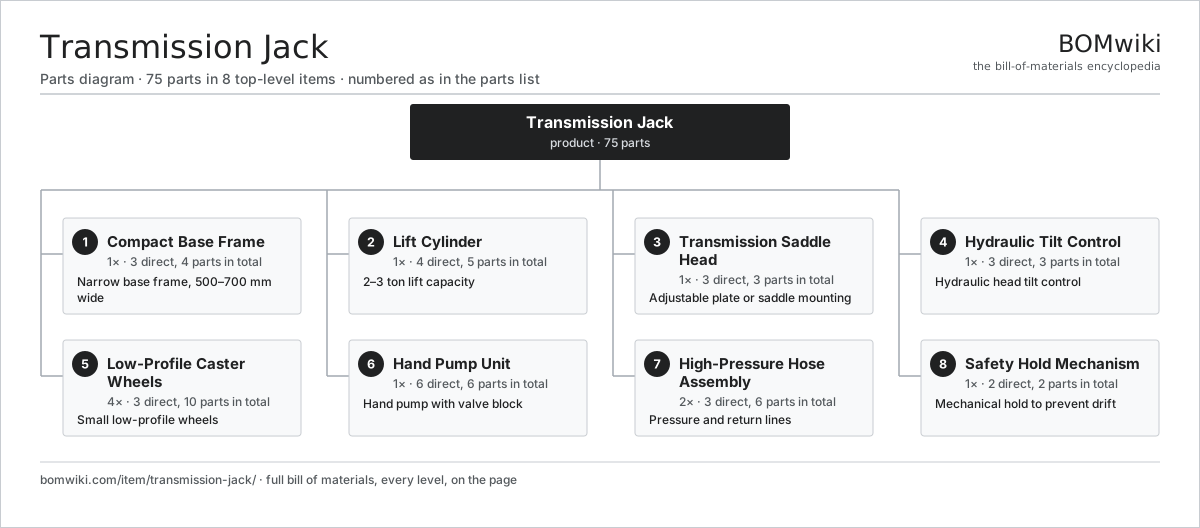
| # | Part | Qty | What it does |
|---|---|---|---|
| 1 | Compact Base Frame 3 parts | 1× | Narrow base frame, 500–700 mm wide |
| 2 | Lift Cylinder 4 parts | 1× | 2–3 ton lift capacity |
| 3 | Transmission Saddle Head 3 parts | 1× | Adjustable plate or saddle mounting |
| 4 | Hydraulic Tilt Control 3 parts | 1× | Hydraulic head tilt control |
| 5 | Low-Profile Caster Wheels 3 parts | 4× | Small low-profile wheels |
| 6 | Hand Pump Unit 6 parts | 1× | Hand pump with valve block |
| 7 | High-Pressure Hose Assembly 3 parts | 2× | Pressure and return lines |
| 8 | Safety Hold Mechanism 2 parts | 1× | Mechanical hold to prevent drift |
3D model
No 3D model yet. Have a CAD file of this? Add a 3D model. STL renders right on this page; STEP, FreeCAD, and OpenSCAD sources are welcome too (openly licensed, like all 3D models on BOMwiki).
Build & assembly graph
expand / collapse · shared sub-assemblies converge · links to related products · est. labourTap an assembly to expand/collapse · tap a part to open it · use “Open page” for any node · drag to pan, scroll to zoom.
Bill of materials for Transmission Jack
8 top-level lines · 35 rows shown · 75 parts total · indented to 3 levels| # | Item / sub-assembly | Part no. | Qty/assy | Ext. qty | Parts | Type |
|---|---|---|---|---|---|---|
| 1 | Compact Base Frame 3 parts | transmission-jack-base | 1× | 1 | 4 | assembly |
| 1.1 | Base Plate | transmission-jack-base-plate | 1× | 1 | · | part |
| 1.2 | Vertical Support | transmission-jack-support-tube | 2× | 2 | · | part |
| 1.3 | Cross-Member | transmission-jack-cross-member | 1× | 1 | · | part |
| 2 | Lift Cylinder 4 parts | transmission-jack-hydraulic-cylinder | 1× | 1 | 5 | assembly |
| 2.1 | Cylinder Barrel | transmission-jack-cylinder-barrel | 1× | 1 | · | part |
| 2.2 | Piston Rod | transmission-jack-piston-rod | 1× | 1 | · | part |
| 2.3 | Piston Head | transmission-jack-piston-head | 1× | 1 | · | part |
| 2.4 | Rod Seal | transmission-jack-rod-seal | 2× | 2 | · | part |
| 3 | Transmission Saddle Head 3 parts | transmission-jack-lifting-head | 1× | 1 | 3 | assembly |
| 3.1 | Saddle Plate | transmission-jack-saddle-plate | 1× | 1 | · | part |
| 3.2 | Adjustable Clamp | transmission-jack-saddle-adjuster | 1× | 1 | · | part |
| 3.3 | Head Swivel Joint | transmission-jack-head-swivel | 1× | 1 | · | part |
| 4 | Hydraulic Tilt Control 3 parts | transmission-jack-tilting-mechanism | 1× | 1 | 3 | assembly |
| 4.1 | Tilt Cylinder | transmission-jack-tilt-cylinder | 1× | 1 | · | part |
| 4.2 | Tilt Valve | transmission-jack-tilt-control-valve | 1× | 1 | · | part |
| 4.3 | Tilt Hose | transmission-jack-tilt-hose | 1× | 1 | · | part |
| 5 | Low-Profile Caster Wheels 3 parts | transmission-jack-casters | 4× | 4 | 10 | assembly |
| 5.1 | Small Caster Wheel | transmission-jack-caster-wheel | 4× | 16 | · | part |
| 5.2 | Caster Swivel | transmission-jack-caster-swivel | 4× | 16 | · | part |
| 5.3 | Caster Brake | transmission-jack-caster-brake | 2× | 8 | · | part |
| 6 | Hand Pump Unit 6 parts | transmission-jack-pump-assembly | 1× | 1 | 6 | assembly |
| 6.1 | Pump Body | transmission-jack-pump-housing | 1× | 1 | · | part |
| 6.2 | Pump Piston | transmission-jack-pump-piston | 1× | 1 | · | part |
| 6.3 | Reservoir | transmission-jack-pump-reservoir | 1× | 1 | · | part |
| 6.4 | Pump Handle | transmission-jack-pump-handle | 1× | 1 | · | part |
| 6.5 | Relief Valve | transmission-jack-relief-valve | 1× | 1 | · | part |
| 6.6 | Function Selector | transmission-jack-selector-switch | 1× | 1 | · | part |
| 7 | High-Pressure Hose Assembly 3 parts | transmission-jack-hose-lines | 2× | 2 | 6 | assembly |
| 7.1 | Lift Pressure Hose | transmission-jack-lift-hose | 1× | 2 | · | part |
| 7.2 | Return Hose | transmission-jack-return-hose | 1× | 2 | · | part |
| 7.3 | Hose Coupler | transmission-jack-hose-couplers | 4× | 8 | · | part |
| 8 | Safety Hold Mechanism 2 parts | transmission-jack-safety-lock | 1× | 1 | 2 | assembly |
| 8.1 | Lock Pin | transmission-jack-lock-pin | 1× | 1 | · | part |
| 8.2 | Release Lever | transmission-jack-lock-lever | 1× | 1 | · | part |
Something wrong in this list? Report a problem with this BOM.
Sourcing: possible vendors
Browse the supplier directory → Prices, MOQ, and lead times are algorithmic estimates, not quotes, and not claims about these companies. Company mappings are curated by keyword; est. price band $1–$300. How estimates work| Vendor | HQ | Specialty | MOQ | Lead time |
|---|
1,168-word article