Rocket Transporter-Erector
ProductOverview
A transporter-erector (TE) is a massive ground support equipment (GSE) machine that moves launch vehicles horizontally from the assembly building to the launch pad, then rotates them from horizontal to vertical in preparation for launch. For rockets weighing 1000 tons and standing 70 meters tall when vertical, the transporter-erector is the only practical means of mating the vehicle to the launch pad while managing structural loads, fluid/electrical connections, and safety constraints.
The transporter-erector consists of six major subsystems: a strongback main beam, two articulated transport bogies, a hydraulic erection system, mechanical hold-down and release bolts, umbilical connections to the launch pad, and proportional control electronics.
Strongback Structural Design
The strongback is a 60-meter welded steel box-beam (200 × 200 mm section) rated to support a 1000-ton rocket at 1.5× safety factor. The strongback forms the spine of the entire structure; all rocket load is transmitted through it.
The rocket interfaces to the strongback via a vertical adapter frame, which has mounting pads aligned to the rocket's four leg or fin-root hard points. The mechanical clamps grip the rocket at these points via four independent brackets, each capable of restraining 500 tons (total 2000 ton capacity, providing 2× redundancy).
Lateral stability during horizontal transport is provided by swing-beam supports pinned to the strongback at swing hinges. These allow the strongback to roll slightly (±5°) to follow the pad rail curvature, then lock solid during erection.
Cross-bracing gussets welded throughout the frame prevent torsional twist, critical when an off-center rocket load (e.g., partially fueled, with payload loaded asymmetrically) creates shear forces during transport or erection.
Hydraulic Erection Mechanism
The hydraulic system is the heart of erection. Two large telescoping cylinders (250 mm bore, 3000 mm stroke) are pinned to the strongback and to a fixed pad anchor. As the pump supplies pressurized oil to the cylinders, the rod extends, rotating the strongback about the lower pivot point from horizontal (0°) to vertical (90°).
Erection proceeds in phases:
Slow initial lift (0–15°): The proportional valve is commanded to a small spool position, restricting flow and reducing speed. Load is heaviest at this angle (lever arm is maximal), so slow speed limits acceleration forces on the rocket structure (limiting to ~0.5 g). The pressure regulator limits pump pressure to 2000 psi.
Acceleration phase (15–60°): As the rocket rotates, the moment arm decreases, allowing faster erection. The proportional valve increases spool position, accelerating the rate to 0.3–0.5 °/second.
Deceleration to vertical (60–90°): Near vertical, the proportional valve throttles again, slowing the final approach to vertical. The pendulum level indicator confirms when true vertical is achieved (within ±0.5°). If the strongback tilts laterally during erection, the small cross-level cylinders nudge the bogie wheels to correct tilt.
Erection safety: The counterbalance valves prevent uncontrolled lowering if a hydraulic hose ruptures. Each cylinder has a pilot-operated check valve that requires minimum pilot pressure (maintained by the pump) to open, trapping load indefinitely if pump pressure is lost. Manual hand-pump access allows crew to lower the rocket in an emergency.
A typical erection cycle takes 3–5 minutes. Crew stand at safe distances >200 meters, and the launch complex is cleared of non-essential personnel.
Transport System
Two transport bogies, each with four wheels, support the strongback on the launch pad rail. The bogies are connected by an articulation joint allowing independent up-down compliance (springs) while keeping the strongback level.
Each bogie has an electric drive motor (30 kW) powering one axle via a 10:1 reducer gear. This allows the transporter to self-propel at 1–2 km/h along the 100-meter pad rail from the vehicle assembly building to the launch pad tower. The low speed is deliberate: road holding, crew safety, and shock-absorption require conservative speeds.
The rail is an embedded steel I-beam, level-surveyed to ±5 mm over its 100-meter length. Mechanical pins engage slots in the rail, preventing lateral shift. A typical transporter-pad combination has <50 mm lateral play even under 1000-ton load.
Umbilical and Launch Pad Transfer
The umbilical mast is a 15-meter swing boom mounted on the launch pad. It carries the rocket's fluid connections (LN₂ loading lines, LH₂ loading lines, GN₂ pressurization, GHe purge) and electrical umbilicals (power, instrumentation, instrumentation).
As the strongback erects, the boom automatically swings outboard via a motor-driven retraction mechanism, keeping the umbilicals slack until the rocket reaches near-vertical. At T-60 minutes, ground crews manually connect the umbilical fluid QD connectors and electrical connector to the rocket at the top of the pad tower (typically 50 meters above ground, accessible via elevator).
At T-5 minutes, the umbilical boom is fully retracted and stowed clear of the launch envelope. The hold-down release switches confirm all mechanical clamps are secure (switch travel indicates the explosive bolts have not yet fired).
Hold-Down and Release
Four shaped-charge explosive bolts are the only mechanical link between rocket and transporter at T=0. Each bolt is rated 500 kN clamp load, allowing the transporter to safely restrain the 1000-ton rocket against any transient loading (wind, oscillations) up to the moment of ignition.
At T-0, the flight computer sends a command to the dual-channel pyrotechnic circuit. This circuit fires two independent bridge wires (redundancy for safety-critical systems), detonating the shaped charges. The linear explosions slice through the bolt shanks in ~10 milliseconds.
The rocket is now free and rises under its own thrust. The limit switches confirm hold-down release (rod travel >10 mm); if switches do not trigger (indicating a misfire), the flight computer aborts launch and triggers backup safe-hold mechanisms.
All four explosive bolts fire in parallel (within <1 millisecond of each other) to avoid asymmetric release forces that could bend the rocket structure. Post-launch, the TE remains on the pad, secured to the anchor blocks. Engineers then conduct post-flight inspection: removing the broken bolt stubs, inspecting the rocket interface frame for cracks, and certifying readiness for the next vehicle.
Control Architecture
The control system is a proportional hydraulic architecture with modern PLC oversight. A programmable logic controller (e.g., Allen-Bradley CompactLogix) executes the erection sequence:
- Receive "Start Erection" command from launch conductor.
- Activate pump motor (soft-start contactor ramps to full speed over 10 seconds).
- Monitor pressure transducers on both main cylinders. If pressure diverges >50 psi between cylinders, stop erection and alert operator (unbalanced loading indicates possible structural damage or misalignment).
- Command the proportional valve amplifiers to slowly open spool position (0–3 seconds to reach erection speed).
- Monitor angle position sensors. If erection rate drops below 0.1 °/second (indicating pump cavitation or hose rupture), emergency stop and go to safe hold.
- As strongback approaches 90°, progressively throttle proportional valve, decelerating to <0.05 °/second.
- When pendulum level confirms within ±0.2° of vertical, issue "Erection Complete" signal.
- Stop pump; confirm pressure in cylinders is maintained (counterbalance valves holding load).
- Lock proportional valve in neutral (spool centered, all ports blocked).
The entire sequence is automated; human input is only launch control's "Go/No-Go" command. Modern transporters also record pressure, angle, and acceleration data on every erection for trend analysis and anomaly detection.
Operational Constraints and Maintenance
Weather: Wind speeds above 30 km/h are unsafe for erection; side gusts could topple the rocket before the pad tower provides lateral support. Temperature extremes affect hydraulic oil viscosity; erections are postponed if ambient temperature falls below +5 °C (oil becomes too stiff) or exceeds +50 °C (cavitation risk).
Rocket trimming: If the rocket's center-of-gravity is offset (e.g., asymmetric fuel loading), the strongback will tilt during erection. This is corrected by commanding the cross-level cylinders to shift a bogie laterally, re-centering the load. The pendulum sensor confirms convergence to vertical.
Cylinder seal degradation: The main cylinders' internal piston seals (Nitrile or PTFE) gradually wear over thousands of erection cycles. Internal leakage increases, reducing erection speed. Seals are inspected every 5 years and replaced if wear exceeds 10% of bore diameter.
Corrosion: The steel strongback and bolts are painted with epoxy enamel and annually touched up. Salt spray (if pad is near coast) accelerates corrosion; some pads apply cathodic protection or stainless fasteners.
Hydraulic fluid: The 2000 psi hydraulic circuit operates with ISO 46 mineral oil (or synthetic equivalent for extreme temperatures). Oil is sampled annually for water content, acid number, and particle count. If contamination exceeds limits, the entire system is flushed, a 3-day procedure.
Modern Deployments
SpaceX's TE systems (Starship and Falcon 9) use proportional hydraulics with PLC oversight, erecting 70+ meter rockets in 2–3 minutes. Blue Origin's New Shepard uses a simpler cable-winch TE for smaller suborbital vehicles. NASA's Space Launch System (SLS) employs a massive Mobile Launcher Platform (MLP) derived from Saturn V-era hardware, upgraded with modern proportional controls.
The transporter-erector is invisible to launch spectators but central to on-time mission execution: a single hydraulic failure or control fault can delay launch by days while repair and checkout occur. Reliability and redundancy are paramount.
Rocket Transporter-Erector parts and their functions
7 top-level parts · 167 parts in total · full bill of materials below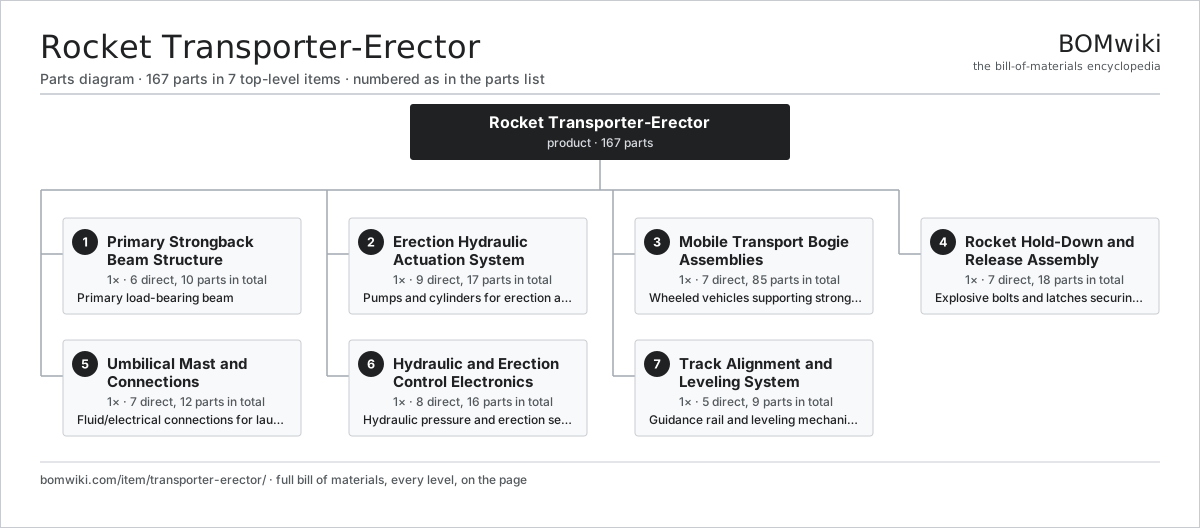
| # | Part | Qty | What it does |
|---|---|---|---|
| 1 | Primary Strongback Beam Structure 6 parts | 1× | Primary load-bearing beam |
| 2 | Erection Hydraulic Actuation System 9 parts | 1× | Pumps and cylinders for erection actuation |
| 3 | Mobile Transport Bogie Assemblies 7 parts | 1× | Wheeled vehicles supporting strongback |
| 4 | Rocket Hold-Down and Release Assembly 7 parts | 1× | Explosive bolts and latches securing rocket base |
| 5 | Umbilical Mast and Connections 7 parts | 1× | Fluid/electrical connections for launch pad transfer |
| 6 | Hydraulic and Erection Control Electronics 8 parts | 1× | Hydraulic pressure and erection sequencing control |
| 7 | Track Alignment and Leveling System 5 parts | 1× | Guidance rail and leveling mechanisms |
3D model
No 3D model yet. Have a CAD file of this? Add a 3D model. STL renders right on this page; STEP, FreeCAD, and OpenSCAD sources are welcome too (openly licensed, like all 3D models on BOMwiki).
Build & assembly graph
expand / collapse · shared sub-assemblies converge · links to related products · est. labourTap an assembly to expand/collapse · tap a part to open it · use “Open page” for any node · drag to pan, scroll to zoom.
Bill of materials for Rocket Transporter-Erector
7 top-level lines · 61 rows shown · 167 parts total · indented to 3 levels| # | Item / sub-assembly | Part no. | Qty/assy | Ext. qty | Parts | Type |
|---|---|---|---|---|---|---|
| 1 | Primary Strongback Beam Structure 6 parts | te-strongback-structure | 1× | 1 | 10 | assembly |
| 1.1 | Main Strongback Box Girder | te-main-beam | 1× | 1 | · | part |
| 1.2 | Lateral Support Beam | te-lateral-beams | 2× | 2 | · | part |
| 1.3 | Cross-Bracing Gusset Plate | te-cross-bracing | 1× | 1 | · | part |
| 1.4 | Rocket Interface Adapter Frame | te-rocket-interface-frame | 1× | 1 | · | part |
| 1.5 | Fastener Set | fastener-set | 4× | 4 | · | part |
| 1.6 | Cable Harness | cable-harness | 1× | 1 | · | part |
| 2 | Erection Hydraulic Actuation System 9 parts | te-hydraulic-system | 1× | 1 | 17 | assembly |
| 2.1 | Large Telescoping Hydraulic Cylinder | te-main-cylinder | 2× | 2 | · | part |
| 2.2 | Hydraulic Pump Unit | te-pump-assembly | 1× | 1 | · | part |
| 2.3 | Pilot-Operated Pressure Regulator | te-pressure-regulator | 1× | 1 | · | part |
| 2.4 | Proportional Directional Control Valve | te-directional-valve | 2× | 2 | · | part |
| 2.5 | Counterbalance Valve | te-counterbalance-valve | 2× | 2 | · | part |
| 2.6 | Bladder Accumulator | te-accumulator | 1× | 1 | · | part |
| 2.7 | Ductile Iron Valve Manifold | te-manifold-block | 1× | 1 | · | part |
| 2.8 | Connector | connector | 4× | 4 | · | part |
| 2.9 | High-Pressure Hydraulic Hose | hose-assembly | 3× | 3 | · | part |
| 3 | Mobile Transport Bogie Assemblies 7 parts | te-transport-bogies | 1× | 1 | 85 | assembly |
| 3.1 | Bogie Structural Frame | te-bogie-frame | 2× | 2 | · | part |
| 3.2 | Wheel Axle with Bearings | te-axle-assembly | 4× | 4 | · | part |
| 3.3 | Wheel Assembly 5 parts | wheel-assembly | 8× | 8 | 9 | assembly |
| 3.3.1 | Alloy Wheel | alloy-wheel | 1× | 8 | · | part |
| 3.3.2 | Tire | tire | 1× | 8 | · | part |
| 3.3.3 | TPMS Sensor | tpms-sensor | 1× | 8 | · | part |
| 3.3.4 | Lug Nut | lug-nut | 5× | 40 | · | part |
| 3.3.5 | Valve Stem | valve-stem | 1× | 8 | · | part |
| 3.4 | Bogie Drive Motor | te-motor-drive | 2× | 2 | · | part |
| 3.5 | Helical Gear Pair | gear-pair | 2× | 2 | · | part |
| 3.6 | Te Articulation Joint | transporter-erector-te-articulation-joint | 1× | 1 | · | part |
| 3.7 | Fastener Set | fastener-set | 2× | 2 | · | part |
| 4 | Rocket Hold-Down and Release Assembly 7 parts | te-hold-down-release | 1× | 1 | 18 | assembly |
| 4.1 | Mechanical Hold-Down Clamp | te-hold-down-bracket | 4× | 4 | · | part |
| 4.2 | Shaped-Charge Explosive Bolt | te-explosive-bolt | 4× | 4 | · | part |
| 4.3 | Dual-Channel Pyro Ignition Circuit | te-pyro-firing-circuit | 1× | 1 | · | part |
| 4.4 | Relay | relay | 2× | 2 | · | part |
| 4.5 | Hold-Down Release Limit Switch | te-position-switch | 4× | 4 | · | part |
| 4.6 | Connector | connector | 2× | 2 | · | part |
| 4.7 | Fastener Set | fastener-set | 1× | 1 | · | part |
| 5 | Umbilical Mast and Connections 7 parts | te-umbilical-interface | 1× | 1 | 12 | assembly |
| 5.1 | Umbilical Swing-Arm Boom | te-mast-boom | 1× | 1 | · | part |
| 5.2 | Cable Management Tray | te-cable-tray | 1× | 1 | · | part |
| 5.3 | Fluid Quick-Disconnect Coupler | te-quick-disconnect-fluid | 4× | 4 | · | part |
| 5.4 | Electrical Multi-Pin QD Connector | te-quick-disconnect-electric | 1× | 1 | · | part |
| 5.5 | Boom Retraction Actuator | te-retraction-motor | 1× | 1 | · | part |
| 5.6 | Connector | connector | 3× | 3 | · | part |
| 5.7 | Fastener Set | fastener-set | 1× | 1 | · | part |
| 6 | Hydraulic and Erection Control Electronics 8 parts | te-control-system | 1× | 1 | 16 | assembly |
| 6.1 | Programmable Logic Controller | te-plc-controller | 1× | 1 | · | part |
| 6.2 | Hydraulic Pressure Sensor | te-pressure-transducer | 4× | 4 | · | part |
| 6.3 | Strongback Angle Position Sensor | te-position-sensor | 2× | 2 | · | part |
| 6.4 | Proportional Valve Drive Amplifier | te-proportional-amplifier | 2× | 2 | · | part |
| 6.5 | Motor Control Relay Panel | relay-panel | 1× | 1 | · | part |
| 6.6 | Bare PCB | pcb-bare | 1× | 1 | · | part |
| 6.7 | Connector | connector | 4× | 4 | · | part |
| 6.8 | Power Supply | power-supply | 1× | 1 | · | part |
| 7 | Track Alignment and Leveling System 5 parts | te-rail-system | 1× | 1 | 9 | assembly |
| 7.1 | Launch Pad Guidance Rail | te-guidance-rail | 1× | 1 | · | part |
| 7.2 | Rail Engagement Lock Pin | te-rail-lock-pins | 4× | 4 | · | part |
| 7.3 | Gravity Pendulum Level Sensor | te-pendulum-level | 1× | 1 | · | part |
| 7.4 | Cross-Level Correction Cylinder | te-cross-level-actuator | 2× | 2 | · | part |
| 7.5 | Fastener Set | fastener-set | 1× | 1 | · | part |
Something wrong in this list? Report a problem with this BOM.
Related products
same domain, ranked by shared parts Solar Simulator
97 parts · shares 1 with this page
Solar Simulator
97 parts · shares 1 with this page
 Space Station Treadmill
151 parts · shares 2 with this page
Space Station Treadmill
151 parts · shares 2 with this page
 Sample Return Capsule
53 parts · shares 1 with this page
Sample Return Capsule
53 parts · shares 1 with this page
 Satellite Ground Station Antenna
274 parts · shares 1 with this page
Satellite Ground Station Antenna
274 parts · shares 1 with this page
 Satellite Laser Communication Terminal
197 parts · shares 1 with this page
Solar Sail Spacecraft
170 parts · shares 1 with this page
Satellite Laser Communication Terminal
197 parts · shares 1 with this page
Solar Sail Spacecraft
170 parts · shares 1 with this page
Sourcing: possible vendors
Browse the supplier directory → Prices, MOQ, and lead times are algorithmic estimates, not quotes, and not claims about these companies. Company mappings are curated by keyword; est. price band $50k–$500M. How estimates work| Vendor | HQ | Specialty | MOQ | Lead time |
|---|---|---|---|---|
|
🇺🇸SpaceX
spacex.com ↗
|
Hawthorne, US | Launch & spacecraft | made to order | 52–104 wks |
| northropgrumman.com ↗ | Falls Church, US | Space & defense | made to order | 52–104 wks |
|
🇫🇷Airbus
airbus.com ↗
|
Toulouse, FR | Aerospace OEM | made to order | 52–104 wks |
| rocketlabusa.com ↗ | Long Beach, US | Launch & spacecraft | made to order | 52–104 wks |
| thalesaleniaspace.com ↗ | Cannes, FR | Satellites | made to order | 52–104 wks |
1,684-word article