Tray Forming Machine
ProductOverview
A tray-forming machine heats plastic film roll and moulds it into shallow thermoformed trays for food packaging (ready meals, fresh produce, meat, pastries, bakery). The process, heating, forming, cooling, trimming and stacking, is highly automated and cost-effective for high-volume, low-variety production. Most machines use infra-red heating to soften plastic to pliability, a vacuum-assisted forming cavity to shape the tray, water cooling to set the form, and a trim station to remove excess webbing before ejecting. Tray formers are the backbone of fresh-food retail packaging in developed markets.
Film supply and tension
Plastic film comes on large rolls mounted on the Film Reel. An Unwind Motor with encoder feedback controls unwinding speed so the film advances at synchronisation with the forming cycle. A Tension Arm (a spring-loaded dancer) maintains constant tension, preventing slack or web flutter. Guide rollers keep the film path straight and centred through the Film Guide system before the film reaches the heating station.
Heating
The softened plastic is created by radiant heating: the Heating Station contains 6–8 quartz or ceramic Heating Element panels, each emitting far-infrared radiation down onto the film surface. Polished Heating Reflector panels above focus the heat downward. Surface temperature rises from ambient to 150–250 °C (depending on resin: polystyrene ~160 °C, PET ~210 °C, acrylic ~190 °C). A pair of Temperature Sensor infrared pyrometers measure film surface temperature and feed back to a Heating Controller that adjusts heater power via solid-state relays. The plastic becomes rubbery and plastic-deformable but not yet flowing.
Forming and vacuum
The softened film advances into the Forming Station. A precision cavity mould (the Cavity Mould) sits below, shaped to produce the desired tray. A heated Heating Platen (typically 40–80 °C, containing embedded Heater Cartridge elements and cooling channels) descends and clamps the film onto the mould opening. At this moment, a Vacuum Pump (rotary vane or piston type) rapidly evacuates air from beneath the film through the Vacuum Port passages in the platen and mould. Pressure drops to 500–800 mbar, and atmospheric pressure pushes the film down into every detail of the cavity, undercuts, ribs, corner detail, in 2–8 seconds depending on vacuum pump displacement and tray size. The forming clamp can be pneumatic or hydraulic.
Cooling and ejection
As soon as the film is drawn into the cavity shape, Mould Cooling System must chill the plastic to lock in the geometry. A Cooling Pump circulates chilled water (typically 15–25 °C) through galleries in the Cavity Mould and Heating Platen. Cooling time is 5–20 seconds: the film solidifies, regains rigidity, and heat transfer occurs at the mould surface. A Temperature Control monitors the coolant circuit and regulates flow or flow rate to keep cycle time consistent. Once cooled, the Forming Clamp opens, and ejector pins (the Ejector Pin array, typically 4–6 pins per tray) push the formed tray out of the cavity.
Trimming and stacking
The formed tray, still connected to excess film, advances onto the Trim Station. A sharp Trim Blade or a set of rotating shear blades trims the web close to the tray perimeter, separating the part from the scrap. The scrap is often collected in a grinding system and recycled into the resin feed. The trimmed tray is then conveyed by the Take-Away Conveyor to a Stacking Nest or downstream equipment (usually a thermoformer lid-former or a case packer loading tray/product combinations).
Synchronisation and control
All operations, film advance, heater modulation, vacuum timing, cooling, ejector action and trim, are orchestrated by a Control PLC running a cycle profile. A Main Drive (variable-frequency motor, reduction gearbox and timing belt) provides the heartbeat. Typically, the machine indexes one tray cavity worth of film per cycle; longer dwell times in heating, forming or cooling increase cycle time. The Control HMI displays throughput, cavity temperature, vacuum level and alarms. Operators input tray type (selecting a saved recipe) and the platen temperature, heater power, vacuum level and cooling flow auto-adjust.
Material and sustainability
Tray formers can run polystyrene (fast-cooling, very detailed), PET (heavier trays, better barrier), polypropylene (hinge-able lids), and increasingly recycled PET (rPET) and post-consumer resin (PCR). Multi-material laminates (PET/PE/barrier coatings) are common in premium fresh-food trays. Scrap re-grind, if clean, is usually fed back into the virgin resin or sold to compounders. Cycle time scales inversely with film thickness: thinner film cools faster.
Tray Forming Machine parts and their functions
10 top-level parts · 202 parts in total · full bill of materials below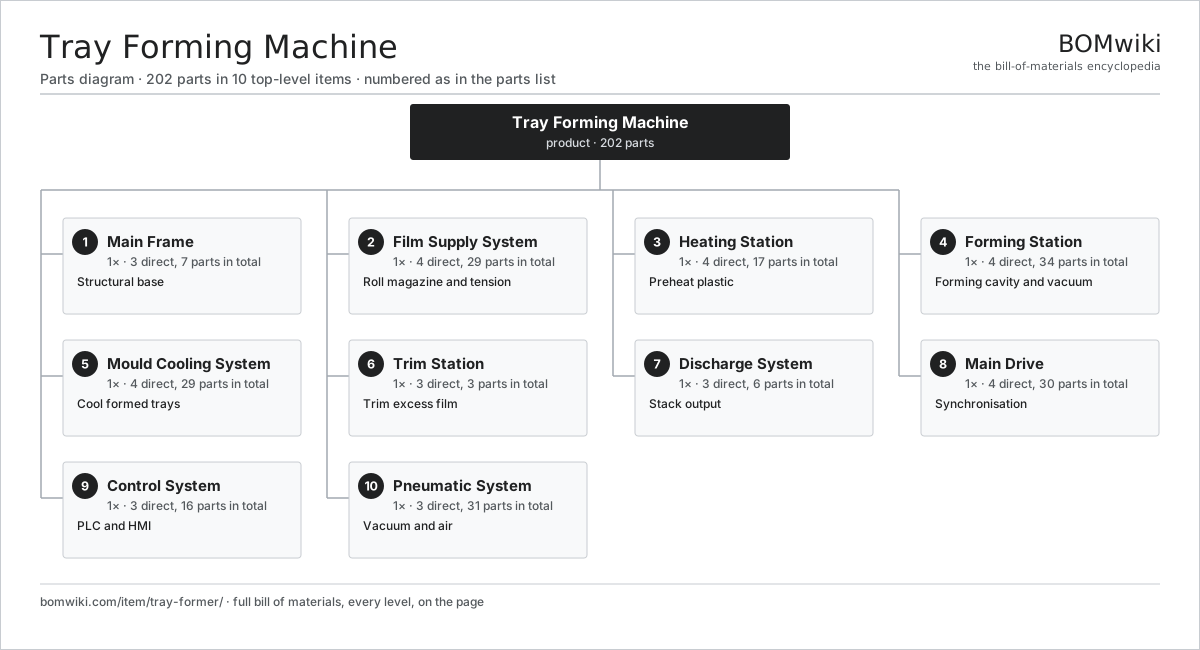
| # | Part | Qty | What it does |
|---|---|---|---|
| 1 | Main Frame 3 parts | 1× | Structural base |
| 2 | Film Supply System 4 parts | 1× | Roll magazine and tension |
| 3 | Heating Station 4 parts | 1× | Preheat plastic |
| 4 | Forming Station 4 parts | 1× | Forming cavity and vacuum |
| 5 | Mould Cooling System 4 parts | 1× | Cool formed trays |
| 6 | Trim Station 3 parts | 1× | Trim excess film |
| 7 | Discharge System 3 parts | 1× | Stack output |
| 8 | Main Drive 4 parts | 1× | Synchronisation |
| 9 | Control System 3 parts | 1× | PLC and HMI |
| 10 | Pneumatic System 3 parts | 1× | Vacuum and air |
3D model
No 3D model yet. Have a CAD file of this? Add a 3D model. STL renders right on this page; STEP, FreeCAD, and OpenSCAD sources are welcome too (openly licensed, like all 3D models on BOMwiki).
Build & assembly graph
expand / collapse · shared sub-assemblies converge · links to related products · est. labourTap an assembly to expand/collapse · tap a part to open it · use “Open page” for any node · drag to pan, scroll to zoom.
Bill of materials for Tray Forming Machine
10 top-level lines · 83 rows shown · 202 parts total · indented to 3 levels| # | Item / sub-assembly | Part no. | Qty/assy | Ext. qty | Parts | Type |
|---|---|---|---|---|---|---|
| 1 | Main Frame 3 parts | tray-former-main-frame | 1× | 1 | 7 | assembly |
| 1.1 | Side Frame | tray-former-side-frame | 2× | 2 | · | part |
| 1.2 | Cross Member | tray-former-cross-member | 4× | 4 | · | part |
| 1.3 | Base Casting | tray-former-base-casting | 1× | 1 | · | part |
| 2 | Film Supply System 4 parts | tray-former-film-supply | 1× | 1 | 29 | assembly |
| 2.1 | Film Reel | tray-former-film-reel | 1× | 1 | · | part |
| 2.2 | Unwind Motor 4 parts | tray-former-unwind-motor | 1× | 1 | 25 | assembly |
| 2.2.1 | Stator Assembly 3 parts + deeper › | stator-assembly | 1× | 1 | 3 | assembly |
| 2.2.2 | Rotor Assembly 4 parts + deeper › | rotor-assembly | 1× | 1 | 19 | assembly |
| 2.2.3 | Encoder | encoder | 1× | 1 | · | part |
| 2.2.4 | Ball Bearing | ball-bearing | 2× | 2 | · | part |
| 2.3 | Tension Arm | tray-former-tension-arm | 1× | 1 | · | part |
| 2.4 | Film Guide | tray-former-film-guide | 2× | 2 | · | part |
| 3 | Heating Station 4 parts | tray-former-heating-station | 1× | 1 | 17 | assembly |
| 3.1 | Heating Element | tray-former-heating-element | 8× | 8 | · | part |
| 3.2 | Heating Reflector | tray-former-heating-reflector | 2× | 2 | · | part |
| 3.3 | Temperature Sensor | tray-former-temperature-sensor | 2× | 2 | · | part |
| 3.4 | Heating Controller 4 parts | tray-former-heating-controller | 1× | 1 | 5 | assembly |
| 3.4.1 | Microcontroller | mcu | 1× | 1 | · | part |
| 3.4.2 | Bare PCB | pcb-bare | 1× | 1 | · | part |
| 3.4.3 | SMD Passive (R/C/L) | smd-passives | 1× | 1 | · | part |
| 3.4.4 | Relay | relay | 2× | 2 | · | part |
| 4 | Forming Station 4 parts | tray-former-forming-station | 1× | 1 | 34 | assembly |
| 4.1 | Heating Platen 3 parts | tray-former-heating-platen | 1× | 1 | 7 | assembly |
| 4.1.1 | Platen Block | tray-former-platen-block | 1× | 1 | · | part |
| 4.1.2 | Heater Cartridge | tray-former-heater-cartridge | 4× | 4 | · | part |
| 4.1.3 | Vacuum Port | tray-former-vacuum-port | 2× | 2 | · | part |
| 4.2 | Cavity Mould | tray-former-cavity-mold | 1× | 1 | · | part |
| 4.3 | Vacuum Pump 4 parts | tray-former-vacuum-pump | 1× | 1 | 25 | assembly |
| 4.3.1 | Stator Assembly 3 parts + deeper › | stator-assembly | 1× | 1 | 3 | assembly |
| 4.3.2 | Rotor Assembly 4 parts + deeper › | rotor-assembly | 1× | 1 | 19 | assembly |
| 4.3.3 | Ball Bearing | ball-bearing | 2× | 2 | · | part |
| 4.3.4 | O-Ring Set | oring-set | 1× | 1 | · | part |
| 4.4 | Forming Clamp | tray-former-forming-clamp | 1× | 1 | · | part |
| 5 | Mould Cooling System 4 parts | tray-former-mold-cooling | 1× | 1 | 29 | assembly |
| 5.1 | Cooling Pump 3 parts | tray-former-cooling-pump | 1× | 1 | 24 | assembly |
| 5.1.1 | Stator Assembly 3 parts + deeper › | stator-assembly | 1× | 1 | 3 | assembly |
| 5.1.2 | Rotor Assembly 4 parts + deeper › | rotor-assembly | 1× | 1 | 19 | assembly |
| 5.1.3 | Ball Bearing | ball-bearing | 2× | 2 | · | part |
| 5.2 | Heat Exchanger | tray-former-heat-exchanger | 1× | 1 | · | part |
| 5.3 | Cooling Manifold | tray-former-cooling-manifold | 1× | 1 | · | part |
| 5.4 | Temperature Control 3 parts | tray-former-temperature-control | 1× | 1 | 3 | assembly |
| 5.4.1 | Microcontroller | mcu | 1× | 1 | · | part |
| 5.4.2 | Pressure Sensor | pressure-sensor | 1× | 1 | · | part |
| 5.4.3 | Bare PCB | pcb-bare | 1× | 1 | · | part |
| 6 | Trim Station 3 parts | tray-former-trim-station | 1× | 1 | 3 | assembly |
| 6.1 | Trim Blade | tray-former-trim-blade | 1× | 1 | · | part |
| 6.2 | Trim Actuator | tray-former-trim-actuator | 1× | 1 | · | part |
| 6.3 | Trim Guide | tray-former-trim-guide | 1× | 1 | · | part |
| 7 | Discharge System 3 parts | tray-former-discharge | 1× | 1 | 6 | assembly |
| 7.1 | Ejector Pin | tray-former-ejector-pin | 4× | 4 | · | part |
| 7.2 | Take-Away Conveyor | tray-former-take-away-conveyor | 1× | 1 | · | part |
| 7.3 | Stacking Nest | tray-former-stacking-nest | 1× | 1 | · | part |
| 8 | Main Drive 4 parts | tray-former-main-drive | 1× | 1 | 30 | assembly |
| 8.1 | Main Motor 3 parts | tray-former-main-motor | 1× | 1 | 24 | assembly |
| 8.1.1 | Stator Assembly 3 parts + deeper › | stator-assembly | 1× | 1 | 3 | assembly |
| 8.1.2 | Rotor Assembly 4 parts + deeper › | rotor-assembly | 1× | 1 | 19 | assembly |
| 8.1.3 | Ball Bearing | ball-bearing | 2× | 2 | · | part |
| 8.2 | Reduction Gearbox | tray-former-reduction-gearbox | 1× | 1 | · | part |
| 8.3 | Timing Belt | tray-former-timing-belt | 1× | 1 | · | part |
| 8.4 | Ball Bearing | ball-bearing | 4× | 4 | · | part |
| 9 | Control System 3 parts | tray-former-control-system | 1× | 1 | 16 | assembly |
| 9.1 | Control PLC 4 parts | tray-former-control-plc | 1× | 1 | 11 | assembly |
| 9.1.1 | Microcontroller | mcu | 1× | 1 | · | part |
| 9.1.2 | Bare PCB | pcb-bare | 1× | 1 | · | part |
| 9.1.3 | Connector | connector | 8× | 8 | · | part |
| 9.1.4 | SMD Passive (R/C/L) | smd-passives | 1× | 1 | · | part |
| 9.2 | Control HMI 4 parts | tray-former-control-hmi | 1× | 1 | 4 | assembly |
| 9.2.1 | LCD Panel | lcd-panel | 1× | 1 | · | part |
| 9.2.2 | Touch Digitizer | touch-digitizer | 1× | 1 | · | part |
| 9.2.3 | Bare PCB | pcb-bare | 1× | 1 | · | part |
| 9.2.4 | Microcontroller | mcu | 1× | 1 | · | part |
| 9.3 | Safety Module | tray-former-safety-module | 1× | 1 | · | part |
| 10 | Pneumatic System 3 parts | tray-former-pneumatic-system | 1× | 1 | 31 | assembly |
| 10.1 | Air Compressor 4 parts | tray-former-air-compressor | 1× | 1 | 25 | assembly |
| 10.1.1 | Stator Assembly 3 parts + deeper › | stator-assembly | 1× | 1 | 3 | assembly |
| 10.1.2 | Rotor Assembly 4 parts + deeper › | rotor-assembly | 1× | 1 | 19 | assembly |
| 10.1.3 | Ball Bearing | ball-bearing | 2× | 2 | · | part |
| 10.1.4 | O-Ring Set | oring-set | 1× | 1 | · | part |
| 10.2 | Receiver Tank | tray-former-receiver-tank | 1× | 1 | · | part |
| 10.3 | Air Manifold 2 parts | tray-former-air-manifold | 1× | 1 | 5 | assembly |
| 10.3.1 | Relay | relay | 4× | 4 | · | part |
| 10.3.2 | Fastener Set | fastener-set | 1× | 1 | · | part |
Something wrong in this list? Report a problem with this BOM.
Related products
same domain, ranked by shared parts Aerosol Filling Machine
119 parts · shares 3 with this page
Aerosol Filling Machine
119 parts · shares 3 with this page
 Automatic Strapping Machine
251 parts · shares 3 with this page
Channel Letter Bender
196 parts · shares 3 with this page
Robotic Case Packing Cell
497 parts · shares 3 with this page
Thermoform-Fill-Seal Machine
364 parts · shares 3 with this page
Wraparound Case Packer
278 parts · shares 3 with this page
Automatic Strapping Machine
251 parts · shares 3 with this page
Channel Letter Bender
196 parts · shares 3 with this page
Robotic Case Packing Cell
497 parts · shares 3 with this page
Thermoform-Fill-Seal Machine
364 parts · shares 3 with this page
Wraparound Case Packer
278 parts · shares 3 with this page
Sourcing: possible vendors
Browse the supplier directory → Prices, MOQ, and lead times are algorithmic estimates, not quotes, and not claims about these companies. Company mappings are curated by keyword; est. price band $10k–$3M. How estimates work| Vendor | HQ | Specialty | MOQ | Lead time |
|---|---|---|---|---|
| heidelberg.com ↗ | Heidelberg, DE | Printing presses | 10 units | 12–22 wks |
|
🇨🇭Bobst
bobst.com ↗
|
Lausanne, CH | Packaging machinery | 10 units | 12–22 wks |
| koenig-bauer.com ↗ | Würzburg, DE | Printing presses | 10 units | 12–22 wks |
| wuh-group.com ↗ | Lengerich, DE | Flexible packaging machines | 10 units | 12–22 wks |
| markandy.com ↗ | Chesterfield, US | Label presses | 10 units | 12–22 wks |
806-word article