Tree Spade
ProductOverview
The tree spade is a hydraulic excavation tool mounted on a truck bed that excavates living trees from the ground with their root ball intact, enabling transplanting to new locations. The device combines four articulated hardened steel Spade Blade 1, Spade Blade 2, Spade Blade 3, and Spade Blade 4 spade blades that close around a tree trunk like a clam shell, cutting the root system and forming a soil ball. The Bucket Arms extend and angle the spade, while Hydraulic Control System proportional control valves allow precise operation from the truck's existing auxiliary hydraulic system.
Tree spades are employed in urban landscaping, highway infrastructure projects, and environmental restoration, enabling the relocation of established trees without sacrificing decades of growth. They are also used in tree farming to harvest nursery stock at sales size.
How it works
The truck operator positions the vehicle with the tree at the center of the Truck Mount Frame base mounting frame, which is bolted to the truck bed. The operator activates the truck's auxiliary hydraulic pump (40–80 liters/min @ 250 bar), supplying the Proportional Control Valve proportional control valve via the Hose Bundle.
Using a proportional joystick or lever mounted in the truck cabin, the operator first adjusts the Bucket Arms positioning. The tree-spade-arm-angle-cylinder angles the spade bucket to orient it vertically around the tree trunk. The tree-spade-arm-extend-cylinder then extends the spade to position the four blades approximately 500 mm from the tree base (the reach distance depends on tree size and soil type; typically 0.5–1.5 m circumference).
Once positioned, the operator engages the Master Blade Cylinder, a 100 mm bore master cylinder that closes all four blades simultaneously via a mechanical linkage. The Spade Blade 1 through Spade Blade 4 blades converge on the tree trunk, cutting downward and inward to sever the root system at a predetermined depth (typically 400–800 mm for established trees). Each blade is 1.2 m long and 400 mm wide, with hardened edges to penetrate rocky or clay soils.
As the blades close, they form a soil ball around the tree. Once the blades are fully closed (typically 30–60 seconds), the tree and its root ball are mechanically supported by the Blade Frame central pivot. The operator then retracts the tree-spade-arm-extend-cylinder, drawing the closed spade (with the tree inside) back toward the truck.
A second operator or assistant can then attach a chain hoist or use the truck's integrated crane to lift the tree from the spade bucket onto the truck bed. The soil ball, typically weighing 1–5 tonnes depending on tree size and soil type, is wrapped in burlap for transport.
At the transplant site, the process is reversed: the truck positions the spade over the prepared planting hole, lowers the tree, and opens the blades to release it. The entire cycle takes 15–30 minutes per tree depending on soil conditions and tree size.
Spade Bucket Design
The Spade Assembly is the core excavation tool. Four hardened steel blades, Spade Blade 1, Spade Blade 2, Spade Blade 3, and Spade Blade 4, are arranged radially around a Blade Frame central pivot block. Each blade is 1.2 m long and curved at the leading edge (toe) to penetrate soil with minimal resistance.
The blades are pinned to the central frame via Blade Pivot Pin hardened steel pins with bronze bushings, allowing free opening and closing motion. A Master Blade Cylinder master cylinder (100 mm bore, 600 mm stroke) is connected to the blades via a four-way mechanical linkage, ensuring all blades close in perfect synchronization.
Blade material is hardened alloy steel, typically 40–50 mm thick at the cutting edge, tapered to 15 mm at the base for stiffness. The leading edges are replaceable, bolted on with hardened fasteners, allowing field edge sharpening or replacement. A well-maintained blade set lasts 30–50 tree digs before requiring professional re-hardening.
The Blade Frame is a ductile iron block that houses all blade pivot points and the master cylinder mounting. It is designed to transmit the full excavation load (roots providing passive resistance as the spade digs) without deflection, maintaining round ball geometry.
Articulation and Control
The Bucket Arms consist of a tree-spade-arm-base-frame welded steel structure that attaches to the truck mount, two tree-spade-arm-extend-cylinder cylinders (90 mm bore, 1200 mm stroke) for bucket reach, and two tree-spade-arm-angle-cylinder cylinders (70 mm bore, 500 mm stroke) for bucket angle adjustment.
The proportional Proportional Control Valve in the Hydraulic Control System network allows independent control of arm extension, angle, and blade closure. A Flow Divider proportional unit ensures left and right arm extension cylinders advance synchronously, maintaining lateral balance.
Maximum reach is 3.5–4.5 m (fully extended), allowing the spade to be positioned around large or offset trees without repositioning the truck. Angle adjustment of ±45° fore and aft allows the operator to optimize spade orientation for sloped terrain or obstacle avoidance.
Truck Integration
The Truck Mount Frame is a bolted interface between the spade tool and the truck chassis. A Frame Base Plate (welded steel 2.0 m × 1.5 m) is bolted to the truck bed via existing tie-down points or custom bracket drilling. Two Vertical Column columns (200×200 mm steel tube) rise 2.0 m, supporting the Frame Crossbeam where the arm pivot pins attach.
The operator controls the spade via a proportional joystick or proportional lever connected to the truck's auxiliary hydraulic supply. Modern installations include onboard solenoid control valves fed by the truck's 12V electrical system, allowing remote proportional control from the cabin. The Proportional Control Valve responds to pilot pressure, modulating flow to each circuit.
The Hose Bundle connects the truck's auxiliary pump outlet to the proportional valve block mounted on tree-spade-valve-block-mount-plate. Total hose runs are typically 4–6 lines in a protective spiral wrap, routed along the truck frame to minimize snagging.
Soil and Root Considerations
Spade performance depends on soil type and root system structure. In loose sandy soils, a 600–800 mm excavation depth captures most fibrous roots. In clay or rocky soils, shallow digging (400 mm) may be necessary to avoid equipment damage, even though root recovery is reduced.
Tree size and age affect success. Trees smaller than 30 mm diameter may be extracted too easily, leaving insufficient soil ball; trees larger than 800 mm diameter require longer digging cycles and heavier equipment. Deciduous hardwoods (oak, maple, ash) hold soil in their root balls better than conifers (spruce, fir), allowing greater ball size and depth.
For tropical species with shallow root systems (e.g., mango, coconut), blade angle can be adjusted to follow the root spread, excavating shallow wide balls rather than deep narrow ones.
Applications and Performance
Modern tree spades are deployed in:
- Urban street tree transplanting (moving mature specimens to improve aesthetics or repair infrastructure damage)
- Highway expansion projects (preserving landmark or protected trees)
- Reforestation of native species (harvesting from nurseries at mature size)
- Environmental restoration (relocating trees to adjacent land during construction)
A skilled operator can transplant 8–12 trees per day under good soil conditions, or 3–5 per day in difficult rocky terrain. Success rate (tree survival one year post-transplanting) is 85–95% for species suited to the climatic zone, versus 40–60% for bare-root or conventional balled-and-burlapped stock.
Manufacturers like Bobcat, Vermeer, and Finn produce tree spade attachments as standard mounted tooling, ensuring compatibility with common truck chassis and hydraulic systems.
Tree Spade parts and their functions
5 top-level parts · 29 parts in total · full bill of materials below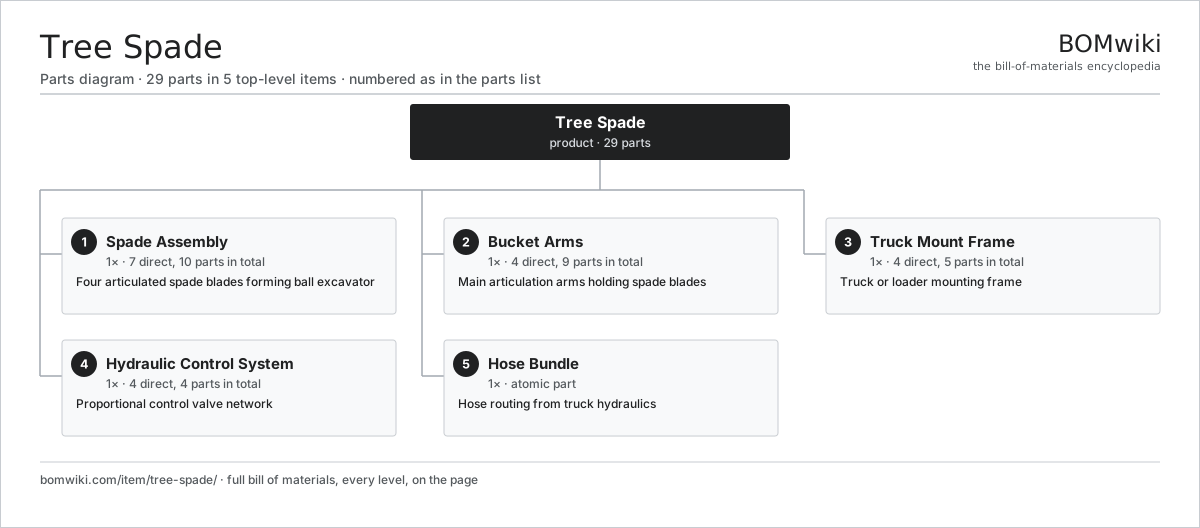
| # | Part | Qty | What it does |
|---|---|---|---|
| 1 | Spade Assembly 7 parts | 1× | Four articulated spade blades forming ball excavator |
| 2 | Bucket Arms 4 parts | 1× | Main articulation arms holding spade blades |
| 3 | Truck Mount Frame 4 parts | 1× | Truck or loader mounting frame |
| 4 | Hydraulic Control System 4 parts | 1× | Proportional control valve network |
| 5 | Hose Bundle | 1× | Hose routing from truck hydraulics |
3D model
No 3D model yet. Have a CAD file of this? Add a 3D model. STL renders right on this page; STEP, FreeCAD, and OpenSCAD sources are welcome too (openly licensed, like all 3D models on BOMwiki).
Build & assembly graph
expand / collapse · shared sub-assemblies converge · links to related products · est. labourTap an assembly to expand/collapse · tap a part to open it · use “Open page” for any node · drag to pan, scroll to zoom.
Bill of materials for Tree Spade
5 top-level lines · 24 rows shown · 29 parts total · indented to 3 levels| # | Item / sub-assembly | Part no. | Qty/assy | Ext. qty | Parts | Type |
|---|---|---|---|---|---|---|
| 1 | Spade Assembly 7 parts | tree-spade-spade-assembly | 1× | 1 | 10 | assembly |
| 1.1 | Blade Frame | tree-spade-blade-frame | 1× | 1 | · | part |
| 1.2 | Spade Blade 1 | tree-spade-blade-section-1 | 1× | 1 | · | part |
| 1.3 | Spade Blade 2 | tree-spade-blade-section-2 | 1× | 1 | · | part |
| 1.4 | Spade Blade 3 | tree-spade-blade-section-3 | 1× | 1 | · | part |
| 1.5 | Spade Blade 4 | tree-spade-blade-section-4 | 1× | 1 | · | part |
| 1.6 | Master Blade Cylinder | tree-spade-blade-cylinder | 1× | 1 | · | part |
| 1.7 | Blade Pivot Pin | tree-spade-blade-pivot | 4× | 4 | · | part |
| 2 | Bucket Arms 4 parts | tree-spade-bucket-arms | 1× | 1 | 9 | assembly |
| 2.1 | Arm Base Frame | tree-spade-arm-base | 1× | 1 | · | part |
| 2.2 | Arm Extend Cylinder | tree-spade-arm-extend | 2× | 2 | · | part |
| 2.3 | Arm Angle Cylinder | tree-spade-arm-angle | 2× | 2 | · | part |
| 2.4 | Arm Articulation Pin | tree-spade-arm-pin | 4× | 4 | · | part |
| 3 | Truck Mount Frame 4 parts | tree-spade-frame-mount | 1× | 1 | 5 | assembly |
| 3.1 | Frame Base Plate | tree-spade-frame-base-plate | 1× | 1 | · | part |
| 3.2 | Vertical Column | tree-spade-frame-vertical | 2× | 2 | · | part |
| 3.3 | Frame Crossbeam | tree-spade-frame-crossbeam | 1× | 1 | · | part |
| 3.4 | Valve Block Mount Plate | tree-spade-valve-block-mount | 1× | 1 | · | part |
| 4 | Hydraulic Control System 4 parts | tree-spade-hydraulics | 1× | 1 | 4 | assembly |
| 4.1 | Proportional Control Valve | tree-spade-proportional-valve | 1× | 1 | · | part |
| 4.2 | Pressure Relief | tree-spade-pressure-relief | 1× | 1 | · | part |
| 4.3 | Flow Divider | tree-spade-flow-divider | 1× | 1 | · | part |
| 4.4 | Pilot Solenoid Valve | tree-spade-pilot-valve | 1× | 1 | · | part |
| 5 | Hose Bundle | tree-spade-hoses-bundle | 1× | 1 | · | part |
Something wrong in this list? Report a problem with this BOM.
Sourcing: possible vendors
Browse the supplier directory → Prices, MOQ, and lead times are algorithmic estimates, not quotes, and not claims about these companies. Company mappings are curated by keyword; est. price band $5k–$800k. How estimates work| Vendor | HQ | Specialty | MOQ | Lead time |
|---|---|---|---|---|
| deere.com ↗ | Moline, US | Agriculture & turf | made to order | 14–24 wks |
| cnh.com ↗ | Basildon, GB | Agriculture (Case IH, New Holland) | made to order | 14–24 wks |
|
🇺🇸AGCO
agcocorp.com ↗
|
Duluth, US | Agriculture (Fendt, Massey Ferguson) | made to order | 14–24 wks |
|
🇩🇪Claas
claas.com ↗
|
Harsewinkel, DE | Harvesters & tractors | made to order | 14–24 wks |
|
🇯🇵Kubota
kubota.com ↗
|
Osaka, JP | Compact tractors & equipment | made to order | 14–24 wks |
1,334-word article