Truck Scale (Weighbridge)
ProductOverview
A truck scale (or weighbridge) is a large platform scale designed to weigh fully-loaded vehicles up to 120 metric tons while they drive onto the deck. Used extensively in quarries, recycling centers, scrap yards, and commodity trading facilities, truck scales are rugged, stationary instruments that provide high accuracy and repeatability over millions of weighing cycles.
The scale comprises a modular steel frame and concrete deck platform mounted on four to eight load cells positioned at the corners and mid-points. Each load cell measures the portion of the vehicle's weight it supports, and their summed signals produce the total weight. A weighing terminal displays the result, logs the transaction, and optionally prints a weight ticket.
The design prioritizes durability and low maintenance. The steel structure and concrete wearing surface withstand millions of axle passes, while the load cells are sealed against water and dust. The junction box conditions and sums the weak 4–20 mA signals from the load cells, and the terminal manages user interaction, calibration, and data export.
How it Works
When a truck drives onto the deck, its weight is distributed across the platform to the load cells beneath. Each cell experiences a bending strain proportional to the load at that corner. The strain gauge bridge in the load cell outputs a current (typically 4–20 mA) that increases with load.
The Junction Box Assembly receives these four or eight analog signals via shielded twisted-pair cables. A summing amplifier (typically a precision instrumentation amp) adds them together, producing a single 0–10 V analog signal proportional to total weight. The Weighing Terminal receives this voltage, converts it via a 12- or 16-bit A/D converter, and applies calibration coefficients (span and zero trim) stored in non-volatile memory.
The indicator CPU performs additional filtering to reject vibration harmonics (a 50 Hz notch filter is common to eliminate mains hum coupling), applies a low-pass filter (typically 30–50 Hz corner frequency), and averages the result over 1–2 seconds to stabilize the display. The operator sees a steady weight; pressing "Print" sends the current weight, timestamp, and item ID to the optional Thermal Printer or to a remote database via Ethernet.
Structural & Mechanical
The Deck Structure is composed of modular sections: a welded structural steel frame (typically I-beams or box section, Grade 50 steel) with a wearing surface of pre-cast reinforced concrete modules (150–300 mm thick) bolted on top. Expansion joints between modules accommodate thermal growth; a 24 m span can expand by ±5 mm over a 60 °C temperature swing.
The Load Cell Array are mounted on elastomeric pads (natural rubber or neoprene) at the base of the frame, isolated from the deck superstructure by pivot blocks. This isolation allows the deck to flex slightly without introducing parasitic loads into the cells, and it decouples vibration from the measurement. Each cell is sealed with a weatherproof cover and IP67-rated cable glands to prevent water ingress.
The Foundation & Leveling is typically a reinforced concrete pit (1.5–3 m deep) sunk into the ground, allowing the deck to sit near grade level. Alternatively, surface-mounted scales rest on concrete pads. Leveling shims (stainless steel and elastomer) are inserted between the deck frame and foundation to correct slope and ensure equal load sharing among the four or eight load cells. Proper leveling is critical: a 2 mm tilt can introduce 1–2% error if not corrected.
Electrical & Control
Power is typically 230 V AC, 1–3 kVA, fed via a three-phase or single-phase mains plug to the Weighing Terminal enclosure. The terminal houses the indicator CPU, display, and optional thermal printer. The terminal is NEMA 4X (IP65) stainless steel 304, with drain holes and cable glands, measuring roughly 600 × 400 × 250 mm.
Signals from the Load Cell Array are cabled via 100–200 m runs of shielded 4–20 mA twisted-pair (Belden-grade) to the Junction Box Assembly, typically mounted in a weatherproof enclosure near the scale. The junction box sums the four or eight analog inputs, filters them, and outputs a clean 0–10 V signal back to the terminal.
The terminal CPU is a real-time embedded microcontroller (e.g., ARM Cortex-M4 or equivalent) running a field-proven kernel or custom RTOS. It performs A/D conversion, applies calibration coefficients, logs transactions to flash memory, and communicates with external systems via Ethernet (RJ45), USB, or optional GSM modem. Weight data is typically stored in a local SQLite database or transmitted in real-time to a remote server.
Calibration & Accuracy
Truck scales are calibrated using certified test weights conforming to ASTM Class 1 or OIML M2 standards. A technician places known weights on the deck incrementally, recording the displayed weight and comparing it to the nominal load. Calibration corrections (span and zero trim) are entered via the terminal keypad and stored in the CPU's non-volatile memory.
Accuracy is specified as ±0.5% for a Class 2 scale (OIML-defined). This means a 100 MT load can weigh anywhere from 99.5 to 100.5 MT on the display. Repeatability is typically ±0.3%; the same load weighed ten times in a row will vary by less than 0.3%.
Maintenance involves periodic recalibration (annually or every 2–3 years, depending on usage), visual inspection of the load cells and cables for damage, and testing of the connector seals. Load cells typically last 10–15 years before creep or fatigue requires replacement.
Applications
Truck scales are used in a wide variety of industries:
- Mining & Quarrying: Weighing loaded haul trucks to optimize payload and prevent overloading.
- Recycling: Measuring incoming scrap metal, plastic, or construction waste by the ton.
- Agriculture: Weighing grain, fertilizer, and hay at harvest or sale.
- Waste Management: Recording tipping fees at landfills and transfer stations.
- Commodities Trading: Verifying contractual weights for bulk materials (sand, gravel, coal, ore).
- Port & Logistics: Weighing shipping containers and vehicles at distribution hubs.
Regulatory classes (OIML R76 for vehicle scales) define maximum permitted errors; many jurisdictions require annual inspection and certification for trade-weighted scales.
Related Reading
See also Load Cell Array, Weighing Terminal, and Junction Box Assembly for technical detail on individual subsystems.
Truck Scale (Weighbridge) parts and their functions
8 top-level parts · 31 parts in total · full bill of materials below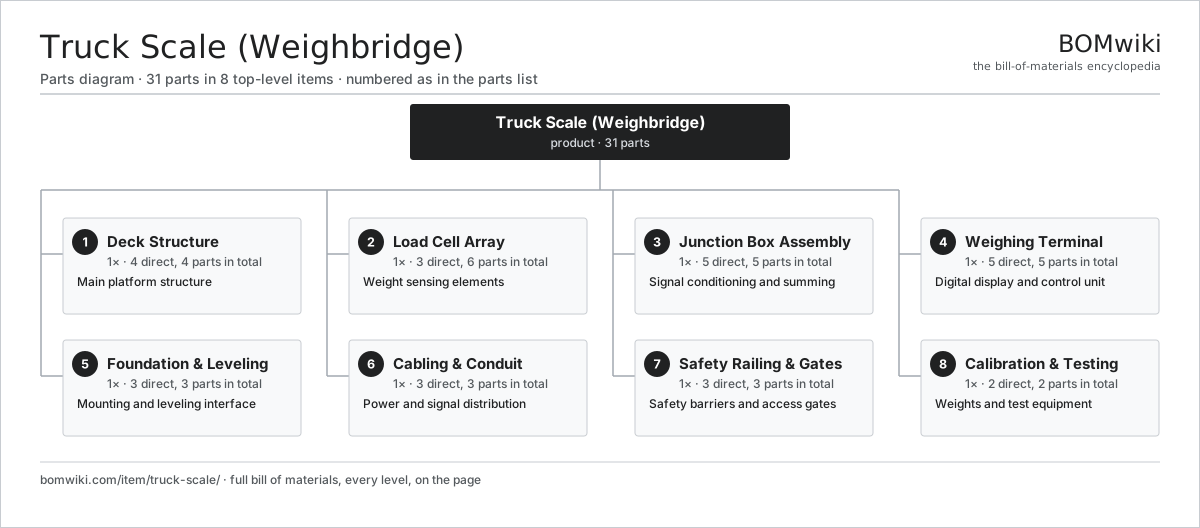
| # | Part | Qty | What it does |
|---|---|---|---|
| 1 | Deck Structure 4 parts | 1× | Main platform structure |
| 2 | Load Cell Array 3 parts | 1× | Weight sensing elements |
| 3 | Junction Box Assembly 5 parts | 1× | Signal conditioning and summing |
| 4 | Weighing Terminal 5 parts | 1× | Digital display and control unit |
| 5 | Foundation & Leveling 3 parts | 1× | Mounting and leveling interface |
| 6 | Cabling & Conduit 3 parts | 1× | Power and signal distribution |
| 7 | Safety Railing & Gates 3 parts | 1× | Safety barriers and access gates |
| 8 | Calibration & Testing 2 parts | 1× | Weights and test equipment |
3D model
No 3D model yet. Have a CAD file of this? Add a 3D model. STL renders right on this page; STEP, FreeCAD, and OpenSCAD sources are welcome too (openly licensed, like all 3D models on BOMwiki).
Build & assembly graph
expand / collapse · shared sub-assemblies converge · links to related products · est. labourTap an assembly to expand/collapse · tap a part to open it · use “Open page” for any node · drag to pan, scroll to zoom.
Bill of materials for Truck Scale (Weighbridge)
8 top-level lines · 36 rows shown · 31 parts total · indented to 3 levels| # | Item / sub-assembly | Part no. | Qty/assy | Ext. qty | Parts | Type |
|---|---|---|---|---|---|---|
| 1 | Deck Structure 4 parts | truck-scale-deck | 1× | 1 | 4 | assembly |
| 1.1 | Steel Frame | truck-scale-steel-frame | 1× | 1 | · | part |
| 1.2 | Concrete Deck Modules | truck-scale-concrete-modules | 1× | 1 | · | part |
| 1.3 | Deck Fasteners | truck-scale-deck-fasteners | 1× | 1 | · | part |
| 1.4 | Expansion Joint | truck-scale-expansion-joint | 1× | 1 | · | part |
| 2 | Load Cell Array 3 parts | truck-scale-load-cells | 1× | 1 | 6 | assembly |
| 2.1 | Shear Beam Load Cell | truck-scale-load-cell-unit | 4× | 4 | · | part |
| 2.2 | Load Cell Mounting | truck-scale-cell-mounting | 1× | 1 | · | part |
| 2.3 | Cell Protection Kit | truck-scale-cell-protection | 1× | 1 | · | part |
| 3 | Junction Box Assembly 5 parts | truck-scale-junction-box | 1× | 1 | 5 | assembly |
| 3.1 | Summing Amplifier Board | truck-scale-summing-board | 1× | 1 | · | part |
| 3.2 | Buffer Amplifier | truck-scale-buffer-amp | 1× | 1 | · | part |
| 3.3 | Filter & Damping | truck-scale-filter-network | 1× | 1 | · | part |
| 3.4 | Calibration Trim | truck-scale-calibration-trim | 1× | 1 | · | part |
| 3.5 | Connector | connector | 1× | 1 | · | part |
| 4 | Weighing Terminal 5 parts | truck-scale-terminal | 1× | 1 | 5 | assembly |
| 4.1 | Terminal Enclosure | truck-scale-terminal-enclosure | 1× | 1 | · | part |
| 4.2 | LCD Weighing Indicator | truck-scale-display-unit | 1× | 1 | · | part |
| 4.3 | Indicator CPU Module | truck-scale-terminal-cpu | 1× | 1 | · | part |
| 4.4 | Thermal Printer | truck-scale-printer-module | 1× | 1 | · | part |
| 4.5 | Communications Module | truck-scale-comms-card | 1× | 1 | · | part |
| 5 | Foundation & Leveling 3 parts | truck-scale-foundation | 1× | 1 | 3 | assembly |
| 5.1 | Foundation Pit or Pads | truck-scale-foundation-pit | 1× | 1 | · | part |
| 5.2 | Leveling Shim Packs | truck-scale-leveling-shims | 1× | 1 | · | part |
| 5.3 | Anchor Bolts | truck-scale-anchor-bolts | 1× | 1 | · | part |
| 6 | Cabling & Conduit 3 parts | truck-scale-cabling | 1× | 1 | 3 | assembly |
| 6.1 | Signal Cables | truck-scale-signal-cables | 1× | 1 | · | part |
| 6.2 | Power Cables | truck-scale-power-cables | 1× | 1 | · | part |
| 6.3 | Conduit & Ducting | truck-scale-conduit-system | 1× | 1 | · | part |
| 7 | Safety Railing & Gates 3 parts | truck-scale-railing | 1× | 1 | 3 | assembly |
| 7.1 | Rail Posts | truck-scale-rail-posts | 1× | 1 | · | part |
| 7.2 | Rail Panels | truck-scale-rail-panels | 1× | 1 | · | part |
| 7.3 | Access Gate Assembly | truck-scale-access-gate | 1× | 1 | · | part |
| 8 | Calibration & Testing 2 parts | truck-scale-calibration | 1× | 1 | 2 | assembly |
| 8.1 | Test Weights | truck-scale-test-weights | 1× | 1 | · | part |
| 8.2 | Calibration Manual | truck-scale-calibration-manual | 1× | 1 | · | part |
Something wrong in this list? Report a problem with this BOM.
Sourcing: possible vendors
Browse the supplier directory → Prices, MOQ, and lead times are algorithmic estimates, not quotes, and not claims about these companies. Company mappings are curated by keyword; est. price band $2k–$300k. How estimates work| Vendor | HQ | Specialty | MOQ | Lead time |
|---|---|---|---|---|
| toyota-industries.com ↗ | Kariya, JP | Forklifts & logistics | 20 units | 10–16 wks |
| kiongroup.com ↗ | Frankfurt, DE | Forklifts (Linde, STILL) | 20 units | 10–16 wks |
| jungheinrich.com ↗ | Hamburg, DE | Warehouse trucks | 20 units | 10–16 wks |
| crown.com ↗ | New Bremen, US | Forklifts | 20 units | 10–16 wks |
|
🇨🇳Hangcha
hcforklift.com ↗
|
Hangzhou, CN | Forklifts & material handling | 20 units | 10–16 wks |
1,050-word article