Tuba
ProductOverview
The tuba is the contrabass voice of the brass family, providing the foundation of orchestras, wind bands, and brass ensembles. Patented in 1835 by Wilhelm Wieprecht and Johann Moritz in Berlin as the "bass tuba," it replaced the ophicleide and serpent within a generation because its valves gave a fully chromatic, evenly voiced bass. A BB-flat contrabass tuba coils roughly 5.5 m of tubing into an upright body about a meter tall and weighs 8–14 kg; its lowest fundamental, B-flat0, lies near 29 Hz.
Like all brass instruments the tuba is a lip-reed: the player's buzzing lips against the Mouthpiece modulate airflow into the tube, and the resonances of the air column lock the buzz to discrete pitches of the harmonic series. The tuba's bore is wide and mostly conical, expanding from about 13 mm at the Leadpipe to as much as half a meter at the Bell Flare, which favors strong fundamentals and the round, non-edgy tone the part demands.
How it works
Valves make the instrument chromatic. Most American tubas use top-action piston valves: each Piston Valve, a Monel-clad cylinder drilled with curved ports, travels about 18 mm inside its honed Valve Casing. Up, the ports pass air straight through; pressed, they divert it through the valve's extra loop. A Coil Spring returns the piston, a Valve Guide keeps it from rotating out of port alignment, and Valve Felt washers silence and index the stroke between the Valve Top Cap and Valve Bottom Cap. Many European and rotary-model instruments substitute rotary valves operated by paddles, with the same plumbing logic.
Valves 1, 2, and 3 add tubing for a tone, semitone, and tone-and-a-half. Combinations come up short of theoretical length, so serious instruments carry a fourth valve, tuned to a perfect fourth, which both fixes the badly sharp 1+3 combination and opens the register below E1; orchestral tubas often add a fifth or sixth valve for further intonation control. Each loop is trimmed by its Valve Slide, overall pitch by the Main Tuning Slide, and players commonly adjust the first-valve slide while playing.
The tube run from valves to bell passes through expanding Inner Branch sections, around the sheet-formed Outer Bows at the top and bottom of the coil, and up the Bell Stack to the flare. The bell does the final impedance matching between the air column and the room; its rim is rolled around a Bell Rim Wire for stiffness. With cold breath flowing through five meters of brass, condensation is constant, drained at two Water Keys.
Construction
Bows and the bell are made from sheet brass: blanks are cut, formed in halves or gusseted cones, brazed along the seam, then hammered and spun on mandrels to final shape. Cylindrical sections are drawn tube bent on ice- or pitch-filled mandrels to avoid kinking. The assembly is held by soldered Braces, with Guard Plates at wear points and Slide Ferrules reinforcing the slide joints; Knuckles connect casings to branches. Finishes are clear lacquer or silver plate. Bodies of yellow brass (70/30) sound brighter; gold brass (85/15) warmer.
The Mouthpiece is the largest of the standard brass family, with a rim inner diameter near 32 mm and a deep cup feeding a backbore that blends into the leadpipe taper. Rim and cup dimensions trade endurance against low-register response, and tubists typically keep separate mouthpieces for orchestral and solo work.
Variants
Tubas come in pairs of registers: contrabass instruments in BB-flat (band standard) and CC (American orchestral standard), and bass tubas in E-flat (British brass band) and F (German orchestral and solo work). The sousaphone is a tuba re-coiled to wrap around a marching player's body with a forward bell, developed for John Philip Sousa's band in the 1890s. The euphonium and baritone horn are smaller conical-bore relatives an octave above the contrabass. Recording-bell models with detachable forward bells, and travel instruments in fiberglass, fill out the family.
Tuba parts and their functions
6 top-level parts · 80 parts in total · full bill of materials below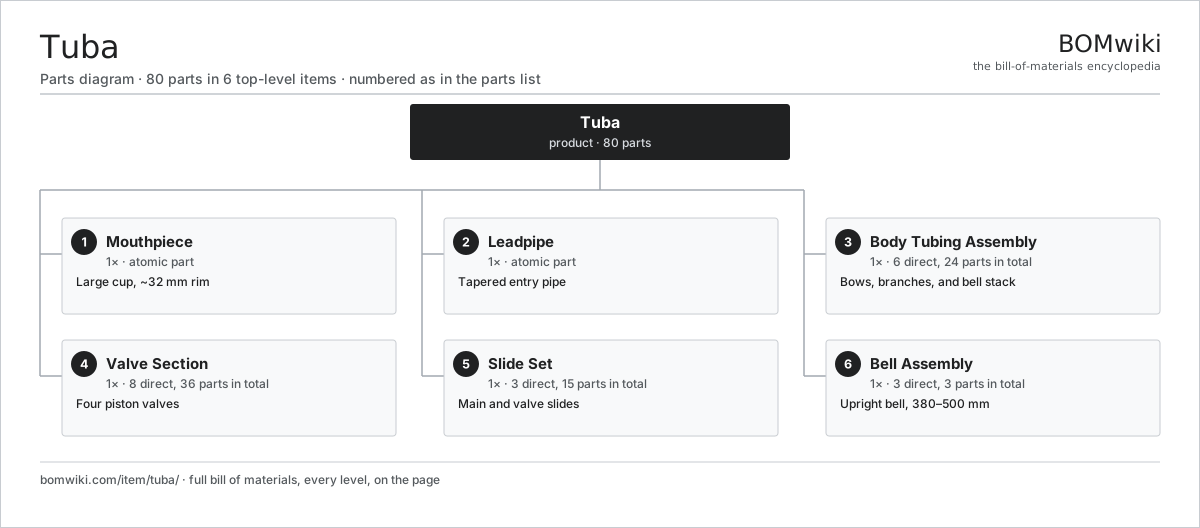
| # | Part | Qty | What it does |
|---|---|---|---|
| 1 | Mouthpiece | 1× | Large cup, ~32 mm rim |
| 2 | Leadpipe | 1× | Tapered entry pipe |
| 3 | Body Tubing Assembly 6 parts | 1× | Bows, branches, and bell stack |
| 4 | Valve Section 8 parts | 1× | Four piston valves |
| 5 | Slide Set 3 parts | 1× | Main and valve slides |
| 6 | Bell Assembly 3 parts | 1× | Upright bell, 380–500 mm |
3D model
No 3D model yet. Have a CAD file of this? Add a 3D model. STL renders right on this page; STEP, FreeCAD, and OpenSCAD sources are welcome too (openly licensed, like all 3D models on BOMwiki).
Build & assembly graph
expand / collapse · shared sub-assemblies converge · links to related products · est. labourTap an assembly to expand/collapse · tap a part to open it · use “Open page” for any node · drag to pan, scroll to zoom.
Bill of materials for Tuba
6 top-level lines · 26 rows shown · 80 parts total · indented to 3 levels| # | Item / sub-assembly | Part no. | Qty/assy | Ext. qty | Parts | Type |
|---|---|---|---|---|---|---|
| 1 | Mouthpiece | tuba-mouthpiece | 1× | 1 | · | part |
| 2 | Leadpipe | tuba-leadpipe | 1× | 1 | · | part |
| 3 | Body Tubing Assembly 6 parts | tuba-body-tubing | 1× | 1 | 24 | assembly |
| 3.1 | Outer Bow | tuba-outer-bow | 2× | 2 | · | part |
| 3.2 | Inner Branch | tuba-inner-branch | 4× | 4 | · | part |
| 3.3 | Knuckle | tuba-knuckle | 6× | 6 | · | part |
| 3.4 | Brace | tuba-brace | 8× | 8 | · | part |
| 3.5 | Water Key | tuba-water-key | 2× | 2 | · | part |
| 3.6 | Guard Plate | tuba-guard-plate | 2× | 2 | · | part |
| 4 | Valve Section 8 parts | tuba-valve-section | 1× | 1 | 36 | assembly |
| 4.1 | Piston Valve | tuba-piston | 4× | 4 | · | part |
| 4.2 | Valve Casing | tuba-valve-casing | 4× | 4 | · | part |
| 4.3 | Finger Button | tuba-finger-button | 4× | 4 | · | part |
| 4.4 | Valve Guide | tuba-valve-guide | 4× | 4 | · | part |
| 4.5 | Coil Spring | coil-spring | 4× | 4 | · | part |
| 4.6 | Valve Felt | tuba-valve-felt | 8× | 8 | · | part |
| 4.7 | Valve Top Cap | tuba-top-cap | 4× | 4 | · | part |
| 4.8 | Valve Bottom Cap | tuba-bottom-cap | 4× | 4 | · | part |
| 5 | Slide Set 3 parts | tuba-slide-set | 1× | 1 | 15 | assembly |
| 5.1 | Main Tuning Slide | tuba-main-slide | 1× | 1 | · | part |
| 5.2 | Valve Slide | tuba-valve-slide | 4× | 4 | · | part |
| 5.3 | Slide Ferrule | tuba-slide-ferrule | 10× | 10 | · | part |
| 6 | Bell Assembly 3 parts | tuba-bell-assembly | 1× | 1 | 3 | assembly |
| 6.1 | Bell Flare | tuba-bell-flare | 1× | 1 | · | part |
| 6.2 | Bell Stack | tuba-bell-stack | 1× | 1 | · | part |
| 6.3 | Bell Rim Wire | tuba-bell-rim-wire | 1× | 1 | · | part |
Something wrong in this list? Report a problem with this BOM.
Related products
same domain, ranked by shared parts Bb Trumpet
74 parts · shares 1 with this page
Bb Trumpet
74 parts · shares 1 with this page
 Concert Pedal Harp
554 parts · shares 1 with this page
Concert Pedal Harp
554 parts · shares 1 with this page
 Digital Piano
689 parts · shares 1 with this page
Digital Piano
689 parts · shares 1 with this page
 Drum Kit
226 parts · shares 1 with this page
Drum Kit
226 parts · shares 1 with this page
 Electric Guitar
133 parts · shares 1 with this page
Electric Guitar
133 parts · shares 1 with this page
 Electronic Drum Kit
336 parts · shares 1 with this page
Electronic Drum Kit
336 parts · shares 1 with this page
Sourcing: possible vendors
Browse the supplier directory → Prices, MOQ, and lead times are algorithmic estimates, not quotes, and not claims about these companies. Company mappings are curated by keyword; est. price band $50–$5k. How estimates work| Vendor | HQ | Specialty | MOQ | Lead time |
|---|---|---|---|---|
| yamaha.com ↗ | Hamamatsu, JP | Audio & instruments | 200 units | 8–14 wks |
|
🇺🇸Fender
fender.com ↗
|
Los Angeles, US | Guitars & amps | 200 units | 8–14 wks |
|
🇺🇸Gibson
gibson.com ↗
|
Nashville, US | Guitars | 200 units | 8–14 wks |
|
🇯🇵Roland
roland.com ↗
|
Hamamatsu, JP | Electronic instruments | 200 units | 8–14 wks |
| steinway.com ↗ | New York, US | Pianos | 200 units | 8–14 wks |
702-word article