Turbocharger
ProductOverview
A turbocharger is an exhaust-driven air compressor that increases the mass flow of oxygen-rich air into an engine's cylinders, enabling higher fuel burn and greater power output without increasing engine displacement. Modern turbocharged engines deliver 30–50% more power than naturally aspirated equivalents of the same size, making them essential for fuel economy regulations while maintaining performance.
The turbo operates as a heat engine in reverse: exhaust gas (800–950°C) expands through a turbine wheel mounted on a shared rotor shaft, spinning at 80,000–200,000 rpm. This mechanical energy is transferred to a compressor wheel on the same shaft, which compresses incoming air to 1.5–3 bar absolute pressure before it enters the cylinders. A floating bearing cartridge lubricated by engine oil supports the rotor, and a pneumatic wastegate valve regulates boost pressure by diverting excess exhaust around the turbine.
How It Works
Exhaust gas from the engine's cylinders (900–950°C peak) flows through the engine's exhaust manifold and enters the turbocharger at the Turbine Housing. This casting is a spiral volute, a tapered channel that directs gas tangentially at high velocity onto the Turbine Impeller, a small, curved-blade impeller (30–50 mm tip diameter) cast from nickel-steel to withstand thermal cycling and stress.
The turbine wheel has typically 4–6 blades optimized for extracting energy from hot, fast-moving exhaust. As gas expands across the blade passages (dropping pressure 3–6x), it pushes the blades tangentially, imparting angular momentum to the Common Rotor Shaft. The rotor accelerates rapidly, reaching 80,000 rpm in 0.5 seconds at full load, and peaking at 200,000 rpm or higher under extreme boost conditions.
The Common Rotor Shaft is rigidly coupled to the Compressor Impeller on the opposite end, a larger aluminum impeller (50–80 mm tip diameter) with 5–8 forward-swept blades. As the rotor spins, the compressor wheel acts as a centrifugal pump: inlet air (from the filtered intake) is drawn axially into the hub and accelerated radially outward by centrifugal force and blade pressure. At the wheel exit (200+ m/s tangential velocity), air density increases sharply due to both centrifugal compression and the blade pressure-rise mechanism.
The Compressor Discharge Scroll (an aluminum volute) then decelerates the high-velocity discharge, converting kinetic energy into static pressure gain. An optional Compressor Diffuser (curved passage) further expands the flow, recovering additional pressure. The result: air enters the Compressor Housing at atmospheric pressure and exits at 1.5–2.5 bar gauge (2.5–3.5 bar absolute).
This pressurized air flows into an intercooler (a separate heat exchanger) where it is cooled back to 40–70°C (compared to 100–120°C right out of the turbo discharge), restoring density before entering the engine's intake manifold. Cool, dense air carries more oxygen per unit volume, enabling more fuel injection and higher combustion pressure.
The rotor does not rest on fixed bearings; instead, the Floating Bearing Cartridge uses an oil-film floating cartridge. The journal bearings are thin-walled bronze or babbitt sleeves surrounding the shaft, typically 0.5–1 mm wall thickness. Engine oil (supplied at 0.2–0.5 bar gauge, 2–5 L/min) is fed into grooves in the journal bearing, creating a pressurized oil film that separates the shaft from the bearing, reducing friction to nearly frictionless hydrodynamic conditions.
A Thrust Bearing (ball or roller type) resists axial loads from the turbine and compressor wheels, keeping the rotor centered with ±0.1 mm tolerance. Labyrinth seals (tortuous carbon or graphite passages) isolate the bearing oil from the compressor inlet (boost pressure) and turbine discharge (hot exhaust), preventing oil leakage and mixing.
Boost Pressure Regulation
Allowing the turbo to accelerate without limit would lead to over-boost: compressor discharge pressure could exceed engine design limits (typically 2–2.5 bar), causing detonation, piston failure, and engine damage. The Wastegate Actuator prevents this.
A signal line taps compressor discharge pressure (or engine manifold pressure) and carries it to a pneumatic actuator connected to a valve stem. When boost pressure rises above the target (usually 0.8–1.5 bar gauge, set by a calibrated spring), the actuator diaphragm opens a wastegate valve, allowing hot exhaust to bypass the turbine and flow directly to the exhaust outlet. With less energy extracted at the turbine, rotor speed stabilizes and boost pressure plateaus.
Modern vehicles use a proportional solenoid valve to vary the boost signal dynamically, enabling closed-loop boost control managed by the engine control unit. This allows strategy tailoring: high boost during hard acceleration, low boost during cruise to save fuel, and boost modulation during gear shifts to manage torque.
Oil Supply and Cooling
Oil is critical to turbo durability. The journal bearing film operates at pressures (40–80 bar) high enough to support the entire rotor weight while the rotor spins at extreme speed. Any oil starvation (low pressure, high viscosity from cold start, or air bubbles) causes direct metal contact, instantaneous scoring and rotor seizure.
High-boost turbos (beyond 1.5 bar) generate significant heat in the bearing cartridge: metal temperatures can reach 250°C without active cooling. Heat is removed primarily through oil circulation (the oil absorbs heat and returns to the engine sump, where it cools) and through the aluminum bearing cartridge radiating to ambient air.
Some extreme-boost turbos include a liquid-cooled jacket around the bearing cartridge, fed by engine coolant. This actively removes heat and extends bearing life in harsh operating conditions (race vehicles, constant full-boost duty).
Failure Modes
Turbine blade erosion from sand or carbon deposits in exhaust is common. Compressor blade FOD (foreign object damage) from intake air leaks or loose hose clamps is preventable but catastrophic when it occurs, a blade strike spins the rotor off-balance, causing catastrophic vibration.
Bearing seizure (rotor stops freely rotating) usually results from starvation or oil sludge. Once a rotor seizes, the turbine continues to accelerate due to exhaust pressure, twisting the shaft or fracturing it, causing immediate turbo destruction.
Boost leak (cracks in compressor housing, loose hose clamps) reduces efficiency and makes boost control impossible.
Modern Variants
Variable geometry turbines (VGT) use movable turbine nozzles that alter flow direction depending on exhaust rate, enabling optimal efficiency across the engine's entire speed range. At low rpm, nozzles are narrow, accelerating slow exhaust to maintain turbine speed. At high rpm, nozzles open, allowing higher flow without over-spinning.
Sequential or twin-stage turbocharging uses two smaller turbos: a small one lights up at low rpm for fast spool (reducing turbo lag), and a larger one handles high-boost duty at higher rpm.
Electric turbocharging supplements exhaust drive with a small electric motor, speeding rotor acceleration and eliminating turbo lag, increasingly common on hybrids and future combustion-engine vehicles.
Turbocharger parts and their functions
8 top-level parts · 25 parts in total · full bill of materials below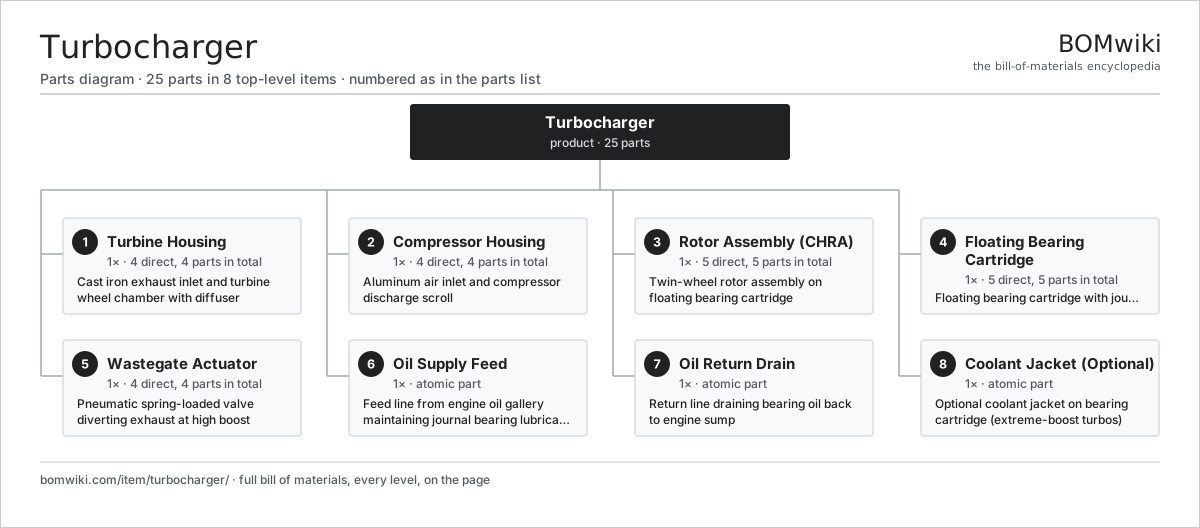
| # | Part | Qty | What it does |
|---|---|---|---|
| 1 | Turbine Housing 4 parts | 1× | Cast iron exhaust inlet and turbine wheel chamber with diffuser |
| 2 | Compressor Housing 4 parts | 1× | Aluminum air inlet and compressor discharge scroll |
| 3 | Rotor Assembly (CHRA) 5 parts | 1× | Twin-wheel rotor assembly on floating bearing cartridge |
| 4 | Floating Bearing Cartridge 5 parts | 1× | Floating bearing cartridge with journal and thrust elements |
| 5 | Wastegate Actuator 4 parts | 1× | Pneumatic spring-loaded valve diverting exhaust at high boost |
| 6 | Oil Supply Feed | 1× | Feed line from engine oil gallery maintaining journal bearing lubrication |
| 7 | Oil Return Drain | 1× | Return line draining bearing oil back to engine sump |
| 8 | Coolant Jacket (Optional) | 1× | Optional coolant jacket on bearing cartridge (extreme-boost turbos) |
3D model
No 3D model yet. Have a CAD file of this? Add a 3D model. STL renders right on this page; STEP, FreeCAD, and OpenSCAD sources are welcome too (openly licensed, like all 3D models on BOMwiki).
Build & assembly graph
expand / collapse · shared sub-assemblies converge · links to related products · est. labourTap an assembly to expand/collapse · tap a part to open it · use “Open page” for any node · drag to pan, scroll to zoom.
Bill of materials for Turbocharger
8 top-level lines · 30 rows shown · 25 parts total · indented to 3 levels| # | Item / sub-assembly | Part no. | Qty/assy | Ext. qty | Parts | Type |
|---|---|---|---|---|---|---|
| 1 | Turbine Housing 4 parts | turbocharger-turbine-housing | 1× | 1 | 4 | assembly |
| 1.1 | Turbine Impeller | turbocharger-turbine-wheel | 1× | 1 | · | part |
| 1.2 | Turbine Boss | turbocharger-turbine-shaft-boss | 1× | 1 | · | part |
| 1.3 | Turbine Volute Scroll | turbocharger-turbine-scroll | 1× | 1 | · | part |
| 1.4 | Turbine Exhaust Port | turbocharger-exhaust-outlet | 1× | 1 | · | part |
| 2 | Compressor Housing 4 parts | turbocharger-compressor-housing | 1× | 1 | 4 | assembly |
| 2.1 | Compressor Impeller | turbocharger-compressor-wheel | 1× | 1 | · | part |
| 2.2 | Compressor Air Inlet | turbocharger-compressor-inlet | 1× | 1 | · | part |
| 2.3 | Compressor Discharge Scroll | turbocharger-compressor-scroll | 1× | 1 | · | part |
| 2.4 | Compressor Diffuser | turbocharger-compressor-diffuser | 1× | 1 | · | part |
| 3 | Rotor Assembly (CHRA) 5 parts | turbocharger-chra-rotor | 1× | 1 | 5 | assembly |
| 3.1 | Common Rotor Shaft | turbocharger-rotor-shaft | 1× | 1 | · | part |
| 3.2 | Turbine Impeller | turbocharger-turbine-wheel | 1× | 1 | · | part |
| 3.3 | Compressor Impeller | turbocharger-compressor-wheel | 1× | 1 | · | part |
| 3.4 | Wheel Locking Nut | turbocharger-wheel-nut | 1× | 1 | · | part |
| 3.5 | Thrust Collar | turbocharger-shaft-thrust-collar | 1× | 1 | · | part |
| 4 | Floating Bearing Cartridge 5 parts | turbocharger-bearing-system | 1× | 1 | 5 | assembly |
| 4.1 | Journal Bearing Set | turbocharger-journal-bearing | 1× | 1 | · | part |
| 4.2 | Thrust Bearing | turbocharger-thrust-bearing | 1× | 1 | · | part |
| 4.3 | Bearing Cartridge Housing | turbocharger-bearing-cartridge | 1× | 1 | · | part |
| 4.4 | Labyrinth Seals | turbocharger-sealing-rings | 1× | 1 | · | part |
| 4.5 | Rotor Centering Spring | turbocharger-centering-spring | 1× | 1 | · | part |
| 5 | Wastegate Actuator 4 parts | turbocharger-wastegate-actuator | 1× | 1 | 4 | assembly |
| 5.1 | Wastegate Diaphragm | turbocharger-actuator-diaphragm | 1× | 1 | · | part |
| 5.2 | Actuator Linkage Rod | turbocharger-actuator-rod | 1× | 1 | · | part |
| 5.3 | Spring Chamber | turbocharger-spring-chamber | 1× | 1 | · | part |
| 5.4 | Boost Control Solenoid | turbocharger-control-solenoid | 1× | 1 | · | part |
| 6 | Oil Supply Feed | turbocharger-oil-inlet | 1× | 1 | · | part |
| 7 | Oil Return Drain | turbocharger-oil-outlet | 1× | 1 | · | part |
| 8 | Coolant Jacket (Optional) | turbocharger-coolant-circuit | 1× | 1 | · | part |
Something wrong in this list? Report a problem with this BOM.
Sourcing: possible vendors
Browse the supplier directory → Prices, MOQ, and lead times are algorithmic estimates, not quotes, and not claims about these companies. Company mappings are curated by keyword; est. price band $8k–$90k. How estimates work| Vendor | HQ | Specialty | MOQ | Lead time |
|---|---|---|---|---|
|
🇯🇵Toyota
global.toyota ↗
|
Toyota City, JP | Automaker | made to order | 16–28 wks |
| volkswagen-group.com ↗ | Wolfsburg, DE | Automaker | made to order | 16–28 wks |
| gm.com ↗ | Detroit, US | Automaker | made to order | 16–28 wks |
| hyundai.com ↗ | Seoul, KR | Automaker | made to order | 16–28 wks |
|
🇨🇳BYD
byd.com ↗
|
Shenzhen, CN | EV & battery manufacturer | made to order | 16–28 wks |
1,151-word article