Turkish Coffee Machine
ProductOverview
A Turkish coffee machine replicates the traditional sand-bed brewing method used across the Middle East, North Africa, and Eastern Europe, but automates the critical foam-detection step that prevents boiling over. Turkish coffee is an unfiltered brew brewed in a small tapered pot called a cezve (or ibrik), where finely ground coffee, water, and sugar/cardamom are heated together until foam rises to the rim. The traditional method requires constant attention, a barista watches for rising foam and removes the pot instantly to avoid overflow. An electric Turkish coffee machine eliminates human vigilance through a Foam Detection Assembly that triggers automatic shutoff the moment foam is detected.
The system uses a heated sand bed (rather than direct ceramic cookers) as the heating medium. Sand provides uniform, radiant heat at 400–500 °F, mimicking traditional charcoal fire. A Heating Element Assembly embedded in a Sand Bed Chamber maintains this temperature via a Temperature Control Unit. Multiple Cezve Cradle Mount mounts hold traditional Turkish pots at the correct angle above the sand, allowing brewing of two or four cups simultaneously in separate pots.
When a customer orders, the barista places a filled cezve into a cradle. The Control Microcontroller heats the pot. As coffee approaches boiling, foam rises in the cezve, triggering the Foam Detection Assembly. The controller immediately cuts power to the Heating Element Assembly, stopping the brew. The barista removes the pot and pours the finished coffee into a serving cup, with grounds settling at the bottom, the traditional presentation.
How it works
A barista fills a traditional cezve (a small, tapered stainless steel or copper pot, 3–4 oz capacity) with finely ground coffee, cold water, and optional sugar or spices. The ratio is typically 1 heaping teaspoon coffee + 1 heaping teaspoon sugar + 3 oz water per person.
The barista places the cezve into one of the Cezve Cradle Mount mounts. The Control Microcontroller activates the Heating Element Assembly, which is embedded in the Sand Bed Chamber base. The Temperature Control Unit confirms the sand bed is at 400–500 °F (pre-heated from the last brew or startup cycle).
Heat radiates from the hot sand upward into the cezve. The coffee mixture warms quickly. Finely ground coffee particles (much finer than espresso grind) suspend in water, and as temperature approaches 195–205 °F, bubbles begin forming. The fine grounds act as nucleation sites, and CO2 released from the coffee grounds creates a rapid foam that rises in the narrow cezve neck.
The Foam Detection Assembly, positioned 2–5 cm above the cezve cradle, continuously monitors the pot. The sensor uses either infrared thermography (sensing the temperature rise of foam) or a photodiode (sensing the change in emissivity when foam appears). The moment foam is detected rising toward the rim, the Solenoid Relay de-energizes the Heating Element Assembly, cutting power instantly.
The barista removes the now-foam-topped cezve from the cradle. Traditional Turkish coffee is served in a small demitasse cup; the barista pours slowly, distributing foam and grounds into cups. The foam sits atop the coffee, and sediment remains at the bottom, this is the expected presentation.
The cezve is returned to the cradle (or another cradle if running a multi-cup service), rinsed quickly, refilled, and repositioned. The Sand Bed Chamber maintains temperature, so recovery time is only 30–60 seconds before the next brew cycle begins.
Any spilled coffee drains into the Drip Tray Assembly, which is emptied daily.
Key engineering features
Sand bed thermal uniformity: The Sand Bed Chamber filled with silica sand or ceramic pellets acts as a thermal mass regulator. Sand heats slowly and cools slowly, maintaining steady 400–500 °F despite rapid loss of heat to the cezve. This is superior to a direct electric coil, which would have hot spots and uneven heating. The sand also provides a cultural authenticity, it mimics the traditional copper disk sitting in hot sand.
Foam detection accuracy: The Foam Detection Assembly must distinguish between liquid surface and rising foam. Foam has a different emissivity (in IR) and reflectivity (in optical) than liquid. IR sensors are more reliable in humid environments (kitchens produce steam). The sensor is positioned to detect foam at approximately 80–90% of cezve height, triggering shutoff before overflow.
Automatic shutoff safety: Turkish coffee boils rapidly; without shutoff, foam spills onto the sand bed and makes a mess. The Solenoid Relay is fail-safe: if the Foam Detection Assembly loses power or the Control Microcontroller fails, a Thermal Cutoff Fuse at 550 °F provides a secondary cutout.
Multi-cradle concurrency: Two or four cradles allow a barista to brew multiple orders simultaneously. Each cradle has independent Cezve Cradle Mount positioning and thermal contact. The Sand Bed Chamber temperature remains stable even with four pots heating at once due to the high thermal mass.
Temperature regulation: The Temperature Control Unit uses a Bed Temperature Sensor (RTD or thermocouple) embedded directly in the sand. If sand temperature dips below 400 °F (from active brewing cooling), the thermostat energizes the Heating Element Assembly to recover. This ensures consistent brew times: whether the machine is idle or mid-service, the sand is always ready.
Brewing chemistry
Turkish coffee brewing is unique because the coffee is never filtered. Finely ground coffee (0.1–0.3 mm, like talcum powder) remains in the cup. This produces a full-bodied, intense flavor because all oils and solids are in the liquid. The unfiltered style is traditional across the Middle East and is preferred in many cultures over filtered coffee.
The foam is desirable, not accidental. It contains dissolved CO2 and volatile aromatic compounds; baristas deliberately pour foam atop each serving for aesthetic and flavor reasons. A machine without foam detection cannot ensure consistent foam, sometimes it overflows, sometimes it doesn't. The Foam Detection Assembly makes every brew consistent.
Variations
Some models include a second temperature setpoint for cardamom or spiced coffee, which may brew slightly cooler (380–400 °F) to preserve volatile aromatics. Others offer programmable brew times, the operator can set "2 minutes" and the machine shuts off automatically at time, independent of foam detection.
Higher-end models include a LCD Panel display showing sand bed temperature, brew count, and elapsed time, allowing operators to track machine health and brewing patterns.
Maintenance
The sand bed is the only consumable part; it should be replaced every 2–3 years as it degrades, compacts, and loses thermal conductivity. Replacement sand is food-grade and inexpensive (under $50). All electrical components are sealed and maintenance-free.
Daily cleaning: empty the Drip Tray Assembly, wipe the cradles to remove coffee oils, and inspect the Foam Detection Assembly optical window for steam buildup. Weekly: run hot water through the cradles to remove mineral deposits.
Turkish Coffee Machine parts and their functions
7 top-level parts · 36 parts in total · full bill of materials below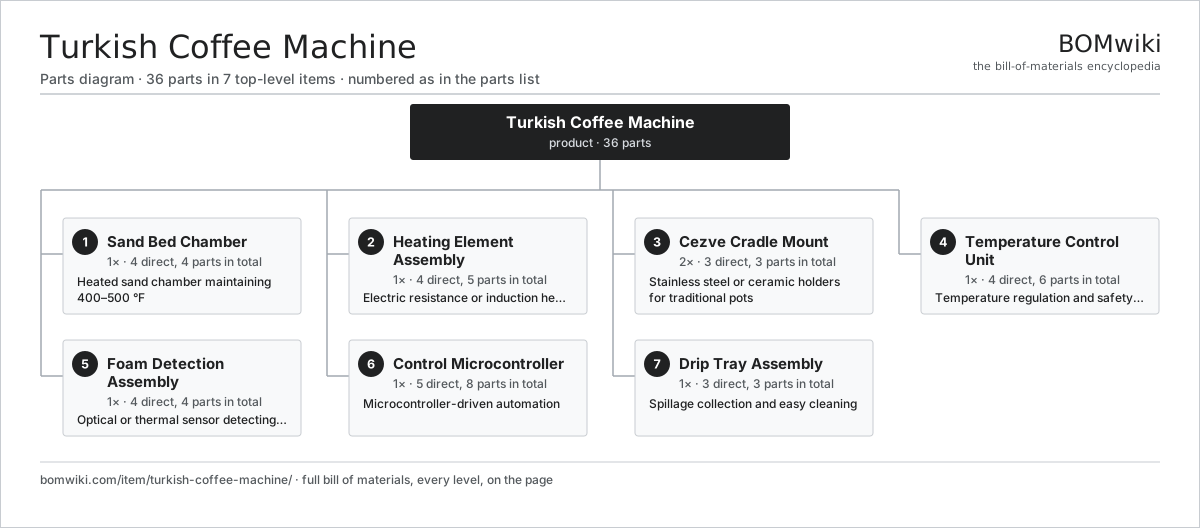
| # | Part | Qty | What it does |
|---|---|---|---|
| 1 | Sand Bed Chamber 4 parts | 1× | Heated sand chamber maintaining 400–500 °F |
| 2 | Heating Element Assembly 4 parts | 1× | Electric resistance or induction heater |
| 3 | Cezve Cradle Mount 3 parts | 2× | Stainless steel or ceramic holders for traditional pots |
| 4 | Temperature Control Unit 4 parts | 1× | Temperature regulation and safety shutoff |
| 5 | Foam Detection Assembly 4 parts | 1× | Optical or thermal sensor detecting rising foam |
| 6 | Control Microcontroller 5 parts | 1× | Microcontroller-driven automation |
| 7 | Drip Tray Assembly 3 parts | 1× | Spillage collection and easy cleaning |
3D model
No 3D model yet. Have a CAD file of this? Add a 3D model. STL renders right on this page; STEP, FreeCAD, and OpenSCAD sources are welcome too (openly licensed, like all 3D models on BOMwiki).
Build & assembly graph
expand / collapse · shared sub-assemblies converge · links to related products · est. labourTap an assembly to expand/collapse · tap a part to open it · use “Open page” for any node · drag to pan, scroll to zoom.
Bill of materials for Turkish Coffee Machine
7 top-level lines · 34 rows shown · 36 parts total · indented to 3 levels| # | Item / sub-assembly | Part no. | Qty/assy | Ext. qty | Parts | Type |
|---|---|---|---|---|---|---|
| 1 | Sand Bed Chamber 4 parts | turkish-coffee-machine-sand-bed | 1× | 1 | 4 | assembly |
| 1.1 | Sand Bed Housing | turkish-coffee-machine-bed-body | 1× | 1 | · | part |
| 1.2 | Sand Bed Medium | turkish-coffee-machine-sand-fill | 1× | 1 | · | part |
| 1.3 | Bed Temperature Sensor | turkish-coffee-machine-bed-thermostat | 1× | 1 | · | part |
| 1.4 | Fastener Set | fastener-set | 1× | 1 | · | part |
| 2 | Heating Element Assembly 4 parts | turkish-coffee-machine-heating-element | 1× | 1 | 5 | assembly |
| 2.1 | Resistance Heater Element | turkish-coffee-machine-heater-wire | 1× | 1 | · | part |
| 2.2 | Heater Terminal Block | turkish-coffee-machine-heater-terminal | 2× | 2 | · | part |
| 2.3 | Thermal Cutoff Fuse | turkish-coffee-machine-thermal-fuse | 1× | 1 | · | part |
| 2.4 | Fastener Set | fastener-set | 1× | 1 | · | part |
| 3 | Cezve Cradle Mount 3 parts | turkish-coffee-machine-cezve-cradle | 2× | 2 | 3 | assembly |
| 3.1 | Cradle Support Frame | turkish-coffee-machine-cradle-frame | 1× | 2 | · | part |
| 3.2 | Cradle Ceramic Liner | turkish-coffee-machine-cradle-insert | 1× | 2 | · | part |
| 3.3 | Fastener Set | fastener-set | 1× | 2 | · | part |
| 4 | Temperature Control Unit 4 parts | turkish-coffee-machine-thermostat | 1× | 1 | 6 | assembly |
| 4.1 | Temperature Sensor | turkish-coffee-machine-temp-sensor | 1× | 1 | · | part |
| 4.2 | Relay | relay | 1× | 1 | · | part |
| 4.3 | SMD Passive (R/C/L) | smd-passives | 2× | 2 | · | part |
| 4.4 | Connector | connector | 2× | 2 | · | part |
| 5 | Foam Detection Assembly 4 parts | turkish-coffee-machine-foam-detector | 1× | 1 | 4 | assembly |
| 5.1 | Foam Detector Sensor | turkish-coffee-machine-foam-sensor | 1× | 1 | · | part |
| 5.2 | Solenoid Relay | turkish-coffee-machine-relay-switch | 1× | 1 | · | part |
| 5.3 | Sensor Protective Window | turkish-coffee-machine-optical-lens | 1× | 1 | · | part |
| 5.4 | Connector | connector | 1× | 1 | · | part |
| 6 | Control Microcontroller 5 parts | turkish-coffee-machine-control-module | 1× | 1 | 8 | assembly |
| 6.1 | Microcontroller | mcu | 1× | 1 | · | part |
| 6.2 | Bare PCB | pcb-bare | 1× | 1 | · | part |
| 6.3 | Relay | relay | 2× | 2 | · | part |
| 6.4 | LCD Panel | lcd-panel | 1× | 1 | · | part |
| 6.5 | Connector | connector | 3× | 3 | · | part |
| 7 | Drip Tray Assembly 3 parts | turkish-coffee-machine-drip-tray | 1× | 1 | 3 | assembly |
| 7.1 | Drip Pan | turkish-coffee-machine-tray-body | 1× | 1 | · | part |
| 7.2 | Drain Plug | turkish-coffee-machine-drain-stopper | 1× | 1 | · | part |
| 7.3 | Fastener Set | fastener-set | 1× | 1 | · | part |
Something wrong in this list? Report a problem with this BOM.
Related products
same domain, ranked by shared parts Automatic Espresso Tamper
45 parts · shares 5 with this page
Beverage Carbonator
95 parts · shares 5 with this page
Automatic Espresso Tamper
45 parts · shares 5 with this page
Beverage Carbonator
95 parts · shares 5 with this page
 Bottle Washing Machine
2,388 parts · shares 5 with this page
Brine Chilling System
239 parts · shares 5 with this page
Bottle Washing Machine
2,388 parts · shares 5 with this page
Brine Chilling System
239 parts · shares 5 with this page
 Can Seaming Machine
658 parts · shares 5 with this page
Can Seaming Machine
658 parts · shares 5 with this page
 Capsule Filling and Sealing Machine
57 parts · shares 5 with this page
Capsule Filling and Sealing Machine
57 parts · shares 5 with this page
Sourcing: possible vendors
Browse the supplier directory → Prices, MOQ, and lead times are algorithmic estimates, not quotes, and not claims about these companies. Company mappings are curated by keyword; est. price band $1k–$500k. How estimates work| Vendor | HQ | Specialty | MOQ | Lead time |
|---|---|---|---|---|
| gea.com ↗ | Düsseldorf, DE | Process technology | 20 units | 12–20 wks |
| buhlergroup.com ↗ | Uzwil, CH | Food & materials processing | 20 units | 12–20 wks |
| tetrapak.com ↗ | Pully, CH | Food packaging & processing | 20 units | 12–20 wks |
| jbtc.com ↗ | Chicago, US | Food processing equipment | 20 units | 12–20 wks |
| alfalaval.com ↗ | Lund, SE | Heat transfer & separation | 20 units | 12–20 wks |
1,191-word article