Two-Post Vehicle Lift
ProductOverview
The two-post vehicle lift is the workhorse of automotive service bays, providing safe and stable elevation of mid-sized vehicles (sedans, SUVs up to pickup trucks) for undercarriage access, tire service, brake work, and suspension repair. The design uses two parallel hydraulic cylinders housed within or mounted to vertical steel posts, actuating a pair of scissor arms that open symmetrically as the cylinders extend. Load capacity ranges from 6,000 to 7,000 lbs per side, accommodating most vehicles encountered in commercial shops.
The lift operates on a closed hydraulic loop: an electric motor drives a fixed-displacement gear pump that pressurizes fluid through a directional control valve into the two Hydraulic Cylinder Assembly. As pressure builds, the cylinders extend, pushing the Scissor Arm Assembly outward and upward. The vehicle rests on rubber-padded contact points at the arm tips. Descent is controlled through a manual override or electrically actuated directional valve, allowing the operator to lower the vehicle in a controlled manner. Critically, each post is equipped with an independent mechanical Mechanical Lock Latch, a spring-loaded pawl that engages a rack on the cylinder rod, preventing uncontrolled drop even if hydraulic pressure is lost. This dual-lock design is the defining safety feature of the two-post lift and is mandated by automotive service shop codes in most jurisdictions.
The Steel Frame Assembly is built from welded structural steel, typically 4–6 inch diameter heavy-wall tubing for the vertical posts, with extensive cross-bracing to prevent lateral sway under unbalanced load. Base plates at each post anchor to the shop floor via concrete bolts, spreading the load over a wide footprint. The Hydraulic Pump Unit assembly, housed in a separate cabinet or pedestal, supplies pressurized fluid through steel-braided hoses. A Pressure Relief Valve valve protects the system at 3,200 psi nominal, and the Electrical Control Circuit circuit provides motor control, solenoid actuation, and interlock logic.
How it Works
When the operator engages the raise control, the Control Transformer and Motor Contactor energize the Drive Motor, spinning the Hydraulic Pump Unit at 1,500–2,000 rpm. The pump draws ISO 46 hydraulic fluid from the Hydraulic Tank and forces it through the Directional Control Valve into the cap-end ports of both Hydraulic Cylinder Assembly. As internal pressure climbs, the Piston Rod pistons begin to extend. The rods are sealed by matched Hydraulic Seals Kit (polyurethane dynamic and PTFE static rings) that maintain pressure while containing leakage to <0.5 cc/min per cylinder.
As the cylinders extend, the scissor geometry of the Scissor Arm Assembly causes them to pivot outward and rise. At full extension (~24–36 inches of rod travel), the vehicle is elevated 72–80 inches, providing ample clearance for a technician to work underneath. Throughout the raise cycle, Pivot Pin bearings support the scissor fulcrum under full load, typically 6,000–7,000 lbs per arm. The Rubber Contact Pad rubber elements flex slightly to distribute pressure and prevent frame scuffing.
If the operator releases the raise control, the Directional Control Valve spring-centers to the neutral (blocked) position, trapping fluid in the cylinders and holding the vehicle at height. The Mechanical Lock Latch pawls are always engaged on the cylinder rod, providing a mechanical backup to hydraulic pressure. If a hose ruptures or pump fails, the mechanical locks arrest descent immediately.
To lower, the operator activates the lower control (protected by an ignition interlock to prevent accidental descent during raise). The directional valve shifts, routing pump flow to the rod-end ports of the cylinders and allowing cap-end fluid to return to the Hydraulic Tank through the low-pressure return line. Descent speed is controlled by a needle-type flow control (integral to the lower valve spool) that meters the return flow, providing a gentle and stable descent at ~45 seconds to fully lower. The Pressure Relief Valve valve remains in standby, only opening if back-pressure exceeds 3,200 psi (e.g., if an obstruction blocks the return path).
The Electrical Control Circuit system is hardwired for simplicity and reliability. A three-phase contactor switches main motor power, while a 2 kVA step-down Control Transformer provides 120V AC for solenoid coils and control logic. Dual Relay circuits interlock raise and lower to prevent simultaneous commands, and a pressure-switch stop protection shuts down the motor if any Pressure Sensor indicates over-pressure.
Maintenance and Standards
Two-post lifts are subject to ANSI/ALI ALCTV standards (automotive lift certification and testing verification). Annual inspections require pressure testing at 150% of nominal (4,800 psi), visual inspection of hoses for cracks and leakage, and functional testing of both mechanical safety locks. The Hydraulic Seals Kit and Gear Set are routine wear items, with seal replacement every 5–10 years depending on oil quality and usage frequency. Hydraulic fluid should be sampled annually for water content and particulate count; ISO 46 with anti-wear (AW) additives is the industry standard. The Drive Motor bearings are sealed and require no lubrication beyond the original grease charge. The Rubber Contact Pad rubber may harden after 10–15 years of UV and ozone exposure, causing slipping; replacement involves removing fasteners and adhering fresh elastomer pads.
Two-Post Vehicle Lift parts and their functions
7 top-level parts · 44 parts in total · full bill of materials below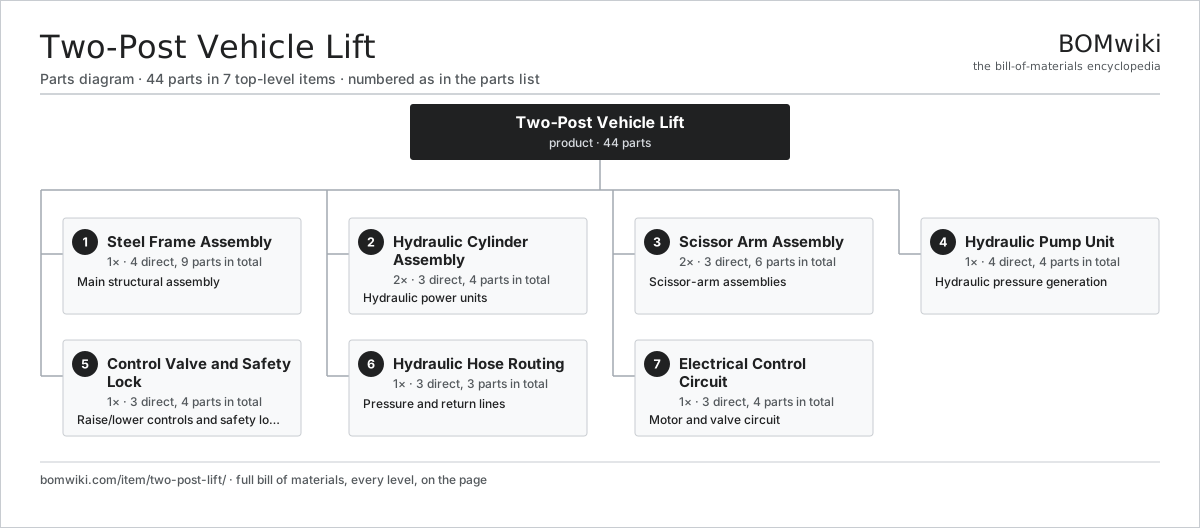
| # | Part | Qty | What it does |
|---|---|---|---|
| 1 | Steel Frame Assembly 4 parts | 1× | Main structural assembly |
| 2 | Hydraulic Cylinder Assembly 3 parts | 2× | Hydraulic power units |
| 3 | Scissor Arm Assembly 3 parts | 2× | Scissor-arm assemblies |
| 4 | Hydraulic Pump Unit 4 parts | 1× | Hydraulic pressure generation |
| 5 | Control Valve and Safety Lock 3 parts | 1× | Raise/lower controls and safety locks |
| 6 | Hydraulic Hose Routing 3 parts | 1× | Pressure and return lines |
| 7 | Electrical Control Circuit 3 parts | 1× | Motor and valve circuit |
3D model
No 3D model yet. Have a CAD file of this? Add a 3D model. STL renders right on this page; STEP, FreeCAD, and OpenSCAD sources are welcome too (openly licensed, like all 3D models on BOMwiki).
Build & assembly graph
expand / collapse · shared sub-assemblies converge · links to related products · est. labourTap an assembly to expand/collapse · tap a part to open it · use “Open page” for any node · drag to pan, scroll to zoom.
Bill of materials for Two-Post Vehicle Lift
7 top-level lines · 30 rows shown · 44 parts total · indented to 3 levels| # | Item / sub-assembly | Part no. | Qty/assy | Ext. qty | Parts | Type |
|---|---|---|---|---|---|---|
| 1 | Steel Frame Assembly 4 parts | two-post-lift-frame | 1× | 1 | 9 | assembly |
| 1.1 | Vertical Posts | two-post-lift-posts | 2× | 2 | · | part |
| 1.2 | Cross Bracing | two-post-lift-cross-members | 4× | 4 | · | part |
| 1.3 | Base Mounting Plate | two-post-lift-base-plate | 2× | 2 | · | part |
| 1.4 | Fastener Set | fastener-set | 1× | 1 | · | part |
| 2 | Hydraulic Cylinder Assembly 3 parts | two-post-lift-cylinders | 2× | 2 | 4 | assembly |
| 2.1 | Piston Rod | two-post-lift-cylinder-rod | 2× | 4 | · | part |
| 2.2 | Hydraulic Seals Kit | two-post-lift-seals | 1× | 2 | · | part |
| 2.3 | Pressure Sensor | pressure-sensor | 1× | 2 | · | part |
| 3 | Scissor Arm Assembly 3 parts | two-post-lift-arms | 2× | 2 | 6 | assembly |
| 3.1 | Arm Beam | two-post-lift-arm-beams | 2× | 4 | · | part |
| 3.2 | Pivot Pin | two-post-lift-pivot-pin | 2× | 4 | · | part |
| 3.3 | Rubber Contact Pad | two-post-lift-contact-pad | 2× | 4 | · | part |
| 4 | Hydraulic Pump Unit 4 parts | two-post-lift-pump | 1× | 1 | 4 | assembly |
| 4.1 | Pump Housing | two-post-lift-pump-body | 1× | 1 | · | part |
| 4.2 | Gear Set | two-post-lift-pump-gears | 1× | 1 | · | part |
| 4.3 | Drive Motor | two-post-lift-motor | 1× | 1 | · | part |
| 4.4 | Hydraulic Tank | two-post-lift-reservoir | 1× | 1 | · | part |
| 5 | Control Valve and Safety Lock 3 parts | two-post-lift-controls | 1× | 1 | 4 | assembly |
| 5.1 | Directional Control Valve | two-post-lift-directional-valve | 1× | 1 | · | part |
| 5.2 | Mechanical Lock Latch | two-post-lift-safety-lock | 2× | 2 | · | part |
| 5.3 | Pressure Relief Valve | two-post-lift-pressure-relief | 1× | 1 | · | part |
| 6 | Hydraulic Hose Routing 3 parts | two-post-lift-hoses | 1× | 1 | 3 | assembly |
| 6.1 | Pressure Hose A | two-post-lift-hose-a | 1× | 1 | · | part |
| 6.2 | Pressure Hose B | two-post-lift-hose-b | 1× | 1 | · | part |
| 6.3 | Return Manifold | two-post-lift-return-line | 1× | 1 | · | part |
| 7 | Electrical Control Circuit 3 parts | two-post-lift-electrical | 1× | 1 | 4 | assembly |
| 7.1 | Motor Contactor | two-post-lift-contactor | 1× | 1 | · | part |
| 7.2 | Control Transformer | two-post-lift-control-transformer | 1× | 1 | · | part |
| 7.3 | Relay | relay | 2× | 2 | · | part |
Something wrong in this list? Report a problem with this BOM.
Related products
same domain, ranked by shared parts ADAS Calibration System
55 parts · shares 2 with this page
ADAS Calibration System
55 parts · shares 2 with this page
 Automotive Paint Booth
59 parts · shares 2 with this page
Diamond-Cut Wheel Lathe
82 parts · shares 1 with this page
Automotive Paint Booth
59 parts · shares 2 with this page
Diamond-Cut Wheel Lathe
82 parts · shares 1 with this page
 Undercoating Sprayer
59 parts · shares 1 with this page
Undercoating Sprayer
59 parts · shares 1 with this page
Sourcing: possible vendors
Browse the supplier directory → Prices, MOQ, and lead times are algorithmic estimates, not quotes, and not claims about these companies. Company mappings are curated by keyword; est. price band $300–$90k. How estimates work| Vendor | HQ | Specialty | MOQ | Lead time |
|---|
926-word article