Ukulele
ProductOverview
The ukulele is a small four-string fretted instrument developed in Hawaii in the 1880s from the Portuguese machete, a miniature guitar-like instrument brought by Madeiran immigrants. It is built like a scaled-down classical guitar: a hollow wooden Body Assembly amplifies the vibration of strings stretched between a Bridge Assembly glued to the soundboard and tuners on the Headstock Assembly. Four sizes are standard. The soprano, at about 530 mm overall with a 330–350 mm scale, is the original form; concert, tenor, and baritone instruments are progressively larger, with the baritone usually tuned a fourth lower like the top four guitar strings.
The defining sound of the instrument comes from its re-entrant tuning: G4-C4-E4-A4, where the fourth string is tuned an octave higher than linear pitch order would place it. All four strings therefore sit within a single octave span, which gives strummed chords their characteristic close, bright voicing.
How it works
A plucked Ukulele String vibrates between two terminations: the Nut at the headstock end and the Saddle at the bridge. The saddle sits in the Bridge Body, a rosewood block glued directly to the Soundboard, so the alternating string force rocks the bridge and drives the top plate. The top, only about 2 mm thick, acts as a diaphragm; together with the air cavity enclosed by the Back Plate and the two Side Hoop hoops it forms a coupled resonator that converts string vibration into radiated sound. The sound hole vents the cavity and contributes a Helmholtz resonance, typically in the 200–300 Hz region on a soprano, which supports the low end of the instrument's range.
Because the top is so thin, it is reinforced from inside by several Soundboard Brace struts in a fan or ladder pattern. The braces are dimensioned to a balance: stiff enough to hold the bridge area flat against roughly 16–22 kg of combined string tension, light enough not to choke the top's motion. Kerfed Lining strips, kerfed so they bend easily, provide the glue surface where the plates meet the sides, while the Neck Block and Tail Block close the two ends of the rib structure.
Fretting works as on any fretted instrument. Pressing a string against a Fret Wire shortens its speaking length; fret positions on the Fretboard follow the equal-temperament rule, each fret sitting at 1/17.817 of the remaining string length. A soprano typically carries 12–15 frets, a tenor up to 19. Position Dot inlays at frets 5, 7, 10, and 12 give the player visual reference.
Tuning is handled by four Geared Tuner machines mounted on the headstock, fitted through Tuner Bushing ferrules. Each contains a worm-and-wheel Helical Gear Pair, usually 14:1, so a full turn of the Tuner Button rotates the Tuner String Post only about 26 degrees, giving fine pitch control. Inexpensive and traditional instruments instead use friction pegs, straight-through pegs clamped by a tension screw, which hold less reliably but keep the headstock light.
Construction and materials
The traditional Hawaiian tonewood is koa (Acacia koa), prized for its figure and a warm, midrange-forward tone; mahogany is the most common alternative, and entry-level instruments use laminated tops. The Neck Blank is normally mahogany, shaped with a carved Neck Heel and attached to the neck block by a glued dowel or single-bolt Neck Joint. Unlike steel-string guitars, ukuleles carry low enough string tension that the neck needs no truss rod. A rosewood or walnut Fretboard is glued to the neck face and a decorative Headstock Veneer veneer to the headstock.
Strings were historically gut and later nylon; most modern sets are fluorocarbon monofilament, which is denser than nylon and so reaches pitch at usable tension with thinner gauges, roughly 0.52–0.74 mm. Each string carries only 3–5 kg of tension, which is why the whole structure can be so light: a finished soprano weighs 400–700 g. Strings attach to the bridge by a simple knot around the tie bar, classical-guitar fashion.
The body edges may be bound, the sound hole ringed by a Rosette, and the whole instrument sealed with a thin satin Finish Coat that protects the wood without adding damping mass. A Strap Button in the tail block is the usual concession to stage use.
Variants
Beyond the four standard sizes, common variants include the pineapple ukulele, with an oval body outline that slightly increases soundboard area; the banjolele, which replaces the wooden body with a banjo-style drum head; and electro-acoustic models fitted with an under-saddle piezo pickup. Tenor and baritone instruments are often strung with a wound low fourth string for linear (non-re-entrant) tuning, extending the bass range by a fourth.
Ukulele parts and their functions
6 top-level parts · 71 parts in total · full bill of materials below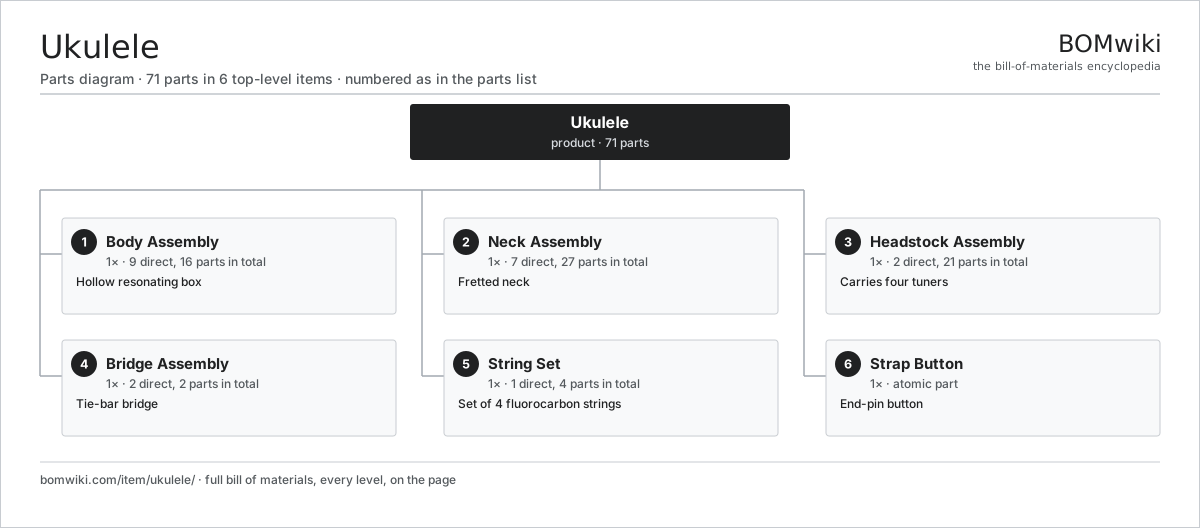
| # | Part | Qty | What it does |
|---|---|---|---|
| 1 | Body Assembly 9 parts | 1× | Hollow resonating box |
| 2 | Neck Assembly 7 parts | 1× | Fretted neck |
| 3 | Headstock Assembly 2 parts | 1× | Carries four tuners |
| 4 | Bridge Assembly 2 parts | 1× | Tie-bar bridge |
| 5 | String Set 1 parts | 1× | Set of 4 fluorocarbon strings |
| 6 | Strap Button | 1× | End-pin button |
3D model
No 3D model yet. Have a CAD file of this? Add a 3D model. STL renders right on this page; STEP, FreeCAD, and OpenSCAD sources are welcome too (openly licensed, like all 3D models on BOMwiki).
Build & assembly graph
expand / collapse · shared sub-assemblies converge · links to related products · est. labourTap an assembly to expand/collapse · tap a part to open it · use “Open page” for any node · drag to pan, scroll to zoom.
Bill of materials for Ukulele
6 top-level lines · 32 rows shown · 71 parts total · indented to 3 levels| # | Item / sub-assembly | Part no. | Qty/assy | Ext. qty | Parts | Type |
|---|---|---|---|---|---|---|
| 1 | Body Assembly 9 parts | ukulele-body | 1× | 1 | 16 | assembly |
| 1.1 | Soundboard | ukulele-soundboard | 1× | 1 | · | part |
| 1.2 | Back Plate | ukulele-back | 1× | 1 | · | part |
| 1.3 | Side Hoop | ukulele-side | 2× | 2 | · | part |
| 1.4 | Soundboard Brace | ukulele-brace | 4× | 4 | · | part |
| 1.5 | Kerfed Lining | ukulele-lining | 4× | 4 | · | part |
| 1.6 | Rosette | ukulele-rosette | 1× | 1 | · | part |
| 1.7 | Neck Block | ukulele-neck-block | 1× | 1 | · | part |
| 1.8 | Tail Block | ukulele-tail-block | 1× | 1 | · | part |
| 1.9 | Finish Coat | ukulele-finish | 1× | 1 | · | part |
| 2 | Neck Assembly 7 parts | ukulele-neck | 1× | 1 | 27 | assembly |
| 2.1 | Neck Blank | ukulele-neck-blank | 1× | 1 | · | part |
| 2.2 | Fretboard | ukulele-fretboard | 1× | 1 | · | part |
| 2.3 | Fret Wire | ukulele-fret | 17× | 17 | · | part |
| 2.4 | Nut | ukulele-nut | 1× | 1 | · | part |
| 2.5 | Position Dot | ukulele-position-dot | 5× | 5 | · | part |
| 2.6 | Neck Heel | ukulele-heel | 1× | 1 | · | part |
| 2.7 | Neck Joint | ukulele-neck-joint | 1× | 1 | · | part |
| 3 | Headstock Assembly 2 parts | ukulele-headstock | 1× | 1 | 21 | assembly |
| 3.1 | Headstock Veneer | ukulele-headplate | 1× | 1 | · | part |
| 3.2 | Geared Tuner 5 parts | ukulele-tuner | 4× | 4 | 5 | assembly |
| 3.2.1 | Helical Gear Pair | gear-pair | 1× | 4 | · | part |
| 3.2.2 | Tuner String Post | ukulele-tuner-post | 1× | 4 | · | part |
| 3.2.3 | Tuner Button | ukulele-tuner-button | 1× | 4 | · | part |
| 3.2.4 | Tuner Bushing | ukulele-tuner-bushing | 1× | 4 | · | part |
| 3.2.5 | Tuner Housing | ukulele-tuner-housing | 1× | 4 | · | part |
| 4 | Bridge Assembly 2 parts | ukulele-bridge | 1× | 1 | 2 | assembly |
| 4.1 | Bridge Body | ukulele-bridge-body | 1× | 1 | · | part |
| 4.2 | Saddle | ukulele-saddle | 1× | 1 | · | part |
| 5 | String Set 1 parts | ukulele-string-set | 1× | 1 | 4 | assembly |
| 5.1 | Ukulele String | ukulele-string | 4× | 4 | · | part |
| 6 | Strap Button | ukulele-strap-button | 1× | 1 | · | part |
Something wrong in this list? Report a problem with this BOM.
Related products
same domain, ranked by shared parts

Sourcing: possible vendors
Browse the supplier directory → Prices, MOQ, and lead times are algorithmic estimates, not quotes, and not claims about these companies. Company mappings are curated by keyword; est. price band $50–$5k. How estimates work| Vendor | HQ | Specialty | MOQ | Lead time |
|---|---|---|---|---|
| yamaha.com ↗ | Hamamatsu, JP | Audio & instruments | 200 units | 8–14 wks |
|
🇺🇸Fender
fender.com ↗
|
Los Angeles, US | Guitars & amps | 200 units | 8–14 wks |
|
🇺🇸Gibson
gibson.com ↗
|
Nashville, US | Guitars | 200 units | 8–14 wks |
|
🇯🇵Roland
roland.com ↗
|
Hamamatsu, JP | Electronic instruments | 200 units | 8–14 wks |
| steinway.com ↗ | New York, US | Pianos | 200 units | 8–14 wks |
814-word article