Underground Storage Tank
ProductOverview
Underground storage tanks (USTs) are the primary fuel repository at retail filling stations and fleet fueling depots. Modern USTs are manufactured as double-wall vessels, an inner tank holding the fuel and an outer tank forming a secondary containment layer. The annular space between walls is monitored by interstitial leak sensors that detect any breach in the primary tank wall. This design complies with EPA and state regulations requiring secondary containment for all underground bulk storage of petroleum products.
A typical 8,000-gallon UST measures 30–40 feet long and 8–10 feet in diameter. The outer shell, usually fiberglass-reinforced plastic (FRP) composite, is chemically inert and corrosion-proof. The inner tank, either steel with protective epoxy coating or fiberglass, contains the fuel. Both shells are welded or bonded with minimal penetrations, all fitted with sanitary fill/discharge/vapor connections. The Manway Assembly at the tank top allows personnel inspection and maintenance.
Tank Construction
The Outer Tank Shell is hand-laid or filament-wound fiberglass composite, typically a polyester or vinyl ester resin matrix with continuous glass fiber reinforcement, achieving 3/8" wall thickness. The resin-rich outer surface is cured with a UV-stabilized gel coat to resist exposure during above-ground periods. The Inner Tank Shell is either carbon steel (3/16" wall) or fiberglass, depending on fuel type and site requirements. For steel inner tanks, a coal-tar or polyurethane epoxy coating protects against corrosion from residual water and fuel oxidation byproducts.
The annular space between shells, typically 1–2 inches, is sealed except for penetrations. The Interstitial Leak Sensor probes hang or mount within this space, continuously monitoring for fuel breakthrough. If fuel pools in the annulus (indicating inner tank failure), the sensor triggers an alarm, alerting site operators to shut down the tank and investigate.
Fill System
The Fill Head Assembly at the tank top receives fuel truck nozzles during periodic deliveries. An integral Overfill Prevention Valve prevents overfilling beyond 95% capacity, protecting the tank from rupture if fuel expands due to temperature rise or if a delivery operator forgets to stop. The fill inlet is sealed with a Fill Cap dust cover when not in use.
Suction and Return Piping
The Discharge (Suction) Piping draws fuel from the tank sump to the Pump Unit via a submerged Submerged Tank Strainer that filters out sediment and water. The Return (Excess Fuel) Piping accepts excess pump flow from the Valve Block Assembly by-pass valve and any nozzle drip from Nozzle with Breakaway breakaway disconnect, returning it above the minimum fuel level to avoid suction-side bubble introduction.
Both lines are typically 1.5" diameter stainless steel or rigid PVC schedule 40 pipe, buried underground from tank to pump house. Quick-disconnect fittings or flanges allow periodic disconnection for maintenance and testing.
Vapor Recovery
The Vapor Recovery System line routes fuel vapors displaced during fill and vehicle fueling back to the tank or to a Charcoal Vapor Canister. The canister adsorbs volatile organic compounds (VOCs), dramatically reducing evaporative emissions that would otherwise vent to atmosphere. A Flame Arrestor Vent Cap caps the main vent opening with a flame arrestor (preventing external fire entry) and vacuum relief (allowing atmospheric backfill during heavy drawdown).
Interstitial Monitoring
The dual-wall design and Interstitial Leak Sensor probes form the core of environmental safety. Each probe is a capacitive electrode or dual-electrode cell suspended in the annular space. When fuel breaches the inner tank, the dielectric constant changes, triggering a 4-20 mA transmitter or discrete alarm contact. Station operators receive electronic alarms via the Fuel Management System and must immediately shut down dispenser pumps and notify environmental response.
Regulatory Compliance
USTs must be registered with state environmental agencies and tested annually for tightness and corrosion integrity. Cathodic protection (sacrificial aluminum anodes) or coating-only methods protect against external corrosion on steel outer shells. All penetrations (fill, suction, return, vent, sensor) are sealed with rubber gaskets and stainless hardware, meeting EPA 40 CFR Part 280 secondary containment requirements.
Anchoring and Settlement
Underground tanks are buried in excavated pits and backfilled with sand or compacted soil. Fiberglass Composite Shell outer shells are sufficiently buoyant that gravel ballast or tie-down straps may be required in high-water-table sites to prevent flotation. The tank sits on a gravel bed sloped toward a sump, ensuring gravity drainage of any leakage to the Interstitial Leak Sensor for detection.
Maintenance and Lifespan
Proper UST lifespan is 20–30 years if corrosion protection is maintained. Internal Internal Baffle dividers suppress fuel sloshing during fill, reducing turbulence and sediment stirring. Every 3–5 years, the Submerged Tank Strainer is pulled and cleaned; the Tank Sump Strainer sump is drained of accumulated water and sediment. Cathodic protection systems (if installed) require anode inspection every 2–3 years.
Underground Storage Tank parts and their functions
8 top-level parts · 57 parts in total · full bill of materials below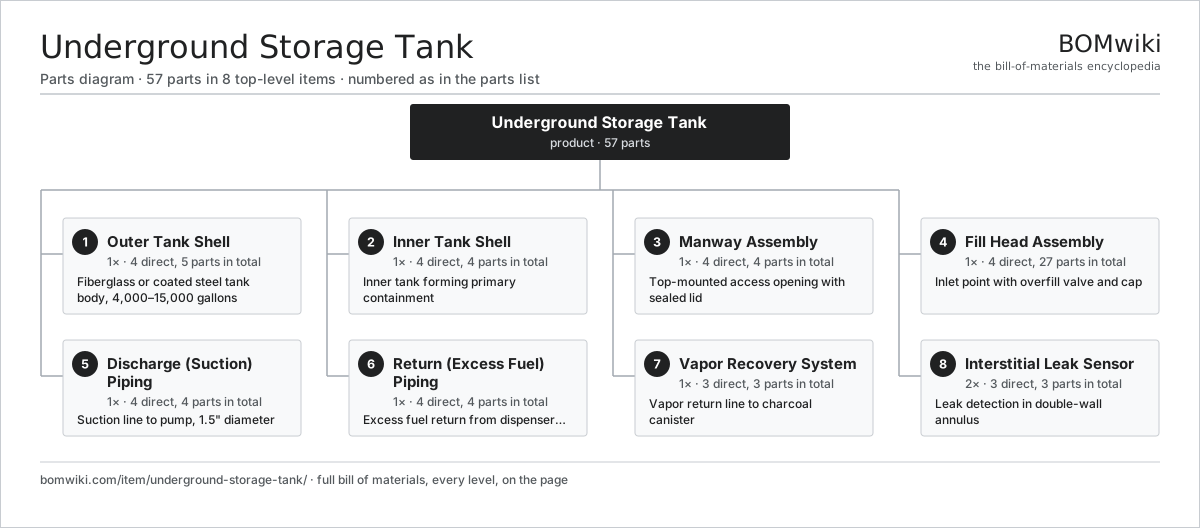
| # | Part | Qty | What it does |
|---|---|---|---|
| 1 | Outer Tank Shell 4 parts | 1× | Fiberglass or coated steel tank body, 4,000–15,000 gallons |
| 2 | Inner Tank Shell 4 parts | 1× | Inner tank forming primary containment |
| 3 | Manway Assembly 4 parts | 1× | Top-mounted access opening with sealed lid |
| 4 | Fill Head Assembly 4 parts | 1× | Inlet point with overfill valve and cap |
| 5 | Discharge (Suction) Piping 4 parts | 1× | Suction line to pump, 1.5" diameter |
| 6 | Return (Excess Fuel) Piping 4 parts | 1× | Excess fuel return from dispenser, 1.5" diameter |
| 7 | Vapor Recovery System 3 parts | 1× | Vapor return line to charcoal canister |
| 8 | Interstitial Leak Sensor 3 parts | 2× | Leak detection in double-wall annulus |
3D model
No 3D model yet. Have a CAD file of this? Add a 3D model. STL renders right on this page; STEP, FreeCAD, and OpenSCAD sources are welcome too (openly licensed, like all 3D models on BOMwiki).
Build & assembly graph
expand / collapse · shared sub-assemblies converge · links to related products · est. labourTap an assembly to expand/collapse · tap a part to open it · use “Open page” for any node · drag to pan, scroll to zoom.
Bill of materials for Underground Storage Tank
8 top-level lines · 46 rows shown · 57 parts total · indented to 3 levels| # | Item / sub-assembly | Part no. | Qty/assy | Ext. qty | Parts | Type |
|---|---|---|---|---|---|---|
| 1 | Outer Tank Shell 4 parts | underground-storage-tank-outer-shell | 1× | 1 | 5 | assembly |
| 1.1 | Fiberglass Composite Shell | underground-storage-tank-fiberglass-laminate | 1× | 1 | · | part |
| 1.2 | Tank Interior Coating | underground-storage-tank-internal-coating | 1× | 1 | · | part |
| 1.3 | Fastener Set | fastener-set | 1× | 1 | · | part |
| 1.4 | Internal Baffle | underground-storage-tank-baffle-plate | 2× | 2 | · | part |
| 2 | Inner Tank Shell 4 parts | underground-storage-tank-inner-shell | 1× | 1 | 4 | assembly |
| 2.1 | Steel Inner Tank | underground-storage-tank-steel-inner | 1× | 1 | · | part |
| 2.2 | Corrosion Protection Coating | underground-storage-tank-corrosion-barrier | 1× | 1 | · | part |
| 2.3 | Tank Sump Strainer | underground-storage-tank-internal-strainer | 1× | 1 | · | part |
| 2.4 | O-Ring Set | oring-set | 1× | 1 | · | part |
| 3 | Manway Assembly 4 parts | underground-storage-tank-manway | 1× | 1 | 4 | assembly |
| 3.1 | Manway Flange Ring | underground-storage-tank-manway-flange | 1× | 1 | · | part |
| 3.2 | Manway Cover Lid | underground-storage-tank-manway-cover | 1× | 1 | · | part |
| 3.3 | Manway Gasket | underground-storage-tank-manway-gasket | 1× | 1 | · | part |
| 3.4 | Fastener Set | fastener-set | 1× | 1 | · | part |
| 4 | Fill Head Assembly 4 parts | underground-storage-tank-fill-head | 1× | 1 | 27 | assembly |
| 4.1 | Fill Inlet Spud | underground-storage-tank-fill-spud | 1× | 1 | · | part |
| 4.2 | Overfill Prevention Valve 8 parts | overfill-prevention-valve | 1× | 1 | 24 | product |
| 4.2.1 | Valve Body Casting 4 parts + deeper › | overfill-prevention-valve-body | 1× | 1 | 6 | assembly |
| 4.2.2 | Float Chamber Assembly 5 parts + deeper › | overfill-prevention-valve-float-chamber | 1× | 1 | 5 | assembly |
| 4.2.3 | Float Ball Assembly 3 parts + deeper › | overfill-prevention-valve-float-ball | 1× | 1 | 3 | assembly |
| 4.2.4 | Poppet Seat | overfill-prevention-valve-poppet-seat | 1× | 1 | · | part |
| 4.2.5 | Float-to-Poppet Linkage 4 parts + deeper › | overfill-prevention-valve-linkage | 1× | 1 | 4 | assembly |
| 4.2.6 | Return Spring | overfill-prevention-valve-spring | 1× | 1 | · | part |
| 4.2.7 | Hardened Seat Insert | overfill-prevention-valve-seat-insert | 1× | 1 | · | part |
| 4.2.8 | Test and Vent Port 3 parts + deeper › | overfill-prevention-valve-test-port | 1× | 1 | 3 | assembly |
| 4.3 | Fill Cap | underground-storage-tank-fill-cap | 1× | 1 | · | part |
| 4.4 | Rubber Gasket Stock | gasket-rubber | 1× | 1 | · | part |
| 5 | Discharge (Suction) Piping 4 parts | underground-storage-tank-discharge-pipe | 1× | 1 | 4 | assembly |
| 5.1 | Suction Line Pipe | underground-storage-tank-suction-pipe | 1× | 1 | · | part |
| 5.2 | Submerged Tank Strainer | underground-storage-tank-pipe-submerged-strainer | 1× | 1 | · | part |
| 5.3 | Connector | connector | 1× | 1 | · | part |
| 5.4 | Fastener Set | fastener-set | 1× | 1 | · | part |
| 6 | Return (Excess Fuel) Piping 4 parts | underground-storage-tank-return-pipe | 1× | 1 | 4 | assembly |
| 6.1 | Return Line Pipe | underground-storage-tank-return-line-pipe | 1× | 1 | · | part |
| 6.2 | Return Line Strainer | underground-storage-tank-return-strainer | 1× | 1 | · | part |
| 6.3 | Connector | connector | 1× | 1 | · | part |
| 6.4 | Fastener Set | fastener-set | 1× | 1 | · | part |
| 7 | Vapor Recovery System 3 parts | underground-storage-tank-vapor-recovery | 1× | 1 | 3 | assembly |
| 7.1 | Vapor Vent Pipe | underground-storage-tank-vapor-pipe | 1× | 1 | · | part |
| 7.2 | Charcoal Vapor Canister | underground-storage-tank-charcoal-canister | 1× | 1 | · | part |
| 7.3 | Flame Arrestor Vent Cap | underground-storage-tank-vent-cap | 1× | 1 | · | part |
| 8 | Interstitial Leak Sensor 3 parts | underground-storage-tank-interstitial-sensor | 2× | 2 | 3 | assembly |
| 8.1 | Interstitial Probe Electrode | underground-storage-tank-probe-electrode | 1× | 2 | · | part |
| 8.2 | Connector | connector | 1× | 2 | · | part |
| 8.3 | Probe Mounting Bracket | mounting-bracket | 1× | 2 | · | part |
Something wrong in this list? Report a problem with this BOM.
Related products
same domain, ranked by shared parts Fuel Dispenser
71 parts · shares 2 with this page
LED Fuel Price Sign
146 parts · shares 1 with this page
Fuel Dispenser
71 parts · shares 2 with this page
LED Fuel Price Sign
146 parts · shares 1 with this page
 Air-Insulated Substation Bay
1,329 parts · shares 1 with this page
Air-Insulated Substation Bay
1,329 parts · shares 1 with this page
 Autotransformer
7,784 parts · shares 1 with this page
Bottom Ash Handling System
1,782 parts · shares 1 with this page
Autotransformer
7,784 parts · shares 1 with this page
Bottom Ash Handling System
1,782 parts · shares 1 with this page
Sourcing: possible vendors
Browse the supplier directory → Prices, MOQ, and lead times are algorithmic estimates, not quotes, and not claims about these companies. Company mappings are curated by keyword; est. price band $5k–$50M. How estimates work| Vendor | HQ | Specialty | MOQ | Lead time |
|---|---|---|---|---|
| gevernova.com ↗ | Cambridge, US | Power generation | made to order | 20–40 wks |
| siemens-energy.com ↗ | Munich, DE | Power & grid | made to order | 20–40 wks |
| hitachienergy.com ↗ | Zurich, CH | Grid & transformers | made to order | 20–40 wks |
|
🇨🇭ABB
abb.com ↗
|
Zurich, CH | Electrification & automation | made to order | 20–40 wks |
| se.com ↗ | Rueil-Malmaison, FR | Electrical & automation | made to order | 20–40 wks |
845-word article