Gas Unit Heater
ProductOverview
A gas unit heater is the simplest and most economical way to heat an uninsulated or poorly insulated space, a warehouse, garage, factory, or outdoor pavilion, where permanent ductwork is not installed. The unit is a self-contained metal box, wall- or roof-mounted, that draws cold outdoor air or recirculated space air, heats it by burning natural gas or propane in an internal combustion chamber, and blows the hot air directly into the space via an integral fan. Sizes range from 50 kBtu/h (15 kW) for a small garage to over 500 kBtu/h (150 kW) for a large warehouse.
The design is robust and field-proven: a Insulated Cabinet houses a Heat Exchanger where hot combustion gases transfer their energy to the airstream, a Burner Assembly that produces the flame, a Fan & Motor Section that delivers air, Gas Control & Safety systems that manage fuel, and simple Control System that respond to a room thermostat. No refrigerant, no chilled-water loop, no annual testing, just a straightforward combustion appliance.
Combustion and heat recovery
The Burner Assembly ignites a gas-air mixture in a Combustion Chamber, producing a flame at 1200–1500 °C. Hot combustion gases flow through the Primary Heat Exchanger, a finned-tube or cast-iron section where air is forced across the tubes and absorbs sensible heat. The flue gas exits the primary at 300–400 °C and passes through an optional Secondary Heat Exchanger that recovers additional heat in a lower-temperature pass. Standard units recover about 75–85% of the burner heat input; condensing units use a special secondary coil that cools exhaust below the dew point (about 55 °C) and capture the latent heat of condensation, achieving 95% efficiency. The remaining flue gas is vented to the roof or wall via the Combustion Exhaust Vent ductwork.
Flame and safety
The Ignition Electrode produces a spark to ignite the gas at startup. Once ignited, a Flame-Sensing Rod electrode sits in the flame and carries a small current back to the Ignition Control Board; this proves the flame is present. If the Solenoid Inlet Valve solenoid loses 24 V power, or if the flame rod current drops below threshold (indicating flame loss), the control board de-energizes the gas valve immediately, shutting down the burner. A High-Temperature Limit Switch monitors discharge air temperature and shuts the burner off if it exceeds 65–75 °C, preventing overheating damage to the space or equipment. A Low-Pressure Switch monitors inlet gas pressure and locks out the burner if supply pressure falls below a minimum, indicating a gas supply failure.
Fan and air delivery
The Centrifugal Blower Wheel is a forward-curved centrifugal impeller that pulls cold air through the heat exchanger and discharges it into the space at 100–300 Pa. The Motor is direct-coupled to the wheel; some larger units use a belt drive to allow speed adjustment. The blower draws its inlet air from either an Air Intake Section louver mounted on the unit or on the building wall (outdoor air), or from the space itself (recirculation mode). Many units allow manual switching or damper adjustment between outdoor-air and recirculation modes.
The fan ramps up slowly over 15–30 seconds after ignition; this purge delay burns out residual gas and ensures clean ignition before air flows. Similarly, the fan runs for a post-purge period (15–20 seconds) after the burner shuts off, cooling the heat exchanger and preventing the space from experiencing a dead band where the unit is off but the casing is still hot.
Gas supply and pressure control
The Gas Control & Safety system consists of a Manual Gas Cock manual shutoff valve (typically a lever ball valve), a Gas Pressure Regulator that steps down inlet pressure from the meter to the burner setpoint (typically 3–10 kPa), and the Solenoid Inlet Valve solenoid that interrupts supply on demand. The Low-Pressure Switch monitors pressure downstream of the regulator; if pressure drops due to a clogged filter, regulator failure, or supply line damage, the unit locks out and requires a manual reset.
Installation and venting
Unit heaters are hung from the ceiling on brackets or mounted on walls. The Combustion Exhaust Vent flue rises through the roof or exits through the wall, with a Draft Hood at the unit outlet that prevents back-pressure from rooftop wind and allows relief if draft becomes excessive. The flue must not terminate into occupied space (except when using a sealed direct-vent unit, which brings combustion air from outside and exhausts to the outside independently).
Control flexibility
A simple installation uses a Room Thermostat dial: the user sets a desired room temperature, and when the space cools below setpoint, the thermostat sends 24 V to the Ignition Control Board, which starts the ignition sequence. When the room warms back to setpoint, the thermostat opens and shuts off the call for heat. More sophisticated systems can modulate burner output using a proportioning gas valve instead of a simple solenoid, or use a BMS to sequence multiple unit heaters for better control across a large space.
Common failures and maintenance
Annual inspection is recommended: the Flame-Sensing Rod should be cleaned of rust or carbon; the Intake Filter replaced if clogged (restricting airflow reduces heat transfer); the Ignition Electrode gap checked; and the Combustion Chamber and Primary Heat Exchanger inspected for soot or corrosion. Condensing units require periodic drain maintenance (the Secondary Heat Exchanger produces water that must drain to a safe location). Gas pressure testing and combustion analysis are recommended annually for safety.
Gas Unit Heater parts and their functions
8 top-level parts · 154 parts in total · full bill of materials below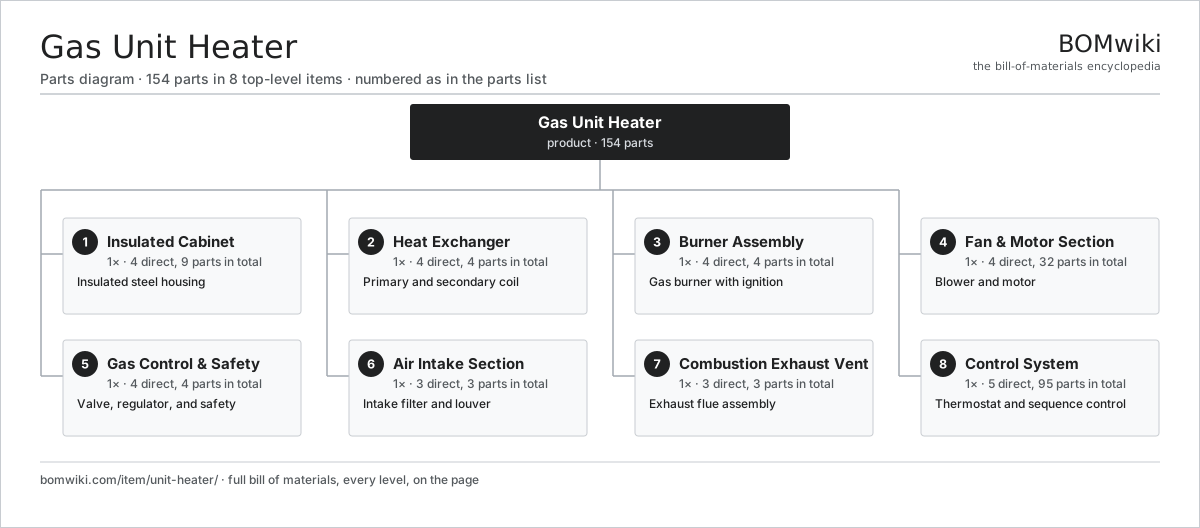
| # | Part | Qty | What it does |
|---|---|---|---|
| 1 | Insulated Cabinet 4 parts | 1× | Insulated steel housing |
| 2 | Heat Exchanger 4 parts | 1× | Primary and secondary coil |
| 3 | Burner Assembly 4 parts | 1× | Gas burner with ignition |
| 4 | Fan & Motor Section 4 parts | 1× | Blower and motor |
| 5 | Gas Control & Safety 4 parts | 1× | Valve, regulator, and safety |
| 6 | Air Intake Section 3 parts | 1× | Intake filter and louver |
| 7 | Combustion Exhaust Vent 3 parts | 1× | Exhaust flue assembly |
| 8 | Control System 5 parts | 1× | Thermostat and sequence control |
3D model
No 3D model yet. Have a CAD file of this? Add a 3D model. STL renders right on this page; STEP, FreeCAD, and OpenSCAD sources are welcome too (openly licensed, like all 3D models on BOMwiki).
Build & assembly graph
expand / collapse · shared sub-assemblies converge · links to related products · est. labourTap an assembly to expand/collapse · tap a part to open it · use “Open page” for any node · drag to pan, scroll to zoom.
Bill of materials for Gas Unit Heater
8 top-level lines · 49 rows shown · 154 parts total · indented to 3 levels| # | Item / sub-assembly | Part no. | Qty/assy | Ext. qty | Parts | Type |
|---|---|---|---|---|---|---|
| 1 | Insulated Cabinet 4 parts | unit-heater-cabinet | 1× | 1 | 9 | assembly |
| 1.1 | Cabinet Frame | unit-heater-cabinet-frame | 1× | 1 | · | part |
| 1.2 | Sheet Metal Panel | sheet-panel | 6× | 6 | · | part |
| 1.3 | Thermal Insulation | unit-heater-insulation | 1× | 1 | · | part |
| 1.4 | Burner Access Door | unit-heater-cleanout-door | 1× | 1 | · | part |
| 2 | Heat Exchanger 4 parts | unit-heater-heat-exchanger | 1× | 1 | 4 | assembly |
| 2.1 | Primary Heat Exchanger | unit-heater-primary-coil | 1× | 1 | · | part |
| 2.2 | Secondary Heat Exchanger | unit-heater-secondary-coil | 1× | 1 | · | part |
| 2.3 | Coil Casing | unit-heater-coil-casing | 1× | 1 | · | part |
| 2.4 | High-Temperature Seal | unit-heater-coil-seal | 1× | 1 | · | part |
| 3 | Burner Assembly 4 parts | unit-heater-burner-assembly | 1× | 1 | 4 | assembly |
| 3.1 | Burner Nozzle | unit-heater-burner-nozzle | 1× | 1 | · | part |
| 3.2 | Ignition Electrode | unit-heater-ignition-electrode | 1× | 1 | · | part |
| 3.3 | Combustion Chamber | unit-heater-combustion-chamber | 1× | 1 | · | part |
| 3.4 | Flame-Sensing Rod | unit-heater-flame-rod | 1× | 1 | · | part |
| 4 | Fan & Motor Section 4 parts | unit-heater-fan-section | 1× | 1 | 32 | assembly |
| 4.1 | Centrifugal Blower Wheel | unit-heater-blower-wheel | 1× | 1 | · | part |
| 4.2 | Motor 5 parts | unit-heater-fan-motor | 1× | 1 | 26 | assembly |
| 4.2.1 | Stator Assembly 3 parts + deeper › | stator-assembly | 1× | 1 | 3 | assembly |
| 4.2.2 | Rotor Assembly 4 parts + deeper › | rotor-assembly | 1× | 1 | 19 | assembly |
| 4.2.3 | Copper Winding | copper-winding | 1× | 1 | · | part |
| 4.2.4 | Motor Housing | motor-housing | 1× | 1 | · | part |
| 4.2.5 | Ball Bearing | ball-bearing | 2× | 2 | · | part |
| 4.3 | Fan Mounting Frame | unit-heater-fan-frame | 1× | 1 | · | part |
| 4.4 | Vibration Isolator Pad | unit-heater-fan-isolation | 4× | 4 | · | part |
| 5 | Gas Control & Safety 4 parts | unit-heater-gas-control | 1× | 1 | 4 | assembly |
| 5.1 | Solenoid Inlet Valve | unit-heater-inlet-valve | 1× | 1 | · | part |
| 5.2 | Gas Pressure Regulator | unit-heater-pressure-regulator | 1× | 1 | · | part |
| 5.3 | Manual Gas Cock | unit-heater-gas-cock | 1× | 1 | · | part |
| 5.4 | Low-Pressure Switch | unit-heater-pressure-switch | 1× | 1 | · | part |
| 6 | Air Intake Section 3 parts | unit-heater-air-intake | 1× | 1 | 3 | assembly |
| 6.1 | Intake Louver | unit-heater-intake-louver | 1× | 1 | · | part |
| 6.2 | Intake Filter | unit-heater-intake-filter | 1× | 1 | · | part |
| 6.3 | Intake Damper | unit-heater-intake-damper | 1× | 1 | · | part |
| 7 | Combustion Exhaust Vent 3 parts | unit-heater-combustion-vent | 1× | 1 | 3 | assembly |
| 7.1 | Flue Duct | unit-heater-flue-duct | 1× | 1 | · | part |
| 7.2 | Draft Hood | unit-heater-draft-hood | 1× | 1 | · | part |
| 7.3 | Flue Cap & Screen | unit-heater-flue-termination | 1× | 1 | · | part |
| 8 | Control System 5 parts | unit-heater-controls | 1× | 1 | 95 | assembly |
| 8.1 | Ignition Control Board 5 parts | unit-heater-control-board | 1× | 1 | 87 | assembly |
| 8.1.1 | Bare PCB | pcb-bare | 1× | 1 | · | part |
| 8.1.2 | Microcontroller | mcu | 1× | 1 | · | part |
| 8.1.3 | SMD Passive (R/C/L) | smd-passives | 80× | 80 | · | part |
| 8.1.4 | Relay | relay | 2× | 2 | · | part |
| 8.1.5 | Connector | connector | 3× | 3 | · | part |
| 8.2 | Room Thermostat | unit-heater-room-thermostat | 1× | 1 | · | part |
| 8.3 | High-Temperature Limit Switch | unit-heater-limit-switch | 1× | 1 | · | part |
| 8.4 | Relay | relay | 2× | 2 | · | part |
| 8.5 | Connector | connector | 4× | 4 | · | part |
Something wrong in this list? Report a problem with this BOM.
Related products
same domain, ranked by shared parts Air Handling Unit
631 parts · shares 16 with this page
Air Handling Unit
631 parts · shares 16 with this page
 Gas Furnace
308 parts · shares 16 with this page
Makeup Air Unit
193 parts · shares 16 with this page
Pool Dehumidifier
209 parts · shares 16 with this page
Steam Humidifier
207 parts · shares 16 with this page
Gas Furnace
308 parts · shares 16 with this page
Makeup Air Unit
193 parts · shares 16 with this page
Pool Dehumidifier
209 parts · shares 16 with this page
Steam Humidifier
207 parts · shares 16 with this page
 VRF Outdoor Unit
801 parts · shares 16 with this page
VRF Outdoor Unit
801 parts · shares 16 with this page
Sourcing: possible vendors
Browse the supplier directory → Prices, MOQ, and lead times are algorithmic estimates, not quotes, and not claims about these companies. Company mappings are curated by keyword; est. price band $100–$20k. How estimates work| Vendor | HQ | Specialty | MOQ | Lead time |
|---|---|---|---|---|
|
🇺🇸Carrier
carrier.com ↗
|
Palm Beach Gardens, US | HVAC | 500 units | 8–14 wks |
| tranetechnologies.com ↗ | Davidson, US | HVAC | 500 units | 8–14 wks |
|
🇯🇵Daikin
daikin.com ↗
|
Osaka, JP | HVAC | 500 units | 8–14 wks |
|
🇺🇸Lennox
lennox.com ↗
|
Richardson, US | HVAC | 500 units | 8–14 wks |
| johnsoncontrols.com ↗ | Milwaukee, US | Building systems | 500 units | 8–14 wks |
978-word article