V-Blender
ProductOverview
A V-blender (or V-mixer) is a batch mixing device that homogenizes powders through simple tumbling action. The vessel is a double cone: two conical sections joined at their wide ends, creating a V-shaped chamber. As the vessel rotates (20–50 rpm), powders cascade from one cone to the other, creating three-dimensional mixing. No rotating internal blades are used in the basic design; instead, gravity and tumbling provide the mixing action.
V-blenders are the workhorse of pharmaceutical powder processing, particularly in the pre-granulation stage. They excel at mixing cohesive APIs with large-volume excipients (fillers, binders, disintegrants) to create a uniform mixture before granulation or compression. They are gentle on delicate materials (fragile crystals, sensitive vitamins) and produce homogenous batches with ±5–10% coefficient of variation (CoV) in active pharmaceutical ingredient (API) concentration.
Typical batch sizes range 10–500 liters. A 50-liter unit fits most small-to-mid-size pharmaceutical facilities. Blend time is typically 10–20 minutes, depending on powder properties (particle size, density, cohesion) and whether an optional internal agitator (intensifier bar) is used.
How it works
The blending process is straightforward:
Loading: Powders (API, fillers, binders, disintegrants) are charged into the V-blender through a top-mounted hopper or chute. Typical API concentration ranges 5–50% w/w; the remainder is excipient.
Rotation Startup: The motor is started (soft-starter ramps speed over 5–10 seconds). The vessel rotates at a constant speed, typically 25–40 rpm. Rotation speed is chosen as a balance: faster rotation increases mixing rate but risks material segregation; slower rotation is gentler but prolongs blend time.
Tumbling & Mixing: As the vessel rotates, powders cascade from one cone to the other in a three-dimensional pattern. Light materials tend to migrate toward the axis; dense materials toward the outer surface. However, the continuous tumbling breaks down stratification. Internal baffles (curved blades welded inside the cones) enhance mixing by forcing non-linear powder paths.
Optional Intensification (if equipped): An optional intensifier bar, a rotating arm with a flat blade, scrapes the powder bed and cuts through lumps. Intensification dramatically reduces blend time (from 20 minutes to 5 minutes) and improves homogeneity (CoV down to ±3–5%). The intensifier rotates at the opposite direction to the vessel, typically 30–60 rpm.
Discharge: At the end of the blend cycle, the timer stops the vessel. A pneumatic actuator opens a large butterfly valve at the bottom of the V. Powder flows freely into a collection hopper below. An optional tilting frame can tilt the vessel 45° to assist gravity discharge and empty the dead space (typically <0.5% of vessel capacity).
Key Subsystems
Vessel Design
The double-cone geometry is carefully engineered. The half-angle of each cone is typically 45°, balancing mixing efficiency against discharge completeness. Steeper angles (>50°) improve discharge but create dead zones where powder stagnates. Shallower angles (<40°) improve mixing but risk incomplete discharge.
Vessel capacity determines batch size. A 50-liter V-blender can hold 30–40 kg of typical pharmaceutical powder (density 1000–1200 kg/m³). Overfilling degrades mixing (insufficient tumbling space); underfilling wastes capacity.
The discharge valve at the V-bottom is a large butterfly valve (150–250 mm diameter for 50 L units). A wide-open valve minimizes restriction and dead space. The valve seat and disc are precision-ground to ensure airtight closure when not in use.
Intensifier Bar (Optional)
The intensifier bar is a mechanical aid that dramatically improves blend quality and speed. A rotating eccentric arm with a flat blade penetrates the powder bed, breaking up agglomerates and promoting cross-mixing. The blade typically rotates at 30–60 rpm, opposite to the vessel rotation (counter-rotating intensifier).
The intensifier is driven by a separate motor via belt or direct connection. Its mechanical design must allow for shaft sealing and bearing support, adding complexity and cost. Intensifiers are optional but recommended for cohesive powders (high-binder or high-fines content) where natural tumbling is slow.
Rotation Drive
The main motor is a constant-speed three-phase induction motor (1.5–7.5 kW depending on vessel size and load). A soft-starter reduces inrush current and ramps motor speed over 5–10 seconds, smoothing the startup transient. A gearbox reduces motor speed (typically 1750 rpm input) to 20–50 rpm output.
The flexible coupling between motor and gearbox absorbs torsional vibration and shock, extending gearbox life. During startup, the vessel is unloaded (empty) before powder is charged; this reduces inrush current further.
Discharge System
The discharge butterfly valve is pneumatic-actuated via a double-acting air cylinder. A proportional solenoid valve controls air flow, allowing gradual opening of the discharge valve. Gradual opening prevents dust clouds and powder aeration (which can cause segregation). A manual throttle valve in the air line can be set to open the valve over 5–10 seconds.
Tilt mechanism (optional) is a hydraulic or pneumatic cylinder attached to the frame base. When activated, it tilts the entire vessel frame 30–45°, assisting gravity discharge. Tilt is particularly useful for cohesive powders that tend to hang up in the vessel apex.
Blend Time Control
A simple timer relay controls blend duration. Operators set the timer based on the formulation and powder properties. Typical blend times:
- Free-flowing powders (low API concentration, small filler particles): 5–10 minutes
- Cohesive powders (high-binder formulations, fine active): 15–25 minutes
- With intensifier bar: 3–8 minutes (dramatically reduced)
Statistical sampling and CoV testing (High-Performance Liquid Chromatography or similar) confirm when adequate mixing is achieved.
Operating Considerations
Blend Time Optimization
Blend time is not fixed; it depends on powder properties. Operators should establish blend times empirically through sampling:
- Start with a conservative estimate (15–20 minutes)
- Run the batch and draw samples at 5, 10, 15, 20, 30 minutes
- Analyze samples via HPLC to measure API concentration distribution
- Calculate coefficient of variation (standard deviation / mean)
- Accept blend time when CoV <±10% (or tighter per specification)
Longer mixing times don't always improve homogeneity; excessive mixing can cause segregation (light and heavy powders separate due to vibrational energy). This is called "over-mixing" and is a risk if blend time exceeds 45–60 minutes.
Batch Loading & Sequencing
The sequence of powder addition affects final homogeneity. A common approach:
- Add the bulk of the filler (e.g., microcrystalline cellulose) first, about 50%
- Add the API (dissolved or suspended in a small amount of filler), typically 30% by weight
- Add remaining filler and other excipients (binder, disintegrant), about 20%
- Close the top access cover and start rotation
This "sandwich" loading ensures the API is distributed throughout the powder mass, rather than concentrated near the discharge point.
Powder Properties & Behavior
Powder behavior in the V-blender depends on:
- Particle size: Fine powders (<50 microns) tend to agglomerate and segregate; coarser powders (100–500 microns) mix more readily.
- Density: Large density differences between API and excipient promote segregation. Blending a light API (density 1.2 g/cm³) with a dense filler (density 2.7 g/cm³) requires longer blend times.
- Moisture content: Damp powders agglomerate and stick to the vessel wall, resulting in incomplete discharge or poor mixing. Powders should be dried to <2% moisture before loading.
- Particle shape: Granular or spherical particles mix better than needle or plate-like crystals, which tend to interlock and resist shear.
Cleanout & Cross-Contamination
The V-blender must be thoroughly cleaned between batches to prevent cross-contamination. The vessel interior should be vacuumed or wiped with lint-free cloth. The discharge valve area often retains powder residue; manual cleaning with a solvent-dampened brush is recommended.
For potent APIs (active at sub-milligram doses), solvent washing (ethanol or water, depending on powder solubility) may be required. The vessel should be air-dried after washing (use compressed air at low pressure to avoid aeration).
Troubleshooting
Poor homogeneity (CoV >15%): Cause: insufficient blend time, cohesive powder, or inadequate initial mixing. Solutions: increase blend time by 5–10 minutes, install intensifier bar, pre-blend API in small portion of filler before batch loading.
Incomplete discharge (>2% dead space in vessel): Cause: cohesive powder, valve undersized, or insufficient tilt. Solutions: tilt frame more aggressively, increase valve opening, or discharge valve is partially blocked, clean it.
Powder segregation post-blending: Cause: over-mixing, large density differences, or vibration during transport. Solutions: reduce blend time, blend immediately before granulation/compression (minimize handling), or increase binder level to increase cohesion.
Vessel tilting difficulty: Cause: hydraulic cylinder weak or tilt mechanism binding. Solutions: check hydraulic pressure (should be 150–200 bar for small tilt cylinders), lubricate tilt frame pivot pins.
Maintenance
Trunnion bearings (which support the rotating vessel) should be greased every 500 operating hours. The gearbox oil should be changed annually or per manufacturer intervals. The motor soft-starter should be inspected annually for burnt components or loose connections; capacitors in soft-starters degrade over time and may require replacement every 3–5 years.
The discharge butterfly valve seat and disc can wear or corrode over time, especially if the blended powder is abrasive (e.g., contains talc) or hygroscopic. Inspect the valve every 1000 operating hours; if the valve leaks or is difficult to open, replace the seat gasket or the entire valve cartridge.
See Also
- V-Shaped Vessel Assembly – Double-cone geometry and discharge design
- Drive Motor & Gearbox – Motor and gearbox for tumbling
- Intensifier Bar (Optional) – Optional agitator for cohesive powders
- Discharge Assembly – Valve and flow control
- Electrical & Control System – Timer and interlock safety
V-Blender parts and their functions
7 top-level parts · 47 parts in total · full bill of materials below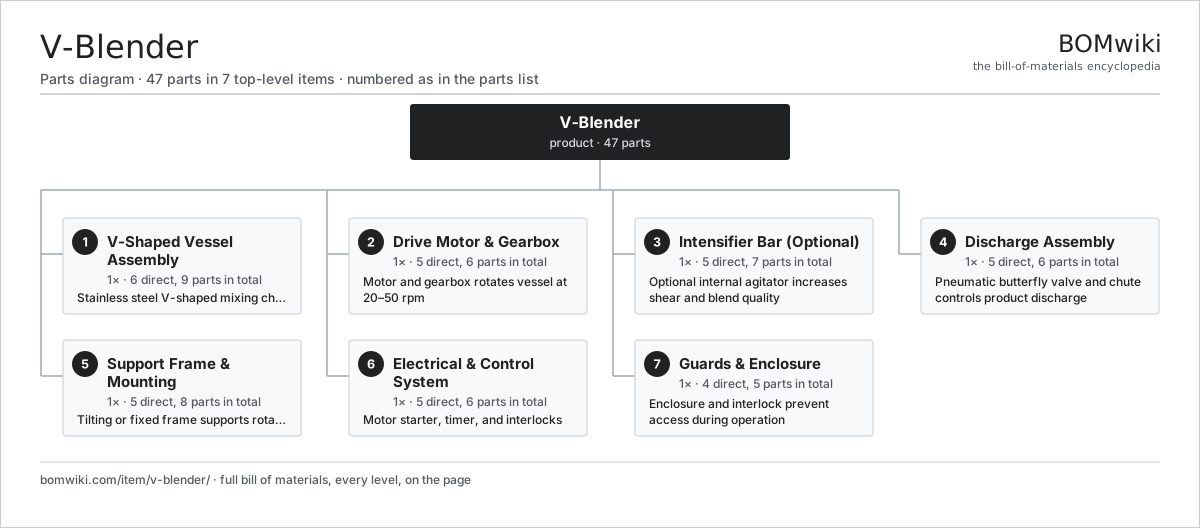
| # | Part | Qty | What it does |
|---|---|---|---|
| 1 | V-Shaped Vessel Assembly 6 parts | 1× | Stainless steel V-shaped mixing chamber with discharge valve |
| 2 | Drive Motor & Gearbox 5 parts | 1× | Motor and gearbox rotates vessel at 20–50 rpm |
| 3 | Intensifier Bar (Optional) 5 parts | 1× | Optional internal agitator increases shear and blend quality |
| 4 | Discharge Assembly 5 parts | 1× | Pneumatic butterfly valve and chute controls product discharge |
| 5 | Support Frame & Mounting 5 parts | 1× | Tilting or fixed frame supports rotating vessel and drive |
| 6 | Electrical & Control System 5 parts | 1× | Motor starter, timer, and interlocks |
| 7 | Guards & Enclosure 4 parts | 1× | Enclosure and interlock prevent access during operation |
3D model
No 3D model yet. Have a CAD file of this? Add a 3D model. STL renders right on this page; STEP, FreeCAD, and OpenSCAD sources are welcome too (openly licensed, like all 3D models on BOMwiki).
Build & assembly graph
expand / collapse · shared sub-assemblies converge · links to related products · est. labourTap an assembly to expand/collapse · tap a part to open it · use “Open page” for any node · drag to pan, scroll to zoom.
Bill of materials for V-Blender
7 top-level lines · 42 rows shown · 47 parts total · indented to 3 levels| # | Item / sub-assembly | Part no. | Qty/assy | Ext. qty | Parts | Type |
|---|---|---|---|---|---|---|
| 1 | V-Shaped Vessel Assembly 6 parts | v-blender-vessel | 1× | 1 | 9 | assembly |
| 1.1 | Double-Cone Shell | v-blender-cone-shell | 1× | 1 | · | part |
| 1.2 | Discharge Butterfly Valve | v-blender-discharge-valve | 1× | 1 | · | part |
| 1.3 | Internal Baffles | v-blender-baffles | 1× | 1 | · | part |
| 1.4 | Discharge Valve Gasket | v-blender-vessel-gasket | 1× | 1 | · | part |
| 1.5 | Vessel Mounting Lugs | v-blender-mounting-lugs | 2× | 2 | · | part |
| 1.6 | Fastener Set | fastener-set | 3× | 3 | · | part |
| 2 | Drive Motor & Gearbox 5 parts | v-blender-rotation-drive | 1× | 1 | 6 | assembly |
| 2.1 | Drive Motor | v-blender-main-motor | 1× | 1 | · | part |
| 2.2 | Reduction Gearbox | v-blender-gearbox | 1× | 1 | · | part |
| 2.3 | Soft-Start Controller | v-blender-soft-starter | 1× | 1 | · | part |
| 2.4 | Flexible Coupling | v-blender-flexible-coupling | 1× | 1 | · | part |
| 2.5 | Fastener Set | fastener-set | 2× | 2 | · | part |
| 3 | Intensifier Bar (Optional) 5 parts | v-blender-intensifier-bar | 1× | 1 | 7 | assembly |
| 3.1 | Intensifier Shaft | v-blender-intensifier-shaft | 1× | 1 | · | part |
| 3.2 | Agitator Blade | v-blender-intensifier-blade | 1× | 1 | · | part |
| 3.3 | Intensifier Motor (Optional) | v-blender-intensifier-drive | 1× | 1 | · | part |
| 3.4 | Intensifier Bearing | v-blender-intensifier-bearing | 2× | 2 | · | part |
| 3.5 | Fastener Set | fastener-set | 2× | 2 | · | part |
| 4 | Discharge Assembly 5 parts | v-blender-discharge-system | 1× | 1 | 6 | assembly |
| 4.1 | Discharge Pneumatic Cylinder | v-blender-discharge-actuator | 1× | 1 | · | part |
| 4.2 | Discharge Solenoid Valve | v-blender-discharge-solenoid | 1× | 1 | · | part |
| 4.3 | Discharge Chute | v-blender-discharge-chute | 1× | 1 | · | part |
| 4.4 | Discharge Flow Throttle | v-blender-discharge-flow-control | 1× | 1 | · | part |
| 4.5 | Fastener Set | fastener-set | 2× | 2 | · | part |
| 5 | Support Frame & Mounting 5 parts | v-blender-support-frame | 1× | 1 | 8 | assembly |
| 5.1 | Support Frame | v-blender-frame-structure | 1× | 1 | · | part |
| 5.2 | Trunnion Bearings | v-blender-trunnion-bearings | 2× | 2 | · | part |
| 5.3 | Shaft Seal Assembly | v-blender-shaft-seal | 1× | 1 | · | part |
| 5.4 | Tilt Mechanism (Optional) | v-blender-tilt-hydraulic | 1× | 1 | · | part |
| 5.5 | Fastener Set | fastener-set | 3× | 3 | · | part |
| 6 | Electrical & Control System 5 parts | v-blender-electrical-control | 1× | 1 | 6 | assembly |
| 6.1 | Motor Starter | v-blender-motor-starter | 1× | 1 | · | part |
| 6.2 | Blend Timer | v-blender-timer-relay | 1× | 1 | · | part |
| 6.3 | Access Interlock Switch | v-blender-access-interlock | 1× | 1 | · | part |
| 6.4 | Emergency Stop Button | v-blender-emergency-stop | 1× | 1 | · | part |
| 6.5 | Fastener Set | fastener-set | 2× | 2 | · | part |
| 7 | Guards & Enclosure 4 parts | v-blender-safety-guards | 1× | 1 | 5 | assembly |
| 7.1 | Top Access Cover | v-blender-top-guard | 1× | 1 | · | part |
| 7.2 | Side Safety Guards | v-blender-side-guards | 1× | 1 | · | part |
| 7.3 | Control Enclosure | v-blender-electrical-enclosure | 1× | 1 | · | part |
| 7.4 | Fastener Set | fastener-set | 2× | 2 | · | part |
Something wrong in this list? Report a problem with this BOM.
Sourcing: possible vendors
Browse the supplier directory → Prices, MOQ, and lead times are algorithmic estimates, not quotes, and not claims about these companies. Company mappings are curated by keyword; est. price band $5k–$2M. How estimates work| Vendor | HQ | Specialty | MOQ | Lead time |
|---|---|---|---|---|
| atlascopco.com ↗ | Stockholm, SE | Compressors & industrial | 10 units | 12–20 wks |
|
🇦🇹Andritz
andritz.com ↗
|
Graz, AT | Process plants & machinery | 10 units | 12–20 wks |
| buhlergroup.com ↗ | Uzwil, CH | Food & materials processing | 10 units | 12–20 wks |
| gea.com ↗ | Düsseldorf, DE | Process technology | 10 units | 12–20 wks |
| mhi.com ↗ | Tokyo, JP | Heavy machinery | 10 units | 12–20 wks |
1,601-word article