VAR Furnace
ProductOverview
Vacuum arc remelting (VAR) is a secondary remelting process that converts feedstock scrap, ingots, or powder-metallurgy compacts into ultra-clean, sound ingots suitable for critical applications: turbine blades, aerospace forgings, medical implants, and precision tool steels. In VAR, a consumable electrode (made from the scrap or alloyed material) is melted by an electric arc under vacuum, and molten droplets drip into a water-cooled copper crucible. The vacuum environment eliminates atmospheric oxygen and nitrogen, and the controlled melting allows volatile elements to evaporate selectively, producing a refined ingot.
The process is slower and more expensive than primary melting but delivers metallurgical purity and porosity-free structure unattainable by conventional cupola or induction furnaces, justifying the cost for high-value parts.
How it works
A cylindrical electrode (typically 50–300 mm diameter, made from scrap or pre-alloyed material) is inserted vertically into the furnace top and clamped by the electrode feed mechanism. The water-cooled crucible sits below, initially empty.
The vacuum pump evacuates the chamber to 0.01–0.1 mbar (removing oxygen and nitrogen). Once vacuum is achieved, the DC power supply is energized, and a high-frequency oscillator strikes an arc between the tungsten electrode and the water-cooled crucible bottom.
The arc, burning at ~3500 K, melts the consumable electrode. Molten metal drips from the electrode tip onto a small "pool" at the crucible bottom, then solidifies against the water-cooled crucible wall, forming an ingot. The servo-controlled electrode feed advances the electrode continuously, maintaining a constant arc gap (controlled by feedback from arc voltage). This steady-state melting continues until the entire electrode is consumed.
The critical feature is the vacuum environment: oxygen and nitrogen dissolved in the molten droplets cannot come out of solution under vacuum. Volatile elements (zinc, sulfur, phosphorus) preferentially evaporate in the low-pressure zone above the metal pool, leaving behind a refined, ultra-clean ingot.
Thermal and metallurgical control
The water-cooled crucible is essential: it maintains a thin liquid layer (preventing crucible fusion) while rapidly solidifying the metal against the copper wall. The high cooling rate (100–1000 K/sec near the surface) produces a fine, equiaxed grain structure with minimal segregation.
The arc current is maintained constant (typically ±5 A) by a closed-loop controller: if arc voltage drops (electrode approaching pool), the power supply reduces current; if voltage rises (arc gap increasing), current increases. This regulation ensures a steady melting rate and uniform ingot quality.
The vacuum pump system removes not only atmospheric gases but also hydrogen and other volatile impurities. Oxygen content in the final ingot is typically 50–80 % lower than the feedstock electrode, dramatically improving fracture toughness and fatigue resistance.
Ingot solidification and internal quality
As the molten pool rises in the crucible, the outer region solidifies first, forming a thin shell. The interior remains liquid until the end of melting, at which point the crucible is water-cooled at maximum rate. This controlled solidification prevents gas bubbles (a major defect in gravity-cast ingots) from forming: dissolved gas cannot precipitate because the pressure (though low) still suppresses bubble nucleation.
The final ingot typically shows:
- Outer zone (0–20 mm): very fine, equiaxed grain structure
- Intermediate zone (20–80 % of radius): columnar grain growth (due to directional heat extraction)
- Center (final 20 % of radius): final solidification zone, slightly coarser but still sound
This structure is far superior to a gravity-cast ingot, which exhibits large shrinkage cavities and gas porosity in the center.
Electrode preparation and scrap recycling
The consumable electrode can be made from:
- Scrap material (same alloy as desired ingot), melted and cast into a electrode shape
- Powder-metallurgy compacts (atomized powder pressed and sintered)
- Previously VAR-melted ingots (multiple remelting passes for ultra-clean material)
Foundries often prepare electrodes by remelting lower-grade scrap from previous castings in a conventional furnace, then casting and cooling the electrode stock. This pre-consolidation improves the feedstock before final VAR refining.
Applications and limitations
VAR is indispensable for:
- Superalloy turbine blades (Ni-based, Co-based superalloys)
- Surgical implants and orthodontic wires (stainless steels, Ti alloys)
- High-strength aerospace forgings
- Tool steel dies and punches
The process is slower (10–50 kg/hour vs. 1000+ kg/hour for cupola) and costlier (~$2–5 per kg material cost for the furnace run), but the resulting ingot commands premium pricing ($10–20 per kg for aerospace-grade material).
Maintenance and operational challenges
The copper crucible, being in contact with molten metal under vacuum, suffers erosion and thermal cycling. Typical crucible life is 5–20 remelts before replacement (cost ~$500–2000 per crucible). The graphite coating prevents the copper from alloying with ferrous metals; this coating must be re-applied periodically.
The chamber top seal (water-cooled O-ring) can leak, allowing air ingress and contaminating a melt. Weekly pressure tests and seal inspection are essential.
The arc power supply generates significant electrical and magnetic noise. The tungsten electrode erodes during melting and must be periodically re-dressed (sharpened on a grinding wheel) to maintain arc stability.
Alternative remelting processes
For lower-value production, foundries may use electroslag remelting (ESR) instead of VAR: the electrode is melted by passing current through a pool of ionic slag (CaF₂-based), which acts as the resistive heater. ESR is faster and cheaper but produces less refined metal (more gas dissolved). VAR is preferred when extreme purity and porosity-free structure are mandatory.
VAR Furnace parts and their functions
8 top-level parts · 40 parts in total · full bill of materials below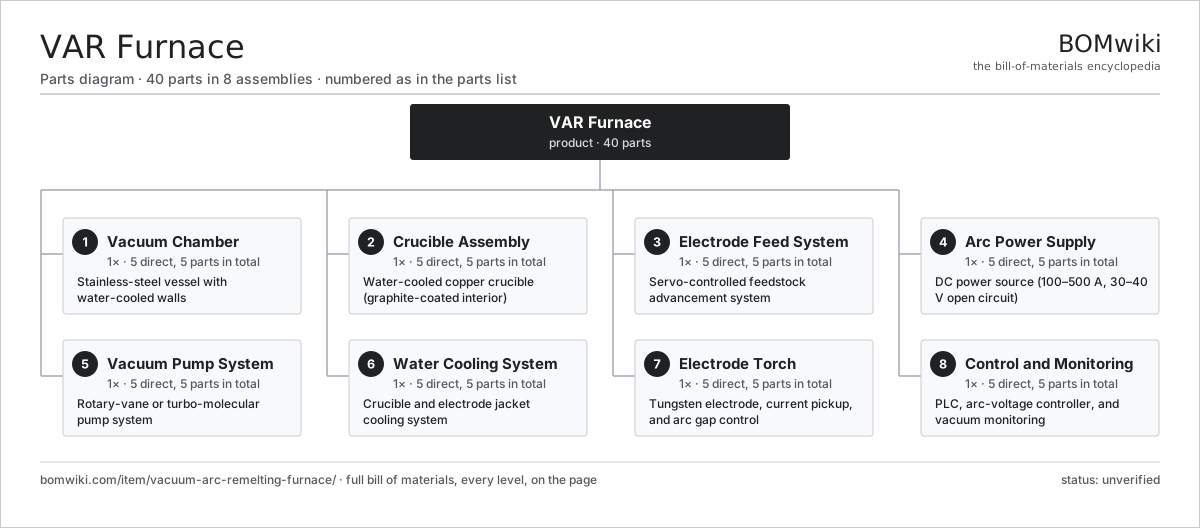
| # | Part | Qty | What it does |
|---|---|---|---|
| 1 | Vacuum Chamber 5 parts | 1× | Stainless-steel vessel with water-cooled walls |
| 2 | Crucible Assembly 5 parts | 1× | Water-cooled copper crucible (graphite-coated interior) |
| 3 | Electrode Feed System 5 parts | 1× | Servo-controlled feedstock advancement system |
| 4 | Arc Power Supply 5 parts | 1× | DC power source (100–500 A, 30–40 V open circuit) |
| 5 | Vacuum Pump System 5 parts | 1× | Rotary-vane or turbo-molecular pump system |
| 6 | Water Cooling System 5 parts | 1× | Crucible and electrode jacket cooling system |
| 7 | Electrode Torch 5 parts | 1× | Tungsten electrode, current pickup, and arc gap control |
| 8 | Control and Monitoring 5 parts | 1× | PLC, arc-voltage controller, and vacuum monitoring |
3D model
No 3D model yet. Have a CAD file of this? Add a 3D model — STL renders right on this page; STEP, FreeCAD, and OpenSCAD sources are welcome too (openly licensed, like all 3D models on BOMwiki).
Build & assembly graph
expand / collapse · shared sub-assemblies converge · links to related products · est. labourTap an assembly to expand/collapse · tap a part to open it · use “Open page” for any node · drag to pan, scroll to zoom.
Bill of materials for VAR Furnace
8 top-level lines · 48 rows shown · 40 parts total · indented to 3 levels| # | Item / sub-assembly | Part no. | Qty/assy | Ext. qty | Parts | Type |
|---|---|---|---|---|---|---|
| 1 | Vacuum Chamber 5 parts | vacuum-arc-remelting-furnace-vacuum-chamber | 1× | 1 | 5 | assembly |
| 1.1 | Chamber Stainless Shell | vacuum-arc-remelting-furnace-chamber-shell | 1× | 1 | · | part |
| 1.2 | Chamber Top Lid | vacuum-arc-remelting-furnace-chamber-top-lid | 1× | 1 | · | part |
| 1.3 | Vacuum Port | vacuum-arc-remelting-furnace-vacuum-port | 1× | 1 | · | part |
| 1.4 | Chamber Water Jacket | vacuum-arc-remelting-furnace-chamber-water-jacket | 1× | 1 | · | part |
| 1.5 | Thermal Radiation Shield | vacuum-arc-remelting-furnace-thermal-shield | 1× | 1 | · | part |
| 2 | Crucible Assembly 5 parts | vacuum-arc-remelting-furnace-crucible | 1× | 1 | 5 | assembly |
| 2.1 | Crucible Copper Shell | vacuum-arc-remelting-furnace-crucible-copper | 1× | 1 | · | part |
| 2.2 | Crucible Graphite Coating | vacuum-arc-remelting-furnace-crucible-graphite-coating | 1× | 1 | · | part |
| 2.3 | Crucible Water Cooling | vacuum-arc-remelting-furnace-crucible-water-jacket | 1× | 1 | · | part |
| 2.4 | Crucible Support Block | vacuum-arc-remelting-furnace-crucible-base-block | 1× | 1 | · | part |
| 2.5 | Crucible Tapping Hole | vacuum-arc-remelting-furnace-crucible-tapping-hole | 1× | 1 | · | part |
| 3 | Electrode Feed System 5 parts | vacuum-arc-remelting-furnace-electrode-ram | 1× | 1 | 5 | assembly |
| 3.1 | Electrode Feed Servo Motor | vacuum-arc-remelting-furnace-electrode-motor | 1× | 1 | · | part |
| 3.2 | Electrode Feed Gearbox | vacuum-arc-remelting-furnace-electrode-gearbox | 1× | 1 | · | part |
| 3.3 | Electrode Collet Chuck | vacuum-arc-remelting-furnace-electrode-collet | 1× | 1 | · | part |
| 3.4 | Electrode Linear Guide | vacuum-arc-remelting-furnace-electrode-guide | 1× | 1 | · | part |
| 3.5 | Electrode Position Sensor | vacuum-arc-remelting-furnace-position-sensor | 1× | 1 | · | part |
| 4 | Arc Power Supply 5 parts | vacuum-arc-remelting-furnace-power-supply | 1× | 1 | 5 | assembly |
| 4.1 | Arc Power Transformer | vacuum-arc-remelting-furnace-transformer | 1× | 1 | · | part |
| 4.2 | Rectifier Diode Stack | vacuum-arc-remelting-furnace-rectifier-stack | 1× | 1 | · | part |
| 4.3 | Arc Current Feedback Controller | vacuum-arc-remelting-furnace-arc-current-controller | 1× | 1 | · | part |
| 4.4 | Electrode Power Cable | vacuum-arc-remelting-furnace-electrode-cable | 1× | 1 | · | part |
| 4.5 | Crucible Return Cable | vacuum-arc-remelting-furnace-crucible-return-cable | 1× | 1 | · | part |
| 5 | Vacuum Pump System 5 parts | vacuum-arc-remelting-furnace-vacuum-pump | 1× | 1 | 5 | assembly |
| 5.1 | Rotary-Vane Vacuum Pump | vacuum-arc-remelting-furnace-rotary-pump | 1× | 1 | · | part |
| 5.2 | Pump Drive Motor | vacuum-arc-remelting-furnace-pump-motor | 1× | 1 | · | part |
| 5.3 | Oil-Mist Separator | vacuum-arc-remelting-furnace-pump-oil-separator | 1× | 1 | · | part |
| 5.4 | Vacuum Pressure Gauge | vacuum-arc-remelting-furnace-vacuum-gauge | 1× | 1 | · | part |
| 5.5 | Pump Isolation Valve | vacuum-arc-remelting-furnace-isolation-valve | 1× | 1 | · | part |
| 6 | Water Cooling System 5 parts | vacuum-arc-remelting-furnace-water-cooling | 1× | 1 | 5 | assembly |
| 6.1 | Cooling Water Pump | vacuum-arc-remelting-furnace-cooling-pump | 1× | 1 | · | part |
| 6.2 | Cooling Tower Heat Exchanger | vacuum-arc-remelting-furnace-cooling-tower | 1× | 1 | · | part |
| 6.3 | Cooling Temperature Control Valve | vacuum-arc-remelting-furnace-cooling-thermostatic-valve | 1× | 1 | · | part |
| 6.4 | Cooling Flow Meter | vacuum-arc-remelting-furnace-flow-meter | 1× | 1 | · | part |
| 6.5 | Water Supply Filter | vacuum-arc-remelting-furnace-water-filter | 1× | 1 | · | part |
| 7 | Electrode Torch 5 parts | vacuum-arc-remelting-furnace-torch-assembly | 1× | 1 | 5 | assembly |
| 7.1 | Tungsten Electrode | vacuum-arc-remelting-furnace-electrode-tip | 1× | 1 | · | part |
| 7.2 | Electrode Holder | vacuum-arc-remelting-furnace-electrode-holder | 1× | 1 | · | part |
| 7.3 | Current Pickup Brush | vacuum-arc-remelting-furnace-current-pickup | 1× | 1 | · | part |
| 7.4 | Arc Voltage Divider | vacuum-arc-remelting-furnace-arc-voltage-sensor | 1× | 1 | · | part |
| 7.5 | Arc Ignition Circuit | vacuum-arc-remelting-furnace-arc-starting-circuit | 1× | 1 | · | part |
| 8 | Control and Monitoring 5 parts | vacuum-arc-remelting-furnace-control-system | 1× | 1 | 5 | assembly |
| 8.1 | Main Control PLC | vacuum-arc-remelting-furnace-main-plc | 1× | 1 | · | part |
| 8.2 | Arc Current Regulator | vacuum-arc-remelting-furnace-arc-current-regulator | 1× | 1 | · | part |
| 8.3 | Electrode Feed PID Controller | vacuum-arc-remelting-furnace-electrode-feed-controller | 1× | 1 | · | part |
| 8.4 | Vacuum Pressure Regulator | vacuum-arc-remelting-furnace-vacuum-regulator | 1× | 1 | · | part |
| 8.5 | Melting Data Logger | vacuum-arc-remelting-furnace-data-logger | 1× | 1 | · | part |
Sourcing: possible vendors
Prices, MOQ, and lead times are algorithmic estimates, not quotes, and not claims about these companies. Company mappings are curated by keyword; est. price band $5k–$2M. How estimates work| Vendor | HQ | Specialty | MOQ | Lead time |
|---|---|---|---|---|
| atlascopco.com ↗ | Stockholm, SE | Compressors & industrial | 10 units | 12–20 wks |
|
🇦🇹Andritz
andritz.com ↗
|
Graz, AT | Process plants & machinery | 10 units | 12–20 wks |
| buhlergroup.com ↗ | Uzwil, CH | Food & materials processing | 10 units | 12–20 wks |
| gea.com ↗ | Düsseldorf, DE | Process technology | 10 units | 12–20 wks |
| mhi.com ↗ | Tokyo, JP | Heavy machinery | 10 units | 12–20 wks |
998-word article