Vacuum Blender
ProductOverview
A vacuum blender is a premium kitchen appliance that enhances a standard high-speed blender with an integrated Vacuum Pump. Before blending, the pump removes air from the sealed Blender Jar, creating a partial vacuum (50–85 kPa below atmospheric). Blending in this oxygen-depleted environment reduces oxidation, preserves color and nutrition in smoothies and juices, and can improve the texture and shelf-life of blended foods.
The design combines two independent systems: the primary Motor Base Unit with a high-speed blender motor (1–2 kW), and a secondary Vacuum Pump powered by a small DC motor. The user places ingredients in the Blender Jar, threads the jar onto the motor base, closes the Sealed Lid with Vacuum Valve, presses the Vacuum Pump Button, waits for the pump to evacuate air, and then operates the blender as normal via the Variable Speed Dial.
The result is a smoother texture, more vibrant color retention, and longer shelf-life compared to conventional blending. This is prized for high-end juicing bars and health-conscious consumers.
How it works
Mains power (220–240 V, 50 Hz) flows through the Power Cord and Mains Plug into the Control Panel, where two independent circuits are managed: the blender motor circuit and the vacuum pump circuit.
Blender Motor Circuit:
When the user presses the main Main Power Switch, current is routed to the AC Induction Motor, a 1–2 kW AC induction motor. The Stator Assembly contains main and auxiliary windings; the Rotor Assembly (squirrel-cage aluminum) spins inside the Motor Housing. At nominal 50 Hz supply, the motor idles at ~1450 RPM, but its mechanical output is not directly used at this speed. Instead, the motor is coupled via a Flexible Motor Coupling (flexible shaft coupler to reduce vibration) to a gearbox or direct-drive arrangement that allows the Rotating Blade Wheel to reach 20,000–30,000 RPM.
The Variable Speed Dial dial on the control panel is connected to a variable frequency drive (VFD) or a triac-based phase-control circuit. When the user adjusts the speed, they modify the electrical signal that commands the drive to increase or decrease the motor output frequency (for VFD) or the phase angle (for phase control). This allows smooth speed modulation from idle to maximum RPM without mechanical gears.
The motor shaft connects to the Blade Assembly, which consists of the Rotating Blade Wheel, a stainless steel rotor with sharp, beveled cutting edges, mounted on a Motor Shaft Coupling Pin pin. As the motor spins, the blade wheel whips at high speed inside the sealed Glass or Tritan Jar.
Vacuum Pump Circuit:
When the user presses the Vacuum Pump Button on the control panel, current is sent to the Pump Drive Motor, a small DC motor (~100–200 W). This motor drives a Diaphragm Pump Element, a flexible rubber or silicone membrane. As the motor oscillates the diaphragm, it creates a pumping action: on the intake stroke, the diaphragm expands and draws air from the jar into the pump chamber; on the exhaust stroke, the diaphragm compresses and pushes the air out through a Check Valve Assembly, a check valve that prevents backflow.
The pump is connected to the jar's interior via a small hose or port that connects to the Sealed Lid with Vacuum Valve. As air is pumped out, the pressure inside the jar falls below atmospheric (~100 kPa) down to ~50–85 kPa, depending on how long the pump runs. The Vacuum Pressure Gauge on the lid provides visual feedback of the current pressure level. Once the user sees the desired vacuum level, they stop the pump by releasing the Vacuum Pump Button. The Check Valve Assembly prevents air from re-entering the jar.
Blending in Vacuum:
With the jar sealed and under partial vacuum, the user initiates blending by pressing the main power switch and adjusting the Variable Speed Dial. The high-speed Rotating Blade Wheel now whips the ingredients in an oxygen-poor environment.
Why this matters:
- Oxidation reduction: In normal blending, the high-speed blades incorporate air into the mixture, which causes oxidation, the browning of fruit flesh, loss of vitamin C, and degradation of flavors. A vacuum environment eliminates this.
- Color preservation: Smoothies from vacuum blenders stay bright green (spinach) or vibrant red (berries) longer than those from standard blenders.
- Texture: Some users report a creamier, more velvety mouthfeel in vacuum-blended smoothies, possibly due to reduced air incorporation.
- Shelf-life: Juice or smoothie blended in a vacuum can be refrigerated longer without flavor degradation.
Sealing System:
The sealing-system is critical. The O-Ring Set (three O-rings at different points) and the Main Jar Gasket (a rubber gasket between the jar and the motor base) create an airtight seal. The Sealed Lid with Vacuum Valve on top of the jar has its own seal and contains the Check Valve Assembly to prevent air re-entry. Together, these components maintain the vacuum throughout the blending process. As the jar warms from friction during high-speed blending, the gas inside expands slightly, but this is typically small enough to remain within the target vacuum range.
Control and Safety:
The Control Panel houses a Main Power Switch (on/off for the main motor), a Variable Speed Dial (variable dial), and a Vacuum Pump Button (on/off for the pump). Status Indicator Light Set signal power status and pump activity.
Safety considerations include:
- Over-vacuum protection: If the vacuum becomes too deep, the jar might implode. Most designs use a Check Valve Assembly that opens if pressure drops below a safety threshold (e.g., 30 kPa absolute).
- Thermal fuse in the pump motor to prevent motor burnout.
- Heavy Glass or Tritan Jar (borosilicate glass or reinforced Tritan) to withstand the pressure differential.
Operation Sequence:
- Fill the Blender Jar with ingredients.
- Thread the jar onto the Motor Base Unit.
- Close the Sealed Lid with Vacuum Valve.
- Press the Vacuum Pump Button; the Pump Drive Motor runs until the user releases the button or the Vacuum Pressure Gauge shows the desired level.
- Adjust the Variable Speed Dial dial.
- Press the main Main Power Switch; the Rotating Blade Wheel spins at the selected speed.
- Blend for 2–4 minutes until smooth.
- Release the power switch and the speed control.
- Open the lid (which vents the jar to atmospheric pressure) and pour or serve.
Maintenance is straightforward: wash the jar, blade, and lid after each use; wipe the motor base; and annually inspect the O-Ring Set for deterioration and replace if necessary. The Pump Drive Motor and Diaphragm Pump Element require no maintenance beyond checking for air leaks (listen for hissing from the valve).
Vacuum Blender parts and their functions
8 top-level parts · 56 parts in total · full bill of materials below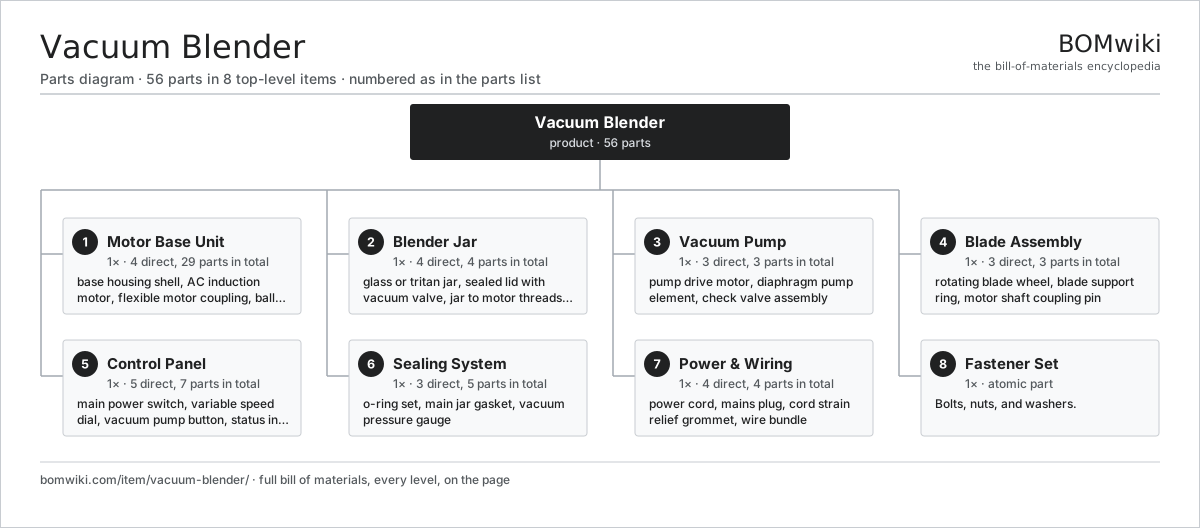
| # | Part | Qty | What it does |
|---|---|---|---|
| 1 | Motor Base Unit 4 parts | 1× | Heavy stand containing the high-speed blender motor. |
| 2 | Blender Jar 4 parts | 1× | Transparent food-grade container with vacuum-sealed lid and blade connection. |
| 3 | Vacuum Pump 3 parts | 1× | Small electric pump that evacuates air from the jar before blending. |
| 4 | Blade Assembly 3 parts | 1× | High-speed cutting blades mounted on motor shaft. |
| 5 | Control Panel 5 parts | 1× | Power switch, speed dial, and vacuum pump button. |
| 6 | Sealing System 3 parts | 1× | O-rings and gaskets that maintain vacuum integrity. |
| 7 | Power & Wiring 4 parts | 1× | Mains cord, plug, and internal electrical harness. |
| 8 | Fastener Set | 1× | Bolts, nuts, and washers. |
3D model
No 3D model yet. Have a CAD file of this? Add a 3D model. STL renders right on this page; STEP, FreeCAD, and OpenSCAD sources are welcome too (openly licensed, like all 3D models on BOMwiki).
Build & assembly graph
expand / collapse · shared sub-assemblies converge · links to related products · est. labourTap an assembly to expand/collapse · tap a part to open it · use “Open page” for any node · drag to pan, scroll to zoom.
Bill of materials for Vacuum Blender
8 top-level lines · 37 rows shown · 56 parts total · indented to 3 levels| # | Item / sub-assembly | Part no. | Qty/assy | Ext. qty | Parts | Type |
|---|---|---|---|---|---|---|
| 1 | Motor Base Unit 4 parts | vacuum-blender-motor-base | 1× | 1 | 29 | assembly |
| 1.1 | Base Housing Shell | vacuum-blender-housing | 1× | 1 | · | part |
| 1.2 | AC Induction Motor 3 parts | vacuum-blender-motor | 1× | 1 | 23 | assembly |
| 1.2.1 | Stator Assembly 3 parts + deeper › | stator-assembly | 1× | 1 | 3 | assembly |
| 1.2.2 | Rotor Assembly 4 parts + deeper › | rotor-assembly | 1× | 1 | 19 | assembly |
| 1.2.3 | Motor Housing | motor-housing | 1× | 1 | · | part |
| 1.3 | Flexible Motor Coupling | vacuum-blender-motor-coupling | 1× | 1 | · | part |
| 1.4 | Ball Bearing | ball-bearing | 4× | 4 | · | part |
| 2 | Blender Jar 4 parts | vacuum-blender-jar-assembly | 1× | 1 | 4 | assembly |
| 2.1 | Glass or Tritan Jar | vacuum-blender-jar-body | 1× | 1 | · | part |
| 2.2 | Sealed Lid with Vacuum Valve | vacuum-blender-sealing-lid | 1× | 1 | · | part |
| 2.3 | Jar to Motor Threads | vacuum-blender-jar-threads | 1× | 1 | · | part |
| 2.4 | Jar Side Handle | vacuum-blender-jar-handle | 1× | 1 | · | part |
| 3 | Vacuum Pump 3 parts | vacuum-blender-vacuum-pump | 1× | 1 | 3 | assembly |
| 3.1 | Pump Drive Motor | vacuum-blender-pump-motor | 1× | 1 | · | part |
| 3.2 | Diaphragm Pump Element | vacuum-blender-pump-diaphragm | 1× | 1 | · | part |
| 3.3 | Check Valve Assembly | vacuum-blender-pump-valve | 1× | 1 | · | part |
| 4 | Blade Assembly 3 parts | vacuum-blender-blade-assembly | 1× | 1 | 3 | assembly |
| 4.1 | Rotating Blade Wheel | vacuum-blender-blade-wheel | 1× | 1 | · | part |
| 4.2 | Blade Support Ring | vacuum-blender-blade-ring | 1× | 1 | · | part |
| 4.3 | Motor Shaft Coupling Pin | vacuum-blender-blade-shaft-connection | 1× | 1 | · | part |
| 5 | Control Panel 5 parts | vacuum-blender-control-panel | 1× | 1 | 7 | assembly |
| 5.1 | Main Power Switch | vacuum-blender-power-switch | 1× | 1 | · | part |
| 5.2 | Variable Speed Dial | vacuum-blender-speed-control | 1× | 1 | · | part |
| 5.3 | Vacuum Pump Button | vacuum-blender-vacuum-button | 1× | 1 | · | part |
| 5.4 | Status Indicator Light Set | vacuum-blender-indicator-lights | 1× | 1 | · | part |
| 5.5 | Connector | connector | 3× | 3 | · | part |
| 6 | Sealing System 3 parts | vacuum-blender-sealing-system | 1× | 1 | 5 | assembly |
| 6.1 | O-Ring Set | oring-set | 3× | 3 | · | part |
| 6.2 | Main Jar Gasket | vacuum-blender-gasket-main | 1× | 1 | · | part |
| 6.3 | Vacuum Pressure Gauge | vacuum-blender-vacuum-gauge | 1× | 1 | · | part |
| 7 | Power & Wiring 4 parts | vacuum-blender-power-module | 1× | 1 | 4 | assembly |
| 7.1 | Power Cord | vacuum-blender-mains-cord | 1× | 1 | · | part |
| 7.2 | Mains Plug | vacuum-blender-plug | 1× | 1 | · | part |
| 7.3 | Cord Strain Relief Grommet | vacuum-blender-strain-relief | 1× | 1 | · | part |
| 7.4 | Wire Bundle | wire-bundle | 1× | 1 | · | part |
| 8 | Fastener Set | fastener-set | 1× | 1 | · | part |
Something wrong in this list? Report a problem with this BOM.
Related products
same domain, ranked by shared parts Blender
68 parts · shares 11 with this page
Blender
68 parts · shares 11 with this page
 Compressor Ice Cream Maker
248 parts · shares 11 with this page
Compressor Ice Cream Maker
248 parts · shares 11 with this page
 Espresso Machine
120 parts · shares 11 with this page
Espresso Machine
120 parts · shares 11 with this page
 Food Processor
66 parts · shares 11 with this page
Food Processor
66 parts · shares 11 with this page
 High-Speed Blender
158 parts · shares 11 with this page
Hot Dog Roller Grill
81 parts · shares 11 with this page
High-Speed Blender
158 parts · shares 11 with this page
Hot Dog Roller Grill
81 parts · shares 11 with this page
Sourcing: possible vendors
Browse the supplier directory → Prices, MOQ, and lead times are algorithmic estimates, not quotes, and not claims about these companies. Company mappings are curated by keyword; est. price band $20–$600. How estimates work| Vendor | HQ | Specialty | MOQ | Lead time |
|---|---|---|---|---|
|
🇦🇺Breville
breville.com ↗
|
Sydney, AU | Kitchen appliances | 2,000 units | 6–10 wks |
| groupeseb.com ↗ | Écully, FR | Cookware & small appliances | 2,000 units | 6–10 wks |
| hamiltonbeach.com ↗ | Glen Allen, US | Small appliances | 2,000 units | 6–10 wks |
| panasonic.com ↗ | Osaka, JP | Electronics & appliances | 2,000 units | 6–10 wks |
|
🇨🇳Midea
midea.com ↗
|
Foshan, CN | Home appliances | 2,000 units | 6–10 wks |
1,168-word article