Vacuum Furnace
ProductOverview
A vacuum furnace is a premium heat-treatment system designed for aerospace, medical, tool steel, and other high-value applications where surface oxidation and decarburization must be eliminated. By operating at pressures below 0.01 mbar (99.99 % vacuum), the furnace eliminates oxygen, preventing scaling and carbon loss that plague conventional air hardening.
The process begins with heating the workpiece in a vacuum environment to the hardening temperature (typically 1000–1200 °C depending on alloy). Once at temperature, the vacuum is backfilled with high-purity nitrogen or argon gas at 5–10 bar pressure. The pressurized inert gas rapidly cools the part, quenching it to hardness while preventing oxidation throughout the cooling cycle.
Vacuum furnaces produce parts with pristine, scaled-free surfaces, precise hardness, minimal distortion, and superior mechanical properties. They are essential for critical applications, aerospace landing gears, turbine blades, medical implants, where every part is 100 % inspected and must meet zero-defect standards.
How it works
Freshly machined or pre-treated parts are loaded into a stainless steel work basket and placed in the load lock chamber, a small antechamber that acts as an airlock. The outer door is closed and sealed.
A separate small vacuum pump evacuates the load lock chamber to approximately 0.1 mbar (roughly 1 millionth of atmospheric pressure). Once at vacuum, a solenoid isolation valve opens, connecting the load lock to the main furnace chamber (which is already at its operating vacuum). The parts are transferred from the load lock basket into the main furnace hearth, and the isolation valve closes again, restoring vacuum isolation.
The main vacuum pump (a two-stage system: rotary vane primary, turbomolecular secondary) maintains the main furnace at <0.01 mbar throughout the heating cycle. At this pressure, the mean free path of gas molecules is hundreds of millimeters, effectively, there is no collisional gas present. Heat transfer occurs purely by radiation from the surrounding furnace walls (which are heated by tungsten or graphite elements).
The furnace heating elements, energized by proportional SCR (silicon-controlled rectifier) power control, raise the furnace temperature toward the setpoint. Thermocouples inside the furnace provide feedback to a PID temperature controller, which adjusts element power to maintain the setpoint within ±5 °C.
Heating rates are typically 10–50 °C/min depending on part mass and desired temperature uniformity. Large parts (100+ kg) heat more slowly to maintain internal-external temperature uniformity. Once the setpoint is reached, a soak timer holds the temperature for a duration specified by the alloy and part size (typically 15–120 minutes for hardening applications).
At the end of the soak, the quenching phase begins. A proportional solenoid valve controlled by the PLC cracks open, admitting high-purity nitrogen or argon gas from a pressurized storage bottle into the furnace chamber. The gas pressure rises to a preset value (typically 5–10 bar). This high-pressure inert gas floods the chamber and rapidly cools the hot parts.
The cooling rate during gas quenching is controlled by gas pressure: higher pressure = faster cooling (higher convective heat transfer coefficient). Typical cooling rates are 10–50 °C/s at the part surface, faster than oil quenching, but slower than water quenching, minimizing part distortion while achieving high hardness.
As the part cools below 300 °C, the metallurgical phase transformation from austenite to martensite is complete. The furnace cooling cycle continues under vacuum or with controlled gas atmosphere until the part temperature drops to 50–100 °C, at which point it is safe to remove from the furnace.
The parts are extracted from the furnace to air-cool to ambient. Because the surface is pristine, no oxide layer, final cleaning is minimal. Parts can proceed directly to dimensional inspection or tempering (if required).
Vacuum Generation and System Design
A proper vacuum furnace employs a two-stage vacuum system:
Primary pump (rotary vane): A large displacement pump (500–2000 L/min) achieves pressures of 0.1 mbar. Its exhaust is vented to atmosphere after an oil mist separator.
Secondary pump (turbomolecular): A high-speed spinning rotor (60,000+ rpm) with close-spaced blades physically accelerates gas molecules to high velocities, ejecting them into the primary pump's inlet. This enables ultra-high vacuum (UHV) conditions: <0.001 mbar or better.
Both pumps operate continuously during the heating and cooling phases. At the end of the cycle, before the furnace is vented to atmosphere for unloading, the pumps are shut down, and a proportional vent valve gently admits air back into the chamber to avoid explosive pressure transients or part damage from sudden pressure change.
Heating Element Materials
Tungsten: Most durable and highest-temperature capability (1300+ °C). Expensive and prone to brittleness if cooled too quickly. Used for the most demanding applications.
Molybdenum: Good strength and lower cost than tungsten. Suitable to 1100 °C continuous operation. Must not be exposed to oxygen above 300 °C (oxidizes rapidly), so load-lock and backfill procedures are critical.
Graphite: Cheapest, suitable to 1000 °C. Oxidizes above 300 °C in air; must never be exposed to oxygen. Rarely used in modern designs due to contamination risk.
Most production vacuum furnaces use tungsten elements for reliability.
Decarburization Prevention
In air furnaces, carbon atoms from the steel surface react with oxygen (O₂), forming CO and CO₂ gas, which escape. This removes carbon from the surface, reducing hardness and strength. In vacuum, there is no oxygen, so no decarburization occurs. A part that would lose 0.1–0.2 % carbon in a traditional air furnace loses essentially zero carbon in a vacuum furnace.
This is particularly valuable for tool steels (high carbon content) and precision parts where dimensional stability and hardness are critical. A tool steel die hardened in a vacuum furnace retains full hardness and dimensional accuracy; the same die in an air furnace might lose 2–5 % hardness due to decarburization.
Distortion and Residual Stress
Oil-quenched parts often experience distortion (warping, growth) due to non-uniform cooling and high thermal stresses. Gas quenching in a vacuum furnace cools more uniformly and at controlled rates, reducing distortion by 50–80 % compared to conventional hardening.
Further, vacuum furnace hardening produces lower residual stress because:
- Uniform heating eliminates thermal gradients.
- Controlled gas-quench rates minimize the severity of phase transformation stresses.
- Optional intermediate tempering (low-temp reheating) can be performed immediately after quenching while parts are still at elevated temperature, relieving remaining stresses.
The combination results in parts with superior dimensional stability and fatigue strength.
Load-Lock Technology
Modern vacuum furnaces integrate a load-lock (small antechamber) to avoid venting the main furnace to atmosphere for each part insertion. The operator loads parts into the load lock at atmospheric pressure, seals the door, evacuates the load lock to vacuum, and transfers parts to the hot furnace chamber. At the end of the cycle, parts are cooled, transferred back to the load lock, vented to atmosphere, and unloaded.
This design maintains the main furnace vacuum continuously, extending pump life and improving energy efficiency. Load-lock cycles take 20–40 minutes per batch, allowing high throughput in multi-shift operations.
Quench Gas Selection
Nitrogen (N₂): Most common, least expensive, inert at all temperatures. Cooling rate is moderate (10–30 °C/s depending on pressure).
Argon (Ar): Slightly better cooling performance than N₂ (5–10 % faster), but 3–5 × more expensive. Used when maximum cooling rate or tight hardness specs demand it.
Helium (He): Rare, very expensive, used only when extreme cooling rates are needed (specialty aerospace applications).
Most industrial applications use nitrogen at 5–8 bar, achieving hardness and distortion targets cost-effectively.
Quality Metrics and Part Consistency
Vacuum-hardened parts exhibit superior consistency:
- Hardness uniformity: ±2 HRC across the part surface (vs. ±5 HRC for oil-quenched).
- Distortion: <0.1 % dimensional change typical (vs. 0.5–1.5 % for oil-quenched).
- Surface quality: Pristine, zero oxide scale, ready for precision grinding or coating.
- Case depth: Reproducible to ±0.05 mm (if carburizing precedes hardening).
These metrics justify the 3–5 × higher cost of vacuum hardening for critical parts. A tool die that costs $50,000 and must hold ±0.005 inch tolerances is hardened under vacuum. A structural bolt costing $2 is air-hardened in a conventional furnace.
Integration with Tempering
Many vacuum furnace systems include in-situ tempering capability. Immediately after quenching, before the parts cool below 200 °C, the element power is reduced and ramp-up heating recommences to a tempering setpoint (typically 150–350 °C). The parts are held at this lower temperature for 30–120 minutes, then cooled to ambient under vacuum.
This triple-cycle (heat-quench-temper) eliminates the need for separate tempering furnaces and produces parts with optimized strength-toughness balance and minimal residual stress.
Maintenance and Reliability
Vacuum furnaces are complex and require dedicated maintenance:
- Pump oil changes: Every 500–1000 operating hours (backflush or fresh oil replacement).
- Thermocouple replacement: Every 1000 hours or as needed.
- Filter replacement: Pump inlet and outlet filters every 500 hours.
- Pressure vessel inspection: Annual hydrostatic test and external inspection per ASME code.
- Heating element inspection: Visual inspection every 500 hours, replacement when <70 % operational power remains.
A well-maintained vacuum furnace has a service life of 20–30 years. Unexpected failures are rare; preventive maintenance is the key.
Cost-Benefit Analysis
A vacuum furnace costs $300,000–$800,000 installed (vs. $50,000–$150,000 for a conventional hardening furnace). Operating costs are 2–3 × higher due to utility consumption (vacuum pumps, water cooling, element heating). However, for high-value, critical parts, the benefit is compelling:
- Zero scrap from oxidation or decarburization.
- Superior mechanical properties (higher hardness, lower distortion, longer fatigue life).
- Reduced secondary operations (less grinding, polishing, or rework).
Break-even point is typically 5,000–20,000 critical parts per year, depending on part complexity and value.
Vacuum Furnace parts and their functions
8 top-level parts · 32 parts in total · full bill of materials below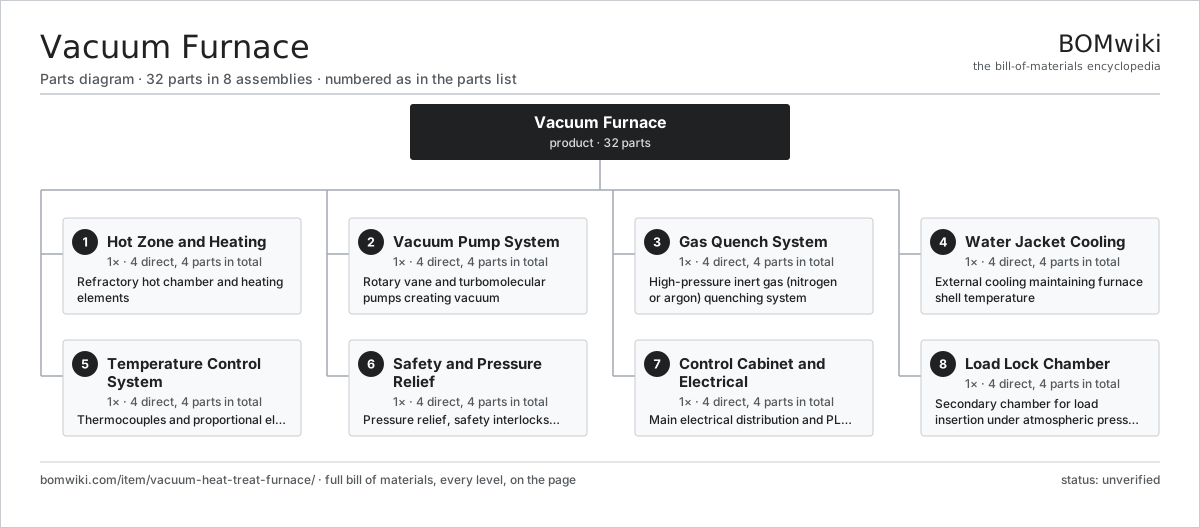
| # | Part | Qty | What it does |
|---|---|---|---|
| 1 | Hot Zone and Heating 4 parts | 1× | Refractory hot chamber and heating elements |
| 2 | Vacuum Pump System 4 parts | 1× | Rotary vane and turbomolecular pumps creating vacuum |
| 3 | Gas Quench System 4 parts | 1× | High-pressure inert gas (nitrogen or argon) quenching system |
| 4 | Water Jacket Cooling 4 parts | 1× | External cooling maintaining furnace shell temperature |
| 5 | Temperature Control System 4 parts | 1× | Thermocouples and proportional element heating control |
| 6 | Safety and Pressure Relief 4 parts | 1× | Pressure relief, safety interlocks, and isolation valve |
| 7 | Control Cabinet and Electrical 4 parts | 1× | Main electrical distribution and PLC interface |
| 8 | Load Lock Chamber 4 parts | 1× | Secondary chamber for load insertion under atmospheric pressure |
3D model
No 3D model yet. Have a CAD file of this? Add a 3D model — STL renders right on this page; STEP, FreeCAD, and OpenSCAD sources are welcome too (openly licensed, like all 3D models on BOMwiki).
Build & assembly graph
expand / collapse · shared sub-assemblies converge · links to related products · est. labourTap an assembly to expand/collapse · tap a part to open it · use “Open page” for any node · drag to pan, scroll to zoom.
Bill of materials for Vacuum Furnace
8 top-level lines · 40 rows shown · 32 parts total · indented to 3 levels| # | Item / sub-assembly | Part no. | Qty/assy | Ext. qty | Parts | Type |
|---|---|---|---|---|---|---|
| 1 | Hot Zone and Heating 4 parts | vacuum-heat-treat-furnace-hot-zone | 1× | 1 | 4 | assembly |
| 1.1 | Furnace Hearth | vacuum-heat-treat-furnace-hearth | 1× | 1 | · | part |
| 1.2 | Heating Element Array | vacuum-heat-treat-furnace-element-array | 1× | 1 | · | part |
| 1.3 | Insulation and Radiation Shield | vacuum-heat-treat-furnace-insulation-box | 1× | 1 | · | part |
| 1.4 | Element Feed-Through | vacuum-heat-treat-furnace-element-terminal | 1× | 1 | · | part |
| 2 | Vacuum Pump System 4 parts | vacuum-heat-treat-furnace-vacuum-system | 1× | 1 | 4 | assembly |
| 2.1 | Rotary Vane Pump | vacuum-heat-treat-furnace-rotary-vane | 1× | 1 | · | part |
| 2.2 | Turbomolecular Pump | vacuum-heat-treat-furnace-turbomol | 1× | 1 | · | part |
| 2.3 | Vacuum Pressure Gauge | vacuum-heat-treat-furnace-vacuum-gauge | 1× | 1 | · | part |
| 2.4 | Isolation Valve | vacuum-heat-treat-furnace-isolation-valve | 1× | 1 | · | part |
| 3 | Gas Quench System 4 parts | vacuum-heat-treat-furnace-gas-quench | 1× | 1 | 4 | assembly |
| 3.1 | Gas Bottle | vacuum-heat-treat-furnace-gas-bottle | 1× | 1 | · | part |
| 3.2 | Gas Pressure Regulator | vacuum-heat-treat-furnace-pressure-regulator | 1× | 1 | · | part |
| 3.3 | Proportional Gas Valve | vacuum-heat-treat-furnace-proportional-valve | 1× | 1 | · | part |
| 3.4 | Quench Distribution Manifold | vacuum-heat-treat-furnace-quench-nozzle | 1× | 1 | · | part |
| 4 | Water Jacket Cooling 4 parts | vacuum-heat-treat-furnace-water-jacket | 1× | 1 | 4 | assembly |
| 4.1 | Cooling Water Jacket | vacuum-heat-treat-furnace-jacket | 1× | 1 | · | part |
| 4.2 | Jacket Circulation Pump | vacuum-heat-treat-furnace-circulation-pump | 1× | 1 | · | part |
| 4.3 | Jacket Cooler Heat Exchanger | vacuum-heat-treat-furnace-cooler-unit | 1× | 1 | · | part |
| 4.4 | Jacket Thermostatic Valve | vacuum-heat-treat-furnace-thermostatic-valve | 1× | 1 | · | part |
| 5 | Temperature Control System 4 parts | vacuum-heat-treat-furnace-temperature-control | 1× | 1 | 4 | assembly |
| 5.1 | Chamber Thermocouple | vacuum-heat-treat-furnace-element-thermocouple | 1× | 1 | · | part |
| 5.2 | Workpiece Thermocouple | vacuum-heat-treat-furnace-workpiece-thermocouple | 1× | 1 | · | part |
| 5.3 | PID Temperature Controller | vacuum-heat-treat-furnace-pid-controller | 1× | 1 | · | part |
| 5.4 | Programmable Ramp-Soak Unit | vacuum-heat-treat-furnace-ramp-soak | 1× | 1 | · | part |
| 6 | Safety and Pressure Relief 4 parts | vacuum-heat-treat-furnace-safety | 1× | 1 | 4 | assembly |
| 6.1 | Pressure Relief Valve | vacuum-heat-treat-furnace-relief-valve | 1× | 1 | · | part |
| 6.2 | Furnace Pressure Gauge | vacuum-heat-treat-furnace-pressure-gauge | 1× | 1 | · | part |
| 6.3 | Manual Isolation Valve | vacuum-heat-treat-furnace-manual-isolation | 1× | 1 | · | part |
| 6.4 | Overpressure Alarm Switch | vacuum-heat-treat-furnace-overpressure-alarm | 1× | 1 | · | part |
| 7 | Control Cabinet and Electrical 4 parts | vacuum-heat-treat-furnace-control-cabinet | 1× | 1 | 4 | assembly |
| 7.1 | Main Disconnect Switch | vacuum-heat-treat-furnace-main-switch | 1× | 1 | · | part |
| 7.2 | Soft-Start Controller | vacuum-heat-treat-furnace-soft-starter | 1× | 1 | · | part |
| 7.3 | Main Contactor | vacuum-heat-treat-furnace-main-contactor | 1× | 1 | · | part |
| 7.4 | E-Stop Safety Relay | vacuum-heat-treat-furnace-estop-relay | 1× | 1 | · | part |
| 8 | Load Lock Chamber 4 parts | vacuum-heat-treat-furnace-loading-chamber | 1× | 1 | 4 | assembly |
| 8.1 | Load Lock Door | vacuum-heat-treat-furnace-load-lock-door | 1× | 1 | · | part |
| 8.2 | Load Lock Vacuum Pump | vacuum-heat-treat-furnace-load-lock-pump | 1× | 1 | · | part |
| 8.3 | Load Lock Isolation Valve | vacuum-heat-treat-furnace-load-lock-valve | 1× | 1 | · | part |
| 8.4 | Load Lock Vent Valve | vacuum-heat-treat-furnace-load-lock-vent | 1× | 1 | · | part |
Sourcing: possible vendors
Prices, MOQ, and lead times are algorithmic estimates, not quotes, and not claims about these companies. Company mappings are curated by keyword; est. price band $10k–$1M. How estimates work| Vendor | HQ | Specialty | MOQ | Lead time |
|---|---|---|---|---|
|
🇩🇪DMG MORI
dmgmori.com ↗
|
Bielefeld, DE | Machine tools | 5 units | 12–20 wks |
|
🇯🇵Mazak
mazak.com ↗
|
Oguchi, JP | Machine tools | 5 units | 12–20 wks |
| haascnc.com ↗ | Oxnard, US | CNC machine tools | 5 units | 12–20 wks |
|
🇯🇵Okuma
okuma.com ↗
|
Niwa, JP | Machine tools | 5 units | 12–20 wks |
|
🇩🇪Trumpf
trumpf.com ↗
|
Ditzingen, DE | Laser & sheet-metal machines | 5 units | 12–20 wks |
1,633-word article