Valve Refacing Machine
ProductOverview
A valve refacing machine grinds the seating surface (the cone-shaped face) of engine valves to create a precise angle (typically 45° for modern engines, 30° for older designs) that seals against the corresponding seat in the cylinder head. The grinding produces a smooth, concentric surface that must be nearly perfect, any runout or irregularity allows combustion gas leakage, reducing compression and power.
The precision chuck holds the valve stem as the grinding spindle rotates a diamond wheel at 1500–2000 rpm. The support arm positions the valve face at the correct angle relative to the wheel. As the valve rotates, the diamond wheel cuts the face in a few seconds, removing 0.005–0.015" of material to restore a clean, flat seating surface.
Engine rebuilders refacing valves after a major overhaul rely on this machine. A valve that has been in service for thousands of hours develops pitting and corrosion on its seating face; grinding removes these defects and restores the hermetic seal. The machine is also used in machine shops doing precision valve work for high-performance engines where exact angle and runout specifications are critical.
Valve chuck and centering
The valve chuck is a rotating spindle with a precision collet that grips the valve stem. Three collet sizes (5/16", 3/8", 7/16") accommodate the vast majority of automotive engine valves. The collet is pulled tight by a drawbar with a spring lock, centering the valve stem within 0.0005" of the chuck axis.
A precision alignment pin ensures that the valve stem centerline is coaxial with the wheel's axis of rotation. This is critical: if the stem is off-center by even 0.005", the ground face will be off-center, and the valve will not seal properly when installed in the head. Most operators use a dial indicator to verify centering before grinding begins.
The chuck rotates at 10–20 rpm during grinding (much slower than the grinding wheel), allowing the diamond wheel to trace a smooth path across the valve face. This low rotation speed is intentional: high speed would cause chatter (vibration), producing a rough, wavy face instead of a smooth surface.
Grinding wheel and angle adjustment
The grinding wheel is typically diamond (4" diameter, 0.125" width), which is harder and longer-lasting than aluminum oxide. Diamond wheels stay sharp through thousands of valve grindings; when they do dull, they are dressed (re-profiled) using a dressing tool rather than replaced.
The angle adjuster allows setting the valve face angle with precision. A graduated dial marks common angles (30°, 45°), and a fine-adjust micrometer enables ±0.5° repeatability. The support arm tilts to the set angle and locks via a lock collar.
Most automotive engines use 45° valve faces, but some older designs (pre-1970s) use 30°. Performance engines might use 35° or custom angles. The machine accommodates this by simply re-setting the angle dial before grinding the next valve. Setup takes 2–3 minutes per valve type, and all identical valves in a batch use the same setting.
Spindle and rotation
The spindle assembly contains the diamond wheel and rotates at 1500–2000 rpm (controlled by a variable-pitch pulley). The 1 hp AC motor drives the wheel via a V-belt. Angular contact ball bearings, preloaded (slightly compressed) to eliminate end play, support the spindle shaft with runout less than 0.001".
A labyrinth seal protects the bearings from coolant spray. As the wheel rotates and the valve chuck slowly turns the valve, the wheel face traces a spiral path across the valve face, grinding it smooth in 5–30 seconds depending on the amount of material to remove.
Coolant and heat management
The coolant system is essential for grinding. A 1/4 hp pump (2–3 gpm) draws soluble oil coolant from a 5 gallon tank and delivers it via a flexible hose to an adjustable spray nozzle. The nozzle directs coolant onto the grinding point where the wheel meets the valve face.
Grinding without coolant is nearly impossible, friction heat exceeds 1200°F in seconds, annealing the valve steel and destroying its hardness. With coolant, grinding stays below 400°F, preserving the valve's metallurgical properties. The used coolant and swarf (ground metal particles) drain into a collection tray and flow back to the tank, where heavier particles settle and can be emptied periodically.
Most shops use ISO VG 46 soluble oil coolant mixed 1:20 with water, providing lubrication, cooling, and rust protection. After extended use, the coolant becomes filled with fine metal powder and must be replaced; many shops refresh the coolant every 2–3 months.
Precision and surface finish
A properly ground valve face is smooth to the naked eye and nearly mirror-like under magnification. The typical surface finish is Ra 8–16 microinches (0.2–0.4 micrometers), comparable to a finely honed bore. The face must be concentric with the stem (runout < 0.001") to ensure even pressure when seated.
The operator verifies the grind visually and with a dial indicator. Some machines have a built-in runout gauge; the operator checks that the indicator needle remains stable as the chuck rotates after grinding, confirming that the face is true. If runout exceeds 0.002", the valve is re-clamped (usually slightly tighter) and re-ground for another 10–30 seconds to correct the error.
Hardened valve seats in the cylinder head are matched to the ground valve face. A 45° valve is paired with a 45° seat; mating at the same angle ensures a tight seal. Some engines have multi-angle seats (e.g., 45° at the center and 30° at the periphery) for enhanced sealing; these require custom valve grinding angles or custom valve designs.
Workflow and batch processing
A typical engine rebuild involves refacing 16 valves (8 intake, 8 exhaust). The operator groups them by type: intake valves and exhaust valves have different stems and may have different face angles. Setup for the first intake valve takes 5 minutes (collet selection, angle dial adjustment, alignment check). Grinding takes 15–30 seconds. Removal and next valve insertion takes 1 minute. The remaining 7 intake valves grind in 15 minutes total.
After all intakes, the angle dial is reset for exhaust valves (often the same angle but recorded separately), and the remaining 8 exhaust valves are ground in 20 minutes. Total time for a 16-valve set: 45–60 minutes. The grind quality is consistent across all 16 valves because the machine's angle is locked and the coolant, speed, and pressure are fixed.
Some high-volume shops use semi-automatic valve grinding machines with part-load platters that feed valves to the spindle automatically, reducing labor. However, the manual machine remains prevalent in smaller rebuild shops and for custom work.
Limitations and custom considerations
The machine accommodates valve stems up to 7/16" diameter, covering 95% of automotive applications. Larger valve stems (race engines, aviation) require custom collets. Valve head diameter is limited by the clearance between the support arm and the grinding wheel; very large valves (> 2.5" diameter) may not fit under the wheel and require tilting the arm differently or using an extension sleeve.
Specialty valve designs (asymmetrical seats, multi-angle seats) may not be grindable on a standard machine. In such cases, a machine shop performs the grinding on a CNC valve refacer, which can create multiple angle surfaces in a single setup. Standard shops handle 95% of valve grinding with the manual machine.
Maintenance and grinding wheel life
Diamond wheels last thousands of valve grindings, a set might grind 5,000–10,000 valves before dressing becomes necessary. Dressing restores the wheel profile and is faster than replacement. When eventual replacement is needed, wheels are swapped by removing a few bolts and sliding the new wheel onto the spindle shaft.
The collets and drawbar should be cleaned of coolant and swarf monthly to prevent corrosion and ensure tight clamping. Bearings are sealed and require no oil; the spindle shaft should never be oiled (oil attracts abrasive dust and creates a lapping compound). Most shops maintain the machine with light cleaning after each shift and a full coolant tank refill.
Valve Refacing Machine parts and their functions
7 top-level parts · 38 parts in total · full bill of materials below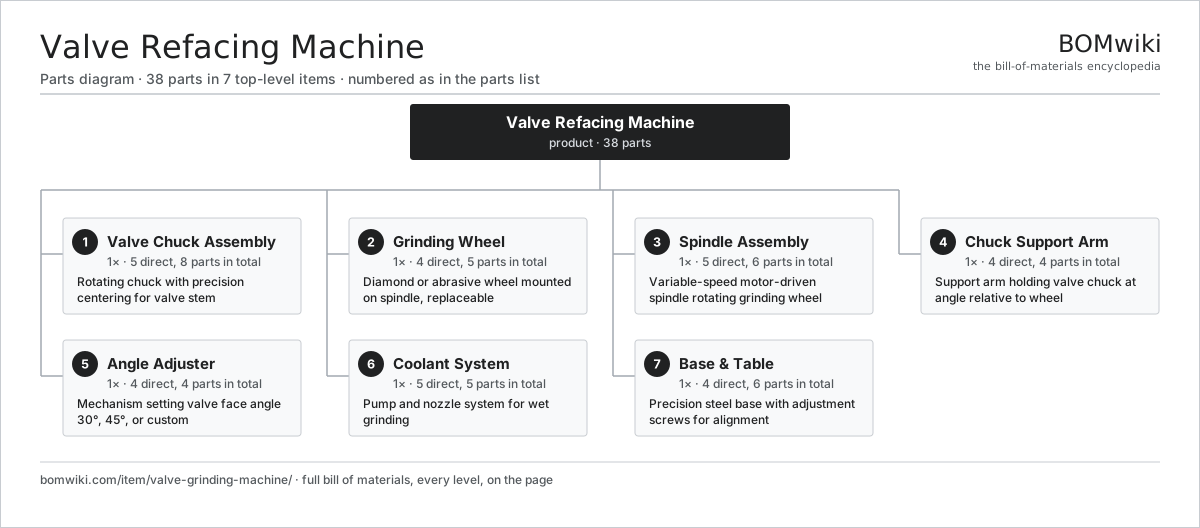
| # | Part | Qty | What it does |
|---|---|---|---|
| 1 | Valve Chuck Assembly 5 parts | 1× | Rotating chuck with precision centering for valve stem |
| 2 | Grinding Wheel 4 parts | 1× | Diamond or abrasive wheel mounted on spindle, replaceable |
| 3 | Spindle Assembly 5 parts | 1× | Variable-speed motor-driven spindle rotating grinding wheel |
| 4 | Chuck Support Arm 4 parts | 1× | Support arm holding valve chuck at angle relative to wheel |
| 5 | Angle Adjuster 4 parts | 1× | Mechanism setting valve face angle 30°, 45°, or custom |
| 6 | Coolant System 5 parts | 1× | Pump and nozzle system for wet grinding |
| 7 | Base & Table 4 parts | 1× | Precision steel base with adjustment screws for alignment |
3D model
No 3D model yet. Have a CAD file of this? Add a 3D model. STL renders right on this page; STEP, FreeCAD, and OpenSCAD sources are welcome too (openly licensed, like all 3D models on BOMwiki).
Build & assembly graph
expand / collapse · shared sub-assemblies converge · links to related products · est. labourTap an assembly to expand/collapse · tap a part to open it · use “Open page” for any node · drag to pan, scroll to zoom.
Bill of materials for Valve Refacing Machine
7 top-level lines · 38 rows shown · 38 parts total · indented to 3 levels| # | Item / sub-assembly | Part no. | Qty/assy | Ext. qty | Parts | Type |
|---|---|---|---|---|---|---|
| 1 | Valve Chuck Assembly 5 parts | valve-grinding-machine-valve-chuck | 1× | 1 | 8 | assembly |
| 1.1 | Chuck Body | valve-grinding-machine-chuck-body | 1× | 1 | · | part |
| 1.2 | Collet | valve-grinding-machine-chuck-collet | 3× | 3 | · | part |
| 1.3 | Drawbar | valve-grinding-machine-chuck-drawbar | 1× | 1 | · | part |
| 1.4 | Chuck Bearing | valve-grinding-machine-chuck-bearing | 2× | 2 | · | part |
| 1.5 | Alignment Pin | valve-grinding-machine-chuck-alignment-pin | 1× | 1 | · | part |
| 2 | Grinding Wheel 4 parts | valve-grinding-machine-grinding-wheel | 1× | 1 | 5 | assembly |
| 2.1 | Diamond Wheel | valve-grinding-machine-wheel-diamond | 1× | 1 | · | part |
| 2.2 | Wheel Flange | valve-grinding-machine-wheel-mount-flange | 2× | 2 | · | part |
| 2.3 | Dressing Tool | valve-grinding-machine-wheel-dressing-tool | 1× | 1 | · | part |
| 2.4 | Guard Shroud | valve-grinding-machine-wheel-guard-shroud | 1× | 1 | · | part |
| 3 | Spindle Assembly 5 parts | valve-grinding-machine-spindle | 1× | 1 | 6 | assembly |
| 3.1 | AC Motor | valve-grinding-machine-spindle-motor | 1× | 1 | · | part |
| 3.2 | Drive Belt | valve-grinding-machine-spindle-belt | 1× | 1 | · | part |
| 3.3 | Spindle Shaft | valve-grinding-machine-spindle-shaft | 1× | 1 | · | part |
| 3.4 | Spindle Bearing | valve-grinding-machine-spindle-bearing | 2× | 2 | · | part |
| 3.5 | Spindle Seal | valve-grinding-machine-spindle-seal | 1× | 1 | · | part |
| 4 | Chuck Support Arm 4 parts | valve-grinding-machine-chuck-support | 1× | 1 | 4 | assembly |
| 4.1 | Support Arm | valve-grinding-machine-support-arm-main | 1× | 1 | · | part |
| 4.2 | Hinge Pin | valve-grinding-machine-support-hinge-pin | 1× | 1 | · | part |
| 4.3 | Lock Collar | valve-grinding-machine-support-lock-collar | 1× | 1 | · | part |
| 4.4 | Extension Sleeve | valve-grinding-machine-support-extension-sleeve | 1× | 1 | · | part |
| 5 | Angle Adjuster 4 parts | valve-grinding-machine-angle-adjuster | 1× | 1 | 4 | assembly |
| 5.1 | Angle Dial | valve-grinding-machine-angle-dial | 1× | 1 | · | part |
| 5.2 | Stop Pin | valve-grinding-machine-angle-stop-pin | 1× | 1 | · | part |
| 5.3 | Angle Micrometer | valve-grinding-machine-angle-micrometer | 1× | 1 | · | part |
| 5.4 | Angle Scale | valve-grinding-machine-angle-scale | 1× | 1 | · | part |
| 6 | Coolant System 5 parts | valve-grinding-machine-coolant-system | 1× | 1 | 5 | assembly |
| 6.1 | Coolant Pump | valve-grinding-machine-coolant-pump | 1× | 1 | · | part |
| 6.2 | Coolant Tank | valve-grinding-machine-coolant-tank | 1× | 1 | · | part |
| 6.3 | Coolant Hose | valve-grinding-machine-coolant-hose | 1× | 1 | · | part |
| 6.4 | Spray Nozzle | valve-grinding-machine-coolant-nozzle | 1× | 1 | · | part |
| 6.5 | Return Tray | valve-grinding-machine-coolant-return-tray | 1× | 1 | · | part |
| 7 | Base & Table 4 parts | valve-grinding-machine-base-table | 1× | 1 | 6 | assembly |
| 7.1 | Base Casting | valve-grinding-machine-base-casting | 1× | 1 | · | part |
| 7.2 | Leveling Foot | valve-grinding-machine-base-foot-adjuster | 3× | 3 | · | part |
| 7.3 | Spindle Pad | valve-grinding-machine-base-spindle-mount | 1× | 1 | · | part |
| 7.4 | Arm Clamp | valve-grinding-machine-base-arm-clamp | 1× | 1 | · | part |
Something wrong in this list? Report a problem with this BOM.
Sourcing: possible vendors
Browse the supplier directory → Prices, MOQ, and lead times are algorithmic estimates, not quotes, and not claims about these companies. Company mappings are curated by keyword; est. price band $5–$2k. How estimates work| Vendor | HQ | Specialty | MOQ | Lead time |
|---|
1,512-word article