Vanadium Flow Battery
ProductOverview
A Vanadium Flow Battery is a long-duration energy storage system that separates power and energy capacity by design. Unlike lithium-ion batteries, where energy and power scale together via cell count, vanadium redox systems decouple them: power scales with the number of Cell Stack Assembly (more cells = higher voltage and current), while duration scales with Electrolyte Storage Tanks size (larger tanks = more ionic charge). This makes vanadium systems uniquely suited to grid-scale storage lasting 4–12 hours.
The chemistry uses four soluble vanadium redox couples: V2+/V3+ (negative half-cell) and VO2+/VO2− (positive half-cell), all dissolved in sulfuric acid electrolyte. During discharge, V2+ oxidizes to V3+ while VO2+ reduces to VO2−, and ions migrate across a cation-exchange Ion Exchange Membrane that blocks vanadium but allows H+ to flow, balancing charge. This ion selectivity is critical: any vanadium crossover contaminates both tanks and degrades performance.
How it works
At startup, Circulation Pump Assembly prime the Positive Electrolyte Tank and Negative Electrolyte Tank, pushing electrolyte through the Cell Stack Assembly at 10–30 L/min. The Control and Monitoring Unit module commands Power Conversion Module to either rectify or invert, depending on charge or discharge mode.
During discharge, V2+ in the negative tank flows into the stack's negative half-cell. At the Bipolar Plate surface, V2+ loses an electron to the graphite electrode, becoming V3+. The electron travels through an external circuit (e.g., an inverter to AC load or a grid tie point). In the positive half-cell, VO2+ gains an electron, reducing to VO2−. Protons from VO2+ flow through the Ion Exchange Membrane to balance the charge deficit. Flow continues until one tank's state-of-charge (SOC) reaches a threshold (typically 10% or 90% to prevent over-discharge).
The Thermal Management Module maintains electrolyte between 15–40°C: at lower temperatures, ionic conductivity drops and voltage efficiency falls; above 40°C, membrane degradation and vanadium dissolution accelerate. The Cooler Radiator sheds heat to ambient, while a Heating Element warms the electrolyte during cold-weather startup.
Voltage and Efficiency
Each cell outputs approximately 1.2–1.4V during discharge. Stacking 10 cells in series (as in a 100 kW system) yields 12–14V DC. The Power Conversion Module module steps this up to 400V DC via a transformer or resonant converter, then inverts to 3-phase AC for grid connection.
Round-trip efficiency (DC charge to DC discharge, excluding AC-to-DC conversion) ranges 75–82%, split between: (1) voltage efficiency (95%, due to overpotential losses at electrodes); (2) current efficiency (100%, near-perfect ion selectivity); (3) energy efficiency (82%, accounting for pump parasitic load and resistive heating in electrolyte). AC-to-AC systems (DC rectifier + battery + inverter) achieve 70–75% overall.
Electrolyte Chemistry and State-of-Charge
A 1000-L vanadium tank at 2 M V concentration holds approximately 2000 moles of vanadium, or roughly 50 kWh of energy per tank. The SOC of each tank is directly correlated to the ratio of oxidized to reduced species. The Control and Monitoring Unit estimates SOC by integrating discharge current over time and cross-checking with measured open-circuit voltage (OCV). OCV depends on the Nernst equation: OCV = 1.41V − 0.06 × log([V2+]/[V3+]) − similar relation for the positive side.
Membrane and Crossover Management
The Ion Exchange Membrane (typically Nafion or Fumasep) is a perfluorinated polymer that conducts protons but rejects vanadium ions by size and charge. Crossover occurs through diffusion and electro-osmotic drag: vanadium species slowly leak across over many cycles, contaminating the opposite tank. Every 2–3 years, electrolyte rebalancing is performed: the contaminated tank is run through a purification cycle or replaced. This is a unique maintenance cost for vanadium systems, but is often cheaper than replacing lithium modules.
Scalability and Modular Design
A 100 kW / 500 kWh system uses two 1 m³ tanks. To extend runtime to 8 hours (800 kWh), simply increase tank volume to 1.6 m³ each; the Power Conversion Module and Cell Stack Assembly remain unchanged. This flexibility makes vanadium batteries ideal for slow-ramp loads like daily arbitrage or wind/solar smoothing. Lithium, by contrast, requires adding entire packs, which scales both power and energy together.
Cooling and Heating Dynamics
During a 100 kW discharge over 5 hours, approximately 25 kW of heat is generated (75% efficiency means 25 kW loss). The Cooler Radiator must dissipate this to keep electrolyte below 40°C. In warm climates or continuous cycling, the cooler fan runs continuously. In winter, the Heating Element warms tanks during idle periods to maintain above 15°C, ensuring acceptable conductivity and ionic mobility when charging resumes.
Integration and Control Strategies
The Control and Monitoring Unit module communicates SOC, stack voltage, tank temperatures, and pump speed via Modbus TCP or IEC 60870-5-104. Typical control modes include: (1) constant power (e.g., 50 kW charge); (2) constant current (e.g., C/5 rate); (3) SOC regulation with hysteresis (e.g., charge if SOC < 20%, hold if 20–80%, discharge if SOC > 80%); (4) grid-forming, where the Power Conversion Module maintains frequency and voltage autonomously.
Lifecycle and Economics
Vanadium systems operate for 10,000+ cycles with negligible fade. A 2000-cycle lifetime costs approximately USD 200–250/kWh of energy capacity, competitive with 4-hour lithium on levelized cost of storage (LCOS). The main advantage is the decoupling of power and energy, allowing buyers to optimize for their specific duration need without over-specifying power electronics.
Vanadium Flow Battery parts and their functions
8 top-level parts · 64 parts in total · full bill of materials below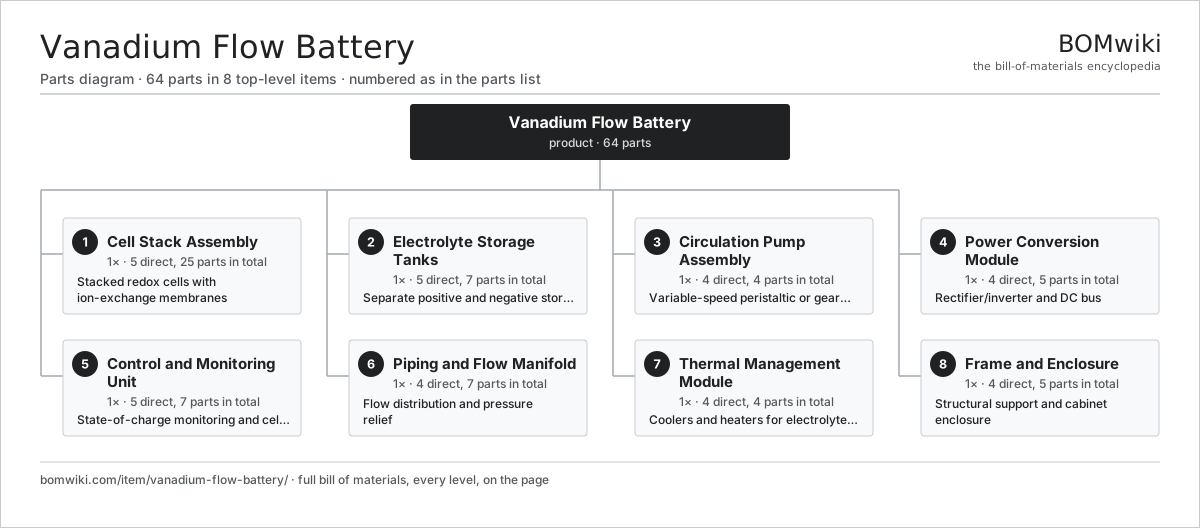
| # | Part | Qty | What it does |
|---|---|---|---|
| 1 | Cell Stack Assembly 5 parts | 1× | Stacked redox cells with ion-exchange membranes |
| 2 | Electrolyte Storage Tanks 5 parts | 1× | Separate positive and negative storage vessels |
| 3 | Circulation Pump Assembly 4 parts | 1× | Variable-speed peristaltic or gear pumps |
| 4 | Power Conversion Module 4 parts | 1× | Rectifier/inverter and DC bus |
| 5 | Control and Monitoring Unit 5 parts | 1× | State-of-charge monitoring and cell voltage regulation |
| 6 | Piping and Flow Manifold 4 parts | 1× | Flow distribution and pressure relief |
| 7 | Thermal Management Module 4 parts | 1× | Coolers and heaters for electrolyte temperature |
| 8 | Frame and Enclosure 4 parts | 1× | Structural support and cabinet enclosure |
3D model
No 3D model yet. Have a CAD file of this? Add a 3D model. STL renders right on this page; STEP, FreeCAD, and OpenSCAD sources are welcome too (openly licensed, like all 3D models on BOMwiki).
Build & assembly graph
expand / collapse · shared sub-assemblies converge · links to related products · est. labourTap an assembly to expand/collapse · tap a part to open it · use “Open page” for any node · drag to pan, scroll to zoom.
Bill of materials for Vanadium Flow Battery
8 top-level lines · 43 rows shown · 64 parts total · indented to 3 levels| # | Item / sub-assembly | Part no. | Qty/assy | Ext. qty | Parts | Type |
|---|---|---|---|---|---|---|
| 1 | Cell Stack Assembly 5 parts | vanadium-flow-battery-cell-stacks | 1× | 1 | 25 | assembly |
| 1.1 | Bipolar Plate | vanadium-flow-battery-bipolar-plate | 10× | 10 | · | part |
| 1.2 | Ion Exchange Membrane | vanadium-flow-battery-ion-exchange-membrane | 11× | 11 | · | part |
| 1.3 | Current Collector Plate | vanadium-flow-battery-current-collector | 2× | 2 | · | part |
| 1.4 | Gasket Assembly | vanadium-flow-battery-gasket-set | 1× | 1 | · | part |
| 1.5 | Fastener Set | fastener-set | 1× | 1 | · | part |
| 2 | Electrolyte Storage Tanks 5 parts | vanadium-flow-battery-electrolyte-tanks | 1× | 1 | 7 | assembly |
| 2.1 | Positive Electrolyte Tank | vanadium-flow-battery-positive-tank | 1× | 1 | · | part |
| 2.2 | Negative Electrolyte Tank | vanadium-flow-battery-negative-tank | 1× | 1 | · | part |
| 2.3 | Fill Cap Assembly | vanadium-flow-battery-fill-caps | 2× | 2 | · | part |
| 2.4 | Level Sensor | vanadium-flow-battery-level-sensors | 2× | 2 | · | part |
| 2.5 | Fastener Set | fastener-set | 1× | 1 | · | part |
| 3 | Circulation Pump Assembly 4 parts | vanadium-flow-battery-circulation-pumps | 1× | 1 | 4 | assembly |
| 3.1 | Variable-Speed Motor | vanadium-flow-battery-pump-motor | 1× | 1 | · | part |
| 3.2 | Peristaltic Pump Head | vanadium-flow-battery-peristaltic-pump | 1× | 1 | · | part |
| 3.3 | Flow Sensor | vanadium-flow-battery-flowmeter | 1× | 1 | · | part |
| 3.4 | Connector | connector | 1× | 1 | · | part |
| 4 | Power Conversion Module 4 parts | vanadium-flow-battery-power-conversion | 1× | 1 | 5 | assembly |
| 4.1 | Rectifier/PCU Bridge | vanadium-flow-battery-rectifier-pcu | 1× | 1 | · | part |
| 4.2 | DC Bus Capacitor Bank | vanadium-flow-battery-dc-bus-cap | 1× | 1 | · | part |
| 4.3 | Control PCB | vanadium-flow-battery-control-pcb | 1× | 1 | · | part |
| 4.4 | Connector | connector | 2× | 2 | · | part |
| 5 | Control and Monitoring Unit 5 parts | vanadium-flow-battery-controls | 1× | 1 | 7 | assembly |
| 5.1 | Microcontroller | mcu | 1× | 1 | · | part |
| 5.2 | Voltage Monitor Module | vanadium-flow-battery-voltage-monitor | 1× | 1 | · | part |
| 5.3 | Temperature Sensor | vanadium-flow-battery-temp-sensor | 3× | 3 | · | part |
| 5.4 | LCD Panel | lcd-panel | 1× | 1 | · | part |
| 5.5 | Wire Bundle | wire-bundle | 1× | 1 | · | part |
| 6 | Piping and Flow Manifold 4 parts | vanadium-flow-battery-piping-manifold | 1× | 1 | 7 | assembly |
| 6.1 | Manifold Block | vanadium-flow-battery-manifold-block | 1× | 1 | · | part |
| 6.2 | Check Valve | vanadium-flow-battery-check-valve | 4× | 4 | · | part |
| 6.3 | Relief Valve | vanadium-flow-battery-relief-valve | 1× | 1 | · | part |
| 6.4 | Hose and Fittings Kit | vanadium-flow-battery-hose-set | 1× | 1 | · | part |
| 7 | Thermal Management Module 4 parts | vanadium-flow-battery-thermal-control | 1× | 1 | 4 | assembly |
| 7.1 | Cooler Radiator | vanadium-flow-battery-cooler-radiator | 1× | 1 | · | part |
| 7.2 | Cooler Fan | vanadium-flow-battery-cooler-fan | 1× | 1 | · | part |
| 7.3 | Heating Element | heating-element | 1× | 1 | · | part |
| 7.4 | Thermostat Controller | vanadium-flow-battery-thermostat | 1× | 1 | · | part |
| 8 | Frame and Enclosure 4 parts | vanadium-flow-battery-frame | 1× | 1 | 5 | assembly |
| 8.1 | Steel Frame | vanadium-flow-battery-steel-frame | 1× | 1 | · | part |
| 8.2 | Sheet Metal Panel | sheet-panel | 2× | 2 | · | part |
| 8.3 | Cable Tray | vanadium-flow-battery-cable-tray | 1× | 1 | · | part |
| 8.4 | Fastener Set | fastener-set | 1× | 1 | · | part |
Something wrong in this list? Report a problem with this BOM.
Related products
same domain, ranked by shared parts Gas-Insulated Switchgear
281 parts · shares 4 with this page
Power Plant DCS Cabinet
1,441 parts · shares 4 with this page
Gas-Insulated Switchgear
281 parts · shares 4 with this page
Power Plant DCS Cabinet
1,441 parts · shares 4 with this page
 SCR NOx Reduction Unit
569 parts · shares 4 with this page
SCR NOx Reduction Unit
569 parts · shares 4 with this page
 Substation Capacitor Bank
3,464 parts · shares 4 with this page
Substation Capacitor Bank
3,464 parts · shares 4 with this page
 Coal Pulverizer Mill
313 parts · shares 3 with this page
Coal Pulverizer Mill
313 parts · shares 3 with this page
 Electrostatic Precipitator
879 parts · shares 2 with this page
Electrostatic Precipitator
879 parts · shares 2 with this page
Sourcing: possible vendors
Browse the supplier directory → Prices, MOQ, and lead times are algorithmic estimates, not quotes, and not claims about these companies. Company mappings are curated by keyword; est. price band $5k–$50M. How estimates work| Vendor | HQ | Specialty | MOQ | Lead time |
|---|---|---|---|---|
| gevernova.com ↗ | Cambridge, US | Power generation | made to order | 20–40 wks |
| siemens-energy.com ↗ | Munich, DE | Power & grid | made to order | 20–40 wks |
| hitachienergy.com ↗ | Zurich, CH | Grid & transformers | made to order | 20–40 wks |
|
🇨🇭ABB
abb.com ↗
|
Zurich, CH | Electrification & automation | made to order | 20–40 wks |
| se.com ↗ | Rueil-Malmaison, FR | Electrical & automation | made to order | 20–40 wks |
957-word article