VAV Terminal Box
ProductOverview
A VAV (variable air volume) terminal box is the lungs of a modern office or institutional building, sitting in every room's ceiling plenum and doing three jobs simultaneously: controlling how much conditioned air flows into that room, maintaining the room's temperature setpoint, and participating in the building's energy optimization. Instead of filling every room with a constant, full-speed stream of cold supply air (as a constant volume or CAV system does), VAV boxes modulate their intake damper to send only the airflow each room needs at that moment. When a room is cool or unoccupied, the damper closes and airflow drops to a minimum ventilation rate; when the room heats up, the damper opens and airflow increases. This dramatically cuts fan energy, a VAV system's fan power scales with the cube of airflow, so reducing average flow by even 20% halves the fan's energy consumption.
The box contains a Intake Damper & Actuator on the supply inlet, a Hot-Water Reheat Coil that can add warm water heating, an Airflow Measurement Sensor that measures actual flow, and a VAV Terminal Controller that orchestrates everything based on the room thermostat demand.
The modulating intake damper
The Intake Damper & Actuator is the heart of the terminal box: a set of four opposed airfoil Damper Blade arranged like a window blind, rotatable on a common Damper Shaft. When the blades are fully open, the plenum supply air flows straight through; when closed, flow is restricted. An Modulating Actuator, a 24 V proportional motor, drives the shaft to any position 0–100%. The Position Feedback potentiometer reports back the actual blade angle so the control loop knows where the damper is.
The VAV controller receives the room thermostat demand (a 0–10 V analog signal: 2 V = 18 °C, 8 V = 28 °C, etc.) and the Airflow Measurement Sensor feedback (0–10 V proportional to actual m³/s). If the room is too cold, the controller modulates the Modulating Actuator toward closed and opens the Reheat Control Valve hot-water valve to reheat the reduced airflow. If the room is too warm, the controller opens the damper and closes the reheat valve, allowing cool supply air to enter. Occupancy and setback rules can further limit maximum flow at night or on weekends.
Reheat coil and temperature control
The Hot-Water Reheat Coil is a small hot-water finned-tube coil downstream of the damper. Hot water from the building boiler (60–82 °C typical) circulates through the coil, and the supply airflow passes across its fins. The Reheat Control Valve is a proportional 2-way valve that modulates water flow (0–100%) in response to the controller. As room temperature falls, the controller opens the reheat valve, allowing more hot water to flow through the coil and warming the (already reduced) supply air. A Discharge Temperature Sensor in the discharge measures actual supply temperature and provides feedback, ensuring accuracy.
Airflow measurement and feedback
Many VAV boxes include a Airflow Measurement Sensor, a differential-pressure or anemometer transmitter in the discharge that measures the actual airflow in m³/s. This Airflow Measurement Sensor output tells the controller whether the damper is delivering the demanded flow or if blockage or leakage is occurring. This feedback allows the system to compensate for aging filters and balance adjustments automatically.
System-level pressure coordination
While individual VAV boxes modulate their dampers, the building's central air-handling unit or VAV fan section must maintain enough static pressure in the plenum to overcome the VAV box pressure drops and deliver the total system flow demanded by all boxes. A Static Pressure Sensor on some VAV boxes sends the ductwork static pressure up to a system controller, which adjusts the main AHU fan speed to maintain a setpoint plenum pressure (typically 100–150 Pa). This ensures all VAV boxes have sufficient supply pressure while keeping the AHU fan from over-pressurizing the system.
Physical installation
The Insulated Casing is a lightweight insulated box, typically 400 × 400 × 300 mm, designed to sit in the ceiling plenum above drop ceilings. The Supply Inlet Collar accepts bolted connection to the plenum supply ductwork (typically 300–400 mm diameter round or rectangular duct). The Discharge Collar connects via short Discharge Flex Duct ductwork and Duct Vibration Hanger isolation hangers to the room's supply registers (typically one or two diffusers in the ceiling). The Access Service Door allows field technicians to access the damper and coil for cleaning or balancing.
Control integration and commissioning
The Room Thermostat is wall-mounted in the occupied space at eye level, typically with a dial or digital display. Users set the desired temperature setpoint; the thermostat generates a 0–10 V analog signal (or BACnet property) representing how far the space is from setpoint, and this feeds the VAV Terminal Controller on the VAV box. More advanced systems integrate all room thermostats into a building-wide BACnet or LON network, allowing a central BMS to override individual room setpoints for energy-conservation schedules, demand-response events, or system-level optimization.
Commissioning is critical: each VAV box's damper and reheat valve must be calibrated so the controller knows the exact 0–100% range; airflow sensor output is verified against a calibrated anemometer or pitot tube; and the interaction between damper modulation and reheat sequencing is tested to ensure there is no hunting (oscillation) or lag. A badly commissioned VAV system will waste energy and fail to maintain room comfort.
Advantages and limitations
VAV systems excel at partial-load operation: as occupancy and cooling demand vary throughout the day, VAV boxes automatically adjust supply flow, cutting fan energy significantly. However, VAV requires much more commissioning and field balancing than constant-volume systems. Reheat, while necessary for room-by-room control, does represent a form of simultaneous heating and cooling (cool air from the AHU's cooling coil is reheated in the VAV box) that is less energy-efficient than a more granular zone design. Modern best practices use demand-controlled ventilation (CO₂ sensors) to reduce minimum ventilation flow when rooms are unoccupied, and enthalpy-based economizer logic in the AHU to minimize reheat need during mild weather.
VAV Terminal Box parts and their functions
8 top-level parts · 123 parts in total · full bill of materials below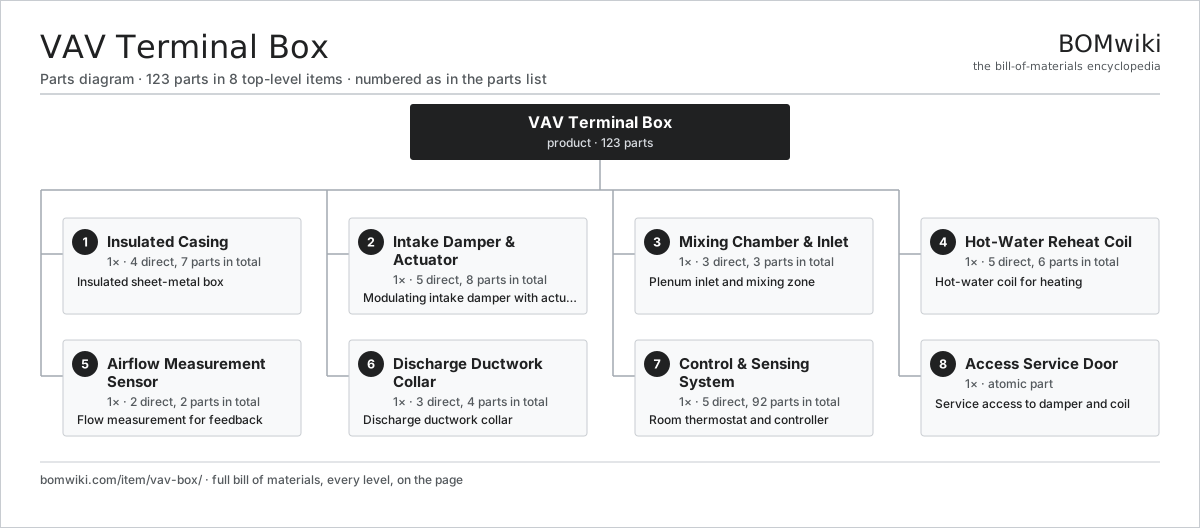
| # | Part | Qty | What it does |
|---|---|---|---|
| 1 | Insulated Casing 4 parts | 1× | Insulated sheet-metal box |
| 2 | Intake Damper & Actuator 5 parts | 1× | Modulating intake damper with actuator |
| 3 | Mixing Chamber & Inlet 3 parts | 1× | Plenum inlet and mixing zone |
| 4 | Hot-Water Reheat Coil 5 parts | 1× | Hot-water coil for heating |
| 5 | Airflow Measurement Sensor 2 parts | 1× | Flow measurement for feedback |
| 6 | Discharge Ductwork Collar 3 parts | 1× | Discharge ductwork collar |
| 7 | Control & Sensing System 5 parts | 1× | Room thermostat and controller |
| 8 | Access Service Door | 1× | Service access to damper and coil |
3D model
No 3D model yet. Have a CAD file of this? Add a 3D model. STL renders right on this page; STEP, FreeCAD, and OpenSCAD sources are welcome too (openly licensed, like all 3D models on BOMwiki).
Build & assembly graph
expand / collapse · shared sub-assemblies converge · links to related products · est. labourTap an assembly to expand/collapse · tap a part to open it · use “Open page” for any node · drag to pan, scroll to zoom.
Bill of materials for VAV Terminal Box
8 top-level lines · 39 rows shown · 123 parts total · indented to 3 levels| # | Item / sub-assembly | Part no. | Qty/assy | Ext. qty | Parts | Type |
|---|---|---|---|---|---|---|
| 1 | Insulated Casing 4 parts | vav-box-casing | 1× | 1 | 7 | assembly |
| 1.1 | Structural Frame | vav-box-frame | 1× | 1 | · | part |
| 1.2 | Sheet Metal Panel | sheet-panel | 4× | 4 | · | part |
| 1.3 | Thermal Insulation | vav-box-insulation | 1× | 1 | · | part |
| 1.4 | Access Service Door | vav-box-access-door | 1× | 1 | · | part |
| 2 | Intake Damper & Actuator 5 parts | vav-box-damper-section | 1× | 1 | 8 | assembly |
| 2.1 | Damper Blade | vav-box-damper-blade | 4× | 4 | · | part |
| 2.2 | Damper Shaft | vav-box-damper-shaft | 1× | 1 | · | part |
| 2.3 | Modulating Actuator | vav-box-damper-actuator | 1× | 1 | · | part |
| 2.4 | Actuator Linkage | vav-box-damper-linkage | 1× | 1 | · | part |
| 2.5 | Position Feedback | vav-box-damper-feedback | 1× | 1 | · | part |
| 3 | Mixing Chamber & Inlet 3 parts | vav-box-mixing-chamber | 1× | 1 | 3 | assembly |
| 3.1 | Supply Inlet Collar | vav-box-inlet-collar | 1× | 1 | · | part |
| 3.2 | Inlet Flow Ring | vav-box-inlet-ring | 1× | 1 | · | part |
| 3.3 | Mixing Baffle | vav-box-mixing-baffle | 1× | 1 | · | part |
| 4 | Hot-Water Reheat Coil 5 parts | vav-box-reheat-coil | 1× | 1 | 6 | assembly |
| 4.1 | Reheat Coil Tubes | vav-box-coil-tubes | 1× | 1 | · | part |
| 4.2 | Coil Fin Pack | vav-box-coil-fins | 1× | 1 | · | part |
| 4.3 | Coil Header | vav-box-coil-header | 2× | 2 | · | part |
| 4.4 | Reheat Control Valve | vav-box-coil-valve | 1× | 1 | · | part |
| 4.5 | Water Strainer | vav-box-coil-strainer | 1× | 1 | · | part |
| 5 | Airflow Measurement Sensor 2 parts | vav-box-airflow-sensor | 1× | 1 | 2 | assembly |
| 5.1 | Flow Measurement Probe | vav-box-flow-probe | 1× | 1 | · | part |
| 5.2 | Flow Transmitter | vav-box-flow-transmitter | 1× | 1 | · | part |
| 6 | Discharge Ductwork Collar 3 parts | vav-box-outlet-duct | 1× | 1 | 4 | assembly |
| 6.1 | Discharge Collar | vav-box-discharge-collar | 1× | 1 | · | part |
| 6.2 | Discharge Flex Duct | vav-box-discharge-flex | 1× | 1 | · | part |
| 6.3 | Duct Vibration Hanger | vav-box-duct-hanger | 2× | 2 | · | part |
| 7 | Control & Sensing System 5 parts | vav-box-controls | 1× | 1 | 92 | assembly |
| 7.1 | VAV Terminal Controller 4 parts | vav-box-controller | 1× | 1 | 85 | assembly |
| 7.1.1 | Bare PCB | pcb-bare | 1× | 1 | · | part |
| 7.1.2 | Microcontroller | mcu | 1× | 1 | · | part |
| 7.1.3 | SMD Passive (R/C/L) | smd-passives | 80× | 80 | · | part |
| 7.1.4 | Connector | connector | 3× | 3 | · | part |
| 7.2 | Room Thermostat | vav-box-room-thermostat | 1× | 1 | · | part |
| 7.3 | Discharge Temperature Sensor | vav-box-temp-sensor | 1× | 1 | · | part |
| 7.4 | Static Pressure Sensor | vav-box-pressure-sensor | 1× | 1 | · | part |
| 7.5 | Connector | connector | 4× | 4 | · | part |
| 8 | Access Service Door | vav-box-access-door | 1× | 1 | · | part |
Something wrong in this list? Report a problem with this BOM.
Related products
same domain, ranked by shared parts Air Handling Unit
631 parts · shares 5 with this page
Air Handling Unit
631 parts · shares 5 with this page
 Gas Furnace
308 parts · shares 5 with this page
Gas Furnace
308 parts · shares 5 with this page
 Gas Unit Heater
154 parts · shares 5 with this page
Makeup Air Unit
193 parts · shares 5 with this page
Gas Unit Heater
154 parts · shares 5 with this page
Makeup Air Unit
193 parts · shares 5 with this page
 Pellet Stove
51 parts · shares 5 with this page
Pool Dehumidifier
209 parts · shares 5 with this page
Pellet Stove
51 parts · shares 5 with this page
Pool Dehumidifier
209 parts · shares 5 with this page
Sourcing: possible vendors
Browse the supplier directory → Prices, MOQ, and lead times are algorithmic estimates, not quotes, and not claims about these companies. Company mappings are curated by keyword; est. price band $100–$20k. How estimates work| Vendor | HQ | Specialty | MOQ | Lead time |
|---|---|---|---|---|
|
🇺🇸Carrier
carrier.com ↗
|
Palm Beach Gardens, US | HVAC | 500 units | 8–14 wks |
| tranetechnologies.com ↗ | Davidson, US | HVAC | 500 units | 8–14 wks |
|
🇯🇵Daikin
daikin.com ↗
|
Osaka, JP | HVAC | 500 units | 8–14 wks |
|
🇺🇸Lennox
lennox.com ↗
|
Richardson, US | HVAC | 500 units | 8–14 wks |
| johnsoncontrols.com ↗ | Milwaukee, US | Building systems | 500 units | 8–14 wks |
1,062-word article