Vein Finder (Near-IR Vein Locator)
ProductOverview
A vein finder is a portable near-infrared (NIR) optical imaging device used to locate subcutaneous veins and project their position onto a patient's arm or hand surface, assisting phlebotomists, nurses, and anesthesiologists in finding difficult-to-visualize vessels for intravenous (IV) line placement, phlebotomy, and vascular access procedures. The device uses 850 nm light, invisible to human vision but penetrating 5–10 mm into tissue, and a sensitive InGaAs camera to detect vein shadows in real time, then displays a live video overlay on the handheld screen showing exactly where each vein runs beneath the skin.
Unlike a visual tourniquet or palpation (feeling for a pulse), which rely on experience and can fail in obese, dark-skinned, or dehydrated patients, the vein finder provides objective, real-time imaging. Clinicians reduce the number of failed stick attempts, patient pain, and tissue damage from repeated punctures. Studies show up to 70% reduction in first-attempt failure rate when using a vein finder on difficult IV cases.
Optical subsystem
The Optical Head Assembly comprises the light source, imaging sensor, and optical path. The Near-Infrared LED Array contains 8–12 individual 850 nm LEDs, each generating 10 mW of NIR light. This light is collimated (made parallel) by a vein-finder-collimating-lens, an aspheric optic that shapes the divergent LED output into a 40° cone of uniform illumination. The light cone impinges on the patient's skin at working distances of 50–300 mm.
The 850 nm light partially penetrates skin and adipose tissue but is absorbed by hemoglobin in venous blood, which appears darker relative to the surrounding tissue. The Bandpass Optical Filter (a bandpass filter centered at 850 ± 25 nm) rejects ambient visible light and infrared above 900 nm, ensuring the camera captures only the 850 nm reflection and scattered light from veins and surrounding tissue.
The InGaAs Camera Module, an InGaAs FPA (focal-plane array) detector, 640 × 512 pixels, with 20 µm pitch, captures the monochrome image. Unlike silicon CCD/CMOS cameras (sensitive to 400–1000 nm), InGaAs is specifically designed for 800–1700 nm and is therefore extremely sensitive to 850 nm light, achieving high signal-to-noise ratio even with modest LED power.
A Projection Lens Group (objective lens, typically f/2.8, 10 mm focal length) focuses the scattered light onto the InGaAs sensor. The focus can be adjusted manually via a Mechanical Focus Ring (50–300 mm working distance range) to match the patient's skin distance.
Image processing and display
Raw pixel data from the InGaAs Image Sensor flows to a Camera Interface Electronics (serializer) that converts the sensor's parallel output to USB or LVDS format. The Main Microprocessor (ARM Cortex-A9 or equivalent, 1 GHz) receives the image stream and runs the real-time vein detection algorithm, typically edge detection, contrast enhancement, and morphological filtering to identify linear dark structures (veins) against lighter background (surrounding tissue).
The processed image, showing veins in white or red overlay against a grayscale skin photograph, is displayed on the LCD Display Panel (3.5 inch, 320 × 240 pixels, transflective design for visibility in daylight). The Image Processing Hardware (FPGA or DSP accelerator) handles the 30 FPS refresh rate required for smooth real-time video, ensuring the operator can move the device over the patient's arm and instantly see the vein network update.
The Ambient Light Sensor monitors ambient light and automatically dims or brightens the display, preserving visibility whether the operator is in a bright patient room or dim ED resuscitation bay.
Power and control
The Battery Power System is a single 3.7 V lithium-ion 18650 cell (2600 mAh, 9.6 Wh capacity) with integrated Battery Protection Module (battery management system) protecting against over-charge, over-discharge, and thermal runaway. Runtime is approximately 5 hours at full brightness, extending to 8–10 hours if the user keeps brightness at 50%.
The Power Management Unit module (charger IC + DC/DC regulators) inside the device converts the 3.7 V battery to regulated 3.3 V (logic) and 5 V (camera, display, LED driver). A USB Charging Port (USB Micro or USB-C, location varies by model) accepts power from a wall charger, typically charging the battery in 1.5–2 hours.
The LED Current Driver circuit includes a precision current source that holds the LEDs at constant current (80–100 mA) regardless of battery voltage variations. The Trigger / Activation Button (momentary pushbutton switch on the grip) activates illumination and image capture. Some models offer a continuous-image mode (button hold) and a single-capture mode (press-and-release freezes one frame on-screen).
A vein-finder-status-indicator LED on the device body indicates battery status: green (normal), yellow (low battery, <20% capacity), or red (critical, <5%, device will shut down in ~1 minute). An optional audible vein-finder-status-buzzer provides feedback if battery is critically low.
Mechanical design
The Handle & Grip is ergonomic: the handheld body is ~250 g and measures ~15 × 8 × 6 cm, shaped to fit one hand comfortably. The Grip Rubber Coating is soft-touch TPR (thermoplastic rubber), providing secure grip even with gloved hands. A Grip Cushion Pad foam insert under the rubber provides pressure distribution, reducing hand fatigue during long scanning sessions.
The Handle Support Arm is a flexible gooseneck or articulated rod, allowing the clinician to orient the optical head (mounted at the distal end) downward toward the patient's arm, while their hand and eye remain at a comfortable viewing angle. The optical head houses the Precision Optics Mounting Bench (precision optical bench) that precisely aligns the LED array, focusing lens, beam splitter, and camera sensor.
The overall Overall Protective Housing (ABS or polycarbonate enclosure) is designed to meet IP54 rating (dust-protected, splash-resistant), so accidental contact with gloved hands, alcohol prep pads, or IV fluids does not compromise electronics. The Dust Seals & Gaskets (gaskets around the screen and connector ports) prevent liquid ingress.
Clinical workflow
The clinician holds the vein finder at 50–150 mm distance from the patient's arm and presses the trigger button. The LED array illuminates, and a live video image appears on the screen, showing the patient's skin surface in grayscale with veins displayed as dark lines or bright overlay (depending on the algorithm). The clinician scans slowly across the antecubital fossa or hand until a suitable vein is identified, typically a straight, unbranching segment, >3 mm diameter, with minimal branching nearby.
Once a target vein is identified, the clinician marks the skin surface with a marking pen (often perpendicular crossing lines) or simply memorizes the position, releases the trigger (freezing the image), then positions an IV catheter over the marked location. Because the light and image update in real time (30 FPS), the entire scan-to-mark process takes 10–30 seconds, significantly faster than traditional palpation and visual inspection, especially in patients with difficult venous access (obesity, dark skin tone, previous IV sites, dehydration).
Pediatric and elderly patients benefit greatly because the device provides objective confirmation of vein location, reducing staff uncertainty and patient anxiety. Emergency departments, intensive care units, and blood banks often employ multiple vein finders to minimize repeated punctures during critical procedures.
Vein Finder (Near-IR Vein Locator) parts and their functions
7 top-level parts · 65 parts in total · full bill of materials below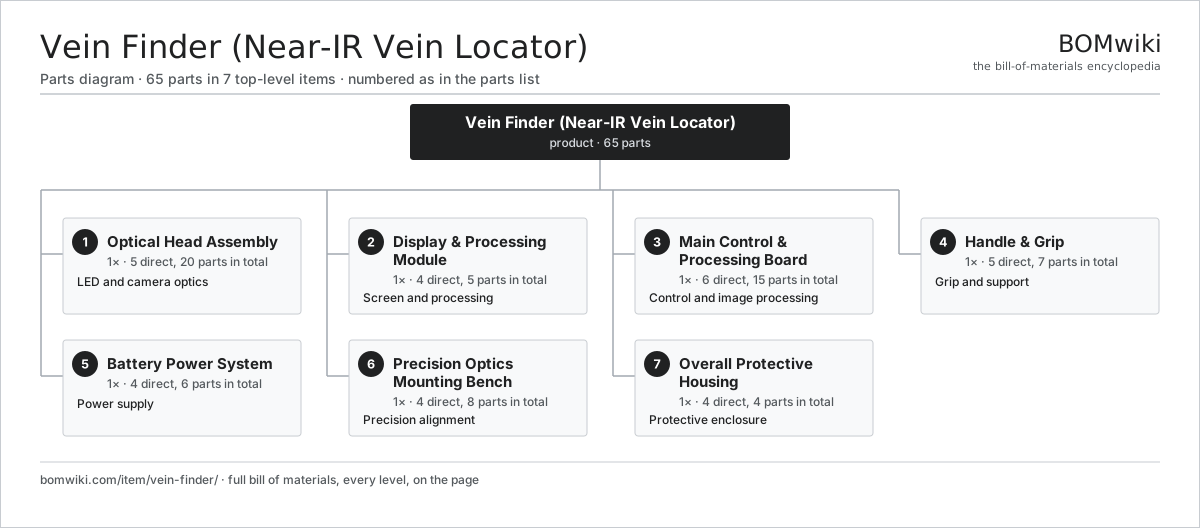
| # | Part | Qty | What it does |
|---|---|---|---|
| 1 | Optical Head Assembly 5 parts | 1× | LED and camera optics |
| 2 | Display & Processing Module 4 parts | 1× | Screen and processing |
| 3 | Main Control & Processing Board 6 parts | 1× | Control and image processing |
| 4 | Handle & Grip 5 parts | 1× | Grip and support |
| 5 | Battery Power System 4 parts | 1× | Power supply |
| 6 | Precision Optics Mounting Bench 4 parts | 1× | Precision alignment |
| 7 | Overall Protective Housing 4 parts | 1× | Protective enclosure |
3D model
No 3D model yet. Have a CAD file of this? Add a 3D model. STL renders right on this page; STEP, FreeCAD, and OpenSCAD sources are welcome too (openly licensed, like all 3D models on BOMwiki).
Build & assembly graph
expand / collapse · shared sub-assemblies converge · links to related products · est. labourTap an assembly to expand/collapse · tap a part to open it · use “Open page” for any node · drag to pan, scroll to zoom.
Bill of materials for Vein Finder (Near-IR Vein Locator)
7 top-level lines · 73 rows shown · 65 parts total · indented to 3 levels| # | Item / sub-assembly | Part no. | Qty/assy | Ext. qty | Parts | Type |
|---|---|---|---|---|---|---|
| 1 | Optical Head Assembly 5 parts | vein-finder-optical-head | 1× | 1 | 20 | assembly |
| 1.1 | Near-Infrared LED Array 2 parts | vein-finder-led-array | 1× | 1 | 11 | assembly |
| 1.1.1 | 850 nm LED Element | vein-finder-led-element | 10× | 10 | · | part |
| 1.1.2 | Current Control Resistor | vein-finder-current-limiting-resistor | 1× | 1 | · | part |
| 1.2 | InGaAs Camera Module 2 parts | vein-finder-camera-module | 1× | 1 | 2 | assembly |
| 1.2.1 | InGaAs Image Sensor | vein-finder-image-sensor | 1× | 1 | · | part |
| 1.2.2 | Camera Interface Electronics 1 parts + deeper › | vein-finder-camera-interface | 1× | 1 | 1 | assembly |
| 1.3 | Bandpass Optical Filter 2 parts | vein-finder-optical-filter | 1× | 1 | 2 | assembly |
| 1.3.1 | Filter Glass Element | vein-finder-filter-element | 1× | 1 | · | part |
| 1.3.2 | Filter Mounting Cell | vein-finder-filter-mount | 1× | 1 | · | part |
| 1.4 | Projection Lens Group 2 parts | vein-finder-lens-assembly | 1× | 1 | 3 | assembly |
| 1.4.1 | Objective Lens Element | vein-finder-objective-lens | 1× | 1 | · | part |
| 1.4.2 | Mechanical Focus Ring 2 parts + deeper › | vein-finder-focus-ring | 1× | 1 | 2 | assembly |
| 1.5 | Beam Splitter Optic 2 parts | vein-finder-beam-splitter | 1× | 1 | 2 | assembly |
| 1.5.1 | Dichroic Coating | vein-finder-dichroic-coating | 1× | 1 | · | part |
| 1.5.2 | Beam Splitter Prism | vein-finder-splitter-prism | 1× | 1 | · | part |
| 2 | Display & Processing Module 4 parts | vein-finder-display-module | 1× | 1 | 5 | assembly |
| 2.1 | LCD Display Panel | vein-finder-lcd-screen | 1× | 1 | · | part |
| 2.2 | Display Driver IC | vein-finder-display-controller | 1× | 1 | · | part |
| 2.3 | Ambient Light Sensor | vein-finder-brightness-sensor | 1× | 1 | · | part |
| 2.4 | Screen Protective Housing 2 parts | vein-finder-screen-enclosure | 1× | 1 | 2 | assembly |
| 2.4.1 | Screen Lens Cover | vein-finder-screen-lens-cover | 1× | 1 | · | part |
| 2.4.2 | Screen Bezel Frame | vein-finder-screen-bezel-frame | 1× | 1 | · | part |
| 3 | Main Control & Processing Board 6 parts | vein-finder-electronics-board | 1× | 1 | 15 | assembly |
| 3.1 | Main Microprocessor 2 parts | vein-finder-main-cpu | 1× | 1 | 2 | assembly |
| 3.1.1 | CPU Chip | vein-finder-cpu-ic | 1× | 1 | · | part |
| 3.1.2 | CPU Decoupling & Clock 1 parts + deeper › | vein-finder-cpu-support-components | 1× | 1 | 1 | assembly |
| 3.2 | Image Processing Hardware | vein-finder-image-processor | 1× | 1 | · | part |
| 3.3 | LED Current Driver 2 parts | vein-finder-led-driver | 1× | 1 | 2 | assembly |
| 3.3.1 | LED Driver IC | vein-finder-led-driver-ic | 1× | 1 | · | part |
| 3.3.2 | Current Sense Resistor | vein-finder-current-sense-resistor | 1× | 1 | · | part |
| 3.4 | Power Management Unit 3 parts | vein-finder-power-management | 1× | 1 | 3 | assembly |
| 3.4.1 | Li-Ion Charger IC | vein-finder-charger-ic | 1× | 1 | · | part |
| 3.4.2 | DC-DC Buck Converter 1 parts + deeper › | vein-finder-dcdc-converter | 1× | 1 | 1 | assembly |
| 3.4.3 | Thermal Sensor (Temperature) | vein-finder-thermal-sensor | 1× | 1 | · | part |
| 3.5 | Memory & Storage 2 parts | vein-finder-memory-module | 1× | 1 | 2 | assembly |
| 3.5.1 | DRAM Module | vein-finder-dram-module | 1× | 1 | · | part |
| 3.5.2 | NAND Flash Storage | vein-finder-nand-flash | 1× | 1 | · | part |
| 3.6 | I/O Connector Board 2 parts | vein-finder-connector-board | 1× | 1 | 5 | assembly |
| 3.6.1 | Connector | connector | 4× | 4 | · | part |
| 3.6.2 | ESD Protection Diode Array | vein-finder-esd-protection | 1× | 1 | · | part |
| 4 | Handle & Grip 5 parts | vein-finder-handle-assembly | 1× | 1 | 7 | assembly |
| 4.1 | Handle Shell / Housing | vein-finder-handle-shell | 1× | 1 | · | part |
| 4.2 | Grip Rubber Coating | vein-finder-grip-rubber-coating | 1× | 1 | · | part |
| 4.3 | Grip Cushion Pad | vein-finder-grip-pad | 1× | 1 | · | part |
| 4.4 | Handle Support Arm 2 parts | vein-finder-handle-support-arm | 1× | 1 | 2 | assembly |
| 4.4.1 | Support Arm Rod | vein-finder-arm-rod | 1× | 1 | · | part |
| 4.4.2 | Ball Joint Mount | vein-finder-arm-ball-joint | 1× | 1 | · | part |
| 4.5 | Trigger / Activation Button 2 parts | vein-finder-finger-trigger-button | 1× | 1 | 2 | assembly |
| 4.5.1 | Push Button Switch | vein-finder-push-button-switch | 1× | 1 | · | part |
| 4.5.2 | Button Spring Return | vein-finder-switch-spring | 1× | 1 | · | part |
| 5 | Battery Power System 4 parts | vein-finder-battery-system | 1× | 1 | 6 | assembly |
| 5.1 | Lithium-Ion Cell (18650) 1 parts | vein-finder-liion-cell | 1× | 1 | 1 | assembly |
| 5.1.1 | Li-ion Cell, 18650 | li-cell-18650 | 1× | 1 | · | part |
| 5.2 | Battery Protection Module 3 parts | vein-finder-battery-bms | 1× | 1 | 3 | assembly |
| 5.2.1 | BMS Protection IC | vein-finder-bms-ic | 1× | 1 | · | part |
| 5.2.2 | Load Disconnect MOSFET 1 parts + deeper › | vein-finder-protection-mosfet | 1× | 1 | 1 | assembly |
| 5.2.3 | Thermal Fuse | thermal-fuse | 1× | 1 | · | part |
| 5.3 | Battery Connector | vein-finder-battery-connector | 1× | 1 | · | part |
| 5.4 | USB Charging Port 1 parts | vein-finder-charging-port | 1× | 1 | 1 | assembly |
| 5.4.1 | Connector | connector | 1× | 1 | · | part |
| 6 | Precision Optics Mounting Bench 4 parts | vein-finder-optics-mount | 1× | 1 | 8 | assembly |
| 6.1 | Optical Bench Base Plate | vein-finder-optical-bench-base | 1× | 1 | · | part |
| 6.2 | Lens Mount Cell 2 parts | vein-finder-lens-mount-cell | 1× | 1 | 2 | assembly |
| 6.2.1 | Cell Threading | vein-finder-cell-threads | 1× | 1 | · | part |
| 6.2.2 | Cell Aperture Stop | vein-finder-cell-aperture | 1× | 1 | · | part |
| 6.3 | Camera Mount Bracket | vein-finder-camera-mount-bracket | 1× | 1 | · | part |
| 6.4 | Alignment Dowel Pin | vein-finder-alignment-pin | 4× | 4 | · | part |
| 7 | Overall Protective Housing 4 parts | vein-finder-housing | 1× | 1 | 4 | assembly |
| 7.1 | Main Enclosure Case | vein-finder-housing-case | 1× | 1 | · | part |
| 7.2 | Thermal Interface Pad | vein-finder-thermal-pad | 1× | 1 | · | part |
| 7.3 | Dust Seals & Gaskets | vein-finder-dust-seals | 1× | 1 | · | part |
| 7.4 | Cable Strain Relief Boot | vein-finder-cable-strain-relief | 1× | 1 | · | part |
Something wrong in this list? Report a problem with this BOM.
Related products
same domain, ranked by shared parts Fetal Doppler
41 parts · shares 3 with this page
Orthopedic Cast Saw
73 parts · shares 3 with this page
Heart-Lung Machine
298 parts · shares 2 with this page
Rehabilitation Robot Arm
467 parts · shares 2 with this page
Infant Scale
66 parts · shares 2 with this page
Fetal Doppler
41 parts · shares 3 with this page
Orthopedic Cast Saw
73 parts · shares 3 with this page
Heart-Lung Machine
298 parts · shares 2 with this page
Rehabilitation Robot Arm
467 parts · shares 2 with this page
Infant Scale
66 parts · shares 2 with this page
Sourcing: possible vendors
Browse the supplier directory → Prices, MOQ, and lead times are algorithmic estimates, not quotes, and not claims about these companies. Company mappings are curated by keyword; est. price band $500–$3M. How estimates work| Vendor | HQ | Specialty | MOQ | Lead time |
|---|---|---|---|---|
| gehealthcare.com ↗ | Chicago, US | Medical imaging & devices | 100 units | 12–20 wks |
| siemens-healthineers.com ↗ | Erlangen, DE | Medical systems | 100 units | 12–20 wks |
|
🇳🇱Philips
philips.com ↗
|
Amsterdam, NL | Health technology | 100 units | 12–20 wks |
| medtronic.com ↗ | Minneapolis, US | Medical devices | 100 units | 12–20 wks |
|
🇨🇳Mindray
mindray.com ↗
|
Shenzhen, CN | Medical devices | 100 units | 12–20 wks |
1,230-word article