Velomobile
ProductOverview
A velomobile is what happens when a recumbent trike is optimized for one variable: aerodynamic drag. Above about 15 km/h, air resistance dominates a cyclist's power budget, and at 40 km/h it consumes nearly all of it. An upright rider presents a drag area (CdA) of 0.3-0.4 m²; the Aerodynamic Shell cuts that to 0.025-0.05 m², an order of magnitude. The practical result is that a rider producing a sustainable 150 W, touring effort on a normal bicycle, good for perhaps 27 km/h, cruises at 40-50 km/h in a velomobile. Commuters routinely log 50-100 km days in them year round, because the shell also keeps off rain, wind and cold.
The shell
The Body Monocoque is the vehicle: a vacuum-infused carbon-aramid skin 1.2-2 mm thick that is simultaneously the fairing and the primary structure, the same logic as an aircraft fuselage. There is no separate frame. Suspension, seat and drivetrain loads enter the skin through bonded Hardpoint Insert fittings and two Foam Bulkhead sandwich panels. The Nose Cone is a separate, replaceable section, since the nose takes every parking scrape and minor collision; the Tail Section tapers the airflow back together and swallows about 50 L of luggage. Each Wheel Well is closely faired because an exposed rotating wheel is one of the worst drag sources on the vehicle. A removable Cockpit Canopy closes the cockpit opening in winter; most riders run open-top in summer for cooling, accepting a few km/h of loss.
Drivetrain
The rider lies in a Seat Assembly reclined to 25-30 degrees on the Seat Mount, pedaling forward against the seat back rather than against body weight. The Crankset sits on a telescoping Bottom-Bracket Boom adjusted to leg length, and uses short 155-165 mm cranks to keep heels clear of the shell and knees out of the airflow opening. From there the Long Drive Chain, roughly 280 links, two and a half ordinary chains, runs the length of the vehicle over two toothed Chain Idler pulleys and through PTFE-lined Chain Tube guides that keep grease off the rider. Gearing is conventional at the back: an 11-34 Cassette and a Rear Derailleur, but with a 50-60 tooth chainring, because the speeds are not conventional. Clipless Pedal retention is effectively mandatory: at recumbent angles a foot that slips off the pedal at 45 km/h goes under the vehicle.
Steering and suspension
Both 406 mm front wheels steer. Inside the cockpit a Steering Tiller between the knees (or twin side-sticks in some designs) moves two Tie Rod links to a Steering Arm on each Steering Knuckle, with Ackermann angles so the inner wheel turns tighter in corners and a light Centering Spring returning the tiller to straight. Steering at 50+ km/h needs almost no input; geometry stability, not rider reflex, keeps the vehicle straight.
Suspension is non-negotiable in a vehicle this fast with 50 mm of ground clearance. Each Front Suspension Corner corner is a small McPherson strut: the wheel rides a sliding Suspension Strut Tube compressed against a Elastomer Spring Stack of urethane pucks giving about 40 mm of travel with inherent damping and zero maintenance. The rear wheel hangs on a single-sided Rear Swingarm sprung by a Rear Elastomer Spring block, single-sided so the wheel can be pulled sideways out of the tail for puncture repair.
Brakes and lights
Both front hubs contain 90 mm Drum Brake units. Drums rather than discs are near-universal in velomobiles: they sit sealed inside the Wheel Well, work identically wet or dry, and their fade limit is acceptable because aerodynamic drag itself retards the vehicle strongly above 50 km/h. The two tiller-mounted Brake Lever units pull the drums through Brake Cable runs, and a Parking Brake Pin latches a lever for parking. Because the rider is sealed inside, hand signals are impossible, so the Lighting System system carries four Turn Indicator flashers along with the LED Headlight and LED Taillight, all fed from a small pack of LiPo Cell cells good for several weeks of commuting per charge.
Performance and limits
The records illustrate what the shell buys. Fully streamlined human-powered vehicles built on the same principles hold the flying 200 m record above 144 km/h; practical commuting velomobiles with luggage and lights are slower but still let an ordinary rider hold speeds that would require a professional's power output on an upright bicycle. The trade-offs are mass (22-32 kg hurts on climbs, where aerodynamics gives nothing back), summer heat load, a 4-5 m turning circle, and price, small-series composite construction puts most velomobiles at the cost of a used car.
Velomobile parts and their functions
9 top-level parts · 112 parts in total · full bill of materials below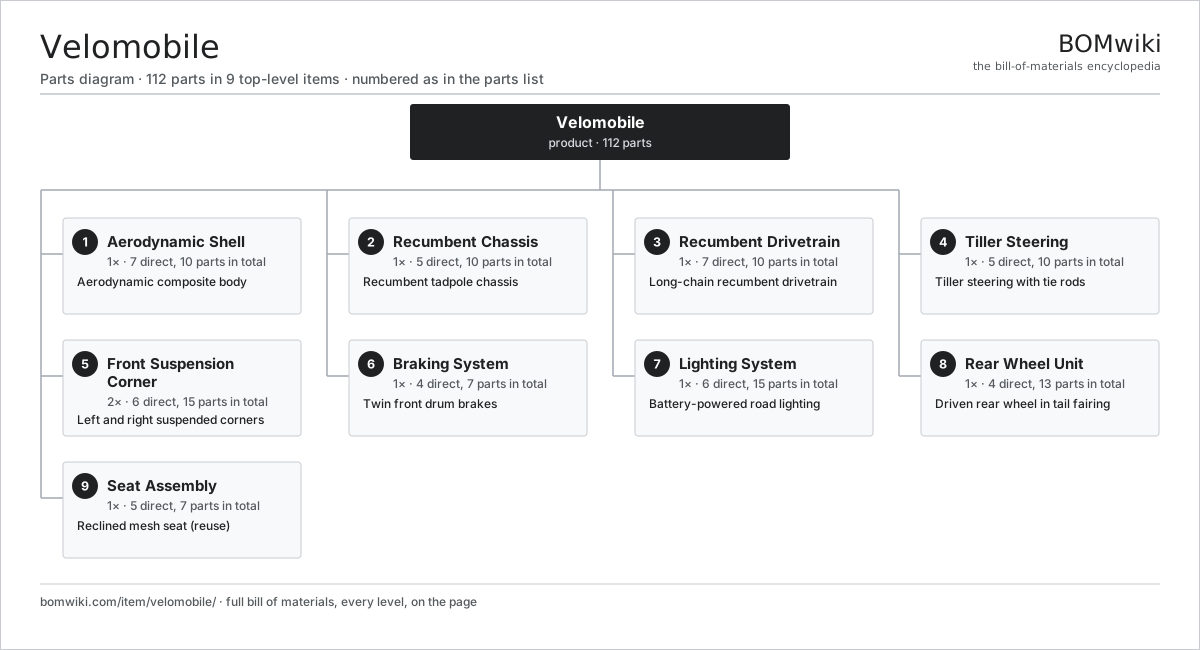
| # | Part | Qty | What it does |
|---|---|---|---|
| 1 | Aerodynamic Shell 7 parts | 1× | Aerodynamic composite body |
| 2 | Recumbent Chassis 5 parts | 1× | Recumbent tadpole chassis |
| 3 | Recumbent Drivetrain 7 parts | 1× | Long-chain recumbent drivetrain |
| 4 | Tiller Steering 5 parts | 1× | Tiller steering with tie rods |
| 5 | Front Suspension Corner 6 parts | 2× | Left and right suspended corners |
| 6 | Braking System 4 parts | 1× | Twin front drum brakes |
| 7 | Lighting System 6 parts | 1× | Battery-powered road lighting |
| 8 | Rear Wheel Unit 4 parts | 1× | Driven rear wheel in tail fairing |
| 9 | Seat Assembly 5 parts | 1× | Reclined mesh seat (reuse) |
3D model
No 3D model yet. Have a CAD file of this? Add a 3D model. STL renders right on this page; STEP, FreeCAD, and OpenSCAD sources are welcome too (openly licensed, like all 3D models on BOMwiki).
Build & assembly graph
expand / collapse · shared sub-assemblies converge · links to related products · est. labourTap an assembly to expand/collapse · tap a part to open it · use “Open page” for any node · drag to pan, scroll to zoom.
Bill of materials for Velomobile
9 top-level lines · 68 rows shown · 112 parts total · indented to 3 levels| # | Item / sub-assembly | Part no. | Qty/assy | Ext. qty | Parts | Type |
|---|---|---|---|---|---|---|
| 1 | Aerodynamic Shell 7 parts | velomobile-shell | 1× | 1 | 10 | assembly |
| 1.1 | Body Monocoque | velomobile-body-monocoque | 1× | 1 | · | part |
| 1.2 | Cockpit Canopy | velomobile-canopy | 1× | 1 | · | part |
| 1.3 | Nose Cone | velomobile-nose-cone | 1× | 1 | · | part |
| 1.4 | Tail Section | velomobile-tail-section | 1× | 1 | · | part |
| 1.5 | Wheel Well | velomobile-wheel-well | 3× | 3 | · | part |
| 1.6 | Foam Bulkhead | velomobile-foam-bulkhead | 2× | 2 | · | part |
| 1.7 | Fastener Set | fastener-set | 1× | 1 | · | part |
| 2 | Recumbent Chassis 5 parts | velomobile-chassis | 1× | 1 | 10 | assembly |
| 2.1 | Bottom-Bracket Boom | velomobile-boom | 1× | 1 | · | part |
| 2.2 | Seat Mount | velomobile-seat-mount | 1× | 1 | · | part |
| 2.3 | Axle Bridge | velomobile-axle-bridge | 1× | 1 | · | part |
| 2.4 | Hardpoint Insert | velomobile-hardpoint-insert | 6× | 6 | · | part |
| 2.5 | Fastener Set | fastener-set | 1× | 1 | · | part |
| 3 | Recumbent Drivetrain 7 parts | velomobile-drivetrain | 1× | 1 | 10 | assembly |
| 3.1 | Crankset | velomobile-crankset | 1× | 1 | · | part |
| 3.2 | Long Drive Chain | velomobile-chain-long | 1× | 1 | · | part |
| 3.3 | Chain Idler | velomobile-chain-idler | 2× | 2 | · | part |
| 3.4 | Chain Tube | velomobile-chain-tube | 2× | 2 | · | part |
| 3.5 | Cassette | velomobile-cassette | 1× | 1 | · | part |
| 3.6 | Rear Derailleur | velomobile-derailleur | 1× | 1 | · | part |
| 3.7 | Clipless Pedal | velomobile-pedal | 2× | 2 | · | part |
| 4 | Tiller Steering 5 parts | velomobile-steering | 1× | 1 | 10 | assembly |
| 4.1 | Steering Tiller | velomobile-tiller | 1× | 1 | · | part |
| 4.2 | Tie Rod | velomobile-tie-rod | 2× | 2 | · | part |
| 4.3 | Ball Rod End | velomobile-rod-end | 4× | 4 | · | part |
| 4.4 | Steering Arm | velomobile-steering-arm | 2× | 2 | · | part |
| 4.5 | Centering Spring | velomobile-centering-spring | 1× | 1 | · | part |
| 5 | Front Suspension Corner 6 parts | velomobile-front-suspension | 2× | 2 | 15 | assembly |
| 5.1 | Suspension Strut Tube | velomobile-strut-tube | 1× | 2 | · | part |
| 5.2 | Elastomer Spring Stack | velomobile-elastomer-stack | 1× | 2 | · | part |
| 5.3 | Steering Knuckle | velomobile-knuckle | 1× | 2 | · | part |
| 5.4 | Wheel Assembly 5 parts | wheel-assembly | 1× | 2 | 9 | assembly |
| 5.4.1 | Alloy Wheel | alloy-wheel | 1× | 2 | · | part |
| 5.4.2 | Tire | tire | 1× | 2 | · | part |
| 5.4.3 | TPMS Sensor | tpms-sensor | 1× | 2 | · | part |
| 5.4.4 | Lug Nut | lug-nut | 5× | 10 | · | part |
| 5.4.5 | Valve Stem | valve-stem | 1× | 2 | · | part |
| 5.5 | Ball Bearing | ball-bearing | 2× | 4 | · | part |
| 5.6 | Oil Seal | oil-seal | 1× | 2 | · | part |
| 6 | Braking System 4 parts | velomobile-braking | 1× | 1 | 7 | assembly |
| 6.1 | Drum Brake | velomobile-drum-brake | 2× | 2 | · | part |
| 6.2 | Brake Lever | velomobile-brake-lever | 2× | 2 | · | part |
| 6.3 | Brake Cable | velomobile-brake-cable | 2× | 2 | · | part |
| 6.4 | Parking Brake Pin | velomobile-parking-pin | 1× | 1 | · | part |
| 7 | Lighting System 6 parts | velomobile-lighting | 1× | 1 | 15 | assembly |
| 7.1 | LED Headlight | velomobile-headlight | 1× | 1 | · | part |
| 7.2 | LED Taillight | velomobile-taillight | 1× | 1 | · | part |
| 7.3 | Turn Indicator | velomobile-indicator | 4× | 4 | · | part |
| 7.4 | LiPo Cell | lipo-cell | 3× | 3 | · | part |
| 7.5 | Wire Bundle | wire-bundle | 1× | 1 | · | part |
| 7.6 | Connector | connector | 5× | 5 | · | part |
| 8 | Rear Wheel Unit 4 parts | velomobile-rear-wheel | 1× | 1 | 13 | assembly |
| 8.1 | Rear Swingarm | velomobile-swingarm | 1× | 1 | · | part |
| 8.2 | Wheel Assembly 5 parts | wheel-assembly | 1× | 1 | 9 | assembly |
| 8.2.1 | Alloy Wheel | alloy-wheel | 1× | 1 | · | part |
| 8.2.2 | Tire | tire | 1× | 1 | · | part |
| 8.2.3 | TPMS Sensor | tpms-sensor | 1× | 1 | · | part |
| 8.2.4 | Lug Nut | lug-nut | 5× | 5 | · | part |
| 8.2.5 | Valve Stem | valve-stem | 1× | 1 | · | part |
| 8.3 | Rear Elastomer Spring | velomobile-rear-elastomer | 1× | 1 | · | part |
| 8.4 | Ball Bearing | ball-bearing | 2× | 2 | · | part |
| 9 | Seat Assembly 5 parts | seat-assembly | 1× | 1 | 7 | assembly |
| 9.1 | Seat Frame | seat-frame | 1× | 1 | · | part |
| 9.2 | Seat Foam | seat-foam | 2× | 2 | · | part |
| 9.3 | Seat Cover | seat-cover | 1× | 1 | · | part |
| 9.4 | Seat Motor | seat-motor | 2× | 2 | · | part |
| 9.5 | Seat Heater Mat | seat-heater | 1× | 1 | · | part |
Something wrong in this list? Report a problem with this BOM.
Related products
same domain, ranked by shared parts Motorized Bicycle
78 parts · shares 15 with this page
Motorized Bicycle
78 parts · shares 15 with this page
 Cargo Trike
96 parts · shares 13 with this page
Cargo Trike
96 parts · shares 13 with this page
 Pedal Go-Kart
243 parts · shares 12 with this page
Pedal Go-Kart
243 parts · shares 12 with this page
 Surrey Quadricycle
109 parts · shares 6 with this page
Surrey Quadricycle
109 parts · shares 6 with this page
 Adult Tricycle
77 parts · shares 6 with this page
Adult Tricycle
77 parts · shares 6 with this page
 Bicycle Cargo Trailer
59 parts · shares 6 with this page
Bicycle Cargo Trailer
59 parts · shares 6 with this page
Sourcing: possible vendors
Browse the supplier directory → Prices, MOQ, and lead times are algorithmic estimates, not quotes, and not claims about these companies. Company mappings are curated by keyword; est. price band $200–$12k. How estimates work| Vendor | HQ | Specialty | MOQ | Lead time |
|---|---|---|---|---|
|
🇹🇼Giant
giant-bicycles.com ↗
|
Taichung, TW | Bicycles | 500 units | 6–12 wks |
|
🇺🇸Trek
trekbikes.com ↗
|
Waterloo, US | Bicycles | 500 units | 6–12 wks |
| specialized.com ↗ | Morgan Hill, US | Bicycles | 500 units | 6–12 wks |
|
🇹🇼Merida
merida-bikes.com ↗
|
Yuanlin, TW | Bicycles | 500 units | 6–12 wks |
| cannondale.com ↗ | Wilton, US | Bicycles | 500 units | 6–12 wks |
818-word article