Veneer Press
ProductOverview
A veneer press is a heated hydraulic clamping machine that applies adhesive veneers to substrate panels (plywood, MDF, particleboard) under controlled temperature and pressure. The machine is essential in furniture manufacturing, architectural millwork, and composite panel production, enabling high-speed veneering with superior adhesion and surface quality.
Manual hand-veneering (pressing by hand or with clamps) produces variable quality and takes 30–60 minutes per panel. A powered veneer press completes identical veneers in 5–15 minutes, scaling production from job-shop to factory volumes.
Heated Platen System
Upper and Lower Platens
Two cast iron platens (2000 × 1200 × 200 mm each) are precisely aligned and leveled. The lower platen sits stationary on the machine frame; the upper platen is hydraulically lowered to clamp the veneer-panel sandwich.
Flatness: Both platens are machined to ±0.5 mm flatness across the entire surface, critical for uniform veneer adhesion and avoiding veneer ripple or waviness.
Heating System
Two independent electric heating circuits:
Upper platen heater: 9 kW resistive cartridge array (typically 12–16 cartridges × 750 W each). Temperature sensor (thermocouple) measures platen surface; PID controller adjusts power to maintain target temperature ±2 °C.
Lower platen heater: Identical 9 kW circuit.
Circulation system (optional): A gear pump circulates hot oil (60–120 °C) through passages within platens, reducing heat-up time and improving temperature uniformity.
Warm-up time: 30–60 minutes to reach full operating temperature (100 °C typical). Modern presses include insulation layers reducing warm-up to 20 minutes.
Hydraulic Pressure System
The hydraulic system generates and regulates clamping pressure:
Pump: 30 cc/rev gear pump, driven by 15 kW motor, produces 350 bar maximum pressure.
Main cylinder: 400 mm bore, 200 mm stroke, mounted vertically above upper platen. At 350 bar, cylinder force = 400 kN. Distributed over 2000 × 1200 mm platen = ~170 kPa (17 bar gauge at platen surface).
Pressure adjustment: Manual relief valve sets maximum system pressure. Operator adjusts 50–350 bar depending on veneer species and adhesive.
Pressure Optimization
Light pressure (50–100 bar): Veneer requiring minimal deformation (hardwood faces, inlays). Reduces crushing and dimensional distortion.
Medium pressure (150–250 bar): Standard production veneering (common domestic hardwoods). Balances adhesion strength with surface quality.
Heavy pressure (300–350 bar): Particleboard or MDF substrates (denser materials require higher pressure for adhesive squeeze-out). Also used for PVC or laminates bonding.
Temperature-Dependent Adhesive Behavior
EVA Hot-Melt
Melting point: 150–180 °C. Above melting point, EVA becomes fluid (viscosity <500 cP). Below, it solidifies.
Optimal press temperature: 100–120 °C. Platen heat melts EVA at veneer surface but substrate stays below melting point, preventing adhesive migration into porous substrates.
Press dwell time: 5–10 minutes. Adhesive cools and gels as platen temperature stabilizes. Short dwell (5 min) accelerates production; long dwell (15 min) improves adhesion strength.
Urea-Formaldehyde (UF)
Thermoset adhesive: Activates and cross-links with heat. Requires elevated temperature (80–100 °C) and dwell time (10–20 minutes) for complete curing.
Shelf life: UF adhesive is time-sensitive; mixed batches remain usable only 2–4 hours. Resin manufacturers supply catalyzed UF in sealed containers; operator mixes with hardener immediately before application.
Polyurethane (PU)
Reaction adhesive: Two-component system; water and hard ened polyol cross-link forming polymer chains. Exothermic reaction generates heat.
Minimal platen heating required: PU's own exothermic reaction can drive adhesion; platen may operate at room temperature for PU. However, moderate heating (40–60 °C) accelerates curing (dwell time reduces 10 min → 5 min).
Press Workflow (Typical Panel Veneering)
Preparation
- Adhesive application: Spread EVA or PU on substrate panel surface (0.1–0.2 mm thickness via roller or spray applicator). Some presses include integrated glue dispensing.
- Veneer positioning: Lay veneer sheet (0.6–2 mm thick) centered on adhesive-coated substrate.
- Clamp mounting: Slide assembled sandwich onto lower platen, aligning with platen edges.
Pressing Cycle
- Close press: Operator engages pump; upper platen descends, contacting veneer.
- Apply pressure: Hydraulic pressure gradually increases (ramp 0–200 bar over 10 seconds) to avoid trapping air bubbles.
- Hold dwell: Maintain constant pressure for 5–15 minutes while adhesive cures.
- Cool (optional): Some presses include water-cooled platen for rapid cooling (accelerates dwell 15 min → 5 min). Manual cool (room temperature) takes 30–60 minutes.
- Open press: Operator releases pressure; upper platen retracts; operator removes cured panel.
Total cycle: 10–20 minutes active pressing + 30–60 minutes cooling = 40–80 minutes per panel (or faster with continuous cooling loop).
Production Rate
For rapid production, shops deploy 2–4 presses in parallel:
- Operator loads Press 1 (5 min dwell) → moves to Press 2, loads while Press 1 cooling → cycles through all presses.
- Throughput: 3 presses × 4 cycles/hour = 12 panels/hour.
Larger facilities use conveyor-fed continuous presses or multi-opening presses (8–16 opening stations) achieving 50–100+ panels/hour.
Veneer Types
Face Veneers
Decorative hardwood: Oak, maple, walnut, cherry, teak. Typically 0.6–2 mm thick. Premium appearance; higher cost (~$5–20 per m² wholesale).
Engineered veneer: Dyed, matched, or reconstructed veneer made from logs and adhesive. Consistent color and pattern; lower cost (~$2–5 per m² wholesale).
Specialty: Burl, quilted, or curly grain veneer from figured logs. Visually striking; high cost ($20–100 per m² wholesale).
Substrate
Plywood: 3–18 mm thick, birch or softwood core. Cross-ply strength prevents warping.
MDF: 16–25 mm density, stable and flat. Ideal for curved veneer (boat hulls, automotive trim). Denser than plywood; requires higher pressing pressure.
Particleboard: Budget substrate; lower shear strength requires careful press pressure (avoid crushing). Used in flat-pack furniture.
Maintenance
Daily:
- Check platen surface temperature (should stabilize within ±2 °C of setpoint within 10 minutes).
- Inspect platen for adhesive residue; scrape off with plastic scraper.
- Test hydraulic pressure gauge; verify pump pressure rising to relief setting.
Weekly:
- Clean platen with mild solvent (acetone, isopropyl alcohol) to remove stubborn adhesive.
- Check hydraulic fluid level; top off if below minimum mark.
- Verify thermocouple probe integrity (replace if corroded).
Monthly:
- Inspect heating cartridge terminals for corrosion; replace if pitting visible.
- Recalibrate PID controller zero reference (setpoint calibration).
- Check pressure transducer accuracy (compare to analog gauge).
Annually:
- Drain and refill hydraulic fluid (mineral or synthetic oil, per manufacturer spec).
- Overhaul hydraulic pump; replace worn gears if noisy.
- Replace platen seals (prevent oil leakage into veneer zone).
- Recalibrate PLC program setpoint.
Limitations
Veneer presses are optimized for flat panels. Curved substrates (bending plywood, boat planking) exceed platen conformability and risk air traps. Custom curved platens or bag-pressing techniques are required. Thick solids (>100 mm hardwood) conduct heat slowly; platen heat doesn't reach core within reasonable dwell time. Large panels (>2000 × 1200 mm) require multi-platen systems or custom-built equipment (high capital cost). Rapid cooling (spray-cooled platens) allows shorter dwell but adds complexity and cost.
Veneer Press parts and their functions
7 top-level parts · 49 parts in total · full bill of materials below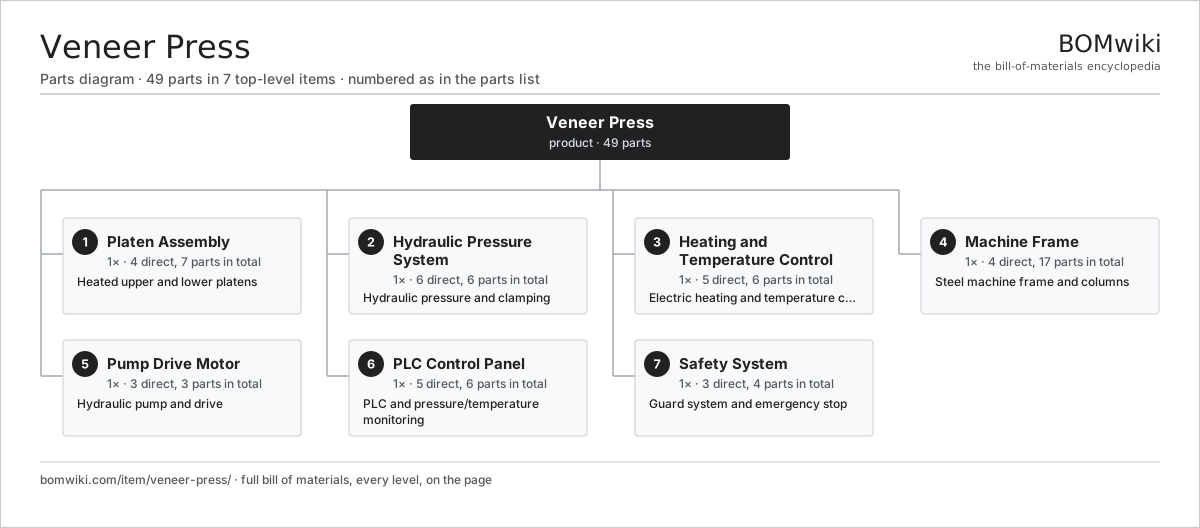
| # | Part | Qty | What it does |
|---|---|---|---|
| 1 | Platen Assembly 4 parts | 1× | Heated upper and lower platens |
| 2 | Hydraulic Pressure System 6 parts | 1× | Hydraulic pressure and clamping |
| 3 | Heating and Temperature Control 5 parts | 1× | Electric heating and temperature control |
| 4 | Machine Frame 4 parts | 1× | Steel machine frame and columns |
| 5 | Pump Drive Motor 3 parts | 1× | Hydraulic pump and drive |
| 6 | PLC Control Panel 5 parts | 1× | PLC and pressure/temperature monitoring |
| 7 | Safety System 3 parts | 1× | Guard system and emergency stop |
3D model
No 3D model yet. Have a CAD file of this? Add a 3D model. STL renders right on this page; STEP, FreeCAD, and OpenSCAD sources are welcome too (openly licensed, like all 3D models on BOMwiki).
Build & assembly graph
expand / collapse · shared sub-assemblies converge · links to related products · est. labourTap an assembly to expand/collapse · tap a part to open it · use “Open page” for any node · drag to pan, scroll to zoom.
Bill of materials for Veneer Press
7 top-level lines · 37 rows shown · 49 parts total · indented to 3 levels| # | Item / sub-assembly | Part no. | Qty/assy | Ext. qty | Parts | Type |
|---|---|---|---|---|---|---|
| 1 | Platen Assembly 4 parts | veneer-press-platen-assembly | 1× | 1 | 7 | assembly |
| 1.1 | Upper Platen | veneer-press-upper-platen | 1× | 1 | · | part |
| 1.2 | Lower Platen | veneer-press-lower-platen | 1× | 1 | · | part |
| 1.3 | Guide Block | veneer-press-platen-guide-block | 4× | 4 | · | part |
| 1.4 | Alignment System | veneer-press-platen-alignment | 1× | 1 | · | part |
| 2 | Hydraulic Pressure System 6 parts | veneer-press-hydraulic-system | 1× | 1 | 6 | assembly |
| 2.1 | Hydraulic Pump | veneer-press-hydraulic-pump | 1× | 1 | · | part |
| 2.2 | Main Cylinder | veneer-press-main-cylinder | 1× | 1 | · | part |
| 2.3 | Relief Valve | veneer-press-pressure-valve | 1× | 1 | · | part |
| 2.4 | Flow Valve | veneer-press-flow-control-valve | 1× | 1 | · | part |
| 2.5 | Accumulator | veneer-press-accumulator | 1× | 1 | · | part |
| 2.6 | Manifold Block | veneer-press-manifold-block | 1× | 1 | · | part |
| 3 | Heating and Temperature Control 5 parts | veneer-press-heating-system | 1× | 1 | 6 | assembly |
| 3.1 | Upper Heater | veneer-press-upper-heater | 1× | 1 | · | part |
| 3.2 | Lower Heater | veneer-press-lower-heater | 1× | 1 | · | part |
| 3.3 | Temperature Probe | veneer-press-temperature-probe | 2× | 2 | · | part |
| 3.4 | PID Controller | veneer-press-pid-controller | 1× | 1 | · | part |
| 3.5 | Circulation Pump | veneer-press-circulation-pump | 1× | 1 | · | part |
| 4 | Machine Frame 4 parts | veneer-press-frame | 1× | 1 | 17 | assembly |
| 4.1 | Frame Column | veneer-press-frame-column | 4× | 4 | · | part |
| 4.2 | Frame Beam | veneer-press-frame-beam | 4× | 4 | · | part |
| 4.3 | Base Plate | veneer-press-base-plate | 1× | 1 | · | part |
| 4.4 | Isolation Foot | veneer-press-vibration-isolator | 8× | 8 | · | part |
| 5 | Pump Drive Motor 3 parts | veneer-press-pump-motor | 1× | 1 | 3 | assembly |
| 5.1 | Drive Motor | veneer-press-drive-motor | 1× | 1 | · | part |
| 5.2 | Motor Starter | veneer-press-motor-starter | 1× | 1 | · | part |
| 5.3 | Coupling | veneer-press-coupling | 1× | 1 | · | part |
| 6 | PLC Control Panel 5 parts | veneer-press-controls | 1× | 1 | 6 | assembly |
| 6.1 | PLC Module | veneer-press-plc | 1× | 1 | · | part |
| 6.2 | Pressure Transducer | veneer-press-pressure-gauge | 2× | 2 | · | part |
| 6.3 | Press Timer | veneer-press-timer | 1× | 1 | · | part |
| 6.4 | HMI Display | veneer-press-touchscreen | 1× | 1 | · | part |
| 6.5 | Safety Relay | veneer-press-safety-relay | 1× | 1 | · | part |
| 7 | Safety System 3 parts | veneer-press-safety-guards | 1× | 1 | 4 | assembly |
| 7.1 | Side Guard | veneer-press-side-guard | 2× | 2 | · | part |
| 7.2 | E-Stop Button | veneer-press-emergency-stop | 1× | 1 | · | part |
| 7.3 | Relief Knob | veneer-press-pressure-relief-knob | 1× | 1 | · | part |
Something wrong in this list? Report a problem with this BOM.
Sourcing: possible vendors
Browse the supplier directory → Prices, MOQ, and lead times are algorithmic estimates, not quotes, and not claims about these companies. Company mappings are curated by keyword; est. price band $5k–$2M. How estimates work| Vendor | HQ | Specialty | MOQ | Lead time |
|---|---|---|---|---|
| atlascopco.com ↗ | Stockholm, SE | Compressors & industrial | 10 units | 12–20 wks |
|
🇦🇹Andritz
andritz.com ↗
|
Graz, AT | Process plants & machinery | 10 units | 12–20 wks |
| buhlergroup.com ↗ | Uzwil, CH | Food & materials processing | 10 units | 12–20 wks |
| gea.com ↗ | Düsseldorf, DE | Process technology | 10 units | 12–20 wks |
| mhi.com ↗ | Tokyo, JP | Heavy machinery | 10 units | 12–20 wks |
1,158-word article