Ventilated Manicure Table
ProductOverview
Ventilated manicure tables are essential equipment in nail salons, combining comfortable work surfaces with downdraft ventilation systems that capture airborne dust and chemical fumes. Nail salon workers face exposure to volatile organic compounds (VOCs) from nail polishes, acrylics, gel hardeners, and nail glues, compounds including formaldehyde, toluene, and dibutyl phthalate (DBP). Prolonged inhalation is associated with respiratory irritation, headaches, and reproductive health concerns. Ventilated tables reduce worker exposure by capturing fumes at the source (downward airflow from the work surface) and filtering or exhausting them outdoors.
The Work Surface Assembly is an ergonomic cushioned desktop with integrated ventilation grilles. Beneath the surface sits a Ventilation System (downward fan) that draws air and fumes through the desktop openings. Air passes through a Filter Cartridge replaceable filter before exhausting to the outside. The entire unit is supported by a sturdy Frame Structure with storage drawers for supplies. Overhead Lighting Assembly provides task lighting for nail detail work. An Arm Rest Assembly padded support extends from the table for client comfort during services.
How it works
The Ventilation System is the core innovation. Beneath the work surface, a Centrifugal Fan (EC brushless motor, 100–200 W, 12V DC) drives a backward-curved blade wheel at 2000–4000 RPM. This fan draws air downward from the work surface through the integrated Vent Openings (perforated grilles, ~50% open area). The suction pressure (typically 50–150 Pa below ambient) creates a downdraft effect that preferentially captures fumes at the nail care zone.
Captured air travels through the Duct Assembly (4–6 inch diameter flexible duct routed below the work surface). The air then passes through the Filter Cartridge: first, a HEPA or activated carbon Filter Media stage (0.3 microns for particles, or activated carbon for VOC adsorption) removes dust and some volatile compounds. A Damper Valve (spring-loaded check valve) prevents external air backflow when the fan is off.
The filtered air is then either exhausted directly to the exterior (via a wall or window duct connection) or recirculated through an optional secondary carbon or HEPA stage within the salon. Most regulatory agencies recommend direct exterior exhaust for nail salons to prevent recirculation of VOCs into the salon air.
The Work Surface Assembly Cushion Pad (high-density foam, 25–40 mm) provides ergonomic comfort for the manicurist's forearms and the client's hands during services (typical 45–60 minute appointment). The padded surface reduces fatigue compared to hard stone or wood surfaces.
The Lighting Assembly (overhead LED or fluorescent, 30–40 W, color temp 3000–4000 K, CRI >90) illuminates the nail detail work, reducing eye strain. The Lamp Arm gooseneck allows positioning for optimal lighting angle.
The Arm Rest Assembly (padded foam core, 300 × 100 × 80 mm) is positioned at the side of the table, supporting the client's arm during manicure or pedicure applications. Removable, washable Armrest Cover vinyl covers enable hygienic cleaning between clients.
Capture effectiveness
Downdraft ventilation is effective when designed properly: studies document >90% capture of particles and volatile compounds at the nail station if:
- Fan airflow is 200–400 CFM (cubic feet per minute).
- Suction velocity at the work surface is 100–150 linear feet per minute.
- Work is performed close to the surface openings (within 10–15 cm).
- No competing air currents (e.g., salon HVAC or open windows) disrupt the downward airflow.
Modern units integrate baffles or curved work surfaces to direct fumes toward ventilation grilles, improving capture efficiency.
Filter maintenance
The Filter Cartridge Filter Media gradually accumulates dust and becomes saturated with VOCs, reducing airflow. Typical filter life is 200–500 operating hours (~2–6 months in a busy salon, assuming 6–8 hours per day). Pressure drop across a saturated filter increases audible fan noise. Filter replacement is straightforward: snap or clip the old cartridge out and snap a new one in (tool-free). Cost per cartridge is $30–$60.
HEPA filters (mechanical particulate removal) are preferred in jurisdictions with high particle concerns (dust from gel sanding, acrylic filing). Activated carbon filters (VOC adsorption) are preferred in areas with strict VOC emission limits. Combination cartridges (HEPA + carbon) offer balanced protection but saturate faster.
Ergonomic design
The Work Surface Assembly desktop height is typically 700–750 mm (adjustable via leveling Adjustable Feet), optimized for seated manicurists (average office desk is 740 mm, but nail stations often prefer slightly lower for better hand control). The Cushion Pad reduces hand fatigue during repetitive filing and painting motions.
The Arm Rest Assembly padded support allows the client to rest their arm throughout a 45–60 minute service, reducing muscle fatigue. Professional grade armrests use 20–30 mm memory foam (Shore A 50–60) which conforms to arm shape and distributes pressure evenly.
Storage and integration
The Frame Structure incorporates 2–4 pull-out Drawer Unit drawers (600 × 200 × 100 mm each, 20 kg capacity) for polish bottles, nail files, cotton pads, and brushes. Full-extension Drawer Slides ball-bearing slides rated to 30,000+ cycles allow easy access without binding.
Some tables incorporate a built-in UV nail lamp stand (integrated into the desktop or side arm) for gel curing, and a removable headrest or neck support for pedicure positioning.
Safety and regulations
OSHA (Occupational Safety & Health Administration) does not set specific exposure limits for nail salons, but recommends that facilities maintain adequate ventilation (minimum 6–8 air changes per hour for salon-wide HVAC, plus local ventilation at nail stations). California's Department of Public Health, South Korea's Ministry of Employment and Labor, and other jurisdictions mandate local ventilation (table-mounted or portable units) in nail salons. Most states require that ventilated tables exhaust to the exterior (not recirculate).
The Damper Valve prevents backflow of outdoor air (or salon air) into the table when the fan is off, ensuring unidirectional airflow and compliance with local building codes.
Maintenance and consumables
The Centrifugal Fan motor (EC brushless, 100–200 W) is rated for 5000+ operating hours (~3–4 years in a busy salon). Fan bearings rarely require maintenance; replacement is necessary only if motor fails (sealed unit, no user-serviceable parts).
The Filter Cartridge cartridge (HEPA + carbon) is replaced every 200–500 hours (~$30–$60/cartridge, cost-effective). Some facilities use disposable Filter Media inserts instead of full cartridges, reducing cost.
The Armrest Cover vinyl cover is hand-washed or machine-washed between clients, lasting 2–5 years before fading or tearing. Replacement covers are ~$20–$40.
The Work Surface Assembly desktop laminate or glass is replaced if cracked or excessively stained (rare, ~10-year lifespan). The Cushion Pad foam may compress or deteriorate after 5–10 years; it can be re-glued or replaced.
Cost and market
Professional ventilated manicure tables cost $600–$2,000 retail; budget models (plastic housing, smaller fan) are $400–$800; premium models (stainless steel, multiple drawers, integrated UV lamp) are $1,500–$3,000. Portable or bench-top units (smaller, no storage) are $300–$600.
Regulatory compliance in jurisdictions with strict local ventilation codes makes ventilated tables mandatory for new salon openings; retrofit installations are common in established salons upgrading worker safety. The market is competitive, with manufacturers from China, Taiwan, and the US (Vent Hoods, Luxury Table, Minerva Beauty, etc.) offering a wide range of designs.
Ventilated Manicure Table parts and their functions
6 top-level parts · 53 parts in total · full bill of materials below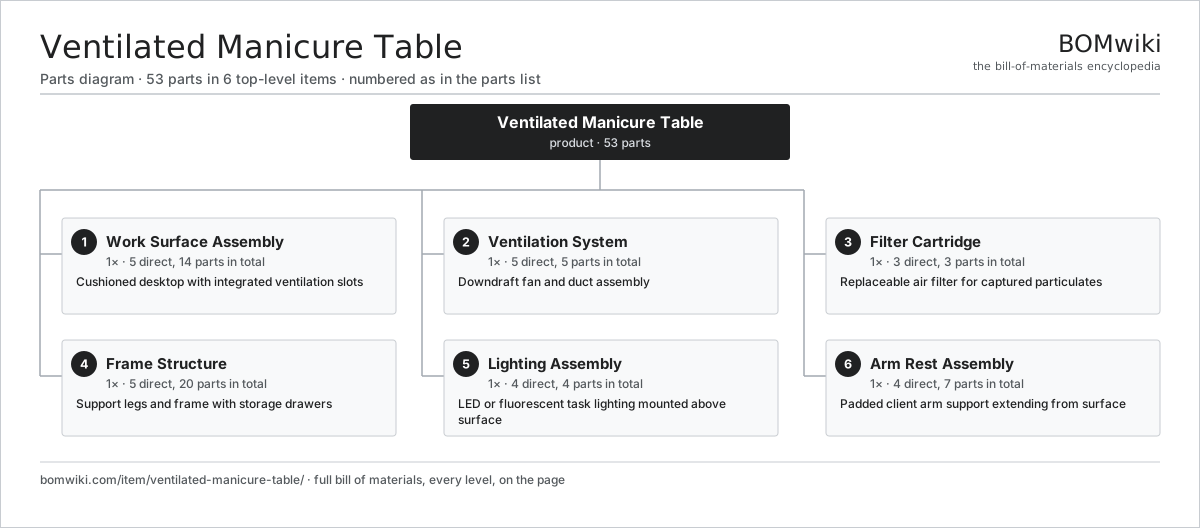
| # | Part | Qty | What it does |
|---|---|---|---|
| 1 | Work Surface Assembly 5 parts | 1× | Cushioned desktop with integrated ventilation slots |
| 2 | Ventilation System 5 parts | 1× | Downdraft fan and duct assembly |
| 3 | Filter Cartridge 3 parts | 1× | Replaceable air filter for captured particulates |
| 4 | Frame Structure 5 parts | 1× | Support legs and frame with storage drawers |
| 5 | Lighting Assembly 4 parts | 1× | LED or fluorescent task lighting mounted above surface |
| 6 | Arm Rest Assembly 4 parts | 1× | Padded client arm support extending from surface |
3D model
No 3D model yet. Have a CAD file of this? Add a 3D model. STL renders right on this page; STEP, FreeCAD, and OpenSCAD sources are welcome too (openly licensed, like all 3D models on BOMwiki).
Build & assembly graph
expand / collapse · shared sub-assemblies converge · links to related products · est. labourTap an assembly to expand/collapse · tap a part to open it · use “Open page” for any node · drag to pan, scroll to zoom.
Bill of materials for Ventilated Manicure Table
6 top-level lines · 32 rows shown · 53 parts total · indented to 3 levels| # | Item / sub-assembly | Part no. | Qty/assy | Ext. qty | Parts | Type |
|---|---|---|---|---|---|---|
| 1 | Work Surface Assembly 5 parts | ventilated-manicure-table-work-surface | 1× | 1 | 14 | assembly |
| 1.1 | Desktop Panel | ventilated-manicure-table-desktop-panel | 1× | 1 | · | part |
| 1.2 | Cushion Pad | ventilated-manicure-table-cushion-pad | 1× | 1 | · | part |
| 1.3 | Vent Openings | ventilated-manicure-table-vent-openings | 2× | 2 | · | part |
| 1.4 | Drawer Unit | ventilated-manicure-table-drawer-unit | 2× | 2 | · | part |
| 1.5 | Fastener Set | fastener-set | 8× | 8 | · | part |
| 2 | Ventilation System 5 parts | ventilated-manicure-table-ventilation-system | 1× | 1 | 5 | assembly |
| 2.1 | Centrifugal Fan | ventilated-manicure-table-centrifugal-fan | 1× | 1 | · | part |
| 2.2 | Fan Housing | ventilated-manicure-table-fan-housing | 1× | 1 | · | part |
| 2.3 | Duct Assembly | ventilated-manicure-table-duct-assembly | 1× | 1 | · | part |
| 2.4 | Damper Valve | ventilated-manicure-table-damper-valve | 1× | 1 | · | part |
| 2.5 | Connector | connector | 1× | 1 | · | part |
| 3 | Filter Cartridge 3 parts | ventilated-manicure-table-filter-cartridge | 1× | 1 | 3 | assembly |
| 3.1 | Filter Media | ventilated-manicure-table-filter-media | 1× | 1 | · | part |
| 3.2 | Filter Housing | ventilated-manicure-table-filter-housing | 1× | 1 | · | part |
| 3.3 | Filter Frame | ventilated-manicure-table-filter-frame | 1× | 1 | · | part |
| 4 | Frame Structure 5 parts | ventilated-manicure-table-frame-structure | 1× | 1 | 20 | assembly |
| 4.1 | Leg Frame | ventilated-manicure-table-leg-frame | 1× | 1 | · | part |
| 4.2 | Base Cabinet | ventilated-manicure-table-base-cabinet | 1× | 1 | · | part |
| 4.3 | Drawer Slides | ventilated-manicure-table-drawer-slides | 2× | 2 | · | part |
| 4.4 | Adjustable Feet | ventilated-manicure-table-adjustable-feet | 4× | 4 | · | part |
| 4.5 | Fastener Set | fastener-set | 12× | 12 | · | part |
| 5 | Lighting Assembly 4 parts | ventilated-manicure-table-lighting | 1× | 1 | 4 | assembly |
| 5.1 | LED Fixture | ventilated-manicure-table-led-fixture | 1× | 1 | · | part |
| 5.2 | Lamp Arm | ventilated-manicure-table-lamp-arm | 1× | 1 | · | part |
| 5.3 | Light Diffuser | ventilated-manicure-table-light-diffuser | 1× | 1 | · | part |
| 5.4 | Connector | connector | 1× | 1 | · | part |
| 6 | Arm Rest Assembly 4 parts | ventilated-manicure-table-arm-rest | 1× | 1 | 7 | assembly |
| 6.1 | Armrest Core | ventilated-manicure-table-armrest-core | 1× | 1 | · | part |
| 6.2 | Armrest Padding | ventilated-manicure-table-armrest-padding | 1× | 1 | · | part |
| 6.3 | Armrest Cover | ventilated-manicure-table-armrest-cover | 1× | 1 | · | part |
| 6.4 | Fastener Set | fastener-set | 4× | 4 | · | part |
Something wrong in this list? Report a problem with this BOM.
Sourcing: possible vendors
Browse the supplier directory → Prices, MOQ, and lead times are algorithmic estimates, not quotes, and not claims about these companies. Company mappings are curated by keyword; est. price band $15–$500. How estimates work| Vendor | HQ | Specialty | MOQ | Lead time |
|---|---|---|---|---|
| philips.com ↗ | Amsterdam, NL | Grooming & care | 2,000 units | 6–10 wks |
|
🇩🇪Braun
braun.com ↗
|
Kronberg, DE | Grooming (P&G) | 2,000 units | 6–10 wks |
|
🇺🇸Conair
conair.com ↗
|
Stamford, US | Personal care appliances | 2,000 units | 6–10 wks |
|
🇬🇧Dyson
dyson.com ↗
|
Malmesbury, GB | Vacuums & hair care | 2,000 units | 6–10 wks |
| panasonic.com ↗ | Osaka, JP | Electronics & appliances | 2,000 units | 6–10 wks |
1,307-word article