Veterinary Clipper
ProductOverview
A veterinary clipper shears animal coat for grooming, surgical site preparation, and dermatological treatment. Functionally it is a miniature reciprocating shear: a motor-driven Cutter Blade sweeps side-to-side across a stationary Comb Blade at up to 4,000 strokes per minute, and any hair caught between a comb tooth and the passing cutter edge is cut scissor-fashion. Veterinary models differ from human barber clippers in three ways that matter daily in a clinic: the detachable A5 blade system that swaps cut lengths in seconds, drivetrains powerful enough for double coats and matted fur, and serious attention to blade temperature, since an animal cannot report that a hot blade is burning it.
Cutting mechanism
Cut length is set entirely by the blade set, not the machine. The Comb Blade is a hardened-steel plate whose tooth geometry leaves a defined stubble: a #10 blade leaves about 1.5 mm and is the everyday clinical blade, while the #40 at roughly 0.1 mm is the surgical-prep standard because incision sites must be shaved essentially bare. The Blade Tension Spring presses the cutter onto the comb at a calibrated 1–2 kg; too little tension pulls hair instead of cutting it, too much multiplies friction heat. The whole set snaps onto the A5 Hinge Socket, the A5 hinge-and-latch interface, an industry standard since the 1960s, which is why blades from any major maker fit any professional clipper body. Snap-on Guide Comb spacers extend finish lengths to 25 mm for breed trims.
Drivetrain
Current professional clippers use a brushless motor built from a Stator Assembly and magnet Rotor Assembly spinning 5,000–10,000 rpm on two Ball Bearing supports, with Hall Sensor commutation. A single Helical Gear Pair reduction drives the Eccentric Cam, whose offset pin orbits inside the Drive Lever; the lever pivots and strips the orbit down to pure lateral motion, which the polymer Drive Tip hands to the cutter. Cam throw of 1.5–2.5 mm defines the stroke. The Motor Controller Board closes a speed loop around the motor, holding stroke rate constant as load rises in dense coat, the audible "bogging" of cheap clippers is exactly this loop missing. The drive tip is sacrificial by design: a few dollars of polymer wears instead of the blade set.
Heat management
Blade heat is the defining veterinary problem. Friction at the cutter-comb interface can push an unmanaged blade past 45 °C within ten minutes, enough for clipper burn on thin-skinned animals such as cats and post-surgical patients. The clipper attacks this on several fronts: a Cooling Fan Impeller on the motor shaft pulls air through Vent Grille openings and across the gear case, the aluminum Front Nose Casting and Heat Spreader Plate wick hinge heat into the shell, and the operator's discipline does the rest, oiling the rails with Clipper Blade Oil every 10–15 minutes, swapping to a cool spare blade, or using evaporative Blade Coolant Spray mid-groom. A removable Removable Hair Filter keeps clipped hair out of the airway, the most common cause of overheating in fielded units.
Power and controls
Cordless dominates clinical practice because surgical prep happens wherever the patient is. The removable Battery Pack holds two Li-ion Cell, 18650 cells with a BMS Board and Thermal Fuse, good for 90–180 minutes of cutting; a Charging Stand refills a pack in about an hour while a spare runs, and a DC Power Jack accepts a cord so a dead pack never delays an emergency prep. The Speed Selector Switch selects two to five stroke rates, low speed for nervous animals and noise-sensitive work around the head, high speed for dense coat, and an LED Indicator Gauge shows charge state. Noise discipline matters more than in human grooming: veterinary models target 55–65 dB(A) and low vibration through the Grip Overmold, because clipper-shy animals are a genuine workflow hazard.
Hygiene and maintenance
Everything an animal touches must survive clinic disinfection. The glass-filled polyamide Body Shell Half tolerates quaternary and accelerated-peroxide wipe-downs, seams are gasketed with an O-Ring Set against hair and fluid ingress, and blade sets detach for ultrasonic cleaning and cold-sterilant immersion between patients, mandatory practice for surgical blades, since clipper blades are a documented vector for dermatophyte (ringworm) transmission between animals. Blades are resharpened commercially several times before replacement; the Cleaning Brush and filter cleaning between animals are the routine that keeps a professional clipper cutting for a decade.
Veterinary Clipper parts and their functions
8 top-level parts · 178 parts in total · full bill of materials below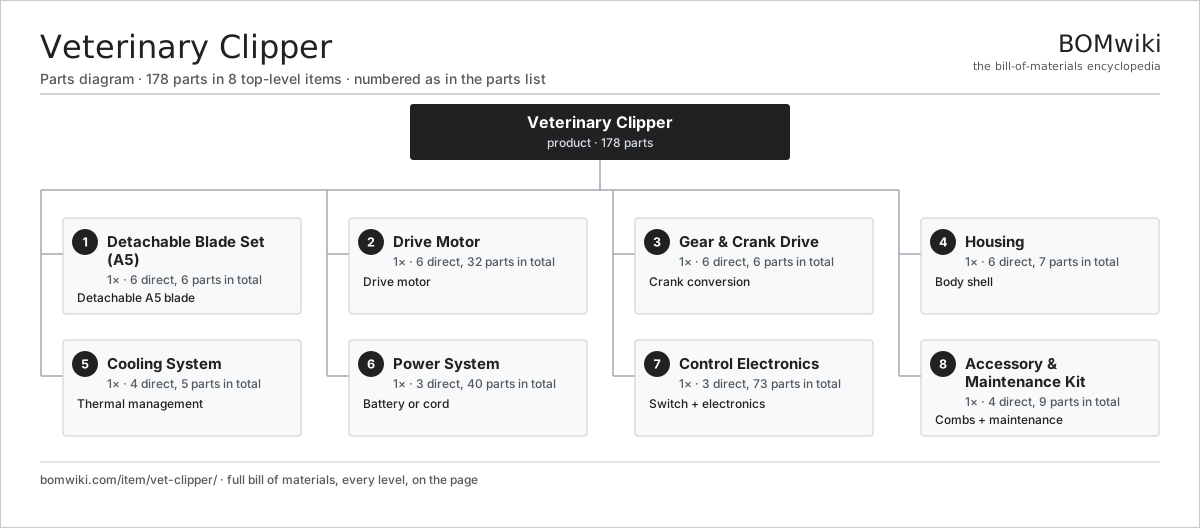
| # | Part | Qty | What it does |
|---|---|---|---|
| 1 | Detachable Blade Set (A5) 6 parts | 1× | Detachable A5 blade |
| 2 | Drive Motor 6 parts | 1× | Drive motor |
| 3 | Gear & Crank Drive 6 parts | 1× | Crank conversion |
| 4 | Housing 6 parts | 1× | Body shell |
| 5 | Cooling System 4 parts | 1× | Thermal management |
| 6 | Power System 3 parts | 1× | Battery or cord |
| 7 | Control Electronics 3 parts | 1× | Switch + electronics |
| 8 | Accessory & Maintenance Kit 4 parts | 1× | Combs + maintenance |
3D model
No 3D model yet. Have a CAD file of this? Add a 3D model. STL renders right on this page; STEP, FreeCAD, and OpenSCAD sources are welcome too (openly licensed, like all 3D models on BOMwiki).
Build & assembly graph
expand / collapse · shared sub-assemblies converge · links to related products · est. labourTap an assembly to expand/collapse · tap a part to open it · use “Open page” for any node · drag to pan, scroll to zoom.
Bill of materials for Veterinary Clipper
8 top-level lines · 66 rows shown · 178 parts total · indented to 3 levels| # | Item / sub-assembly | Part no. | Qty/assy | Ext. qty | Parts | Type |
|---|---|---|---|---|---|---|
| 1 | Detachable Blade Set (A5) 6 parts | vet-clipper-blade-set | 1× | 1 | 6 | assembly |
| 1.1 | Comb Blade | vet-clipper-comb-blade | 1× | 1 | · | part |
| 1.2 | Cutter Blade | vet-clipper-cutter-blade | 1× | 1 | · | part |
| 1.3 | Blade Tension Spring | vet-clipper-blade-spring | 1× | 1 | · | part |
| 1.4 | Cutter Guide | vet-clipper-blade-guide | 1× | 1 | · | part |
| 1.5 | A5 Hinge Socket | vet-clipper-blade-latch | 1× | 1 | · | part |
| 1.6 | Fastener Set | fastener-set | 1× | 1 | · | part |
| 2 | Drive Motor 6 parts | vet-clipper-motor-assy | 1× | 1 | 32 | assembly |
| 2.1 | Stator Assembly 3 parts | stator-assembly | 1× | 1 | 3 | assembly |
| 2.1.1 | Stator Core (laminations) | stator-core | 1× | 1 | · | part |
| 2.1.2 | Copper Winding | copper-winding | 1× | 1 | · | part |
| 2.1.3 | Slot Insulation | stator-insulation | 1× | 1 | · | part |
| 2.2 | Rotor Assembly 4 parts | rotor-assembly | 1× | 1 | 19 | assembly |
| 2.2.1 | Rotor Shaft | rotor-shaft | 1× | 1 | · | part |
| 2.2.2 | Rotor Core | rotor-core | 1× | 1 | · | part |
| 2.2.3 | Neodymium Magnet | neodymium-magnet | 16× | 16 | · | part |
| 2.2.4 | Ball Bearing | ball-bearing | 1× | 1 | · | part |
| 2.3 | Neodymium Magnet | neodymium-magnet | 4× | 4 | · | part |
| 2.4 | Ball Bearing | ball-bearing | 2× | 2 | · | part |
| 2.5 | Hall Sensor | hall-sensor | 3× | 3 | · | part |
| 2.6 | Motor Housing | motor-housing | 1× | 1 | · | part |
| 3 | Gear & Crank Drive 6 parts | vet-clipper-gear-drive | 1× | 1 | 6 | assembly |
| 3.1 | Helical Gear Pair | gear-pair | 1× | 1 | · | part |
| 3.2 | Eccentric Cam | vet-clipper-eccentric-cam | 1× | 1 | · | part |
| 3.3 | Drive Lever | vet-clipper-drive-lever | 1× | 1 | · | part |
| 3.4 | Drive Tip | vet-clipper-drive-tip | 1× | 1 | · | part |
| 3.5 | Oil Seal | oil-seal | 1× | 1 | · | part |
| 3.6 | Ball Bearing | ball-bearing | 1× | 1 | · | part |
| 4 | Housing 6 parts | vet-clipper-housing | 1× | 1 | 7 | assembly |
| 4.1 | Body Shell Half | vet-clipper-body-shell | 2× | 2 | · | part |
| 4.2 | Front Nose Casting | vet-clipper-front-casting | 1× | 1 | · | part |
| 4.3 | Grip Overmold | vet-clipper-grip-overmold | 1× | 1 | · | part |
| 4.4 | Hanger Loop | vet-clipper-hanger-loop | 1× | 1 | · | part |
| 4.5 | O-Ring Set | oring-set | 1× | 1 | · | part |
| 4.6 | Fastener Set | fastener-set | 1× | 1 | · | part |
| 5 | Cooling System 4 parts | vet-clipper-cooling | 1× | 1 | 5 | assembly |
| 5.1 | Cooling Fan Impeller | vet-clipper-fan-impeller | 1× | 1 | · | part |
| 5.2 | Vent Grille | vet-clipper-vent-grille | 2× | 2 | · | part |
| 5.3 | Heat Spreader Plate | vet-clipper-heat-spreader | 1× | 1 | · | part |
| 5.4 | Removable Hair Filter | vet-clipper-air-filter | 1× | 1 | · | part |
| 6 | Power System 3 parts | vet-clipper-power-system | 1× | 1 | 40 | assembly |
| 6.1 | Battery Pack 4 parts | vet-clipper-battery-pack | 1× | 1 | 5 | assembly |
| 6.1.1 | Li-ion Cell, 18650 | li-cell-18650 | 2× | 2 | · | part |
| 6.1.2 | BMS Board | bms-board | 1× | 1 | · | part |
| 6.1.3 | Thermal Fuse | thermal-fuse | 1× | 1 | · | part |
| 6.1.4 | Connector | connector | 1× | 1 | · | part |
| 6.2 | Charging Stand 4 parts | vet-clipper-charge-stand | 1× | 1 | 34 | assembly |
| 6.2.1 | Power Supply | power-supply | 1× | 1 | · | part |
| 6.2.2 | Bare PCB | pcb-bare | 1× | 1 | · | part |
| 6.2.3 | Connector | connector | 2× | 2 | · | part |
| 6.2.4 | SMD Passive (R/C/L) | smd-passives | 30× | 30 | · | part |
| 6.3 | DC Power Jack | vet-clipper-dc-jack | 1× | 1 | · | part |
| 7 | Control Electronics 3 parts | vet-clipper-control | 1× | 1 | 73 | assembly |
| 7.1 | Motor Controller Board 5 parts | vet-clipper-controller-board | 1× | 1 | 71 | assembly |
| 7.1.1 | Bare PCB | pcb-bare | 1× | 1 | · | part |
| 7.1.2 | Microcontroller | mcu | 1× | 1 | · | part |
| 7.1.3 | Power MOSFET | mosfet | 6× | 6 | · | part |
| 7.1.4 | SMD Passive (R/C/L) | smd-passives | 60× | 60 | · | part |
| 7.1.5 | Connector | connector | 3× | 3 | · | part |
| 7.2 | Speed Selector Switch | vet-clipper-speed-switch | 1× | 1 | · | part |
| 7.3 | LED Indicator Gauge | vet-clipper-led-gauge | 1× | 1 | · | part |
| 8 | Accessory & Maintenance Kit 4 parts | vet-clipper-accessories | 1× | 1 | 9 | assembly |
| 8.1 | Guide Comb | vet-clipper-guide-comb | 6× | 6 | · | part |
| 8.2 | Clipper Blade Oil | vet-clipper-blade-oil | 1× | 1 | · | part |
| 8.3 | Blade Coolant Spray | vet-clipper-coolant-spray | 1× | 1 | · | part |
| 8.4 | Cleaning Brush | vet-clipper-cleaning-brush | 1× | 1 | · | part |
Something wrong in this list? Report a problem with this BOM.
Related products
same domain, ranked by shared parts Panoramic Dental X-Ray
507 parts · shares 15 with this page
Veterinary Hydrotherapy Treadmill
249 parts · shares 13 with this page
Panoramic Dental X-Ray
507 parts · shares 15 with this page
Veterinary Hydrotherapy Treadmill
249 parts · shares 13 with this page
 Dental X-Ray Unit
113 parts · shares 12 with this page
Dental X-Ray Unit
113 parts · shares 12 with this page
 Dental Cone Beam CT
523 parts · shares 11 with this page
Dental Autoclave (Class B)
305 parts · shares 12 with this page
Dental Cone Beam CT
523 parts · shares 11 with this page
Dental Autoclave (Class B)
305 parts · shares 12 with this page
Sourcing: possible vendors
Browse the supplier directory → Prices, MOQ, and lead times are algorithmic estimates, not quotes, and not claims about these companies. Company mappings are curated by keyword; est. price band $200–$200k. How estimates work| Vendor | HQ | Specialty | MOQ | Lead time |
|---|---|---|---|---|
| dentsplysirona.com ↗ | Charlotte, US | Dental equipment | 100 units | 10–16 wks |
|
🇺🇸Envista
envistaco.com ↗
|
Brea, US | Dental (KaVo, Nobel) | 100 units | 10–16 wks |
|
🇫🇮Planmeca
planmeca.com ↗
|
Helsinki, FI | Dental units & imaging | 100 units | 10–16 wks |
|
🇺🇸A-dec
a-dec.com ↗
|
Newberg, US | Dental chairs & delivery | 100 units | 10–16 wks |
|
🇺🇸Midmark
midmark.com ↗
|
Versailles, US | Medical & veterinary equipment | 100 units | 10–16 wks |
793-word article